

Key Takeaways
Every career has inflection points, conversations that change what you think is possible. Most don’t announce themselves. They show up as a casual coffee chat, an unexpected piece of feedback, or a question you’re not quite ready to answer.
I’ve spent over two decades building my career. But the five conversations I’m about to share? They changed everything, and they all happened in the last five years. Some felt risky. Some were long overdue. A few I almost didn’t have at all. But each one opened up a version of my career I couldn’t have reached without it.
Here’s what prompted each one, what I learned, and how you can prepare to have these same moments yourself.
#1. The conversation that made me believe in my own potential
My VP, Julia, gets the credit for this one. When I joined Salesforce.org, the company’s mission-driven nonprofit arm, I had nearly 20 years of event marketing experience. When the integration into the broader Salesforce business happened, I assumed I’d keep going in that direction. Julia saw something different. She put me on her partner marketing team instead. I didn’t fully understand why. Honestly? I wasn’t sure I agreed.
But Julia saw something in me that I hadn’t seen in myself … yet. She told me directly: my event marketing experience absolutely mattered. And she saw capabilities beyond it that I hadn’t fully claimed yet — someone who could build things, fix things and whose best work was still ahead of her.
So I made a choice: trust it and give it everything. I leaned into the discomfort of learning a completely new business model, from partner marketing to channel marketing to industry marketing and go-to-market strategy. Each transition grew a muscle I didn’t know I had, but Julia knew I was capable of.
Our weekly 1-1s were also transformative conversations. They weren’t just about what I was working on; she asked what I wanted to be working on, what I was learning and what I needed. I started answering honestly. And that honesty changed what I believed I was capable of asking for in every conversation that followed.
Years later, I asked Julia what she noticed about my growth and she said: “What made you stand out, what I felt like you really hadn’t claimed yet, was the risk-taking. You didn’t see that about yourself in that first conversation but I saw you doing it without you knowing it. But after a while, you start embracing the risks because then you start to see the payoff and the reward from it.”
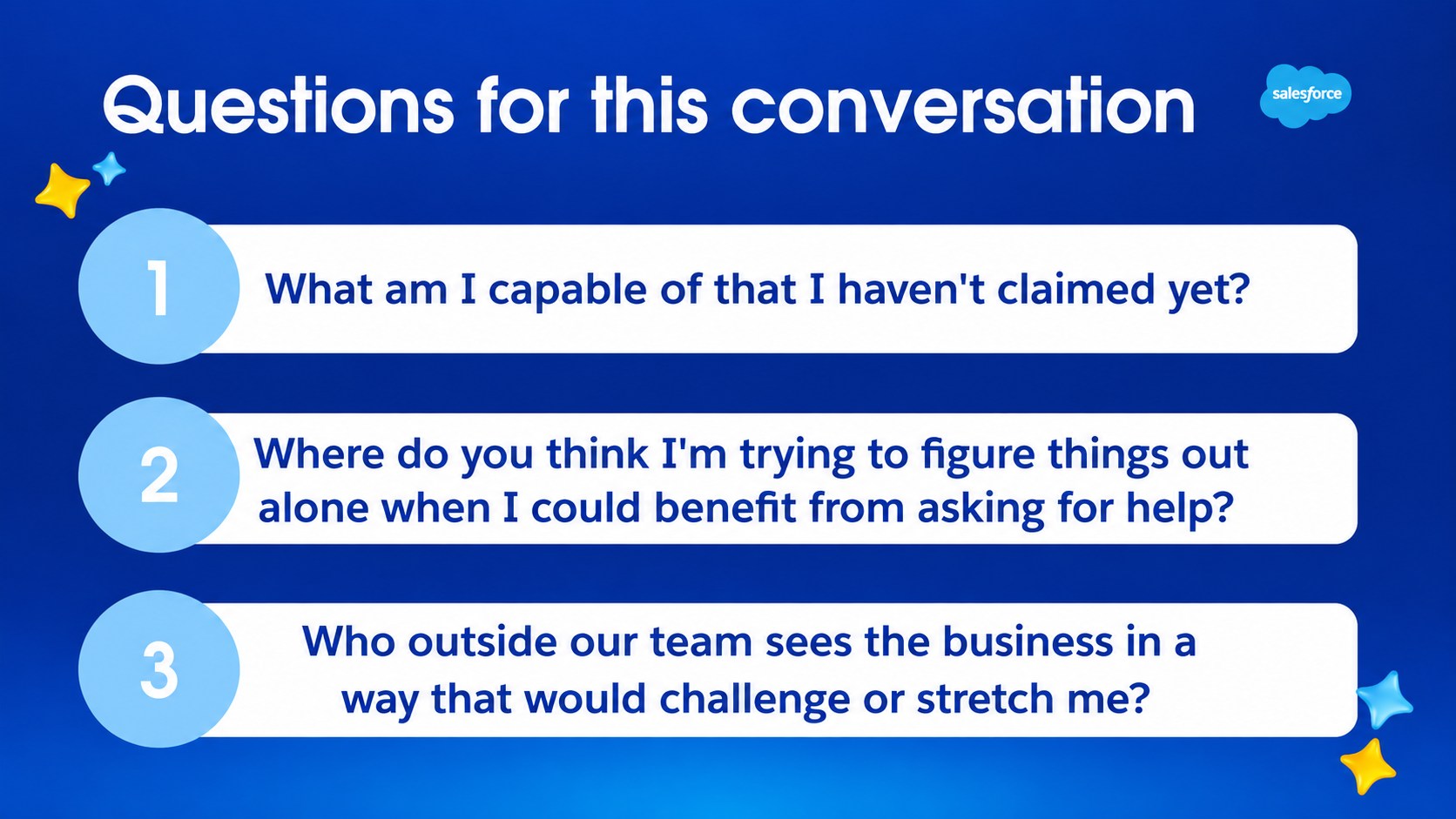
Explore more blogs: Knowing the difference between a mentor, a coach, and a sponsor — and how to build a network that includes all three — is one of the most practical career moves you can make, and this guide breaks down exactly how to do it.
#2. The conversation I had to have with myself
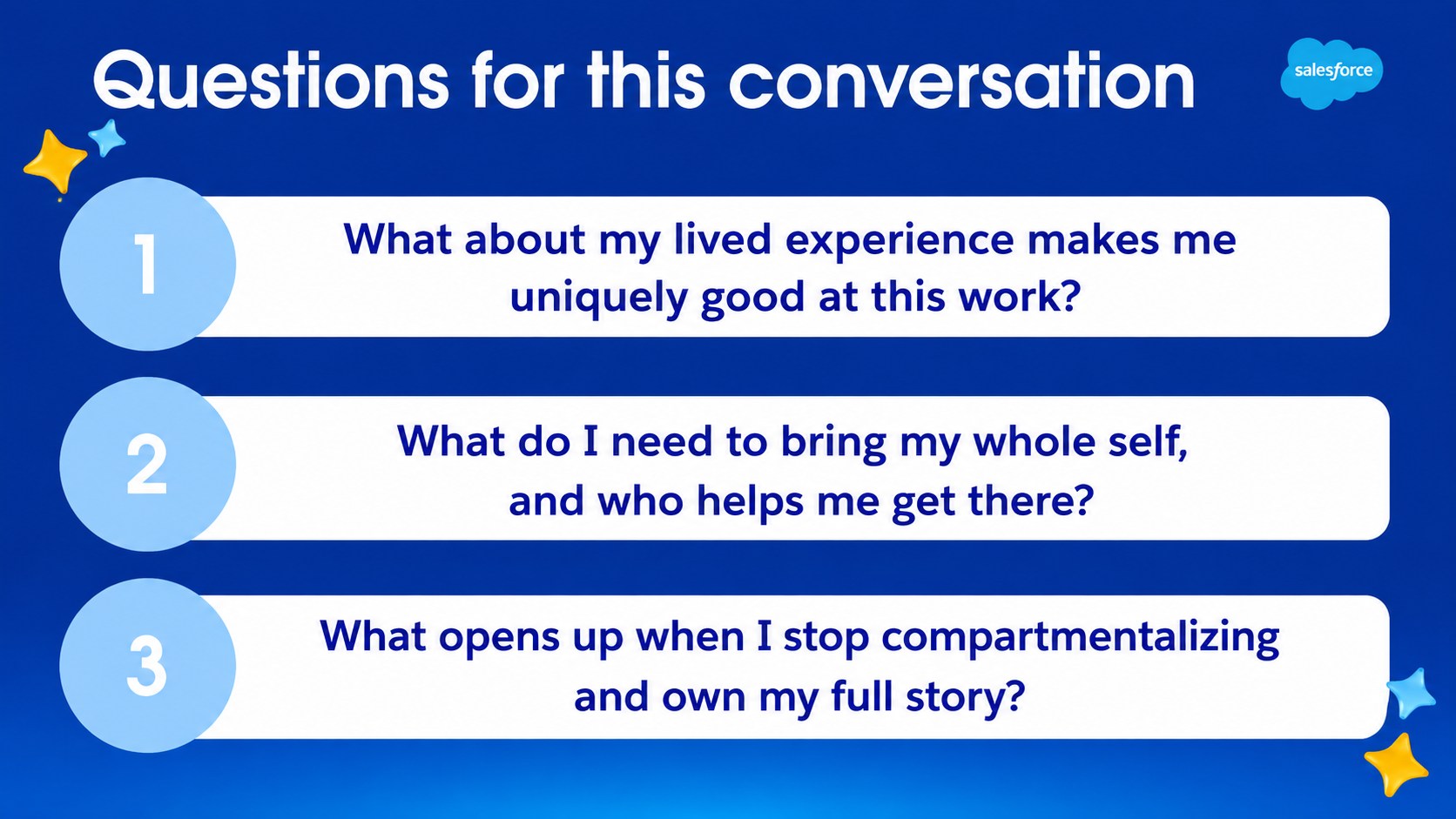
Julia’s conversations challenged me to think bigger about what I was capable of. But what most career evolution narratives leave out is that growth isn’t just external. I had to have a conversation with myself about who I was willing to be at work. And that meant stopping managing parts of myself privately and starting to claim them as part of my story.
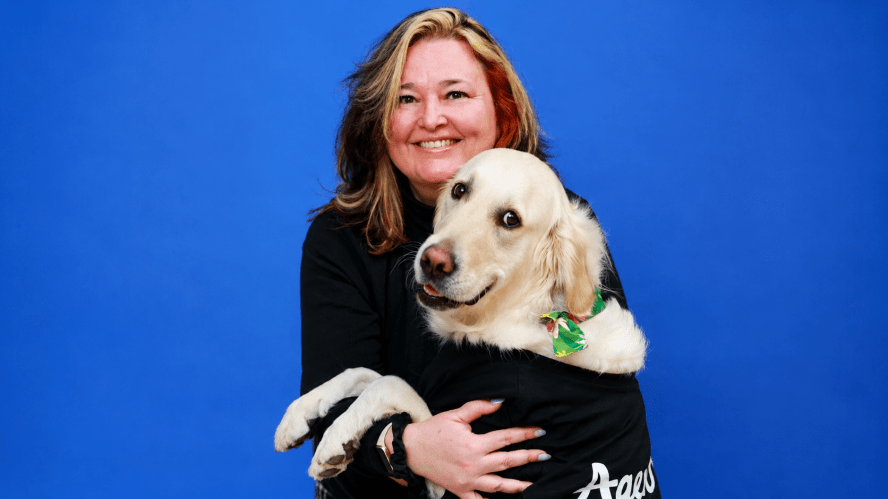
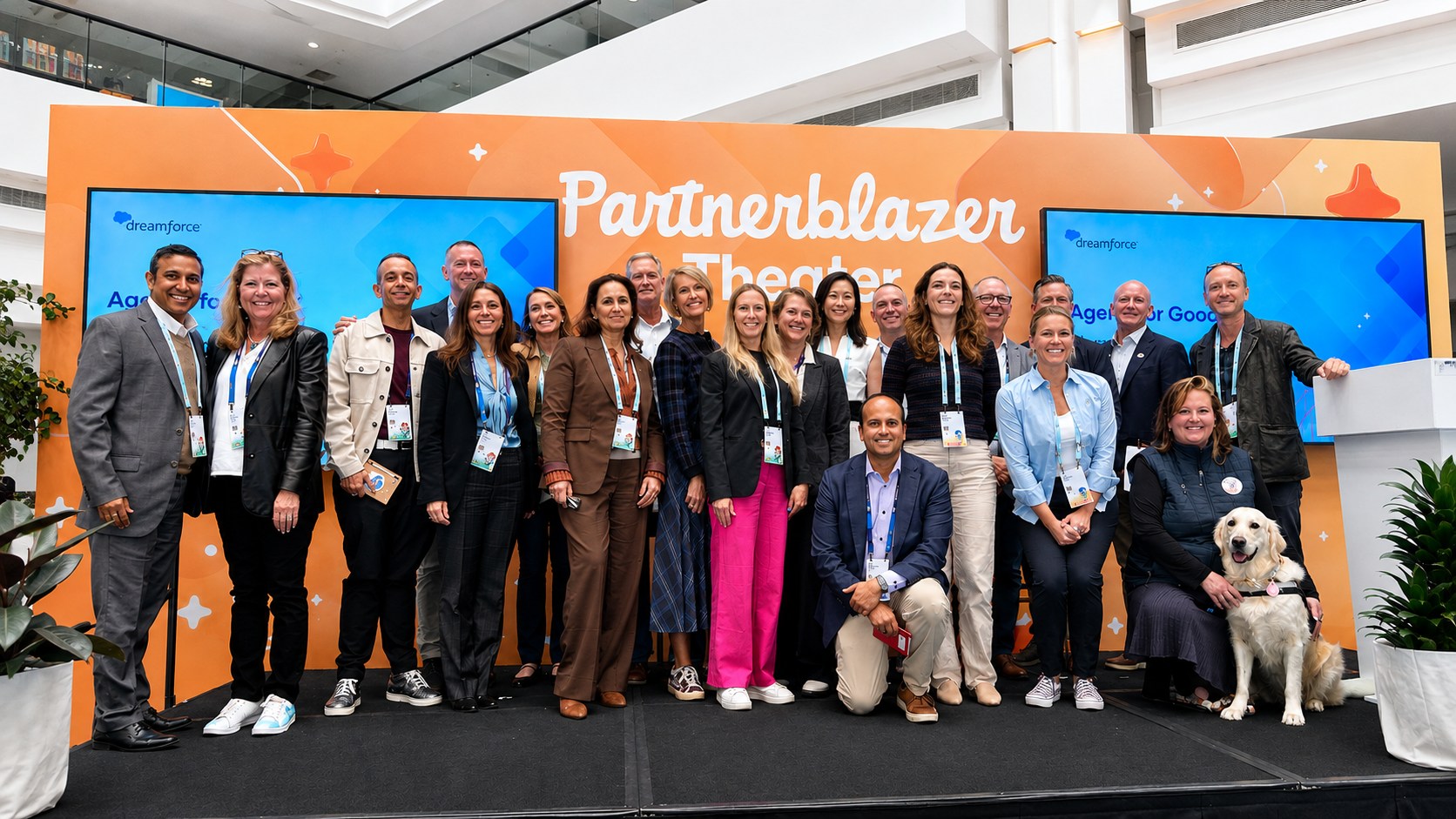
I’m a neurodivergent leader. I have a service dog named Yuki who helps me navigate overstimulation and high-stakes environments. For most of my career, I’d treated my accommodations as something to manage separately — from my work, my ambitions, and the professional version of me I presented to the world.
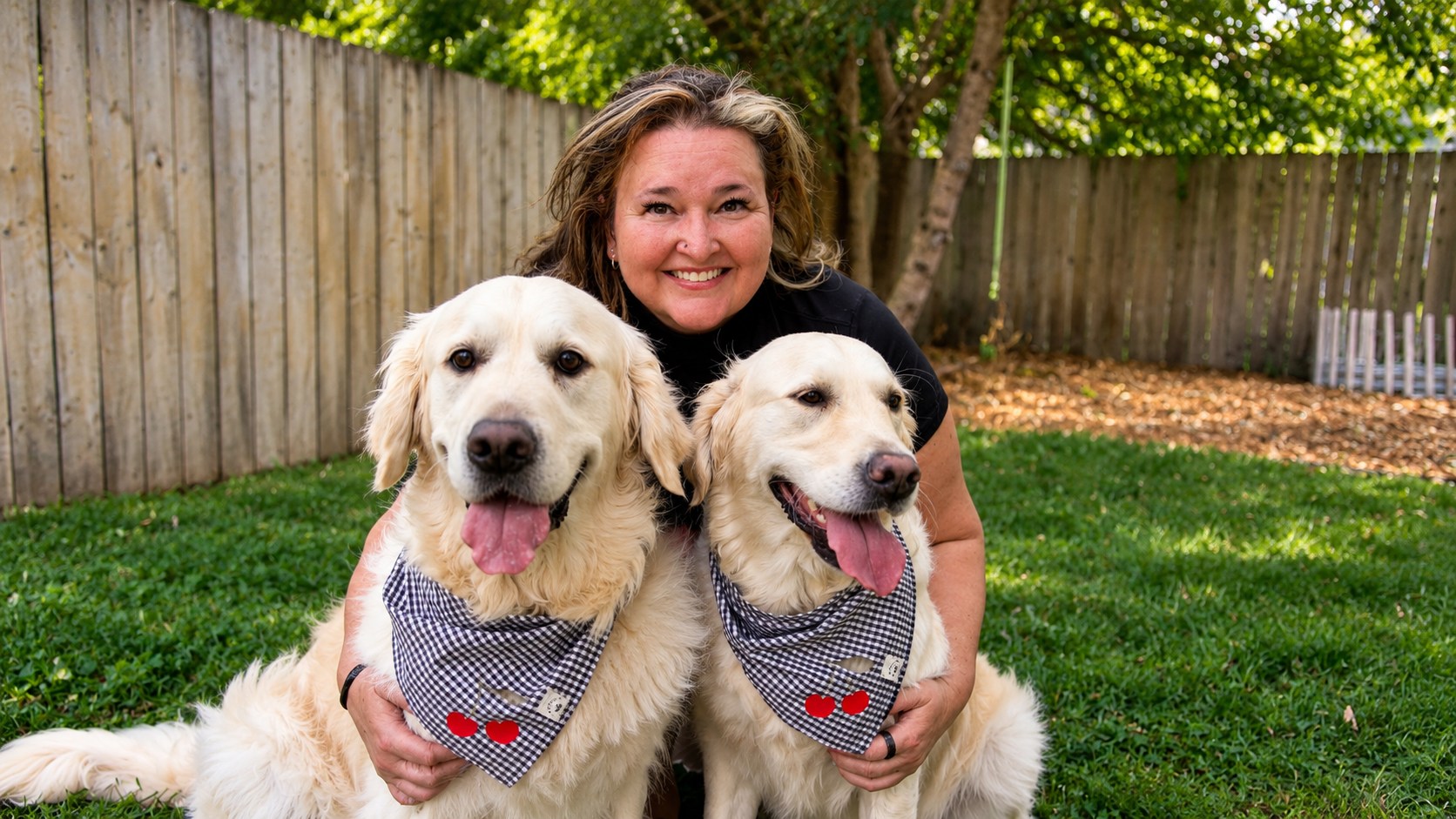
What I eventually learned: compartmentalizing was costing me. Not just energy. Authenticity. Capability. But the moment I stopped keeping those parts of myself separate, everything shifted. I could ask for what I actually needed, advocate more clearly, and show up as one person instead of two. And it turned out that wholeness was a professional advantage, not a liability.
What Julia created was an environment where it felt safe to be that whole person. The choice to show up that way? That was mine. That internal conversation allowed for everything that came after.
Explore more blogs: At Salesforce, equality is a core value and a lived commitment. Learn more about how Salesforce supports neurodivergent employees.
# 3.The conversation that taught me to lead with business impact
My next leader, Clayelle, Senior Director, Partner Marketing, brought something I hadn’t fully experienced in a leader before: direct, trench-level partnership that teaches you who you are as a builder. She wasn’t the kind of manager who told me what I wanted to hear. She’d tell me when something was over-engineered or unproductive, then offer to help fix it in the same breath.
Julia helped me see what I was capable of. Clayelle made me prove I could explain it. She challenged me to shift from builder-focused to being able to articulate how my ideas created value for the organization, in ways our partners could understand and buy into.
The skills I’d carried over from event marketing — stakeholder management, systems thinking, the patience to move a room from skepticism to adoption — turned out to be exactly what this work required. Together, we built the automation systems that became the operational backbone of partner marketing.
What she challenged me to rethink came down to two things:
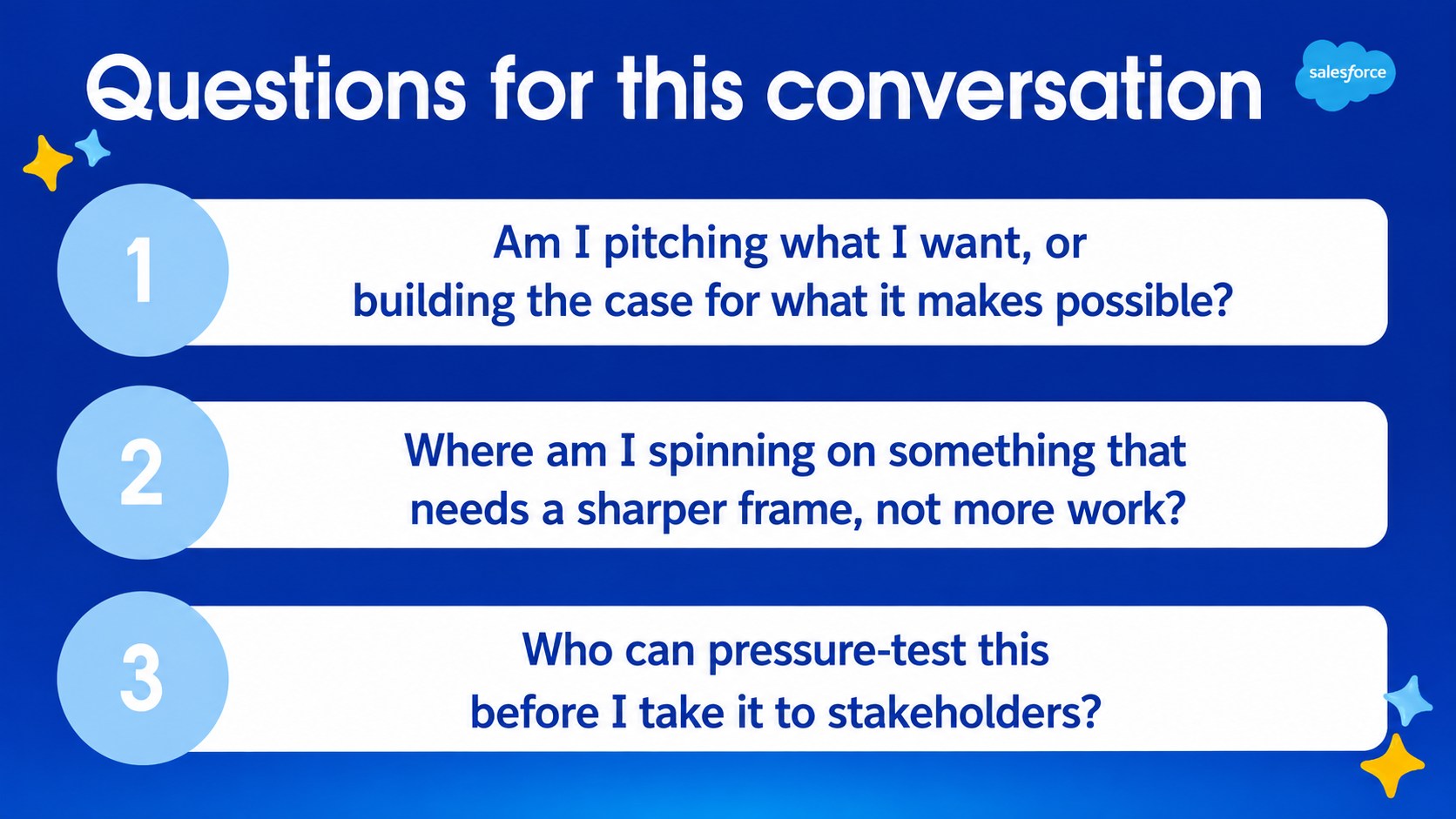
- The framing was getting in my own way. The ideas weren’t the problem. Clayelle pushed me to stop pitching what I wanted and start building the business case for why it mattered — from “here’s what I care about” to “here’s what this makes possible for the org.”
- Adoption is a change management problem, not a process compliance problem. That reframe is 80% of the work.
When I went back and asked her about it, she put it better than I had: “What I’ve watched shift over our time together is how you’ve learned to connect your ideas to what the organization actually needs. You spot the gap, propose the build, and have already thought three steps ahead. That connection to enablement is what makes your work so genuinely effective.”
#4. The conversation no one was having yet
By this point, I knew how to build systems, make a business case, and navigate organizational resistance. And I’d finally stopped keeping pieces of myself separate. The conversations before this one had done their work. Now it was time to do mine.
When AI started becoming a genuine operational lever, not just a trend, I approached it the same way as I did everything else: with curiosity and a desire to build better systems.
So I started building. Without a mandate. Without a tech background. Without a guide.
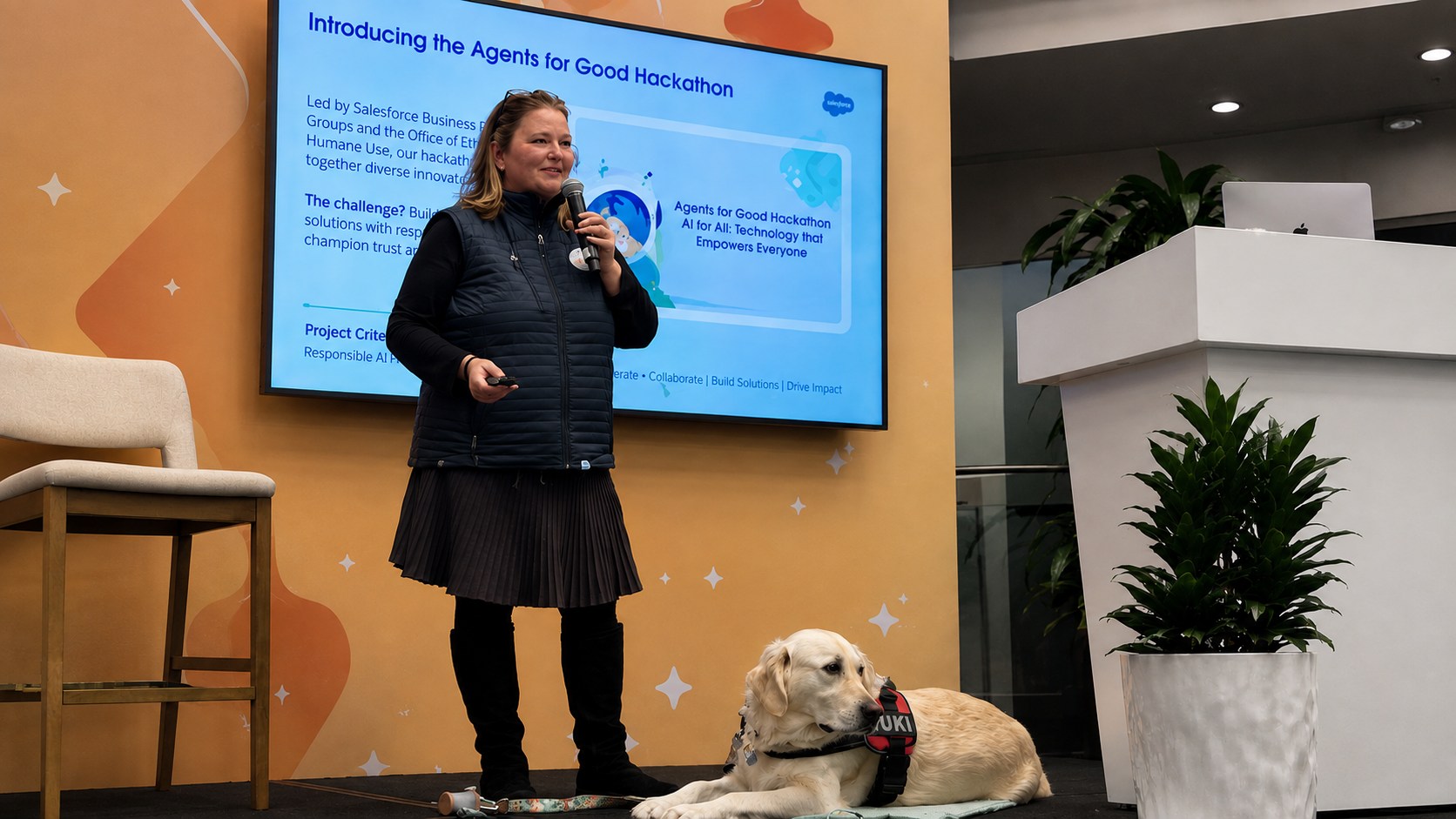
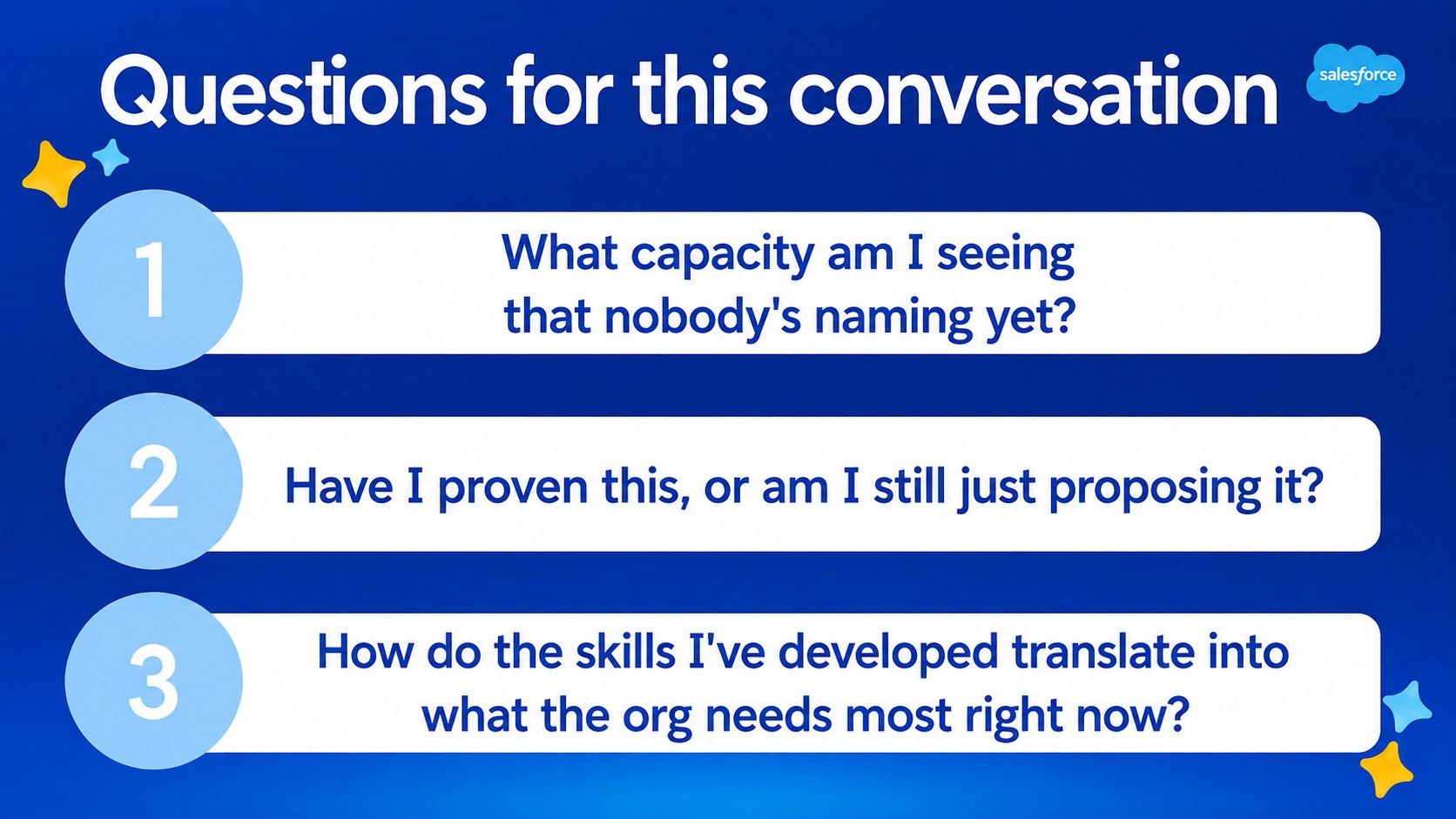
It began with one thing. Then another. Then another. Not because I had a mandate, but because I kept seeing capacity my team didn’t have, and realizing AI could expand it.
So I asked myself the question no one around me was asking yet: what does it look like to actually own this? Not dabble. Own it, build it into the way we work, and help others do the same.
I built Customer Success and Partner Marketing’s entire AI operating model, going from near-zero to 50% AI adoption year over year. The team reclaimed more than 20 hours per week across recurring workflows. I ran training sessions, built internal toolkits, and coached team members one-on-one. I didn’t make the case through proposals. I made it through the results.
What I’d learned from Clayelle showed up here. Build something that works, then show what it makes possible for the organization before anyone asks. The automation, the skills, the processes, the foundation — that was the business case. The work itself was the ask.
Once I’d built it, one question remained: what did all of this open up for me? That question led directly to the next conversation.
Explore more blogs: If you’ve ever wondered whether you can build a career path that doesn’t exist yet, here’s how how AI is forging new career opportunities here at Salesforce.
#5. The conversation where I asked for it
At this point, I had years of capability, now amplified by AI, a real operating model with measurable results, and work I loved. What I didn’t have was a role that claimed any of it.
So this time, I led the conversation. I went back to Julia and asked her to think outside the box with me.
I’d identified a real gap: Customer Success and Partner Marketing needed a dedicated AI transformation function — someone who could drive adoption and connect strategy to execution at scale. Like Clayelle had taught me, I didn’t come in with a wish. I came in with a business case. Then I proposed a new role.
Julia listened, pushed back with hard questions, and then took it further, connecting me with Courtney Sherman, Senior Director, Marketing Strategy and Operations, to explore a home for this role on her team.
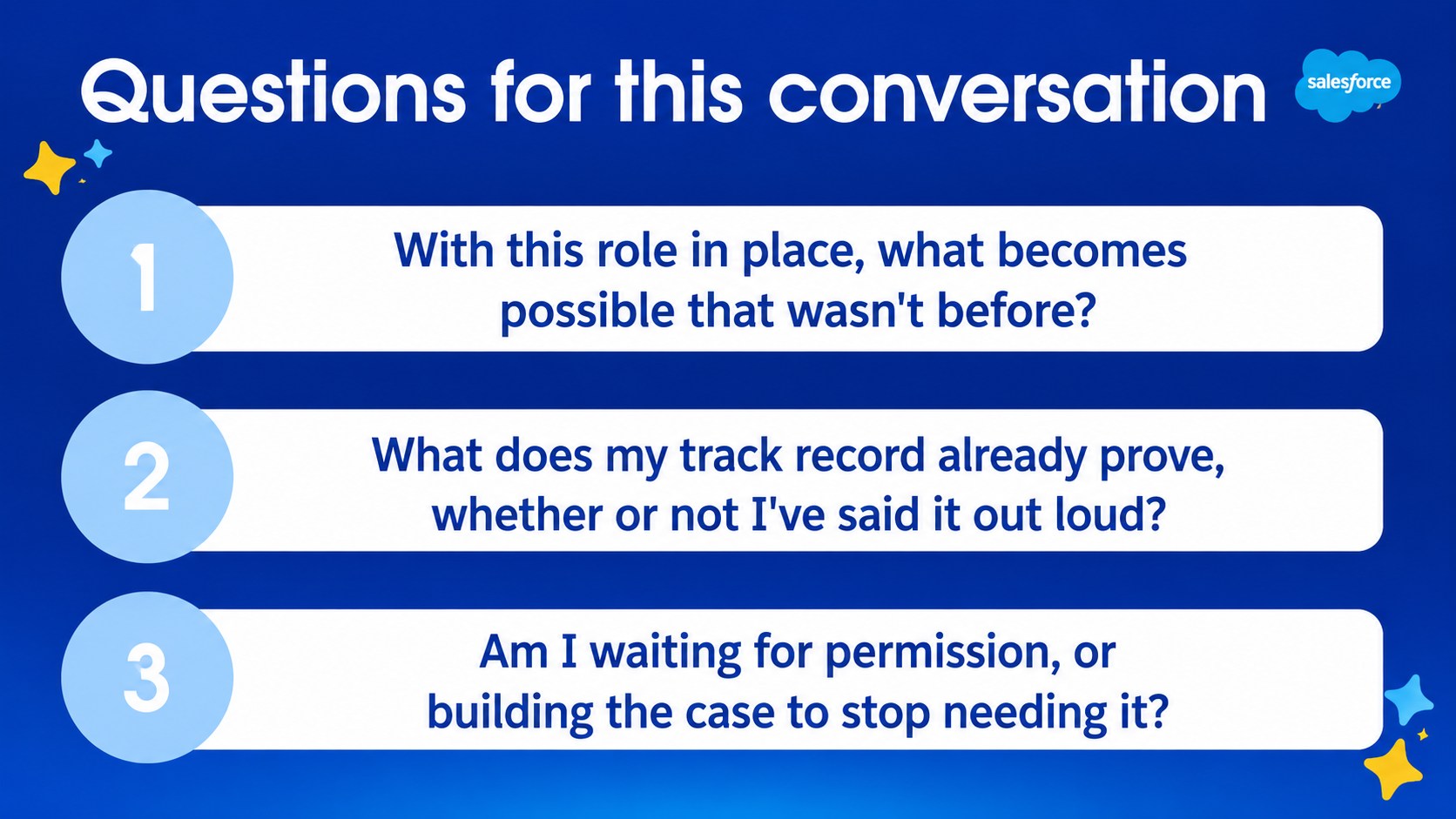
I wrote my own job description: scope, success metrics, reporting structure, and outcomes. Then I went one step further and mapped what the role would deliver for the entire Customer Success and Partner Marketing team. I made it impossible to read as a personal ask. I made it read as an organizational need. The document gave the idea a shape. The track record gave it credibility.
Then I sat down with Courtney directly. She was rigorous — hard questions about scope, 90-day success, and how this connected to where the organization was going. That rigor felt like respect.
In January 2026, I moved into the role: Director, Marketing Strategy and AI Transformation on CSP Marketing’s Strategy and Operations team. When I asked Courtney what convinced her to say yes, not just to the role but to me, she said: “You had built a reputation, a brand, around delivering results quickly and adapting to situations quickly. Those are the two skills that help anyone nail their next role: understand the business problem, set a strategy, execute it quickly, show the proof, and adapt as you go. That’s how you actually drive change.”
Explore more blogs: Discover 10 roles that didn’t exist five years ago and what it takes to grow into them.
Before you have your next career conversation, remember this
If you’re navigating a career transition, an integration, or a moment where the next step doesn’t make sense yet, here’s what I’ve learned.
- The conversation you have with yourself matters most. Before anyone else could see my full capability, I had to decide I was willing to show up as one whole person. That internal conversation, the one where you stop compartmentalizing, unlocks everything else.
- Prove it before you ask for it. When I saw the AI opportunity, I didn’t wait for permission. I built the operating model, drove the adoption, showed the results, and then asked for the role. That’s how you create the role you want instead of waiting for it to exist.
- Advocate with a business case, not just an ask. Map the value to every leader affected. Make it about the organization’s needs, not just yours. Then ask clearly for what you need.
If you lead people: the conversation where Julia told me directly what she saw in me mattered more than any performance review or stretch assignment. She told me the truth. That’s a gift. Give it. Create space for your team to be whole people.
For everyone: I never felt ready. Every conversation scared me. The vulnerability of showing up whole. The risk of asking for something I’d built without permission. But imagine if I’d waited.
Start before you feel ready.
Your next conversation could be with us
If you’re looking for a place where you can build new skills, advocate for the career you want, and have the conversations that actually change things — explore open roles at Salesforce and join our talent community.




AI supported the writers and editors who created this article.