
Key Takeaways
Small and medium businesses (SMB) owners are constantly grappling with the challenges of “big data” and the complexity of modern artificial intelligence (AI) adoption. Many founders and leaders feel the pressure of being left behind if they don’t immediately adopt the newest technology.
Fortunately, there are resources available that can open doors that as an SMB owner, you might have never thought possible. To learn more, we spoke with Salesforce power user Angélica Buffa, a Datablazer, Salesforce MVP, and co-founder and CTO of Modelit, to shed light on how small businesses can navigate these tough questions.
Angélica is deeply involved in the Trailblazer Community; she champions the Datablazer Community as the key resource for connecting IT and business leaders, developers, and data practitioners who want to transform data into their most powerful asset. Let’s hear what she has to say for business owners everywhere.
Data, simplified: What is the Datablazer Community?
The Datablazer Community is a global group for IT and business leaders, developers, and data pros focused on AI and agentic AI readiness. It is a safe, educational space where passionate and innovative people come together to ask tricky questions about data and find out what truly works.
The key benefit for SMBs is the access to free learning, networking, and expert support that helps them achieve a unified customer view. The community runs free learning initiatives led by hands-on practitioners who share honest insights into problems and their solutions, focusing on practical applications rather than theory. It’s open to everyone, regardless of expertise or global location.
Datablazer spotlight: Angélica Buffa
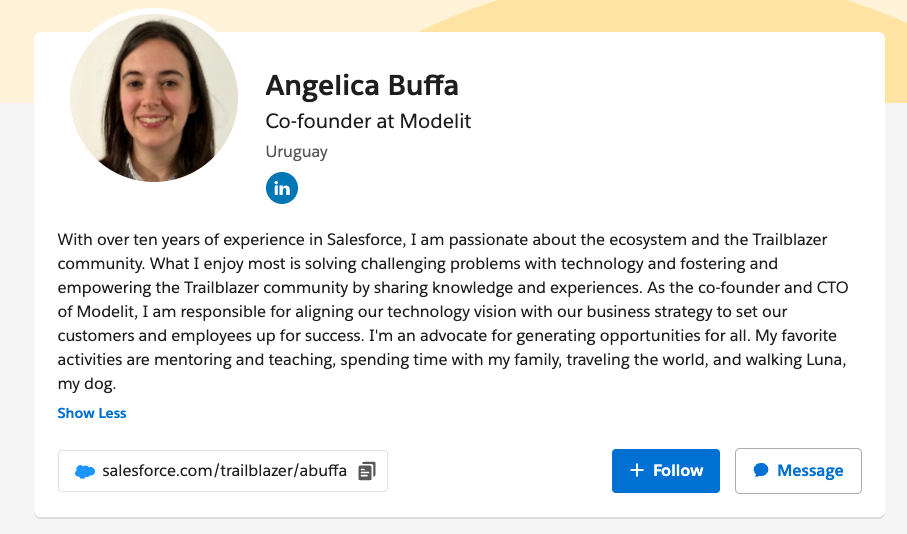
Angélica Buffa is a Salesforce power user based in Montevideo, Uruguay, and serves as the CTO and co-founder of Modelit, a team of experienced and certified Salesforce professionals that help businesses implement Salesforce to its full potential. Angélica began her career at Salesforce in 2009 as a quality engineer, and credits that as her “best decision ever”.
Start with SMB Basics


Can you share a bit about your journey to co-founding Modelit? What was the “spark” that ignited your focus on data and technology?
Angélica: I’ve been part of the Salesforce ecosystem since 2009. It was by accident. I was hired and I knew nothing about Salesforce when I joined. It was kind of scary, getting proficiency in a technology that nobody knew about, but it turned out to be my best decision ever.
I met my soon-to-be co-founder shortly after. At some point, he quit to start his own company, and in 2012, he needed help with a complex data integration project. We were very passionate about Salesforce and doing things the right way, and that’s how things started growing. Right now, we’re almost 60 people. I naturally stepped into the CTO role because I was the most focused on the technical side of Salesforce, from design to implementation.”
Igniting the Datablazer Community
Angélica soon found a path to the Datablazer Community. Here’s the story.
How did your early interest in data stewardship lead you to the Datablazer Community?
Angélica: When Data 360 was launched, I felt like it was my opportunity to go back to my first passion. I crossed paths with a customer of ours who was very passionate about data. He had the idea of founding a community called Data Matters. It was a global virtual community — the first of its type. We started working a lot with Kayla Makki from Datablazers on joint training initiatives, specifically about Data 360. At some point, having two different communities with the same goal wasn’t efficient, so we combined, and that is how we ended up being Datablazer Collective Leaders.
Lean on the community as a way to learn. It’s free, it’s very well-opinionated, it’s honest, and it’s a safe place. It’s a place for everyone. You don’t have to be an expert to go and engage. Datablazer is a global community, so it doesn’t matter where you are. We’re going to be there. Giving back to the community is truly important.
That’s how you become a Datablazer — you meet with others that are passionate about data or have data problems, you learn about the community, and then you show up. That’s it.
The multiplier effect: Championing women in tech
As a female co-founder and CTO, Angélica is a powerful advocate for women in technology, choosing to focus on opportunity over challenge.
What challenges did you face as a female co-founder and CTO?
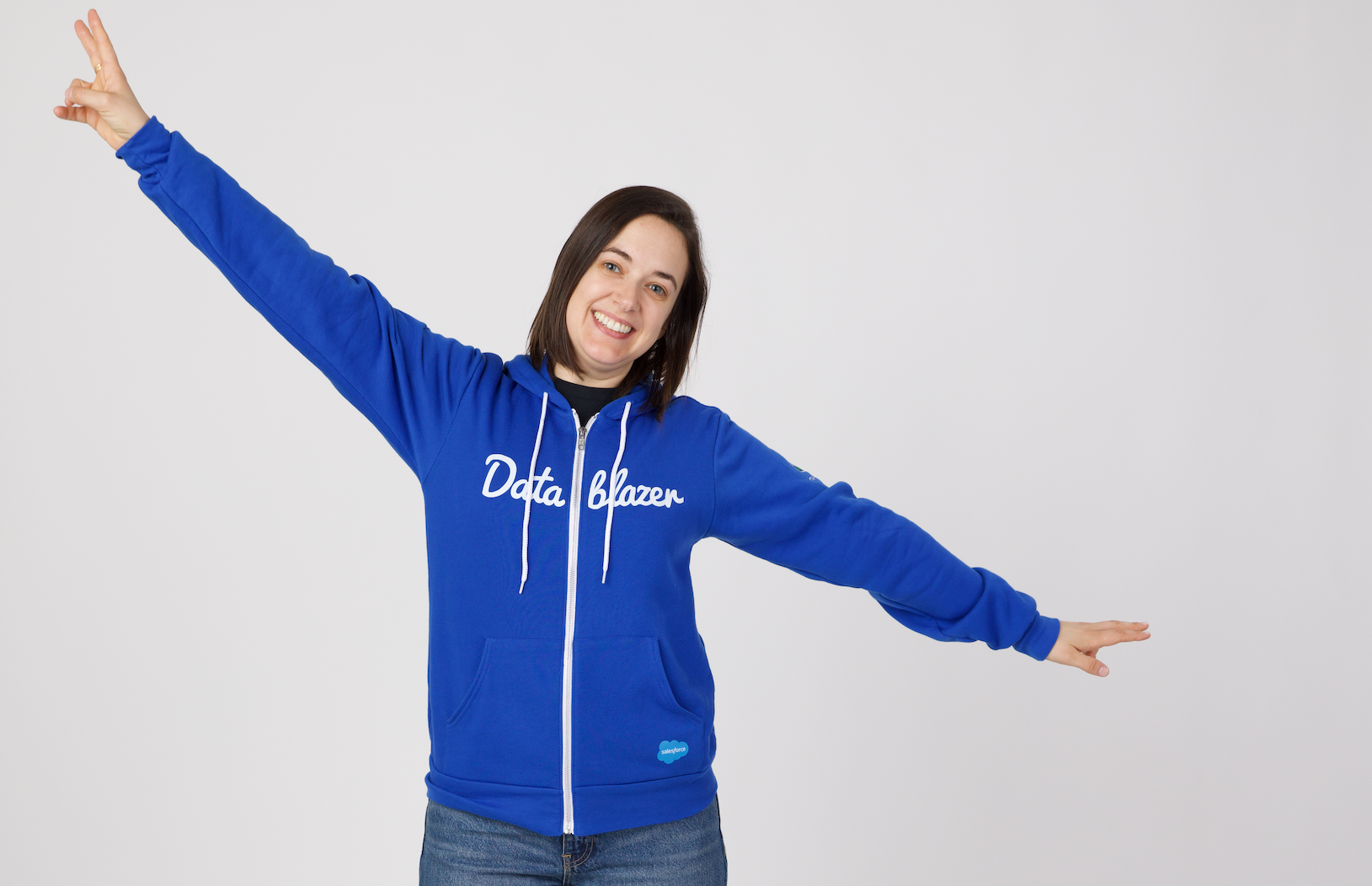
Angélica: I don’t like talking about challenges that we face; I like talking about opportunity. It’s true, you get into a room and there aren’t many female CTOs, so you have to somehow prove yourself. But I really want to see that as an opportunity because once you get into that room, you open the door to other women. You create that multiplier effect where people know it’s possible and you are influencing others to start leading, innovating, or just trying.”
I never saw myself as a role model, but I’ve realized that somehow I am. I remember a new girl on our team sharing with me that she told her parents, “My boss, she’s a woman, and she’s the CTO, and she’s the co-founder, and she’s less than 40 years old, and that is all I want to be.” That is when I started talking more about the opportunities, not the challenges. It’s about sharing a success story, because again, it’s creating that multiplier effect that this is possible. Jump in it. Go for it.
AI and data advice for small business owners
For many small business owners, the AI revolution feels overwhelming. What is your approach to bringing AI into tech strategy?
Angélica: When I’m talking to customers, most of the time the problems they’re having are not about technology; it’s about business processes and business needs, and at the end of the day, it’s having the right data — trusted data — that is going to enable any success.
Sometimes you feel the pressure of being left behind, of not understanding, and feeling that you are missing an opportunity to be more effective. You think about adopting AI as a technology problem — that you need to go and pay licenses — and it’s not.
If your business is a pyramid, the technology solution you’re going to be using is at the very top, but you need to think about the foundation. It’s anchoring to the fundamentals: What’s the business problem that you want to solve? Don’t try to tackle everything. Deconstruct the problems into smaller ones. Define the criteria to identify which problem you want to start with first: Is it delivering a quick win very fast, or is it solving that complex problem that will increase efficiency, save cost, or make your customers and employees happier?
Then, think about the data that is going to feed that process: Is it complete? Is it accurate? Is it current? Then you can ask, “How can AI or automation help me?” AI agents are amazing and very smart, but they need your guidance. They cannot just be plugged in to solve all the problems.
The path to becoming a data-driven SMB (actionable steps)
Angélica’s advice to small business owners and leaders is not to feel pressured to adopt AI or big data technology without first understanding their underlying business problems. The technology solution is at the top of the pyramid, as she says, but the foundation must be anchored to the fundamental business problem you want to solve.
Here is Angelica’s advice on the steps an SMB owner can take right now:
1. Review processes and break down problems: Instead of jumping into adopting a new platform, review your existing processes to identify pain points. Break complex issues into smaller ones. Define clear criteria to prioritize which problems to tackle first, such as seeking a quick win, solving a complex issue that saves cost, or increasing customer/employee happiness.
2. Use data for high-impact insights: Unify different data sources to report on profitability and open capacity, which allows you to make data-driven decisions on resource management and where to sell more. This leads to process improvements, such as collecting data weekly instead of monthly, which are not strictly technology changes.
3. Lean on the Datablazer Community: Joining Trailhead is a safe, cost-effective space to learn from hands-on practitioners. It provides the necessary expertise and honest insights into real problems. You can explore key trails, like Data 360 Basics, and identify your minimum viable product (MVP) — one simple, high-impact use case to start your data journey.
Free your data with Data 360
Level up your business by transforming scattered data into actionable insights.


Start blazing your trail
The Datablazer Community and foundational tools like Salesforce’s CRM empower small businesses and startups to move beyond being overwhelmed by data and start transforming it into their most powerful asset. The ability to give back to the community, teaching and empowering others, is truly important to Datablazers like Angélica Buffa, and we’re so grateful to her and everyone else contributing to its success.
Join your fellow Datablazers today! And when you’re ready, start your journey with the Free or Starter Suite today. Looking for more customization? Explore Pro Suite. Already a Salesforce customer? Activate Foundations to try out Agentforce 360 today.
AI supported the writers and editors who created this article.