10 Ways to Make Your AI Agent a Better Communicator

Conversation design principles help AI agents provide consistent, empathetic, and expert support, building customer trust and making your brand more reliable.


When customers turn to an AI agent for help, they’re not just looking for information — they want to feel understood. An agent that delivers accurate answers but stumbles over tone, structure, or empathy isn’t fully serving the people who depend on it. Fortunately, building with proven conversation design principles can ensure that your agents are effective conversationalists that excel at solving real customer problems.
These 10 practices come from our own experience building the Agentforce on Help support agent at Salesforce. We’re sharing them because the same principles that made our agent more effective can help yours deliver better, more trustworthy experiences.
1. Follow a Structured Response Framework
Customers want answers that are easy to scan and understand quickly. When an agent follows a predetermined template, you can ensure the most important details are prioritized, whether that’s the immediate solution, next steps, or additional resources.
- How to Apply: Create a standardized library of response templates to ensure consistency and scalability. Each template should follow a clear structure, typically including 3 to 5 steps, a helpful link, and a contextual follow-up question.
2. Maintain Brand Voice Consistency
Customers are building a relationship with your brand through every agent interaction. A consistent voice makes customers feel like they’re talking to the same knowledgeable expert every time, which builds trust and familiarity.
- How to Apply: Create a Voice and Tone guide tailored specifically for your agents. Voice reflects your brand’s personality; tone is how it speaks in a given moment. Include specific adjectives (for example, “friendly, but professional”) and examples of on-brand versus off-brand phrasing. If you have multiple agents, they can have varying tones depending on your use case and audience.
3. Handle Difficult Interactions Professionally
When a customer is frustrated, they want to feel heard, not lectured. It’s important to redirect agent responses toward solutions, without judgment, to de-escalate tension and get customers the help they came for.
- How to Apply: If abusive language is detected, the instructions for your agent should focus on reactively setting clear boundaries, staying calm, professional, and empathetic. Have your agent escalate to a human when it cannot solve the problem with its current capabilities or the solution requires human-level nuance.
4. Use Smart Disambiguation
No one wants to waste time with AI that consistently guesses wrong. When a customer’s question could mean multiple things, a well-designed agent asks targeted clarifying questions, not a generic “tell me more.”
- How to Apply: Instruct your agent to clarify intent by asking only one question at a time, preferably open-ended, and ending with a prompt for the customer’s response. Ultimately, your agent should be a good conversationalist who shows curiosity and seeks understanding by asking questions, making the user feel heard.
5. Use Consistent Terminology
Customers shouldn’t have to decode unfamiliar terms or second-guess what the agent means. Consistent terminology reduces confusion and builds trust, making every future interaction feel smoother.
- How to Apply: When writing agent instructions, including greetings and error messages, be sure to include language from your company’s brand guidelines. Defining key terms — including proprietary, common industry, and persona-specific language — ensures the agent is communicating with your customers in a relatable and understandable way.
6. Structure Lists Effectively
When customers need to follow steps or choose between options, the information should be scannable at a glance. Well-structured lists help people quickly identify what’s relevant without reading through noise.
- How to Apply: It’s okay to prioritize clarity over compression when needed. A short answer that leaves out important information won’t help your customer solve things faster. To keep things concise without eliminating necessary context, instruct the agent to group related steps to improve flow and ask clarifying questions before presenting a list to avoid unnecessary branching.
7. Be Strategic with Links
The right number of links helps customers get deeper support when they need it, without overwhelming them. Strategic linking means pointing to the most relevant resource for a specific situation, not a dump of generic articles.
- How to Apply: Use links to keep replies concise. Have your agent surface the most relevant links in order of priority, using descriptive anchor text rather than just URLs.
8. Apply Thoughtful Apology Logic
Customers want acknowledgment when things genuinely go wrong, but excessive apologies make interactions feel hollow and scripted. An appropriate apology validates the experience and keeps focus on solving the problem, and that matters for trust.
- How to Apply: Program your agent to express empathy and acknowledgment, but only apologize for actual errors. Avoid over-apologizing to keep the agent credible and the conversation moving forward.
9. Design Engagement Patterns Intentionally
Agentic conversations should feel natural and helpful, not robotic or pushy. Good engagement means greeting customers appropriately, offering proactive suggestions when they’re genuinely useful, and winding down conversations naturally.
- How to Apply: Craft a greeting that makes a good first impression and demonstrates real value. Define what conditions should trigger proactive outreach versus waiting for the customer to lead. Use tapering to gradually reduce the formality and verbosity of your agent’s responses as users become more familiar with the system. (A formal introduction makes sense when meeting someone for the first time — but the same introduction on a second meeting would feel strange, like they don’t remember you.) Let conversations close naturally once a customer’s needs have been met.
10. Handle Off-Topic Moments Gracefully
Customers should be gently guided back to getting help without feeling shut down. Your agent can acknowledge a friendly question while steering the conversation back on track.
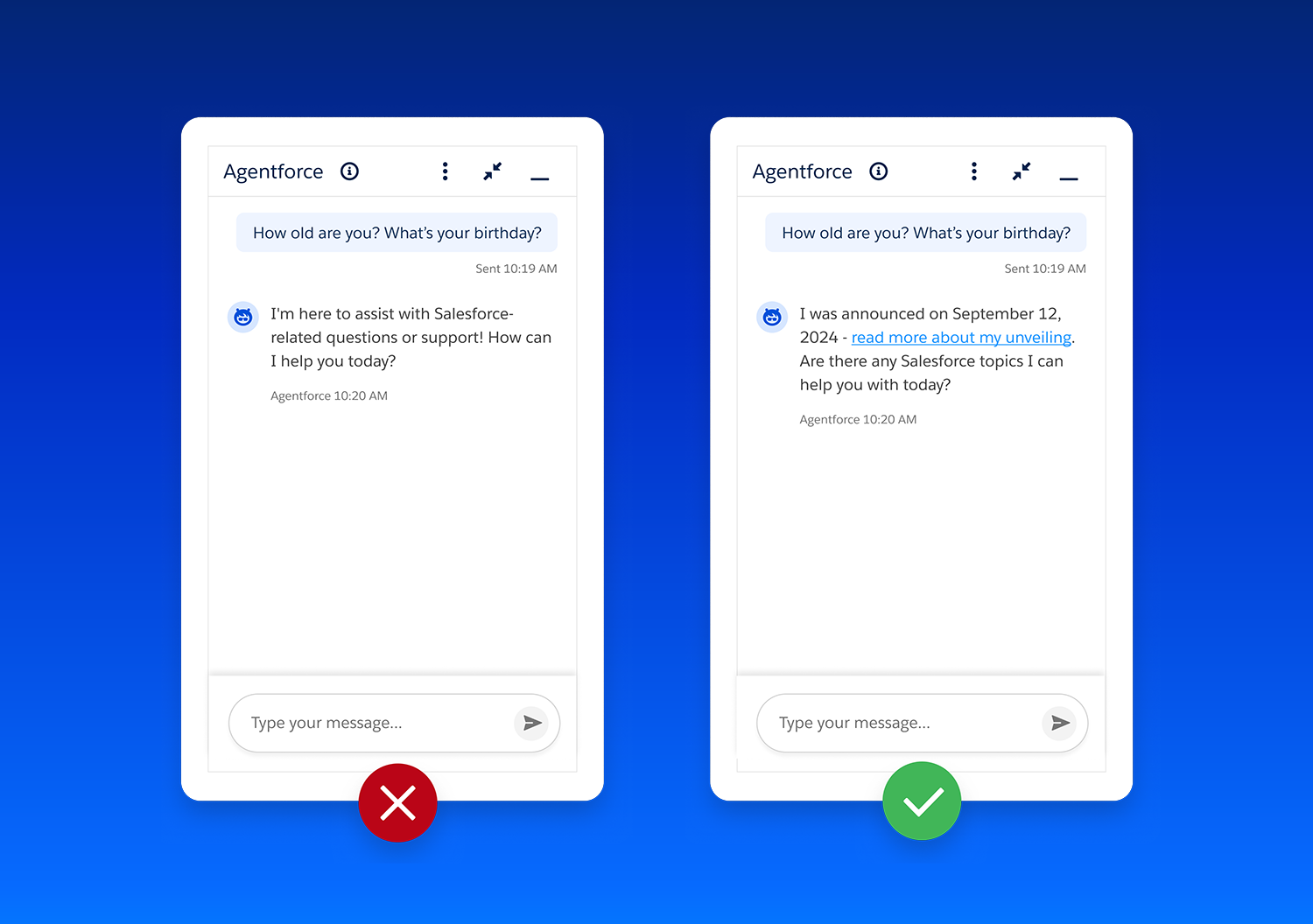
- How to Apply: Map common off-topic or chit-chat queries to conversational, on-brand responses. Moments like “What’s your favorite color?” or “When is your birthday?” are opportunities to reinforce your brand’s personality. A well-handled off-topic exchange builds goodwill and trust, signaling that your agent is designed with care.
The Bottom Line
These principles work together to make customers feel like they’re getting help from a consistent, empathetic expert who understands both your product and how to communicate with people under stress. When your agent earns that trust through every interaction, your brand becomes something customers rely on and return to.
Want to go deeper? Discover how conversation design empowers agentic AI.