

A tech career can seem routine: show up, build things, go home. You may excel, but something important may be missing — the sense that your work matters beyond the next project or closed deal.
Teddy Sergesketter experienced something different at Salesforce, and his story may change how you see your next workplace.
Teddy’s Journey Begins with Usable Technology
Teddy’s background isn’t what you’d call a straight line to tech. He studied Mechanical and Industrial Engineering — think factories, aerospace, the physical world — giving him a systems-thinking lens.
But somewhere in college, he stumbled across something that stopped him in his tracks: Salesforce was being taught in courses at the Blind Institute of Technology.
For Teddy, that moment wasn’t just a detail; it was a signal.
“To me, this showed a commitment to building usable technology — an example many brands could follow.”
That commitment to accessibility, the idea that great technology should work for everyone, resonated deeply with someone who had always cared about inclusion. He started digging.
He found a place to tackle technical challenges, collaborate with world-class companies, and create positive change.
Today, Teddy is a Lead Digital Solution Engineer specializing in the travel industry. He tackles high-stakes architectural puzzles — integrating Agentforce and Data 360 to process massive datasets in real-time — ensuring that for global airlines and hotels, ‘personalization’ isn’t just a marketing term, but a seamless technical reality
His days look like part strategist, part architect, part consultant, and entirely customer-obsessed.
What Customer Success Means in Practice
Salesforce’s core values — Trust, Customer Success, Innovation, Equality, and Sustainability — aren’t just words on a wall. Ask Teddy, and he’ll tell you they’re a decision-making framework that kicks in when things get hard.
He talks about a time he caught a problematic licensing and integration pattern early in an implementation. It wasn’t technically his job to flag it. It would’ve been easier to let it slide and let the implementation partner figure it out down the line.
“Despite this, Customer Success guided me to speak up, causing some friction with the account team, customer, and implementation partner, but ultimately resulting in a better and more cost-effective pattern for the customer.”
In many organizations, staying quiet is the safe bet. At Salesforce, ‘Customer Success’ is a mandate that empowers you to disrupt the status quo if it saves the client from a bad roadmap.
The friction paid off, building trust — a hallmark of Salesforce culture. The right answer isn’t always the easiest, but values-driven decisions are encouraged. This extends beyond business to how we engage with our communities.
Salesforce’s 1-1-1 Model Stands Out
When Salesforce was founded, the company committed 1% of its time, equity, and product to giving back. To many, paid volunteer time and the 1-1-1 model may sound idealistic. Teddy was skeptical until he saw it firsthand.
“Before coming to Salesforce, its commitment to volunteerism and giving always felt like something that could be corporate fluff, but I truly feel it in the day-to-day.”
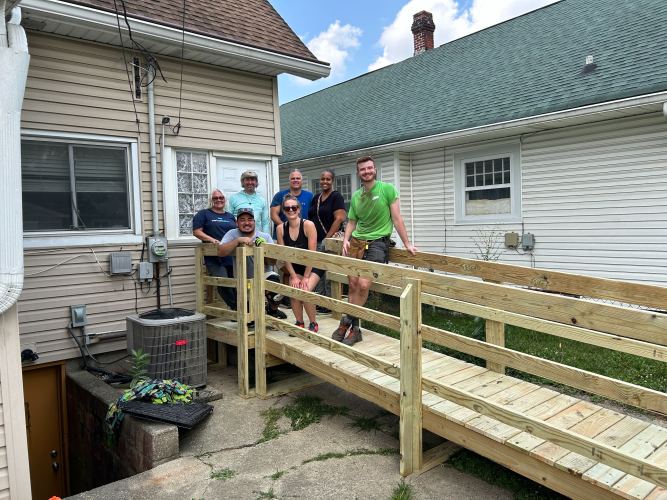
For Teddy, VTO (Volunteer Time Off) became the vehicle for something he’d been passionate about since college: accessibility. Specifically, through an Indianapolis-based nonprofit called Servants at Work (SAWs), which builds wooden wheelchair ramps for people with disabilities who can’t afford them.


The Impact of the 1-1-1 Model at SAWs:
- Salesforce volunteers have collectively contributed more than 1,500 hours overall. Teddy has personally helped build over 50 ramps in five years.
- The company has donated over $30,000 to SAWs, funding 30+ ramps.
SAWs even uses Salesforce as its CRM to manage its mission. Numbers tell part of the story. People tell the rest. And for SAWs, it’s written over 5000 stories since its founding in 2003.
Last year, a Salesforce build team built a ramp for a 20-year-old with rheumatoid arthritis who hadn’t left his home in over a year. His family had an electric power wheelchair, but no way to get it out of the house. The team built him a 50-foot ramp. The first thing they wanted to do? Go see the new Marvel movie.
Then there’s a 20-year-old mother of two, all three of whom live with brittle bone disease. She had broken 155 bones in her life. Five days before Christmas, on a cold December day, a build including Salesforce volunteers built a ramp for her family.
“We provide both physical freedom and psychological safety for clients who live in fear of exiting home in an emergency — the ramp gives them comfort and security.”
Building a Values-Driven Career
So what’s the point of all this for someone weighing their next career move? At Salesforce, you don’t have to choose between doing great work and doing good in the world. The culture gives you the space, the resources, and the encouragement to bring your whole self to work.
Teddy put it simply: “We come to work as fuller versions of ourselves when we have the space to give to what we care about.”
Whether you’re an engineer, a marketer, a recruiter, or a product manager, there’s room here to be excellent at your craft and show up for your community. You can solve hard problems for global brands by day and build wheelchair ramps on a Friday.
Ready to shape your future? We’re looking for architects of change. Explore our open roles or connect with our team to see where your craft meets your purpose.
Blaze your trail to Salesforce!
At Salesforce, we’re not just shaping the future. We’re turning big ideas into breakthroughs. Want to join the #1 AI CRM that’s leading the digital labor revolution? Explore our open roles today!

Related Stories





AI supported the writers and editors who created this article.