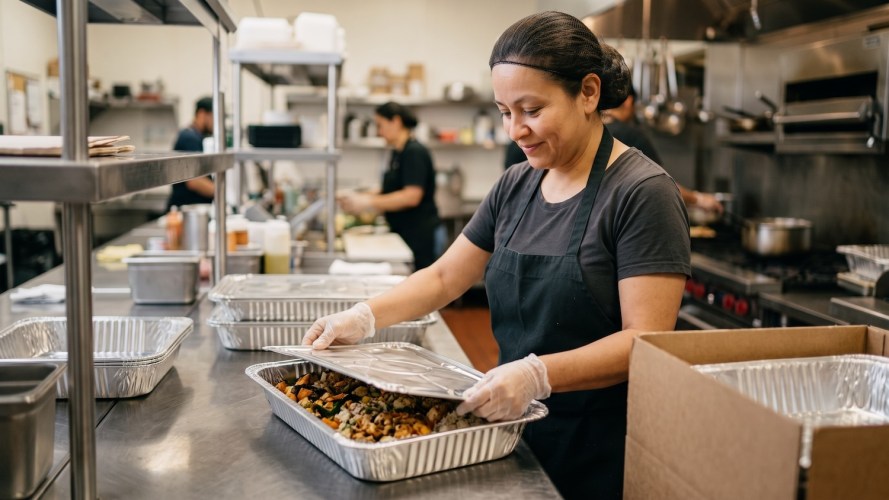

Share My Meals, a nonprofit that recovers prepared meals and delivers them safely to communities in need across New Jersey, New York City, and Pennsylvania, just delivered 230,000 meals in 2025, up from 62,000 in 2023. The technology team grew by half a person.
That efficiency came from building STAN (Safety, Tracking, Allocation, and Navigation), a centralized platform on Salesforce Field Service that connects food donors, volunteers, and recipient nonprofits in real time. The platform solved the bottleneck that was holding them back. They’re now planning to open it as a blueprint for other nonprofits.
A common problem: Too many siloed tools that just can’t scale
Before STAN went live in January 2024, Share My Meals relied on nine separate software tools to manage their meal recovery operations. Each tool handled a different function: volunteer coordination, donor management, meal allocation, and food safety tracking. The fragmented approach required significant manual data entry, lacked any centralization, and made it impossible to scale efficiently.
For a nonprofit operating on a lean budget, that structure was a bottleneck. “As a nonprofit, operational efficiency is not a nice-to-have. It’s a necessity,” Share My Meals Chief Technology Officer Victoire Cleren said. They needed a way to do more with the same resources or growth would stall.
The solution: One platform to connect every stakeholder
Share My Meals built STAN on Salesforce Field Service, creating a single platform that connects food donors, volunteers, and recipient nonprofits in real time.
The decision to build on Salesforce rather than a logistics-specific tool or a custom build came down to where the data already lived. “Because all our operational data already lives in Salesforce, Agentforce can just access and act on it seamlessly,” Cleren explained. Volunteers get a pre-briefing summary directly in the app (a quick at-a-glance overview of their assignment), especially valuable for occasional volunteers.
But the impact goes beyond field operations. Salesforce Field Service also supports Share My Meals’ internal tech team by assisting with configuration, implementation, and coding. “This is transformative for us as a nonprofit,” Cleren said. “It replaces the need for expensive external developers and allows us to continue to improve our platform within our existing budget and team structure.”
The upgrade: Each day’s work now goes even further
Operations Associates set the day’s schedule while trained volunteers and food donors get ready. Right after lunch service, a donor logs their surplus with a quick QR scan, which instantly notifies the matched volunteer where to go and where the food is headed.
The volunteer confirms food safety and quantity, delivers the meals to a waiting nonprofit, and swaps in fresh containers for clean ones, keeping the reusable supply cycling. The moment delivery is marked complete, the donor’s dashboard updates in real time with pounds rescued and meals made possible. While a regional operations associate oversees the bigger picture, stepping in only when a human touch is needed. Repeated dozens of times a day, this self-updating cycle frees staff to focus on what matters, so more meals get rescued, faster.
Field service made simple with AI
Learn how high-performing field service teams are using AI to boost productivity and deliver customer satisfaction.
By the numbers: See the transformation of a modern non-profit
Share My Meals now operates within one unified operation. Donors submit their donation via a QR code, logging quantities directly into the shared system. This automatically triggers an alert to available volunteers and updates the donor dashboard in real time.
Volunteers sign up through the volunteer portal, complete safety training via an on-demand learning platform, and receive instant app notifications when a pickup is ready with location, quantity, and food safety timelines included. They can also scan containers for food safety compliance and reusable container inventory tracking.
Recipients — nonprofit partners and direct families — receive automatic messages and notifications ahead of each delivery. Communication is powered by an integrated call and text system, a native Salesforce product, ensuring every interaction is efficient and fully traceable.
The Effect: 3.7X Growth, Same-Size Tech Team
The numbers make the case. Since STAN went live in January 2024:
- Meals delivered: 62,000 (2023) → 230,000 (2025) — 3.7x increase
- Employees: 7 → 15 — 2.1x increase
- Volunteers: 75 → 293 — 3.9x increase
- Counties served: 5 → 18 — 3.6x increase
- Meal donors: 36 → 120 — 3.3x increase
- Nonprofit partners: 25 → 55 — 2.2x increase
“Without a single unified platform, that pace of growth wouldn’t have been possible,” Cleren said. STAN reduced manual labor, improved data management, and gave them the operational structure to do more with less.
The growth also showed up in platform adoption. Salesforce contractor licenses, reflecting the number of field operators and partners actively using the system, increased from 20 to 160, an 8x increase. That’s 140 more people coordinating food rescue logistics through the platform as Share My Meals expanded geographically and operationally.
The first proof point came when the logistics ran smoothly, end to end, for the first time with all the automations in place. Then came the milestones: 100,000 meals, then 200,000 meals, faster than expected.
But the most meaningful moment? Seeing nonprofit partners moved by what they were receiving. “Beautiful prepared meals delivered safely and consistently, allowing them to serve more people in need,” Cleren said. “That’s when the data became real.”
Volunteering sees an unexpected boost
Volunteer retention became easier, too. When the app guides volunteers clearly and they can complete their shift without confusion or delays, they feel good about their experience. That’s what brings them back.
“The app doesn’t just make our operations more efficient, it makes volunteering with us feel professional and purposeful,” Cleren said. Many volunteers have told the team that the app lends itself to a much more professional experience than expected. They appreciate the level of organization involved.
Unlocking scale, simplifying their tech stack, and recovering food for years to come
The biggest surprise? How much Salesforce empowered Share My Meals’ internal team.
“We built STAN expecting it to improve our field operations and it did,” Cleren said. “But we didn’t fully anticipate how much Salesforce would reduce our dependence on external technical support.”
The team can now implement configuration, troubleshoot, and make improvements that previously required hiring expensive outside developers and consultants. For nonprofits operating on a lean budget, that’s a game changer. “It gives us the technical autonomy that we didn’t have before,” Cleren said.
That autonomy is now driving a bigger vision. Share My Meals’ priority is to deepen impact in the communities they already serve across New Jersey, New York City, and Pennsylvania. There’s still so much need in those regions, and STAN gives them the infrastructure to reach more donors, engage more volunteers, and deliver more meals without a proportional increase in cost and complexity.
But as they saw the platform work, a bigger idea emerged: What if other nonprofits didn’t have to start from scratch?
“Building STAN took years of effort and investment,” Cleren said. “We don’t think that every nonprofit should replicate that heavy lifting.” Share My Meals’ vision is to open the technology to other organizations that can plug in and operate from day one.
“Salesforce and Agentforce make that kind of scalability realistic,” Cleren said. “The goal is no longer just to grow Share My Meals, it’s to use what we’ve built as a blueprint that multiplies impact across the entire food recovery ecosystem.”
Elevate every field service experience
Make sure your customers get fast, complete service from start to finish. This starts with the right field service management solution with AI.