
Key Takeaways
We have all asked the question, “will AI replace me?” The rise of artificial intelligence (AI) has provoked this question across every industry and market. For small and medium businesses (SMB) owners, especially, the promise of AI can feel like a double-edged sword: exciting for its potential to simplify work, but also scary because we don’t know its true capabilities.
To help you to understand how AI can augment your work, we’re going to dig into the term “humans in the loop (HitL)” and what that means for your growing business. Find out how AI is supporting your team, rather than replacing it and how to get on board with training with the right tools.
AI support over replacement: HitL defined
Humans in the loop (HitL) is a framework that emphasises the need for human interaction and guidance throughout the artificial intelligence lifecycle. For a small business, this means that while AI systems handle repetitive tasks and process vast amounts of data, a human expert reviews, refines and validates the output.
Embracing this approach allows your startup or growing business to use the speed and scale of machine learning while preserving the empathy, creativity and strategic insight that only your team can provide.
The essential role of humans in the loop (HitL)
This partnership is important because even the most advanced large language models (LLMs) can be prone to “hallucinations” (generating false information based on incomplete or corrupted data), introduce bias or simply miss the nuance of a specific customer context. By keeping your team involved, you ensure the AI’s accuracy and maintain the quality of every customer interaction, which is the lifeblood of any startup.
Whether it’s reviewing an AI-drafted email before it goes to a high-value sales lead or correcting an automated service response to ensure that it reflects your brand’s voice, your employees provide the final layer of quality control. This collaborative model ensures that your use of AI aligns with your business values and allows you to build stronger, more trusted relationships.
According to a Salesforce survey, 80% of small business leaders believe generative AI will help them better serve customers. This highlights the optimism around AI, but also the expectation that it will enhance, not erase, customer service roles.
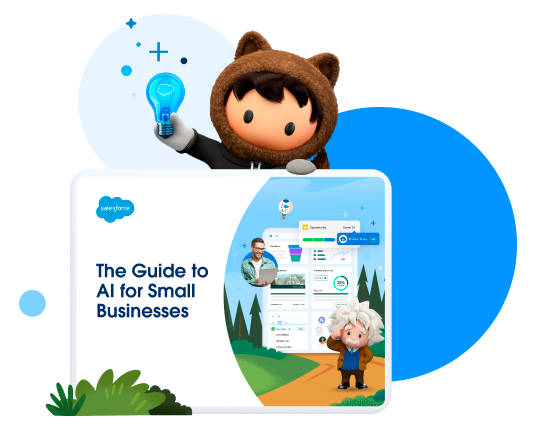
The Guide to AI for Small Business
Check out this free guide on incorporating AI into your business with these tips, strategies and tools.
AI for sales with humans (in the loop)
For small sales teams, AI is an indispensable tool for lead generation and automating administrative tasks within a CRM platform. Instead of spending hours logging data or writing routine follow-ups, your sales teams can dedicate their time to high-value activities. Let’s look at the core benefits of artificial intelligence in sales:
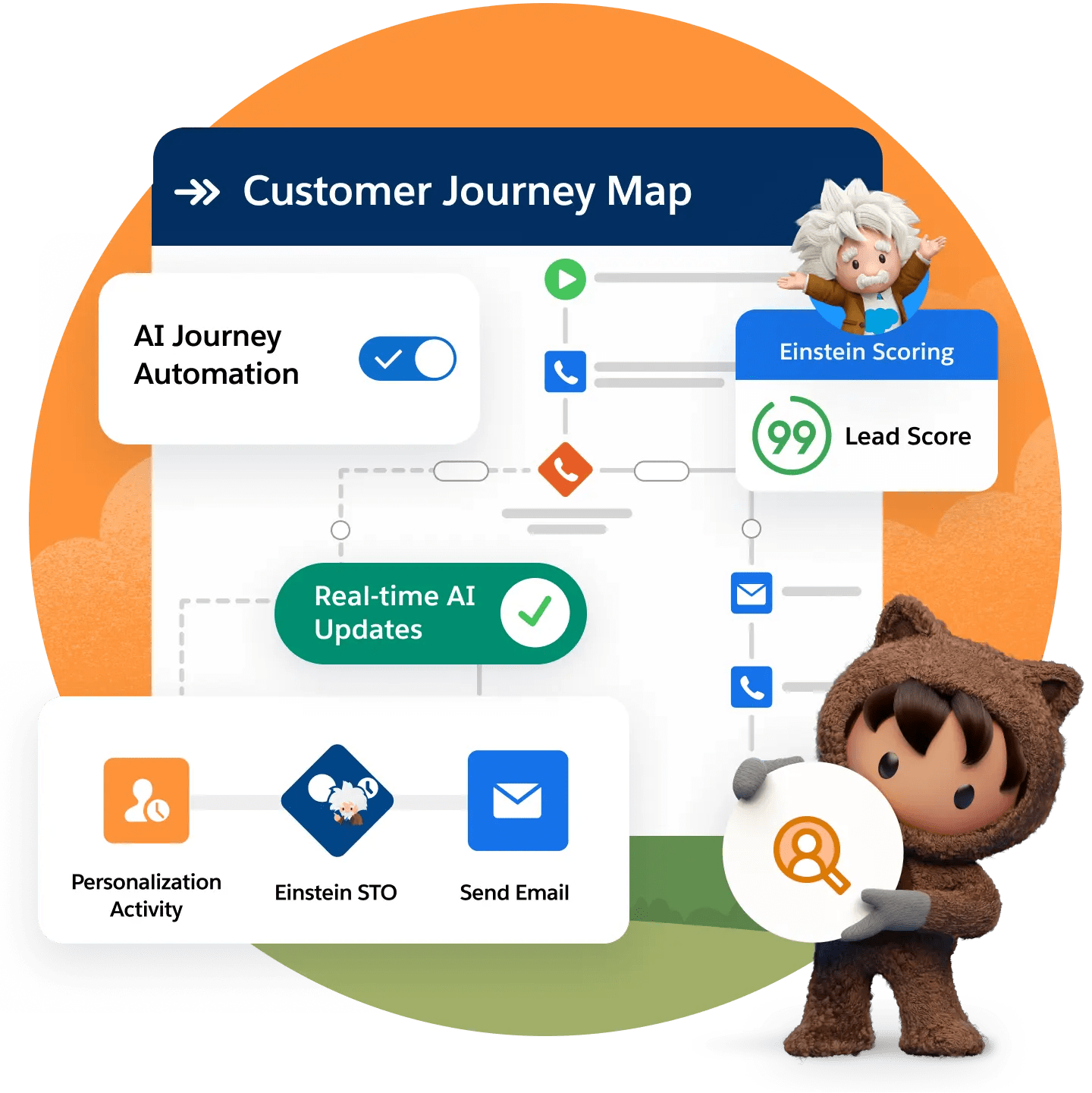
- Lead scoring and prioritisation: AI can score leads based on parameters you create, like engagement, company size and previous purchase history, presenting your team with a ranked list of the hottest prospects. This means a startup’s limited sales resources are always focused on the most promising potential customers.
- Drafting communication: Generative AI can draught personalised emails and summaries of past customer conversations, significantly reducing prep time for sales calls. However, your salesperson is the one who reviews, edits and adds the personal touch that turns a draught into a genuine, compelling message.
This human-machine partnership allows your business to scale personalised outreach by having the AI do the analysis. That way your team focuses on emotional and strategic work.
Enhancing marketing personalisation with human oversight
In small business marketing, personalisation is everything and AI is the engine that makes hyper-personalisation possible. AI analyses customer behaviour across all datasets, both structured and unstructured, to segment audiences and recommend the perfect next step. This allows a growing business to execute marketing campaigns that are personal to every individual’s needs – something that was once only achievable by large enterprises. Here are two ways to get started:
- Content generation and testing: A generative AI model can create multiple versions of ad copy or email subject lines, suggesting the optimal phrasing to maximise engagement. Your marketing team’s role is then to select the most on-brand option and conduct A/B testing to validate the AI’s recommendation, ensuring the tone and message are exactly right for your brand.
- Predictive segmentation: AI can predict which customers are likely to churn or purchase a specific product next, creating highly targeted segments. A marketer then uses this data to craft a tailored offer, transforming a generic promotion into a perfectly timed, relevant communication.
Your marketing CRM for small business is here.
Automate your marketing campaigns with a CRM built for growing businesses.
Boosting human-led customer service with AI
In service, the human in the loop (HitL) model is most clearly demonstrated. Customer-facing AI agents can handle a high volume of routine or low-level enquiries, freeing up your team to handle complex, high-stakes customer issues that require empathy and problem-solving skills. According to Salesforce research, service agents spend about 50% of their time on administrative tasks— AI is designed to cut that number dramatically. Here are just two ways in which humans and AI agents can work together to deliver great service:
- Case summarisation: An AI agent can summarise a long history of customer interactions, giving your agent context in seconds, instead of minutes. This reduces hold times and prevents customers from having to repeat their issue to multiple agents.
- Drafting and refining responses: When a customer sends a request, the AI drafts a potential answer. Your team then quickly reviews the draught, ensures accuracy, adjusts the tone and then sends the final, polished response.
Scaling commerce operations with AI support
For small businesses running ecommerce sites, AI is a powerful tool for optimising the online shopping experience. This includes personalised product recommendations, inventory forecasting and fraud detection. The goal is to make the online store feel as intuitive and responsive as a personalised shopping experience in a physical location. Here’s how humans and AI can collaborate:
- Dynamic pricing and inventory alerts: AI can monitor competitor pricing and demand signals to recommend optimal pricing adjustments, while also alerting your team to potential inventory shortfalls. Your team then makes the final decisions, applying real-world market knowledge to the AI’s data.
- Personalised product bundles: Based on a customer’s browsing and purchase history, AI suggests relevant product bundles and next purchases. Your team ensures these recommendations align with any current promotions or inventory priorities, adding a layer of strategic merchandising that the machine can’t yet replicate.
This human oversight in commerce operations is important for maintaining healthy profit margins and ensuring a seamless, trustworthy customer experience that keeps shoppers’ coming back to your business.
Unleashing team productivity with AI and HitL
AI serves as a powerful productivity co-pilot, handling the tedious, high-volume tasks that consume valuable time, empowering your employees to focus on strategic, human-centric work. A primary area where this partnership shines is within collaboration platforms like Slack. AI, when integrated with your CRM and communication tools, can summarise long discussion threads, extract key action items and even draught meeting agendas, turning hours of review into minutes of focused work.
- Summarise channel activity: Quickly distil weeks of conversation and files shared in a deal-specific channel into a concise brief for a manager, who then provides the final strategic direction.
- Draught follow-up actions: Based on a meeting transcript or a flurry of messages, the AI drafts a list of to-dos for the team, which the project leader reviews and approves before assigning.
- Generate knowledge base snippets: When you ask Slackbot, Slack’s AI assistant, a question, the AI instantly searches and pulls the most relevant data from a knowledge base (like Salesforce Help), giving the human agent the verified answer to share with the team or the customer.
Salesforce for Small Business
Learn how your business can benefit from CRM on Trailhead, Salesforce’s free online learning platform.


How to get started with an AI-powered CRM suite
Small businesses and startups can easily begin by adopting a CRM tool like Salesforce that has AI capabilities built directly into the sales, marketing, commerce and service tools. The most important step is to choose a platform that is designed for easy adoption and scale.
Ready to get going? Start your journey with the Free or Starter Suite today. Looking for more customisation? Explore Pro Suite. Already a Salesforce customer? Activate Foundations to try out Agentforce 360 today.
AI supported the writers and editors who created this article.
Frequently Asked Questions (FAQs)
It’s a framework where AI automates routine tasks and provides data-driven insights, but your human team remains in control to review, validate and apply the final touch of judgement and empathy to ensure accuracy and maintain customer trust.
AI acts as a co-pilot, handling tedious administrative work like data entry, lead scoring and drafting responses. This frees up your team to spend more time on personalised interactions, complex problem-solving and building genuine customer relationships.
No. The goal of HitL is augmentation, not replacement. AI gives your employees superpowers by automating tasks and providing insights, allowing them to focus on high-value, strategic and creative work that only humans can do.
Absolutely. AI is built into scalable CRM platforms like Salesforce Starter Suite, making advanced tools immediately accessible to small teams. You can start by automating one high-impact area, such as service case summarisation and expand from there.
Without human oversight, AI systems can generate inaccurate information (hallucinations), perpetuate unintended bias or simply fail to understand the nuance of a customer’s unique situation, potentially damaging trust and customer relationships.