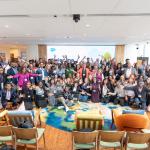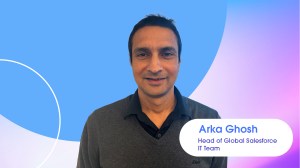



For IT experts such as Arka Ghosh, head of the global Salesforce IT team at Linde, hackathons are much more than a welcome change from everyday work. They open up new perspectives and often deliver concrete, productive solutions in a short period of time. It is no coincidence that ideas quickly turn into results at Linde. As one of the world’s leading industrial and engineering companies, active in around 80 countries, Linde has been relying on Salesforce since 2016 to efficiently manage global sales and service processes. Today, the platform maps central customer-oriented processes, from Sales and Service Cloud to Marketing Cloud to Experience and Data Cloud. Around 5,000 employees worldwide work with Salesforce every day. With the rapid advancement of artificial intelligence, Linde asked itself early on how AI could be integrated into existing processes in a meaningful and measurable way. Instead of viewing AI as an end in itself, the company takes a pragmatic approach: test, learn and evaluate. This is exactly where the hackathon came in. In a short period of time, interdisciplinary teams tested Agentforce using real-world use cases from customer service to reveal potential and deliver tangible results. “Especially in customer service, where high case numbers, complex responsibilities and time pressure characterize everyday work, we see great potential for intelligent AI agents that specifically relieve employees, accelerate processes and sustainably improve the quality of customer interaction,” says Arka Ghosh. “It was important to us not to just discuss Agentforce, but to test it in real-world applications.”
Our Agentblazer Arka Ghosh on …
…pragmatic working with Agentforce
“We handle a large number of service cases every day. The biggest time loss often occurs at the beginning, when employees have to read, understand and classify cases and forward them to the right team. This process is not only time-consuming, but also prone to errors, especially in a global organization with numerous categories and different responsibilities. The aim of the hackathon was to test two specific use cases. We worked directly in the system in two interdisciplinary teams. Supported by Salesforce architects, we took a very focused approach, testing hypotheses immediately and developing solutions iteratively.”
… an AI agent that was immediately put into productive use
“The results of the hackathon significantly exceeded our expectations. In the very first use case, automatic case classification, an AI agent was created within a very short time, which we were able to put into practice immediately after the hackathon. The solution felt like a finished product right away. With Agentforce, we achieved a classification accuracy of around 90 percent, which is an increase of 20 percentage points over the previous approach. In everyday service, it makes a big difference whether a case lands in the right team immediately or goes through unnecessary loops, driving up costs and effort. The second use case dealt with smaller customers who do not have dedicated contact persons. The aim here is to identify dissatisfaction or the risk of churn at an early stage. Agentforce helps us to automatically identify such signals, ask specific questions and generate structured proposals for action. Even though this use case has not yet been fully implemented due to external dependencies, we see the potential of this intelligent support, especially in terms of noticeably reducing the workload on employees while simultaneously increasing service quality.”
… the right balance between humans and AI
“The hackathon was an important milestone for us. It showed that Agentforce is not just a strategic topic for the future, but can already deliver real, measurable added value today. Intelligent automation does not mean automating everything completely. Rather, it is about finding the right balance: Agentforce analyzes, prioritizes, recognizes connections and prepares decisions. However, humans remain in control. In the future, we see Agentforce as a central element in making our service processes more efficient, scalable and robust on a global scale. In an environment with many countries, different requirements and high volumes, this form of intelligent support is crucial. Our goal is close collaboration between humans and AI, with agents taking on routine tasks and our employees gaining the freedom to focus on complex decisions and personal customer contact. For us, this is precisely where the sustainable benefits of Agentforce lie.”