
AI has intelligence.
Marketing has data.
But neither creates enough value in isolation.
The real opportunity begins when intelligence understands the context of the customer and can turn that understanding into trusted action.
This is why I find the next chapter of the Salesforce and Anthropic partnership so interesting.
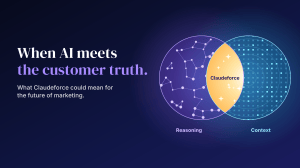
With Claudeforce, Claude’s reasoning is being connected with Salesforce’s trusted data, workflows, business logic, actions and governance.
And for marketers, I believe this points toward something much bigger than another AI integration.
It gives us a glimpse into a future where AI doesn’t simply help us create.
It helps us understand, decide and act.
Intelligence Without Context Isn’t Enough
Generative AI has already transformed marketing.
- We can create copy faster.
- Summarize research.
- Generate campaign concepts.
- Analyze information.
But there is an important limitation.
An AI model can be extraordinarily intelligent and still know very little about the reality of your customer.
- What did they buy?
- Which campaign did they engage with?
- What conversation did they have with Sales?
- Is there an open Service case?
- What does their organization care about?
- What permissions have they given us?
Without that context, even brilliant AI is still reasoning with an incomplete picture.
This is where the Salesforce platform becomes particularly powerful.
Reasoning Meets the System of Record
Claudeforce brings together two fundamentally different capabilities.
Claude provides frontier reasoning.
Salesforce provides trusted enterprise context and the systems through which businesses actually operate.
Salesforce describes the architecture behind this through Headless 360, which makes Salesforce capabilities, including data, applications, workflows, agents and governance, accessible to AI through Model Context Protocol.
That means AI can increasingly interact with Salesforce beyond the traditional Salesforce interface.
The interface can be Claude.
It can be Slack.
And tomorrow, it may be somewhere entirely different.
The important thing is that the trusted enterprise context travels with it.
From Generating Content to Understanding the Customer
This is where the story becomes particularly interesting for CMOs.
The first Salesforce in Claude release is focused on Sales, with 37 prebuilt skills spanning activities from prospecting and account planning to pipeline management and deal execution.
But Salesforce has already outlined Marketing capabilities planned for the future.
The vision includes:
- Grounding campaigns with customer context.
- Creating content for both agents and humans.
- Personalizing customer engagement.
- Building campaigns capable of adjusting based on performance and context.
Think about what that potentially changes.
Today, marketers often move between systems to understand an audience, analyze performance, create content and activate a campaign.
Tomorrow, the starting point may simply be a conversation.
Not: “Show me campaign performance.”
But: “Why is this audience disengaging, what have we learned across Marketing, Sales and Service, and what should we change?”
That is a very different relationship with technology.
The Interface Is Becoming Invisible
For decades, enterprise software taught humans how to work around software.
Open the application.
Find the dashboard.
Navigate the records.
Run the report.
Export the information.
Interpret it.
Then act.
Agentic AI begins to reverse that relationship.
Instead of humans navigating systems to find intelligence, intelligence increasingly comes to humans in the environments where they already work.
Salesforce calls this broader direction AIforce: bringing Salesforce data, applications, workflows and business context into the interfaces where work is happening. Claudeforce and Slackforce are current examples of that direction.
For marketing leaders, this matters.
Because the future of marketing technology may not be defined by another dashboard.
It may be defined by conversation.
But More Intelligence Creates More Responsibility
This is where #MarketingWithPurpose matters.
The more context AI has, the more useful it can become.
But also the greater our responsibility.
Customer data isn’t simply fuel for AI.
It represents people.
- Their preferences.
- Their behaviors.
- Their relationships.
- Their trust.
That means the future CMO cannot simply ask:
“What can our AI do?”
We also need to ask:
“What should it do?”
Where should an agent act autonomously?
Where should humans remain involved?
When should AI recommend rather than decide?
How do we ensure personalization feels valuable rather than intrusive?
These aren’t technical questions alone.
They are leadership questions.
Humans Direct. Agents Execute. Salesforce Governs.
One aspect of the Claudeforce approach particularly resonates with me.
Salesforce describes the model very simply:
Humans direct. Agents execute. Salesforce governs.
Salesforce in Claude is designed to operate through existing Salesforce permissions and business rules. Claude can access what the user is authorized to access and perform actions that user is authorized to perform.
That principle matters.
Because the future of enterprise AI cannot simply be about increasing autonomy.
It must be about creating trusted autonomy.
The Opportunity for CMOs
I believe this changes the CMO conversation again.
Our role isn’t to become AI engineers.
But we do need to understand how intelligence, data, governance and human judgment come together.
The CMO of the Agentic Enterprise must help answer:
- Which customer moments should become agentic?
- Where can AI remove friction?
- Where does human empathy matter most?
- Which data should inform an interaction?
- What should remain under human judgment?
And most importantly:
Marketing With Purpose
As a marketing leader, entrepreneur and mental trainer, I remain convinced that the greatest opportunity of AI isn’t replacing what humans do.
It is giving us the intelligence and time to do the things humans do best.
- Think.
- Create.
- Connect.
- Judge.
- Listen.
- Lead.
Claudeforce is exciting because it demonstrates what becomes possible when powerful reasoning is connected to trusted enterprise context.
But technology is still only the enabler.
Humans determine the intention.
Final Thought
The next era of marketing will not be won by the company with the most AI.
It will be won by organizations that connect intelligence with context, action with governance, and automation with human judgment.
Because intelligence without context is incomplete.
Context without action creates little value.
And action without trust creates risk.
Bring all three together, and something much more powerful becomes possible:
AI that doesn’t just know more.
AI that helps businesses serve better.