

Every business wants to make sales, but the amount you sell doesn’t always equal healthy profits. To truly understand how well your business is performing, you need to know how much revenue you keep once you account for the cost of goods sold (COGS).
This is where gross profit margin comes in. It’s a simple but powerful metric that indicates how much profit your business retains after factoring in the costs of producing or purchasing your product or service.
Gross Profit Margin = (Revenue – COGS) / Revenue X 100
Knowing your gross profit margin will give you insights into your business’s profitability, operational efficiency, and overall business health. In this guide, we’ll explain how to calculate it and how it can help you optimise your profitability and build a more sustainable business.
What you’ll learn:
- What is gross profit margin?
- Gross profit margin vs. gross profit
- Gross profit margin formula (and how to calculate it)
- Margin vs. markup (don’t mix them up)
- What does gross profit margin indicate?
- Real businesses that show why GPM differs across industries
- Gross profit margin vs. other margins
- How does a company increase its gross profit margin?
- How Salesforce can help you elevate your GPM
- FAQs
What is gross profit margin?
Gross profit margin (GPM) is the percentage of your sales income remaining after you subtract your cost of goods sold (COGS). In short, it tells you how much money you’re earning on each dollar after you deduct the direct cost of producing or purchasing your goods.
The higher your gross profit margin percentage, the better your ability to retain profit and manage production expenses. Most businesses aim for a gross profit margin that falls between 20% and 60%, but the benchmark varies by industry. What’s important is that your margin is high enough to cover operating expenses and support growth.
Understanding your gross profit margin helps you assess several key things, such as:
- Whether your direct costs are too high or your pricing is too low for healthy margins
- If you’re making enough of a margin to stay profitable once fixed costs are subtracted
- How your margins stack up against your closest competitors
- How shifts in sales volume or production costs affect profitability
- Whether there’s room to adjust your pricing strategy to improve your bottom line
These insights can help you make more informed decisions, increase efficiency and drive sustainable growth.
Grow fast with the #1 CRM for small businesses.
Get started and scale fast with the #1 AI CRM for small businesses in any industry. Connect marketing, sales, service, and commerce on one platform. Save time with simple setup and built-in guidance. Set the foundation for growth with unified data and AI.


Gross profit margin vs. gross profit
The key difference between gross profit and gross profit margin is how the result is displayed.
Gross profit reveals the total amount of money your business has left after you subtract the direct costs of producing or purchasing your goods or services. On the flipside, gross profit margin reflects that calculation as a percentage of your total revenue.
To make this easier to understand, here’s a table summing up the key differences:
The Difference Between Gross Profit and Gross Profit Margin
| Element | Gross profit | Gross profit margin |
| Definition | Dollar amount left after subtracting your COGS from revenue | Percentage left after subtracting your COGS from revenue |
| Formula | Revenue – COGS | (Revenue – COGS) ÷ Revenue × 100 |
| Shows | Total profit after direct production costs but before fixed costs | Profitability efficiency across products or time |
| Use case | Measuring the profit you have available in dollars | Comparing performance with competitors or in the business over time |
| Example | $500k revenue – $400k COGS = $100k gross profit | ($500k – $400k) / $500k × 100 = 20% gross profit margin |
Understanding this distinction is essential for financial analysis and decision-making. Gross profit provides a direct measure of profit, while gross profit margin allows for benchmarking and comparison, either over time or between your business and its competitors.
Gross profit margin formula (and how to calculate it)
Calculating gross profit margin is an easy way to see how efficiently your business turns sales into profit. And fortunately, it’s really simple to calculate. Here’s another look at the formula.
Gross Profit Margin = (Revenue – COGS) / Revenue X 100
There are two key components you need to understand to calculate gross profit margin:
- Revenue is the amount of money you make from all sales over a period after deducting things like returns, allowances, and discounts.
- The COGS represents the direct costs of producing or purchasing the goods you sell, such as materials, labour or shipping costs. Note that COGS doesn’t include fixed costs, such as rent, loan interest and electricity.
As an example, let’s assume your revenue is $250,000 and your COGS is $175,000. With this information, you can now complete the formula. Here’s how to do that step by step:
1. Calculate gross profit
First, calculate gross profit by subtracting COGS from revenue:
$250,000 (revenue) – $175,000 (COGS) = $75,000
This gives us a gross profitof $75,000.
2. Calculate GPM
Next, divide the gross profit by revenue:
$75,000 (gross profit) ÷ $250,000 (revenue) = 0.3
3. Convert to a percentage
Finally, we need to multiply the sum by 100 to turn the sum into a percentage:
0.3 × 100 = 30% gross profit margin
This gives us a 30% GPM, indicating that 70% of every dollar we earn goes towards covering the cost of producing the goods.
Margin vs. markup (don’t mix them up)
Gross margin and markup are easy to confuse, but they measure separate things:
- Gross profit margin shows profit as a percentage of revenue after subtracting COGS. It helps you understand how efficiently your business turns sales into profit.
- Gross profit markup is the percentage of a product’s cost price that’s added to arrive at a selling price. It helps you determine how much to charge to achieve your desired profit.
Both of these calculations are important for evaluating profitability and building a sound pricing strategy. Let’s sum up the differences in a table:
The Difference Between Gross Profit Margin and Gross Profit Markup
| Element | Gross profit margin | Gross profit markup |
| Definition | Profit as a percentage of revenue after deducting COGS | Profit as a percentage of the cost of goods sold (COGS) |
| Formula | (Revenue – COGS) ÷ Revenue × 100 | (Revenue – COGS) ÷ COGS × 100 |
| Focus | How much of each sales dollar is profit | How much above cost a product is sold for |
| Used for | Measuring profitability against competitors or previous periods | Setting prices based on known costs |
You can calculate both of these formulas if you know your revenue and COGS. For instance, let’s assume we have a revenue of $10,000 and a COGS of $6,000:
- Margin: ($10,000 – $6,000) ÷ $10,000 × 100 = 40% gross profit margin
- Markup ($10,000 – $6,000) ÷ $6,000 × 100 = 66.7 gross profit markup
These two formulas work together to help you evaluate your current margin, see whether it’s aligned with profitability goals and then identify potential opportunities to adjust your markup where needed to strengthen your bottom line.
Experience Salesforce with an interactive demo.
Get hands on with our products and explore real use cases and solutions built for agentic enterprises.
What does gross profit margin indicate?
Think of gross profit margin as a window into your business’s financial health that reveals how well your business is managing costs and sustaining profitability over time. To elaborate, here are five key insights calculating GPM can reveal:
Cost efficiency
A strong gross profit margin is a signal that your business is managing production or procurement costs effectively, whereas a weak gross profit margin suggests that your material costs are too high, your supply chain is inefficient or your customers aren’t willing to pay the price you’ve set.
Once you understand your GPM, you can dive deeper into your data with the help of analytics or AI-driven recommendations to determine whether you should hold where you are, reduce your COGS, or adjust pricing to balance profitability and demand.
Pricing
When paired with sales volume metrics, GPM can also indicate whether your pricing is too high, too low, or just right. For instance:
- 60% GPM + high sales volume: A stable GPM and steady volume of sales indicate steady growth. Your pricing meets consumer needs and demand.
- 60% GPM + low sales volume: A stable GPM but low sales volume means you’re pricing too high. You may need to lower your price to drive sales.
- 10% GPM + high sales volume: A weak GPM with high sales volume reveals you’re pricing too low. Consider increasing the price to improve margins or lowering COGS.
You can then use these insights to refine your pricing strategies and optimise per-unit profit.
Financial trends
Monitoring your GPM over time will reveal gross profit trends that identify opportunities and risks. If your margin is growing over time, this suggests stability and sound management, whereas a declining margin could indicate cost creep, market changes or consumer shifts.
Analysing your current GPM against past data gives you the insights you need to make targeted adjustments before minor issues become major problems.
Competitor analysis
You can also use a gross profit analysis to benchmark your company’s performance against your competitors. If your margin is consistently higher than industry averages, this indicates you have competitive pricing or a cost advantage.
If it’s lower, this suggests you need to investigate further to understand why your competitors are performing better and how you can close the gap.
Product-level profitability
Looking at gross profit margins for individual products or services will reveal which ones drive the most value and which are dragging down your overall performance.
These insights will help you make smarter decisions on pricing, promotions and resource allocation, and they’ll help you determine whether you should double down or scale back on marketing efforts for individual items.
Real businesses that show why GPM differs across industries
While a gross profit margin of 30% to 70% is usually considered the gold standard, that isn’t true for every industry. For instance, margins are often lower in the grocery retail industry because of high competition, while luxury goods enjoy higher margins because customers are willing to pay more due to brand perception.
To show how margins differ by industry, here are some examples for well-known companies:
Woolworths
In 2025, Woolworths made $69,077 million in revenue, with a COGS of $50,262 million, meaning its gross profit margin was 27.2%. This means that for every dollar of revenue Woolworths generated, it kept $0.272 after deducting the direct costs of buying stock and fulfilling orders.

Source: Woolworths Group Annual Report 2025
This margin may look fairly tight, but in the highly competitive Australian supermarket industry, where price sensitivity is high, it’s actually quite strong. It suggests Woolworths is managing procurement and stock fulfilment well.
Qantas
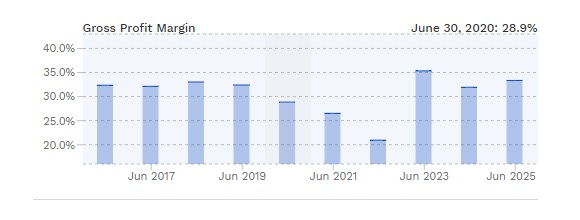
As of June 2025, Qantas reported a gross profit margin of 33.4%, meaning for every dollar of revenue generated, it kept $0.34 after deducting the cost of goods sold.
Source: Finbox
Direct costs in the airline industry are particularly high, particularly for fuel, labour, and maintenance. This means a 33.4% margin is strong, suggesting Qantas is doing a good job of optimising its operating costs.
JB Hi-Fi Limited
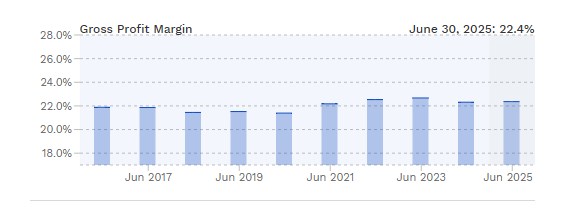
JB Hi-Fi’s gross profit margin currently sits at 22.4%, meaning they keep $0.224 out of every dollar of revenue.
Source: Finbox
The consumer electronics industry has high competition, frequent discounts and rapidly depreciating inventory, making a 22.4% margin slightly above average for this space.
Apple
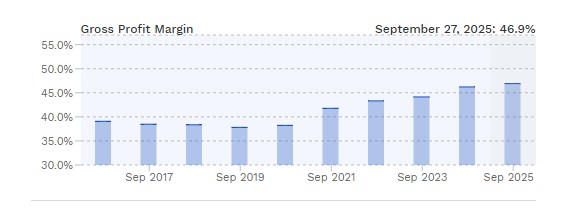
Apple’s gross profit margin in 2025 was 46.9%, its highest ever. This tells us Apple keeps $0.469 of each dollar of revenue it generates.
Source: Finbox
Apple operates in the luxury goods industry, and it has a loyal customer base that will buy its products for the brand name alone. This gives it the freedom to charge a higher price, resulting in a very healthy gross profit margin.
Gross profit margin vs. other margins
Gross profit margin isn’t the only way to measure profitability. There are two other key metrics that give an indication of your financial health: operating profit margin and net profit margin. Let’s take a look at each in more detail.
Operating profit margin
Operating profit margin looks similar to gross profit margin, but it also factors in operating expenses like rent, utilities, marketing costs, admin expenses and salaries of staff not directly tied to the production of goods. Here’s the formula:
(Revenue – COGS – Operating Expenses) ÷ Revenue × 100
Whereas gross profit margin only focuses on profitability after covering direct costs, operating profit margin tells you how efficiently your business is running after factoring in your daily operational costs. It’s best used for evaluating your overall operating efficiency.
Net profit margin
Net profit margin takes things one step further by also accounting for interest and taxes. Here’s how to calculate it:
(Revenue – COGS – Operating Expenses – Interest – Taxes) ÷ Revenue × 100
This is the margin that shows your true profitability, how much you actually take home on every dollar after all costs are factored in. For this reason, stakeholders typically care most about this metric as a true sign of business performance.
Tying the three together
It can be helpful to think of your gross profit margin as the upper layer of your profitability.
Ultimately, your GPM needs to be strong enough to support operating expenses and any additional taxes and interest. If your margin is too low, you won’t have enough cash to cushion your daily expenses and obligations.
And, as GPM is driven by pricing and COGS, it’s easier to tweak than expenses like rent, salaries, interest and taxes. This means it’s best to start at the top and make GPM the priority when you’re trying to improve your profitability.
How does a company increase its gross profit margin?
Gross profit margin improvement comes down to three primary levers: increasing prices, focusing on higher-value products and decreasing costs. Let’s discuss each strategy:
Increase prices strategically
One way to improve gross profit margin is to raise your prices. However, it isn’t as simple as tagging an extra $10 on every product. Here are a few strategic options to consider:
- Dynamic pricing: One approach is to adjust pricing based on demand. For instance, taxi services often charge more during peak demand periods. Solutions like Agentforce Revenue Management can help optimise prices for profit without driving away customers.
- Enhancing perceived value: Strengthen your brand, customer experience and loyalty programs to back up price increases. Salesforce Marketing Cloud gives a complete view of customer preferences, helping you tailor experiences that justify premium prices.
- Set guardrails with CPQ (Configure, Price, Quote): For businesses with sales teams, CPQ software helps your reps stay consistent by ensuring they can provide accurate, personalised quotes. This ensures you aren’t underselling the products you offer.
Remember that aggressive price increases can alienate your target customers and reduce sales volume. Increase prices strategically, test every adjustment and clearly communicate the increase in value to your primary consumers.
Take the first step with Starter Suite.
Discover the all-in-one CRM for small businesses. Starter Suite brings marketing, sales, service, and commerce tools together, so you can grow your business with one easy-to-use suite.
Focus on higher-margin products
Another strategy to increase your overall GPM is to focus your resources on the products that offer the highest margin. Here are three ideas:
- Product mix optimisation: Allocate resources to high-margin products, reduce your reliance on low-margin products, and adjust your marketing accordingly. Sales Cloud can track performance and highlight profitable opportunities.
- Order value increases: Encourage your customers to purchase higher-margin products by including them in bundles or upselling them as extras to products they’re interested in. Agentforce can recommend upsells based on past customer behaviour.
- Customer segmentation: Identify and target the customers that are more likely to buy your highest-margin products. This will place more emphasis on sales that are driving the most value, improving overall gross profit margin.
Too much emphasis on high-margin products can reduce diversity, so it’s important to keep the balance to maintain multiple income streams and avoid over-reliance on one set of customers.
Reduce costs
Reducing the cost of producing or acquiring goods is the most immediate way to improve your gross profit margin without impacting the end customer. Strategies include:
- Supplier negotiation: Communicate with your supplier to see if there’s an opportunity for a discount for bulk ordering or longer-term agreements. Alternatively, assess alternatives to see if there’s a different supplier that could supply materials for less.
- Inventory management: Keep your stock levels in check to prevent overstocking, understocking and unnecessary handling costs. Tools like Salesforce Order Management provide real-time visibility into inventory to help you reduce storage costs and improve fulfilment efficiency.
- Operational efficiency: Look for ways to streamline internal processes during day-to-day workflows. Mulesoft can help you deploy AI agents to automate routine tasks and free up staff to focus on higher-value activities that contribute directly to revenue.
Cost reduction doesn’t have to come at the cost of product quality or customer experience. The goal is smart efficiency, not simply the materials you use.
How Salesforce can help you elevate your GPM
Calculating your gross profit margin is the best way to know how much profit your business keeps after covering direct costs. The more you increase your margin, the better you’re able to cover expenses, withstand fluctuations in the market and invest in your growth.
But understanding GPM is one thing; gross profit margin optimisation is another. For that, you need the right set of tools that can help you make decisions strategically, work efficiently and operate in the best interests of your ideal customers.
Salesforce’s suite of tools can provide real-time insights into business performance, automate workflows, refine pricing, recommend promotions and optimise inventory management. Those insights will enable you to reduce costs, deliver premium customer experiences and maximise your profitability, and it’s all driven by groundbreaking AI within the world’s most powerful CRM solution.
Try Salesforce for free today to start prioritising your business growth.
FAQs
What is the gross profit margin calculation?
The gross profit margin calculation is (Revenue – COGS) ÷ Revenue × 100.
Revenue refers to the total amount you’ve earned from your sales in a given period. COGS (cost of goods sold) indicates the direct cost needed to make those goods.
What’s the difference between gross profit and net profit?
Gross profit is the money your business keeps after covering direct costs, such as materials and packaging. Net profit takes gross profit and subtracts every other expense, such as operating costs (rent, utilities, marketing, etc.), interest and taxes. In essence, gross profit shows how effectively you’re producing your products, while net profit shows your overall profitability as a business.
Is labour included in the cost of goods sold (COGS)?
That depends. Any wages or salaries of employees who are directly involved in producing a product or service are counted as direct costs. However, any salaries for employees indirectly involved, such as HR, marketing, sales or admin staff, are not included in COGS and are instead considered operating expenses.