7 Ways AI Can Help With Change Management
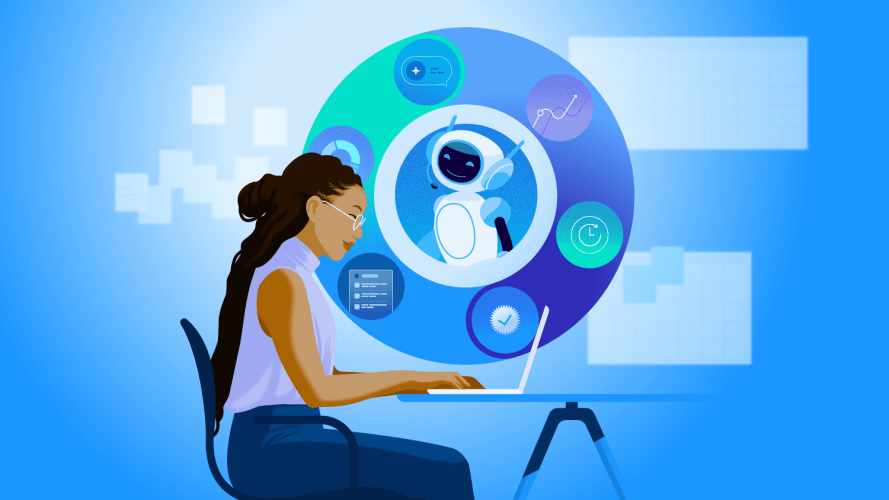
Only half of companies have a change management strategy for AI. Here's how you can use AI to implement your own plan and get ahead of the competition.

Key Takeaways
With so many companies trying to adopt AI, change management is having its moment in the spotlight. Change managers, after all, figure out how to get from Point A to Point B. They create a strategy for transformation. They provide training and support to employees. They plan how to best communicate the change, and they measure outcomes.
But the work of change is hard. Because really, who wants to change if they don’t have to? The good news is there’s a way to make it easier: AI.
An Amazon Web Services (AWS) study found that, in 2024, only 14% of companies in 2024 had a change management strategy for adopting AI. But that percentage jumped to 54% in 2025, and it’s expected to reach 76% by the end of this year. If you’re struggling to see the ROI of AI, having the right change management strategy in place can help — and AI itself can be a powerful tool to implement that change.
“AI is a force multiplier,” said Giulia Sergi, director, Go To Market (GTM) and AI fluency, at Salesforce. “It’s already shifting the change manager’s role from being really detailed and task-oriented to one where they can think more strategically and proactively.”
This is not pie-in-the-sky theory. Here are seven practical ways AI can make change management faster and more effective.
1. It can analyze data to help you map a strategy
A lot of change management is understanding where a company is, where it needs to go, and the strategy you need to get there. That usually involves data analysis. “But you can upload tons of data into AI tools and say, ‘I want you to create a stakeholder analysis based on this information. Tell me what the biggest gaps and highest impact areas are that we need to get more information about,” said Sergi.
In the past, this process could have taken weeks or months, as change managers interviewed people and reviewed data manually. “But if you have the right data sources, you can automate this work to distill the information very quickly,” Sergi said.
2. AI can help companies redesign roles
Arvind Karunakaran, an assistant professor of management science and engineering at Stanford University, said that one of the most powerful ways companies can use AI is to determine what skills the company needs. He suggested that companies use AI to map workflows, identify roles, and break roles down into tasks. Companies can then figure out which tasks can be automated. They can also see where employees need to be upskilled to handle the more complex aspects of their roles.
He referred to this as “task-first” rather than technology-first change management. “Instead of mandating that employees in nontechnical roles learn how to write prompts better, you should figure out the most complex parts of their jobs, or the work they don’t have the time or the bandwidth to do, and give them the skills they need for those tasks,” said Karunakaran. “That’s where a lot of the value would lie.”
He shared the example of a law firm that reskilled its paralegals to do more legal research, work that had previously fallen to junior associates. By taking on these high-value tasks, Karunakaran said, paralegals saved the firm money. “It’s a way to measure impact beyond just the time saved,” he said. “There’s a dollar value to these more complex tasks.”
3. It can offer upskilling support 24/7
Once a company has figured out what skills employees need, it can use AI to help with the upskilling. Many companies already use AI to create personalized learning paths. But it can also act as an interactive tutor. The law firm mentioned above, for example, created an AI chatbot to teach paralegals how to do legal research. Whenever a paralegal had a question about how to proceed, they simply asked the chatbot, anytime, day or night.
Likewise, when Salesforce employees have questions about a new tool or a change that’s taking place, they can use Slackbot — Slack’s internal AI agent — or the company’s employee agent. Salesforce’s change management team has trained these agents on knowledge articles and equipped them to answer just as a member of the change management team would. “Now, I don’t have to manage or make sure there’s a system in place for people to get answers because it’s all autonomous and it’s 24/7,” said Sergi. “That’s a huge unlock for change teams and change management in general.”
4. AI can help with sentiment analysis
When companies are going through a transition, change management leaders always want to know: How are employees reacting? How do they feel about the change?
Sergi tracks these sentiments using AI. “You can ask Slackbot, ‘How are people feeling about the change we’re implementing?’” she said, “and it combs through conversations in public channels to get a sense.”
If a lot of employees are complaining about a new training module, for example, change managers might decide to review the module and change course. But if employees are enthusiastic about a new tool, change managers know the transition is going well.
Sergi said, however, that change managers need to apply critical thinking to AI’s findings for sentiment analysis. “The human still needs to use good judgement and evaluate the output, ultimately playing the role of the strategist across any transformational change,” she said.
5. It can create a communications plan
By now, most people have used AI to write emails. But change managers can also use AI to help communicate with employees in more subtle and powerful ways.
Sergi said that AI can be used to craft entire communication plans. Once you’ve provided an AI agent with the right data, she suggested using a prompt like this:
“I want you to act as a change management lead. Use this data or project brief to create a simple stakeholder analysis table. Then, I’d like you to give me the right groups I should communicate this change to, the right impact levels, the right messages, and a three-phase communication plan. This should include pre-launch, launch, and post-launch communication, and two to three key activities or messages for each phase.”
Carlos Martinez, formerly senior director, global workforce policy at Salesforce, said AI can also help by identifying how best to communicate with a certain team. He cited Salesforce’s Great Insights survey, the company’s biannual employee survey, as an example. “We can have AI analyze the data in the survey and help us understand the biggest pain points for a specific function or group of employees, along with what’s going well,” he said, “and that helps us craft a narrative that resonates most with the pain points a specific function is experiencing.”
After you’ve done all this, AI can help you determine the right channels and timing of communication, based on your company’s usage patterns or engagement metrics.
But Karunakaran cautioned that humans need to oversee the communication plan to make sure everything stays human-centered and employees don’t get flooded with messages and emails — which they’ll ignore if there are too many.
Looking to turn your AI potential into business reality?
Follow this free guide with step-by-step instructions, the latest use cases, expert interviews, and interactive worksheets for your team.

6. AI can run predictive analytics
Predictive analytics help change management experts see where they might hit bumps and how to manage them. “This is where AI is going to offer the most powerful strategic value,” Sergi said. “It will help us move from being reactive to predicting.”
She especially likes to use AI to predict where dips in productivity might occur during a change. “I can give the AI historical data, employee demographics, and process changes, and ask it to forecast the likely dip in the recovery curve for productivity,” she said. Productivity dips are a normal part of change, as employees adjust to new tools or processes. But if Sergi has an idea where they’ll occur, she can set expectations with company leaders in advance.
AI can also identify employees who may be at risk for struggling with change, based on factors like role complexity, adaptability, engagement metrics, and sentiment scores. But this doesn’t mean people will be singled out as laggards. AI-generated predictive analytics simply give change managers a better sense of which employees might need extra support or proactive coaching.
7. It can help measure success
One thing you’ll want to know throughout the change management process is: Is it working?
This is one place where AI excels. On the most basic level, it can track adoption rates. It can also track how many people have taken an assigned learning path and how far they’ve gotten.
But Sergi thinks AI’s real value is going beyond these metrics to the insights they contain. That is, what impact has the adoption or training created? “I like to ask AI not just how people are doing but to track the changes over time between training completion and shifts in high-value output, specifically looking at the correlations between behavioral change and how people are creating more business value,” she said. “That’s more interesting than tracking metrics.”
The biggest benefit of AI for change management
More than anything, change managers envision a better future. They think about how work could be done differently and how to make that happen. The role requires a lot of thinking. That’s why Sergi uses AI as a brainstorming partner. “I need to be the person that makes the final decisions, but I appreciate having this 24/7 brainstorming partner I can bounce ideas off of and that can share new ways of thinking I otherwise wouldn’t have explored,” she said. “To me, that’s the biggest unlock.”
FAQs
- What is change management?
Change management is a process through which companies switch from old ways of working to new ones. It includes creating a strategy for transformation; providing training and support to employees; communicating the change; and measuring outcomes. - How can AI help with your change management strategy?
AI can quickly look at company data and spot problem areas, such as skills gaps. This saves change managers weeks of manual work. - Can AI replace human trainers?
No, but it can help 24/7. Employees can ask AI agents and chatbots questions about new tools anytime they want. - How does AI track employee reactions to change?
AI can track conversations in public chat channels. It can tell if people are happy or frustrated about changes. - How can AI help change managers predict how a change might unfold?
AI can analyze huge amounts of historical data to predict problems that might occur during a change process. It can identify, for example, when productivity might drop or which employees need extra help. - How does AI measure success?
AI can track who is using new tools and completing training. It can also show if people are working more effectively as a result of the changes.