The Deskless Revolution: One Year of Agentic Field Service (And What Comes Next)
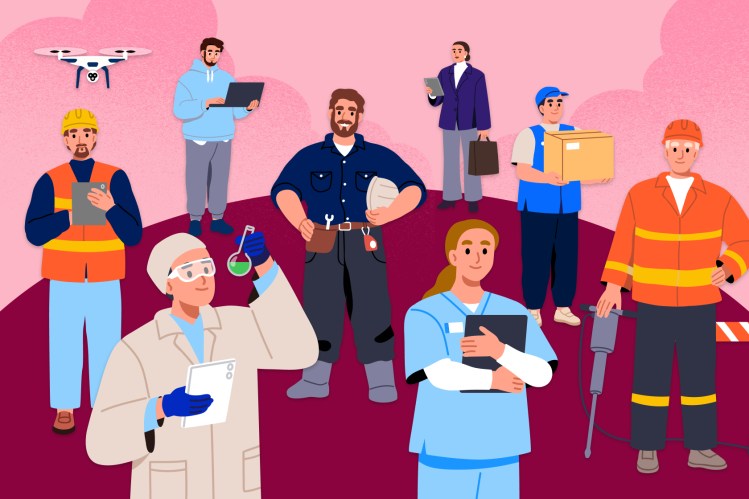
The biggest AI value isn't simply summarizing emails. It's in the utility trench, the lab inspection, and the building facility. Applied AI is in the field solving real-world, physical problems for mobile workers.

Your mobile workers aren’t alone in the field anymore. They now have AI agents, assistants that can supercharge their every move. Monitoring asset health across your entire operation. Scheduling appointments overnight. Summarizing work reports as they happen.
We spent the last year building agentic solutions for field operations. As impressed as we’ve been with the productivity gains we’ve seen, we learned something more important: how to deploy them successfully.
The patterns that emerged
Agents are always-on helpers. They don’t replace teams — they handle the work that slows teams down. The work that happens in gloves, in extreme heat, in environments where typing is impossible. The work that used to drain time now drives revenue.
The question we hear most from organizations deploying agents: “Where do we start?” Working with early adopters, we learned that this transition is more than a tech upgrade. Leaders need a roadmap to redefine the very nature of work.
Here are three key learnings to consider:
- Complexity is the enemy of velocity.
Don’t boil the ocean. Pick one high-friction process that is easy to automate. Success creates the flywheel and the credibility to scale. - Grounded enterprise data is the key.
AI is only as intelligent as the data beneath it, yet teams spend 95% of their effort on LLM tuning and only 5% on data quality. This ratio should be completely inverted. When you connect customer signals across every touchpoint, agents act on complete context, not fragments. - Rethink the work.
Fix the process before you apply AI. You can’t automate a broken process. Automate a mess and you just get a faster mess.
Lessons from early adopters
Most customers begin with AI-generated job briefings, giving technicians instant context before they even step out of the truck. From there they deploy agents to handle scheduling, often starting with after-hours traffic or piloting the tech across five specific branches.
By diverting routine scheduling and work-briefing tasks to agents, these companies aren’t just saving time; they’re ensuring that every asset is monitored and every job is optimized, from the customer hitting the website to the technician heading home.Focus on quick wins. They build organizational momentum, demonstrate value to stakeholders, and create the confidence you need to keep going.
Where could agents fit across your field operations? Consider these options.
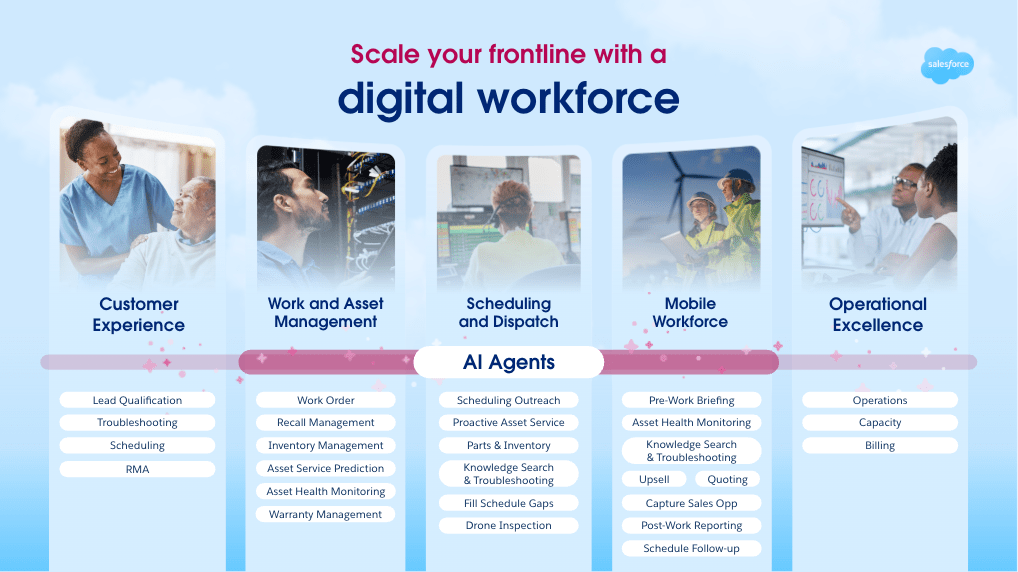
Field Service Supercharged: Your Agentic AI Guide
Learn how AI agents can help field service teams scale, work, and deliver service with confidence.

Multi-modal, conversational field work
Agents are just one part of the transformation. The other part? How your teams actually interact with the technology — and how that speed translates to revenue capture.
For too long, field operations ran on tools built for desks, not for the field. And every minute spent wrestling with technology was a minute not spent serving customers or identifying new opportunities.
Multi-modal, conversational field work from Field Service and Operations is changing everything. Your teams talk. The system listens. Work happens faster.
Here’s what that looks like.
Voice-to-Form
One of our customers is a water treatment inspector. Now their mobile workers, even in a loud plant, wearing safety gloves, can conduct a compliance survey. They speak naturally — out of order, with pauses, using industry shorthand — and the form fills itself. Voice to Form captures it all in real time. How? Agentforce understands the job context and the form’s metadata so it knows which fields those values belong in and even knows to structure the data correctly.
The inspection that used to take 2-4 hours to document? Now it takes 20 minutes. Completed on-site. Audit-ready. No typing. No clipboard. No office write-up. Just talk. That time savings means more inspections per day. More inspections means more billable work.
The Workdry Group is using Voice to Form from Field Service and Operations. After the press of one button, a field tech can speak naturally and the form fills itself out.
Native GIS
Knowing where an asset is matters as much as knowing what needs to be done. Now, locating an asset, like an underground pipe, and completing compliance checks happen seamlessly. With Native GIS (Geographic Information System), we’ve integrated Esri’s ArcGIS platform directly into the Field Service mobile app, so the map lives right in their workflow.
Technicians can view geospatial information and public and private layers like electric grid location and interact with CRM data – like upload an image or kick off an inspection form – all in the same experience. No app switching. No delays. No time wasted searching for context.
Guided Upsell
The best time to close a deal? While the customer is still watching the work happen.
Agentforce uncovers upsell and cross-sell opportunities the moment a worker arrives on-site — generating technically valid quotes instantly based on asset data, service history, and inventory. Workers suggest personalized recommendations immediately, in the high-touch moment when customers are most engaged.
Voice. Maps. Conversational intelligence. This isn’t adding bells and whistles to an app. It’s about removing friction standing between your team and mobile workers doing what they do best — building customer relationships.
Cut hidden costs in field service
From scheduling woes to administrative bloat, uncover what’s adding to costs, inefficiencies, and burnout. And get a free assessment on how AI agents could recapture ROI.
First to market and not slowing down
While the industry was debating what “agentic” meant, we were deploying agent capabilities into production environments. Beyond simply being first, we built the platform for you to build your own agents.
With our Agentforce Testing Center, organizations can build, test, and deploy custom agents fast. Not in months. In days. You can prototype agent behaviors, validate responses against real scenarios, and ship confidently.
Teams are building agents that pull real-time asset telemetry and predict failures before they happen, preventing expensive emergency repairs and protecting recurring revenue relationships. Custom agents are tracking parts across warehouses, vans, and suppliers. They reorder automatically when stock hits certain thresholds, ensuring jobs don’t get delayed for lack of inventory. There are agents that monitor regulatory requirements and flag jobs that need specific certifications, preventing compliance issues that could shut down revenue-generating operations.
Agent-first field service isn’t a roadmap item. It’s happening now. And the organizations building on our platform are the ones turning operational efficiency into measurable revenue growth.
Monthly innovation isn’t hype. It’s how we operate.
We’re launching new agent capabilities and field innovations every month. The agents you deploy this quarter will be smarter next quarter. The workflows you build today will have more capabilities next month.
The competitive advantage: Field operations used to wait years for meaningful innovation. That era is over. Your frontline gets better every month. New agents. Smarter capabilities. Faster workflows. More revenue opportunities.
What’s next for agentic field operations
Field Service and Operations is not slowing down. Every month, new agent capabilities. Every month, smarter workflows. Every month, organizations building on our platform turn operational gains into revenue growth.
The organizations that deployed agents early aren’t just more efficient. They’re more profitable. And the gap keeps widening.
Waters’ wins with Field Service and Operations
With 1,500+ field engineers managing millions of assets, downtime was costly. A switch to Field Service brought a 40% referral revenue boost and 10% cut in replacement part costs.