CEOs of the Classroom: Why Principals are the Key to the AI Era



Learn how philanthropic funding and AI reskilling can prepare students for jobs of the future.

For two decades, I walked school halls as an educator in the Oakland Unified School District – first as a teacher, then as a principal, and eventually, as a superintendent leading my district. I mostly worked in middle schools. During this time, it became glaringly clear to me that there is a “missing middle” in education.
Educators and administrators are working tirelessly to support middle schoolers, and they’re doing it largely without external support. While traditional philanthropy supports funding and training in early childhood and post-secondary education, it often leaves the pivotal middle school years hanging in the balance. Think about it like this: if a student loses interest at age 12, a college scholarship at age 18 won’t help them.
This gap in support for middle schools has become exacerbated in the AI era. Now, middle school principals and educators are preparing for an unknown future without the proper resources or reskilling necessary. Without the latest knowledge and support, how are they supposed to prepare students for jobs of the future?
That’s why the technology industry has a responsibility to share what we know. Without democratizing AI learning for our schools, we risk future progress and hinder the next generation of innovators.
Approaching this problem requires a twofold solution: providing schools with the funding they need for the present and the AI skills training they need for the future.
Let’s dive in:
- Supporting principals — the CEOs of their schools
- Demystifying the future of AI in education
- Today’s middle schoolers, tomorrow’s technology leaders
Learn more about Salesforce’s
commitment to education
Salesforce’s longstanding commitment to education and AI accessibility is paving the way for students, educators, and communities.



Supporting principals — the CEOs of their schools
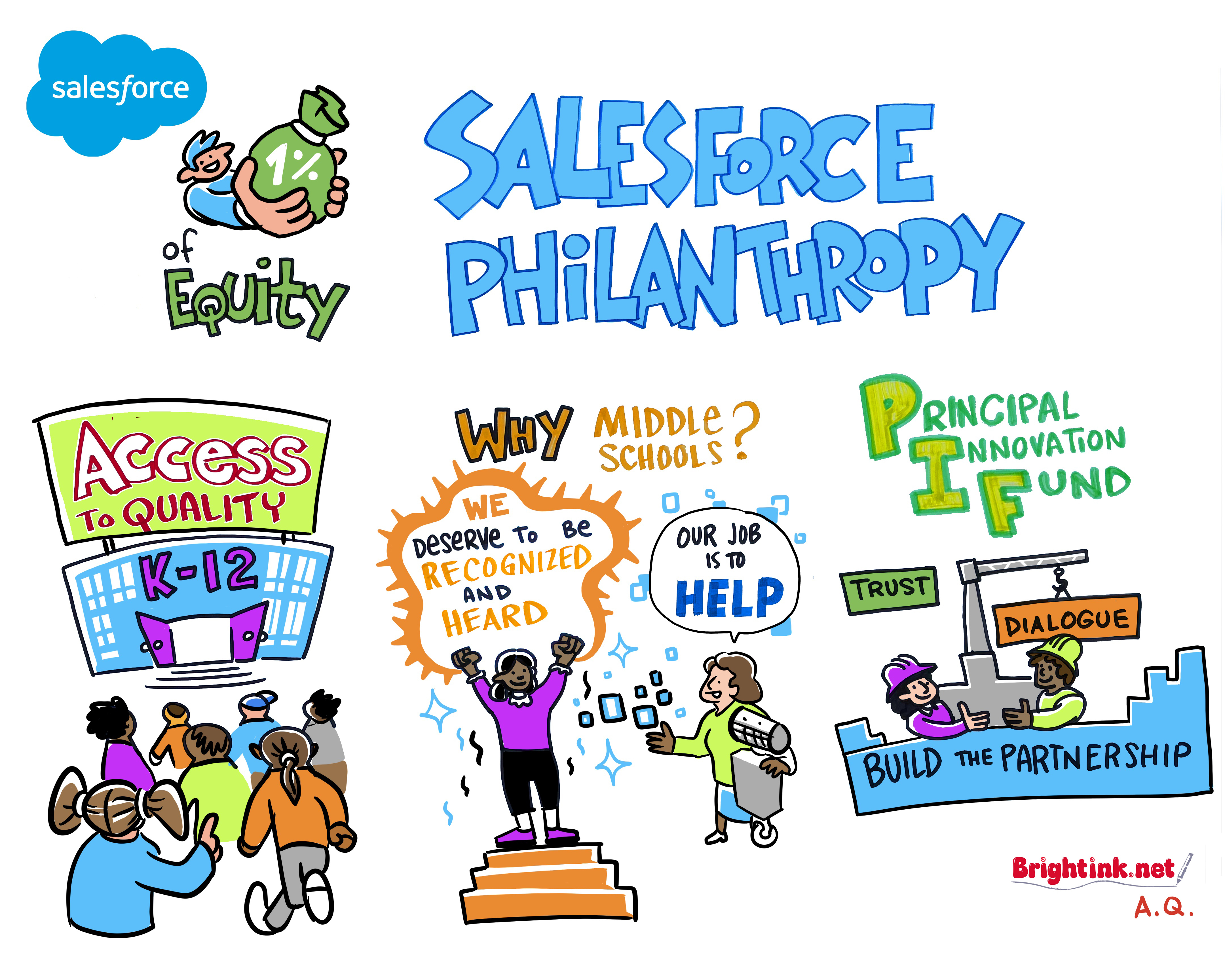
External funding sources for middle schools are hard to come by — and traditional education philanthropy often comes with strings attached. To get the grant, school leaders must prove their impact, defined by parameters set by the funder. What’s missing in this equation is true partnership and space for principals to lead with their expertise.
For 13 years, Salesforce has supported Bay Area public schools with $145 million in all-time giving, including over $50M in funding for our Principal Innovation Fund. What’s special about this particular fund, and what I hope other funders can learn from it, is its focus on treating principals as the CEOs of their schools – giving them flexible funding that empowers them to invest in their greatest needs. Every middle school principal in SF and Oakland receives $100K to enact their vision, whether it’s a new computer lab or a new after school program centered on students’ interests. Their leadership is critical in this strategic partnership. Because only principals truly know the needs of their schools, we give them the same trust we give a Fortune 500 leader to run their company.
Demystifying the future of AI in education
While flexible funding allows school leaders to meet urgent needs, preparing for an AI-powered future requires a long-term approach. We explored this topic with dozens of school leaders at our recent Future Forward: Bay Area Principal Summit. The conversation shifted from using AI as a mere efficiency tool to understanding its role in a new agentic era of education.
Our key takeaways:
1. There’s an important line between the work AI agents can handle and what humans should handle – principals and teachers can navigate this nuance together, armed with insights from AI experts in the technology sector.
The immediate value of agentic AI is its ability to handle the “autonomic core” of a school — the routine, administrative tasks that weigh heavily on teachers and contribute to burnout. With roughly 81% of teachers reporting that AI saves time on admin, we can’t miss this opportunity to free up time for teachers so they can give that time back to their students. And yet, we must reach deeper than simple time-saving methods if we’re designing a holistic approach to the future of education. Mick Costigan, VP of Salesforce Futures, shared that as AI capabilities expand, the educational focus should shift toward nurturing uniquely human characteristics in students — like navigating complex meaning, expressing viewpoints, and social-emotional growth — that no algorithm can replicate.
2. The goal of AI in schools isn’t just efficiency; it’s reclaiming time for the human connection between teachers and students that is the cornerstone of education.
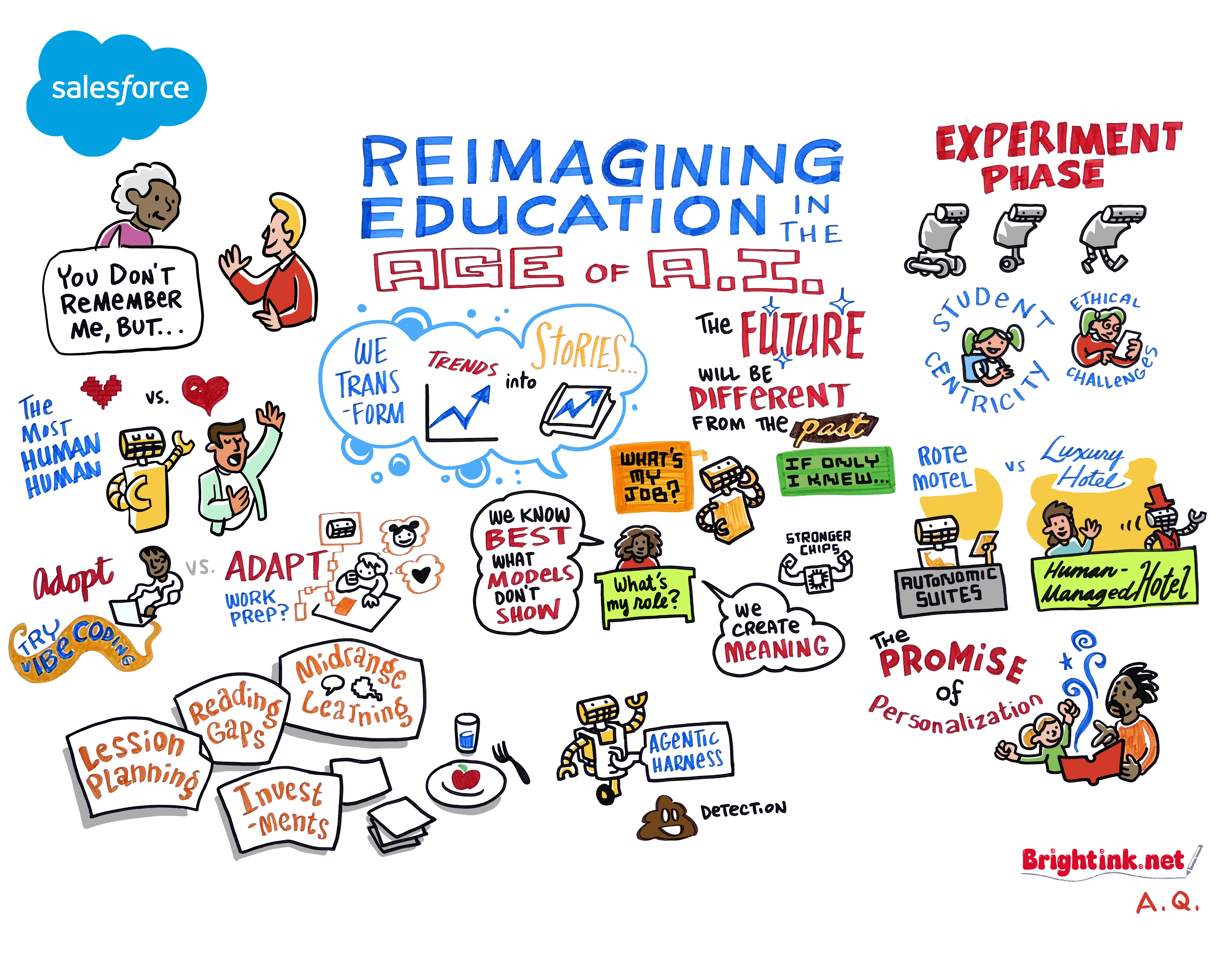
In peer-to-peer conversations, principals shared that many teachers are currently experimenting with AI behind closed doors, often feeling a sense of uncertainty that prevents them from exploring AI out in the open. This also results in more surface-level use cases of AI that don’t actually improve educational experiences for the student or teacher. To move past this, Mick urged leaders to help their staff navigate what he calls AI’s “jagged intelligence.” AI excels at tasks that are legible and specifiable, like drafting text or coding; yet, it struggles with the high-context judgments, ethical nuances, and strategic thinking that define great teaching.
3. By creating “safe-to-fail” spaces for experimentation, principals can move staff from “hidden” AI use to productive, open AI literacy.
As we scale these innovations, our focus remains on ensuring humans and AI agents work together to improve the learning process, not in contention. This requires a robust “agentic harness” – a governance model that addresses bias and student safety while ensuring equal access. Think of this as a harness for a horse, keeping it on track and moving to our destination. The same is true for AI models – we must guide them if we want trusted, reliable AI. Over time these agentic harnesses will become more sophisticated and capable of delivering real world outcomes, but we must be right there at the helm.
That’s especially true for our school leaders as they guide their students in the AI era. By treating middle school principals as the chief innovators of this transition, we are ensuring that the “missing middle” isn’t just keeping up with the present, but actively co-authoring the future.

Today’s middle schoolers, tomorrow’s technology leaders
As I listened to the conversations between principals during our summit, I understood that each of us has a role to play in shaping a better future for our students.
When industry joins forces with the education system, we bring together the critical players necessary to improve educational outcomes that affect us all. Our work improving education and AI reskilling today will have a ripple effect on a more promising future.
Today’s middle schoolers will someday lead Salesforce and the technology industry forward. Let’s give them the right tools for the job.
Support students and staff with Agentforce
With agentic AI and built-in automation, Agentforce 360 for Education empowers institutions to take faster, smarter actions that improve the student and staff experience at scale.