Why Salesforce Shifted to Headless IT Operations (And Ditched the Browser)
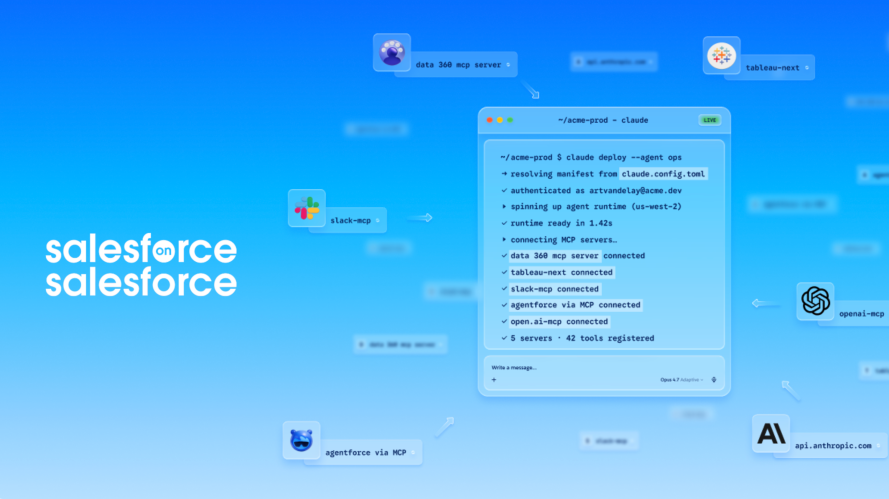
Here’s how Salesforce uses headless IT operations to eliminate browser friction and automate engineering workflows.

Before our products reach our customers, we have built with, tested, and scaled them internally. At Salesforce, we call this principle being Customer Zero.
Like many of our customers, Salesforce IT and engineering teams faced a massive architectural challenge: How do you deliver unified, instant operational workflows to a global, distributed workforce? To keep up with the fast pace of the agentic era, our team of +80,000 employees across the world needed to manage everything from system access and service tickets to critical infrastructure monitoring and project statuses from anywhere.
However, layout fragmentation was creating a massive operational logjam, forcing employees to constantly switch between different web tools, static forms, and browser tabs just to fulfill routine access requests or triage live infrastructure alerts. To break through this friction, our goal was clear: unlock omni-channel automation, eliminate browser-bound context switching, and establish an interconnected ecosystem built to slash manual administrative overhead and give time back to our employees.
The solution? AIforce, which decouples Salesforce’s backend logic from the standard browser UI, letting the platform power any experience (e.g. Slack, mobile, voice, agents) without requiring users to open Salesforce at all.
The employee experience: then vs. today
Historically, Salesforce’s enterprise workflows have been tied directly to screen layouts. If an employee needed to request access to a protected engineering system or open a critical support ticket, they had to navigate separate portals, log into distinct org configurations, or type data into static, multi-field web forms. With AIforce, Salesforce now operates silently behind the scenes as the heavy-duty engine, while the user experience is rendered natively inside Slack, which employees use all day.
“Not every employee spends their day sitting at a desk looking at a standard browser console view,” says Ky Hale, Senior Manager of IT Product Management. “To scale 24/7 IT operations effectively, the application needs to meet the user wherever they are already communicating.”
With AIforce, the IT team successfully decoupled our backend transaction logic and metadata layer from the standard user interface. This creates a unified Slack interface where human employees and digital agents co-work in real time on the exact same records and tasks. This architecture operationalizes our core leadership philosophy: Human Guides, Agents Execute, and Platform Governs.
Unlocking operational velocity with headless architecture
Through AIforce, engineering rolled out two game-changing internal production architectures that redefine the intake pipeline:
Unifying Ticket Support Across Channels
To keep support centralized, Salesforce uses a custom experience front-end called BaseCamp built on a standalone Salesforce org. Using AIforce, this portal securely pulls live data directly from Techforce (our core Service Cloud instance). This same headless engine powers the MyTickets App (a Slack application), which enables employees to request system access or track their ticket progress conversationally through Slackbot. Slackbot uses the Data 360 MCP to automatically determine entitlements and submit requests to backend infrastructure.
This headless intake optimization shifted routine IT queries out of browser dashboards, slashing resolution times from 10 minutes to near-instantaneous automated execution.
Automating real-time triage and minimizing production risk
For internal platform engineers, logging directly into core production orgs just to triage a system alert is risky and slow. To streamline operations, Salesforce built an agentic monitoring system in Slack powered by an autonomous Agentforce instance configured to monitor backend infrastructure health.
Here’s how it works:
- A system alert triggers a dedicated Slack channel thread
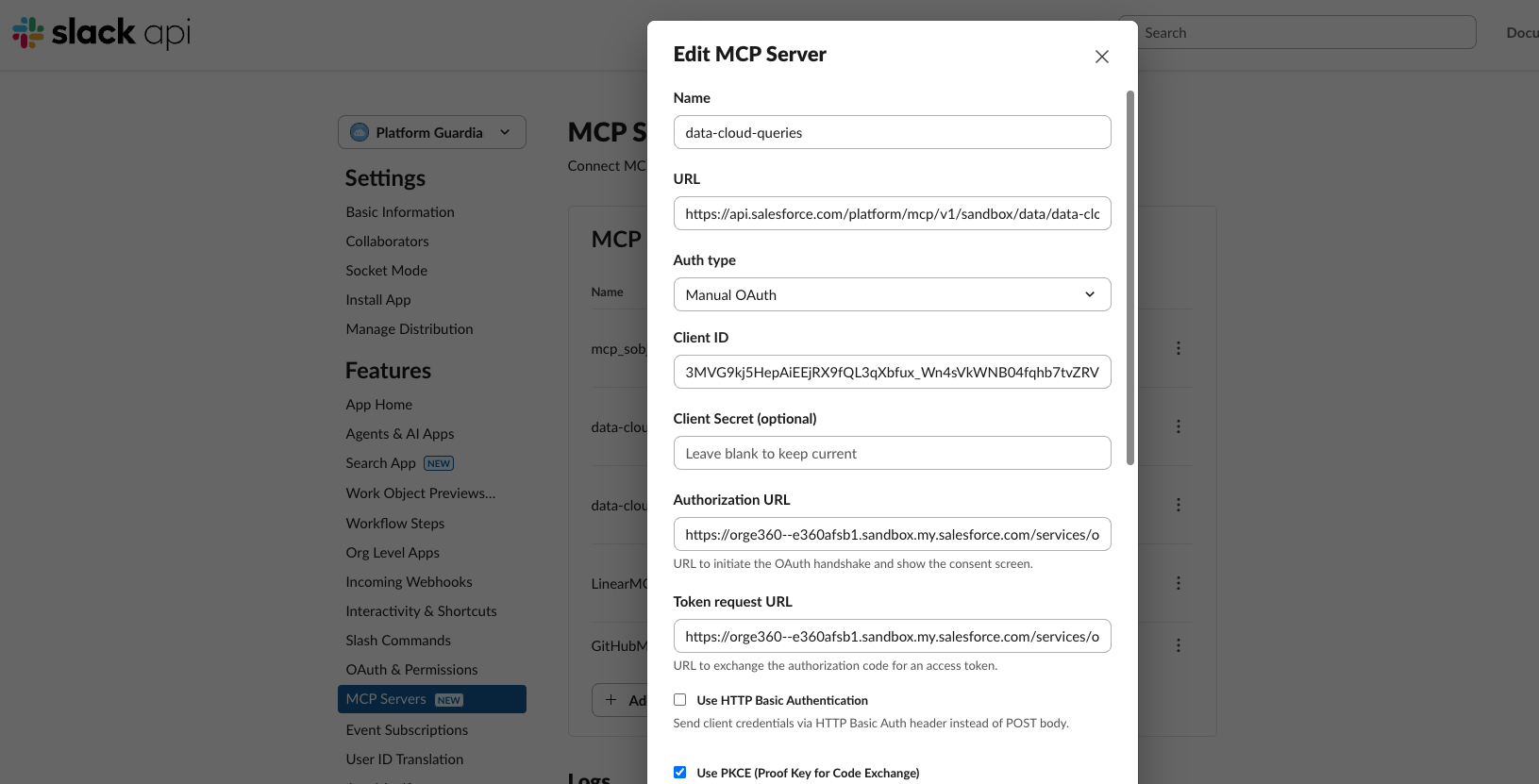
- A custom app creates an enhanced messaging pipeline directly back into Salesforce
- Automated agents and human analysts collaborate directly within the Slack thread, passing real-time system context back and forth without ever opening a browser console.
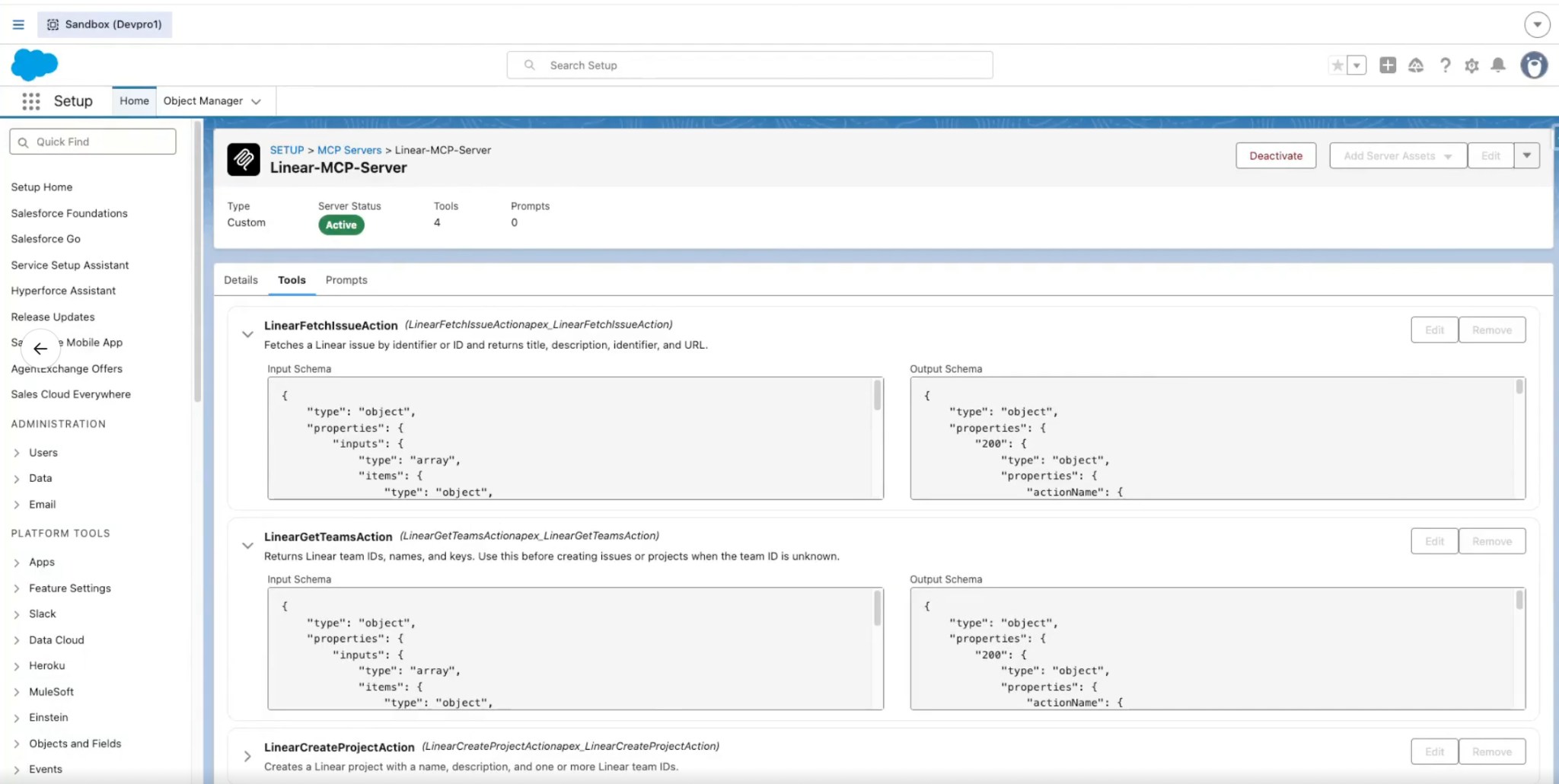
Engineers can conversationally triage platform issues and log them as Service Cloud cases without ever opening a browser or risking production downtime. The system instantly syncs cases with engineering backlogs via the Linear MCP. This creates a seamless, automated loop between IT triage teams and product engineers with zero manual handoffs and over 14,000 engineering hours saved annually.
Safeguarding the agentic lifecycle
With great power (of autonomous execution) comes great responsibility (of comprehensive governance). When giving autonomous agents access to core systems and data, trust is everything. If an agent is able to read data and change records on its own, the testing pipeline must be flawless.
Here’s how we approach securing the agentic lifecycle:
- Before any agent instruction touched production, we needed to know exactly how it would behave across 140+ configurations. Full Copy Sandboxes gave us a 1:1 replica to validate against meaning no surprises at go-live.
- Testing conversational AI requires realistic data. But we can’t hand an LLM real employee PII. Data Mask & Seed lets us create a compliant, realistic playground without ever exposing sensitive records.
- At the transaction volumes headless integrations generate, a single pipeline failure could mean lost data. Daily automated backups and point-in-time recovery give us a clean fallback every time.
Secure, scalable AI delivery starts here
Get the four essential Agent & Application Development stages designed to tackle AI complexity, providing actionable insights and clear guidance so your teams can innovate faster and more securely.



The Customer Zero Impact
By decoupling our platform architecture, we have fundamentally accelerated our internal operational velocity while maintaining an enterprise-grade security posture.
AIforce allows us to build complex backend business rules exactly once and surface them instantly across any channel, whether it’s a Slack thread, a native mobile application, or an external custom web portal.