


Back when I joined Salesforce, one of the first things that struck me was the sheer ambition of our engineering organization. Fifteen thousand engineers shipping software across a portfolio of products that millions of businesses depend on.
To manage operations at this scale, our engineering leadership had built Engineering360: a comprehensive platform that pulled together data from dozens of siloed systems—code repositories, incident logs, deployment pipelines, productivity metrics—into a unified view. Ninety billion records, integrated in real time with Data Cloud, Tableau, and the rest of our stack. We had, at last, a single source of truth. And yet the questions that mattered most still took days to answer. We’ll return to how we solved that shortly…
First, let me use an analogy to explain the relevance and importance of Engineering360.
In 1935, the British Air Ministry asked its scientists for a “death ray” that could knock enemy planes out of the sky. Research scientist Robert Watson-Watt ran the numbers, told them the death ray was hopeless, and offered something better in its place: The same radio waves that couldn’t destroy an aircraft could reveal one, bouncing off its body and returning a faint echo that told you where it was and how fast it was moving. Within weeks his team detected a bomber eight miles off.
Radar was born.
In that moment, nothing new was created. The echoes had always been there — radio waves had been reflecting off objects since long before anyone thought to listen for them. What Watson-Watt built was the layer that made those echoes legible, turning something already present in the air into a picture a person could act on while it still mattered. Five years later, a small team in a control room could watch an entire sky at once, and that changed the course of the Battle of Britain, and ultimately the war.
Most enterprises are living in “the moment right before radar.”
They are saturated with signal — error rates, pipeline movement, contact center telemetry, developer activity — millions of data points an hour. The answer to almost any question they care about is already somewhere in that stream. And still, the insight that could have prevented the outage, prevented the attrition, or saved the account tends to surface in a report a week later, long after the moment to act has passed. The signal is in the air. What’s missing is the layer that makes it legible.
That layer is what makes Engineering360 so much more than a dashboard. We call it operational intelligence.
What Is Operational Intelligence?
Every modern enterprise runs on a continuous stream of operational signals: latency metrics, error rates, request volumes, log lines, infrastructure telemetry, pipeline shifts, the list goes on. That stream of signal is mostly routine. But a small fraction carries the early warning of something that matters: a service degrading, a cost overrun forming, a customer cohort beginning to churn. The value of that insight lies entirely in catching it at the right time.
The traditional way to manage this is the dashboard, where humans monitor, interpret, and decide. That model worked when signal volume was measured in hundreds of rows a day. At today’s scale it starts to break down. A single contact center can generate more telemetry in an hour than any team can meaningfully review in a week. The dashboard shows what already happened; it can’t watch the stream for you.
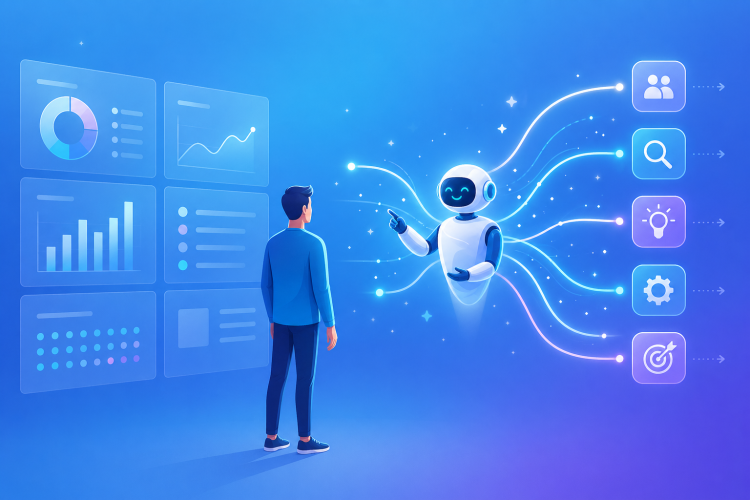
Operational intelligence rests on two capabilities that, together, close that gap. The first is proactive vigilance: the system watches continuously, at machine scale, and surfaces only what genuinely requires a human decision. This is the radar operator’s view — the whole sky at once, with attention drawn to the one track that’s converging. The second is the ability to reason over insight. Up until now, dashboards, like radar, could tell a human what to pay attention to and what the issues are, yet they couldn’t reason over the insights—coudn’t question it, challenge it, interrogate it. This is what our AI Research set out to build: operational intelligence that lets leaders have a genuine conversation about the data, the way they would with a trusted analyst. Engineering360 was our first production example of these capabilities in action.
We’ve been able to push this concept further with two scaled capabilities our AI Research team built: Deep Insights, which reasons over the structured record of the business, and Moirai, our time-series intelligence model which reads how business signals move over time. Together they let a leader do more than receive an answer — they can question it, in plain language, the way they would with their top data scientist.
To understand how this works in practice, let me explain what these two types of enterprise data demand—and why a model trained on language alone will miss both.
Enterprise data is more than language
The AI most people picture every day runs on language. Large language models are trained on an enormous diet of text, and they learn its patterns — which words tend to follow other words — with an increasingly higher level of sophistication. That is what makes them so fluent, and so useful for the work that lives in words.
But an enterprise doesn’t run on language. It runs on its operations: the records, transactions, and metrics that pile up across every system, and the way those numbers move over time. Feed a model raised on text, and you get fluency without understanding of the thing that actually matters. To reason over how a business runs, a model has to be raised on a different diet entirely — the numerical, temporal, structured data of the enterprise itself. That is the science beneath operational intelligence, and it takes two distinct forms.
The first is tabular data: the structured records, transactions, logs, emails, and business metrics that describe what happened across the organization. There is an enormous amount of it, and the hard part has never been collecting it; it’s discovering what it means — what changed, why it changed, where the bottleneck actually is, and what to do next. A dashboard can show the numbers, but it can’t answer those questions on its own. This is the work of Salesforce AI Research’s team’s Deep Insights, a capability that reasons over tabular data the way a seasoned analyst would: analyzing the history, surfacing the trends and anomalies, tracing a result back to its root cause, and recommending the action likely to move the metric. It does automatically, and continuously, what once required an expert and a week of investigation.
A powerful subset of enterprise data takes a second form: time series data — the same kinds of metrics observed as they move through time. Sales trajectories, pipeline movement, product adoption, service demand, infrastructure load: their meaning lives in the rhythm, the seasonality, and the deviation from an expected trend. Reading that signal well is a genuinely different scientific problem, and a model trained on text can’t do it — it was never taught to understand a number as a quantity, or a sequence of numbers as a trend unfolding over time. That is why we built Moirai, a family of models trained the way language models are, but on that different diet: vast amounts of numerical, temporal data.
The result is a system purpose-built for forecasting, anomaly detection, and temporal reasoning. What makes Moirai more than a forecasting engine is that it reads time in context. A conventional model might predict next quarter’s demand purely from last year’s pattern. Moirai combines the temporal signal with the surrounding business context — a planned product launch, a holiday weekend, a major customer renewal, a regional event — so the forecast reflects both the history and what the organization already knows is coming. That same grounding in context lets a leader interrogate the forecast in plain terms, asking not only what the number will be, but why it might move and what happens if they respond.
Together, these two sciences give operational intelligence its reach: Deep Insights to understand the vast tabular record of the business, and Moirai to read the signals that only reveal themselves over time.
Operational Intelligence in the Contact Center: The Future of Customer Service
Beyond Engineering360, a second example lives in an entirely different corner of the enterprise, and it has the time-series edge. Every contact center runs on time: call volumes that rise and fall by the hour, handle times that shift with the mix of issues, staffing that has to be planned against demand nobody can see yet. This is time series data at its most consequential — get the forecast wrong, and the cost shows up immediately as long waits or idle agents.
In partnership with our Service team, we’re applying Moirai inside Contact Center, our cloud contact center platform. It forecasts demand, handle times, and staffing needs directly from the temporal signal, and because it reads that signal in context, its forecasts account for the holiday weekend or the regional event that a conventional model would miss. A workforce planner can go further and ask why demand is likely to spike, or what staffing would absorb it — turning a forecast into a conversation about what to do next.
These two capabilities are at their most powerful together. Our own AIOps — the intelligence that keeps Salesforce’s infrastructure running — draws on both: Moirai to forecast load and flag anomalies before they cascade, Deep Insights to trace an incident back to its cause.
What It Means for the Future of Business
What we’re learning from our own deployments extends well beyond engineering and the contact center. Operational intelligence applies wherever an organization relies on finding patterns across large-scale data, which in practice means everywhere.
In sales operations, pipeline health can be monitored continuously, at-risk deals flagged before a rep notices, and intervention strategies recommended from what has worked in similar situations across the organization — so the forecasting meeting begins with both the problem and a proposed solution already in hand. In marketing, campaign analysis moves past reporting what worked to explaining why it worked, correlating engagement, timing, audience, and external signal to show where to double down and where to pivot. In supply chain and manufacturing, the same temporal models that forecast contact center demand can detect a demand-signal shift weeks before it cascades into an inventory shortage, giving operations leaders the one thing they can never manufacture: lead time.
The common thread is straightforward. Operational intelligence converts the data your enterprise already generates into decisions your leaders can act on; continuously, proactively, and at the speed the business actually moves.
For enterprise leaders, this marks a real shift in how organizations learn from their own data — moving from periodic reports and quarterly reviews toward continuous, intelligent analysis that runs at the speed of the business itself. Operational intelligence brings these capabilities into a single, continuous operating layer, giving enterprises the ability to understand their operations in real time, anticipate what’s coming, and act with confidence.
The organizations that embrace it will make better decisions, make them faster, and keep their best people focused on the work only humans can do. This is a new form of AI, purpose-built for the enterprise. The signal was always in the air. Now, at last, we can see it.
—-
I would like to thank Alex Hu, Gautam Vasudev, Doyen Sahoo, Junnan Li, Jacob Lehrbaum, Itai Asseo and Karen Semone for their insights and contributions to this article.