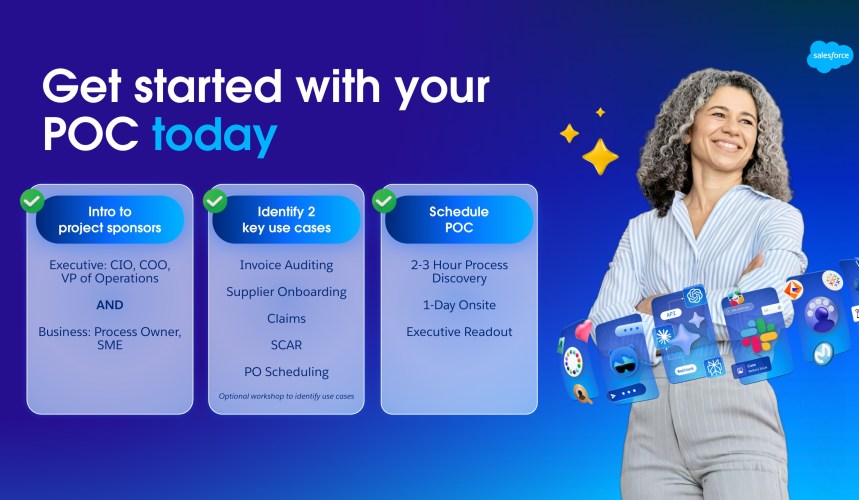

You’ve sat through a proof of concept before. You know how they usually go. A fancy deck. Canned data that has no resemblance to your actual work. A 12-week cycle that quietly disappears into someone’s desktop folder.
The POC for Agentforce Operations (AFO, formerly Regrello) works differently. First, our process experts work with you to understand your biggest process bottlenecks, what metrics matter to you, and how your processes work today. Then, we come onsite and build together. In a single day, we co-build processes in Agentforce Operations that will drive value for your business immediately. By the time we leave, those processes are running in AFO and ready to pressure-test so, you get to see if the technology delivers as promised, no commitments. In a week, we’ll share a readout from the POC with real metrics and a phased approach to scaling. If you choose to move forward, you already have the start of your implementation.
Here’s why that matters now. Your back-office and supply-chain operations are paced by the wait states between fragmented systems — the manual emails, spreadsheets, and human routers stitching everything together. That’s where money sits, decisions stall, and time gets lost.
AFO is the operating layer underneath that work — a set of specialized agents that handle the back-and-forth, escalations, and decisions your teams currently do by hand. It’s broader than a point solution, which is why the best way to evaluate it is to watch it run on your own processes — and that’s what the workshop gives you.
Five reasons it’s worth your day.
1. One day
Traditional proof-of-concept cycles take a full quarter before they produce anything you can pressure-test. Ours takes a single day.
Prep is light. About 90 minutes to two hours of discovery per use case in the lead-up, plus a dozen sample documents, such as invoices. No system integrations or infosec assessment until your security team requires it as part of moving to production.
The day itself runs in three parts. The first hour orients your team to the AFO interface with our Building Blocks walkthrough. Most of your attendees will be logging in for the first time, and they’re building from minute one. From there, your team spends roughly 90 minutes to two hours on each of your two pre-selected processes. You edit, you test, you act as the end user. The last two hours stay flexible. Some teams use the time to identify additional use cases that will drive immediate value — many leave with a roadmap of close to ten. Others bring in our customer success team for a longer-arc conversation.
2. Free
If you can spend the day, that’s the whole price. Salesforce comes to you. You’ll have a solution engineer (SE), a process consultant, your account team, and often your implementation partner in the room. We bring lunch.
3. Your real processes, on sample data
We use your exact processes. Your real PO confirmation flow or supplier qualification process, for example.
The table below shows four common starting points across our customers. We’ll help you pick two that will prove significant ROI after implementation.
| Process | Bottom-line impact |
| Supplier qualification | Onboard suppliers in hours instead of months, with consistent and auditable decisions that reduce regulatory exposure. |
| PO confirmations and rescheduling | Free trapped working capital and prevent expediting cost spikes by catching unconfirmed POs and rescheduling against real demand. |
| Invoice audit | Eliminate revenue leakage and fraud risk by catching duplicate payments and overpayments before they post. |
| Claims and damage reporting | Resolve claims faster and stop revenue leakage from inventory shrinkage and write-offs. |
For data, we use sample sets that mirror the structure of your real ones. This is practical, since live customer data triggers a full infosec assessment that takes weeks, which would delay the workshop. Sample data sidesteps that timeline without compromising the build. Since the process you build is real, swapping in your live data after you sign is straightforward and doesn’t require a rebuild.
4. Walk away with 70% built
By the time we leave, your team has roughly 70% of two real use cases built in AFO, configured on your actual processes and tested against sample data. You’ll also walk away with three weeks of continued platform access and two demo videos built around your processes. Those are the artifacts your sponsor takes into a board or steering-committee conversation in the same week.
What happens after week three? Configurations port directly into a paid AFO org if you proceed.
If you need more than three weeks to decide, we can keep the workshop environment available longer so the work your team built doesn’t disappear.
The remaining 30% is mostly integrations and live data. One or two pieces stay open on purpose — say, an approval threshold, a routing rule, or an escalation matrix — and we change them live during the executive readout. Your leadership team sees how fast an agent’s behavior can be modified in real time. That’s usually what makes the strategic case land.
The teams that get the furthest are the ones who stay logged in after we leave.
5. A clear path to ROI
On top of the build itself, you walk away with a custom value analysis built on your numbers and a phased scaling plan.
If you decide to move forward, you’re picking up two processes that are already 70% built, with the security and integration questions already mapped. The post-workshop executive readout hands your sponsor a fully scoped business case to bring to their next decision conversation.
When leaders watch a process that used to take days of manual handoffs come together in an afternoon, they start picturing what their teams could do with that time back. The conversation shifts from “is this real” to “where do we start.”
Who this is built for
The companies that get the most out of an AFO workshop are the ones whose back-office and supply-chain operations run on human connective tissue — where wait states between fragmented systems are setting the pace of the entire business. Supplier qualification, PO confirmations and rescheduling, claims handling, invoice audit, order variance, change management. If your operations leadership can name a process that drags on for weeks because it’s stitched together by humans and email, that’s a candidate for the day.
Across customers who’ve moved from workshop to production, the gains we see most often hit the bottom line. One customer redesigned invoice verification and reported $40 million in savings. Another reached 85% automation of supplier onboarding. A third saw 45% automation of order-variance and change-management work, with 40% reductions in manual workload inside the first quarter. Cycle times come down by as much as 77% along the way.
These are outcomes from teams that started with two processes and a single day.
Get a POC on the calendar
Here’s the short list of what we’ll ask of your team — most of it handled in two or three pre-workshop calls.
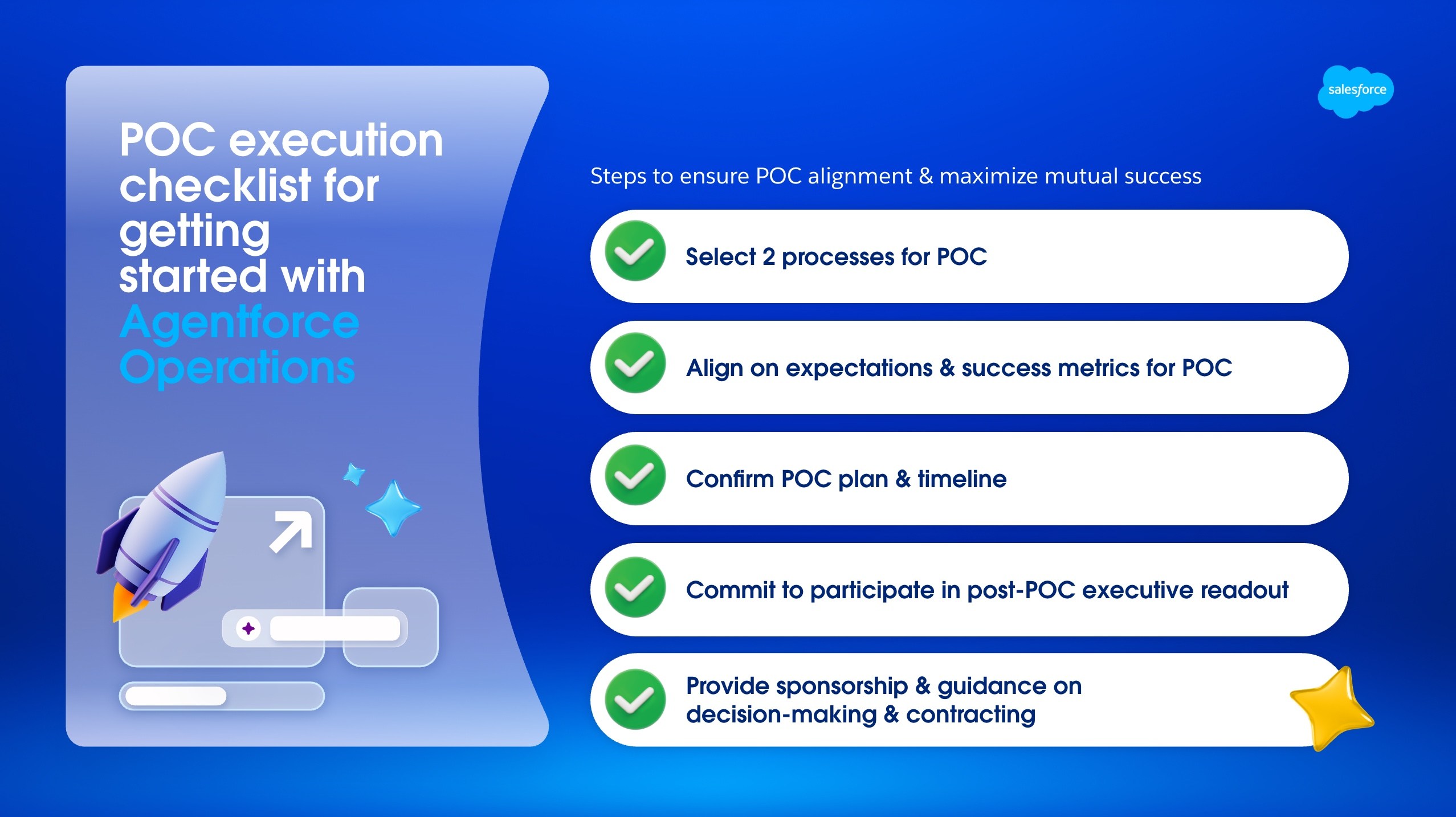
If that sounds like a reasonable trade for a day, ask your Salesforce account team to connect you with the Agentforce Operations team. We run the qualification, the executive scoping conversation, and the workshop ourselves, then come back to you with a date.
You’ll know by the end of the day whether AFO belongs in your 2026 roadmap. We’d rather you find that out in a day than a quarter.