
Key Takeaways
Have you heard of “spaghetti marketing”? Throwing marketing dollars at the metaphorical wall and hoping for the best? Or maybe you’ve heard of “web marketing”, where you just toss a really big marketing campaign net out there and hope to catch a few leads? There’s a better way to market your business. Now, artificial intelligence (AI) is here to help you stand out — with data, not hopes and nets.
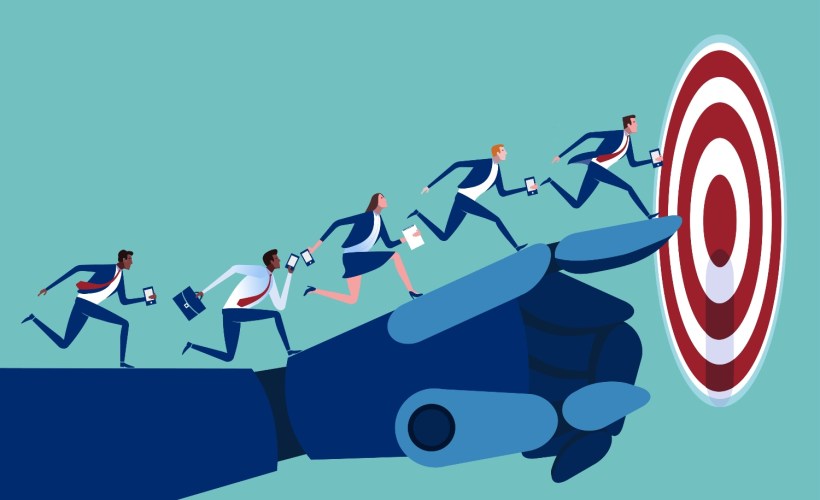
This is the art of AI audience targeting. With AI you don’t just know who your customer is; you can predict what action they’re going to take next, allowing you to serve the right recommendation to the right person at precisely the right moment. Targeting your audience with AI is the start of focusing on the customers who truly matter. Ready to learn about AI audience targeting for your small team? It’s not complicated, we promise.
What is AI audience targeting?
AI audience targeting is an advanced marketing technique that uses machine learning to identify, segment, and reach the most valuable potential customers for your business.
Traditional audience targeting relies on structured data, that is, tabulated data on spreadsheets and in other sources. AI takes targeting to the next level by processing vast amounts of both structured and unstructured data — from tabulated customer and third-party data to real-time trend reports written in natural language — to create incredibly precise, dynamic customer profiles.
And that’s not all. Instead of defining an audience as “women aged 25 – 35 interested in fitness,” AI takes this a step further by making grounded predictions about what a customer might do next. Using both structured and unstructured data, it can identify individuals who have, for example, visited a specific product page three times this week, abandoned a cart containing a certain item, and engaged with a competitor’s ad on Instagram within the last 24 hours. It can then relay this information back to you in natural language, so you don’t have to guess what the data might mean.
AI Tools for Small Business


How does AI audience targeting work?
AI audience targeting works on a continuous cycle of data collection, analysis, and execution. It starts by gathering a huge amount of customer data from every source. Here are just a few:
- website clicks and heatmaps
- purchase history
- email engagement metrics
- service interactions
- social media behavior
- market trends
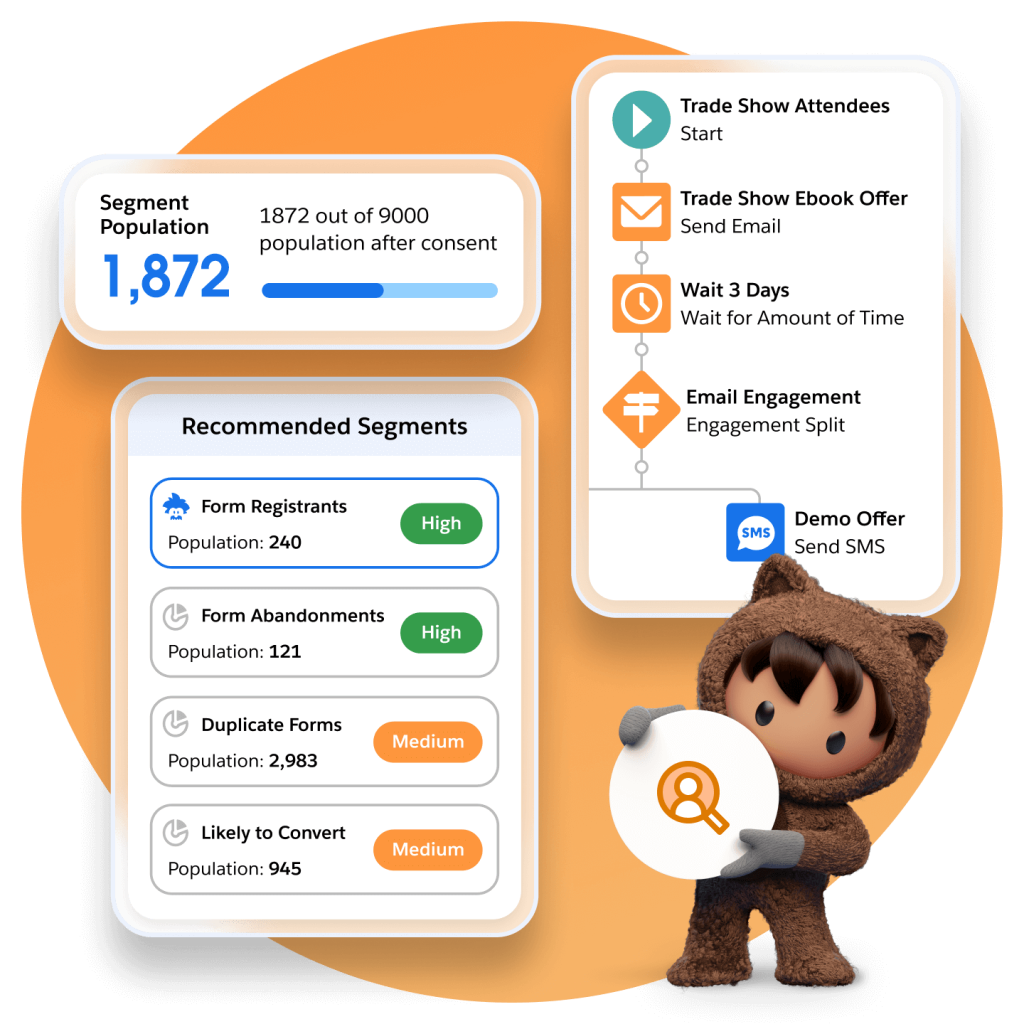
Machine learning algorithms analyze this data, finding complex patterns that human analysts miss. These patterns are used to segment your audience much more precisely than simple demographics, creating specific groups based on predicted behavior, like “likely to buy product X soon” or “might stop being a customer after a service issue.”
The next phase is activation. The AI platform automatically pushes these dynamic segments to your various marketing channels like ad networks, email platforms, or websites. For instance, a customer identified as a “high-intent browser” might instantly see a targeted ad on social media and a personalized product recommendation on your homepage.
The system doesn’t stop there — it continuously monitors the performance of these targeted campaigns, using the results (conversions, clicks, email opens) as feedback. This real-time feedback loop allows the AI to self-optimize, constantly refining its audience segments and targeting strategies to improve return on investment (ROI) without constant manual intervention from your team.
How can you integrate this into your business?
To put this into action, businesses rely on a customer relationship management (CRM) system. A CRM like Salesforce is important because it acts as the centralized data hub, aggregating all the disparate customer information. For example, a CRM’s AI capabilities can take service case data, combine it with recent website activity, and automatically flag a customer who’s both frustrated and exploring a competitor’s product.
This allows the system to trigger a targeted, personalized retention email or alert a sales rep with a proactive offer. Without a centralized, unified CRM, executing this level of integrated, precise targeting across the customer journey would be nearly impossible for a small team.
5 Steps to Implementing AI Agents for Small Businesses
Learn how to get your AI agent up and running in no time with this free e-book.

Thank you for downloading the free e-book!
Here's your free e-book!What does it mean for small businesses?
For small and medium businesses (SMBs), AI audience targeting levels the playing field against larger competitors with massive marketing budgets. Historically, advanced targeting was cost-prohibitive or too complex for an SMB to manage. Now, integrated AI features in modern CRM platforms put this power directly into the hands of small business owners.
It means moving from spray-and-pray marketing to surgical precision. With limited resources, every marketing dollar counts. AI ensures your ads, emails, and promotions are seen by the people most likely to convert, maximizing your ROI. It allows a small team to manage complex segmentation and personalization that would be impossible manually.
AI audience targeting enables small businesses to:
- Focus ad spend: Stop wasting money on uninterested audiences.
- Personalize experiences: Deliver messages and offers that feel unique and relevant to the individual customer.
- Predict future needs: Anticipate what customers want before they even know it, aiding in inventory, service, and product development.
Benefits of AI audience targeting
Harnessing AI for audience targeting delivers tangible advantages across your entire business portfolio: sales, marketing, service, commerce, and productivity.
Increased marketing efficiency and ROI
AI automatically identifies the optimal channels, times, and content for reaching different segments, significantly improving campaign performance. By predicting the likelihood of a customer purchasing or unsubscribing, AI helps allocate budget where it will have the greatest impact.
Deeper customer understanding
AI analyzes interactions across all touchpoints, building a 360-degree view of your customer that is far richer than static profiles. This deep insight allows for micro-segmentation, creating small, highly relevant groups based on behavioral cues and intent, not just demographics.
Enhanced personalization and customer experience (CX)
Personalization goes beyond addressing a customer by name. AI allows you to personalize the entire journey:
- Marketing: Dynamic content in emails or ads based on browsing history.
- Commerce: Personalized product recommendations on your online store.
- Service: Routing high-value customers to priority support agents.
- Sales: Providing sales teams with AI-driven next-best-action recommendations.
Wherever you are — just get started.
No matter where you are on your journey as a business owner, you can get started with Starter Suite for free — the CRM made for growth.

Improved sales forecasting and productivity
By identifying high-potential leads, AI improves the quality of your sales pipeline. This means your sales team spends less time chasing dead-ends and more time closing deals. For productivity, AI automates the segmentation and targeting process, freeing up your team to focus on strategy and creativity.
Tools to try for your own targeting campaign
To effectively use AI audience targeting, you need a CRM that can collect and process all your customer data.
Salesforce AI CRM
For small businesses, Salesforce provides integrated CRM and AI capabilities designed to scale with your growth. With built-in AI features, you can use your existing customer data to perform complex segmentation and prediction tasks automatically. With Starter Suite or Pro Suite you can:
| CRM FEATURE | AI AUDIENCE TARGETING CAPABILITY |
|---|---|
| Predictive lead scoring | Ranks leads based on their conversion likelihood, helping prioritize sales |
| Customer journey mapping | Uses AI insights to identify customer touch points and automate interventions in action. |
| Personalized Commerce recommendations | Delivers customized suggestions across commerce and marketing channels, including ecommerce stores. |
| Automated marketing segmentation | Creates audience segments dynamically based on real-time behavior (like cart abandonment). |
| Integrated Slack and collaboration tools | Boost productivity and team communication with Slack integration. |
Agentforce Marketing Quick Guide
Get the free guide and start targeting smarter with Agentforce Marketing today.
Expert tips for getting started
Start small with lookalike audiences: If you have a small list of your absolute best customers, use AI tools to generate “lookalike” audiences, or new, potential customers who share key characteristics and behaviors with your existing successful customers.
Focus on intent data: Pay attention to customer actions that signal intent, like price-page visits, white paper downloads, or frequently asked questions (FAQs). Target these users with specific, timely calls to action (CTAs).
Test AI-driven subject lines: Use AI to generate and test email subject lines and ad copy. AI can quickly determine which language resonates best with different audience segments, optimizing your open and click-through rates.
Embrace service data: The data from your service interactions (case resolution time, frequently reported issues) is gold. Use AI to segment customers who may be at risk of churn based on their service history and proactively offer retention campaigns.
Get your data ready for AI with Salesforce Foundations
Easily activate Foundations in your existing CRM to add key features in Agentforce 360, Sales, Service, Marketing, Commerce, and Data — all for free.


Ready to target smarter? Here are your next steps
AI audience targeting is no longer a luxury for companies; it is a key strategy for small businesses looking to maximize their marketing, personalize their customer experiences, and grow fast. By using the power of AI targeting, you move past guesswork and start communicating directly with customers ready to buy. The future of marketing is targeted. Are you ready?
Start your journey with the Free or Starter Suite today. Looking for more customization? Explore Pro Suite. Already a Salesforce customer? Activate Foundations to try out Agentforce 360 today.
AI supported the writers and editors who created this article.
Frequently Asked Questions (FAQs)
Traditional targeting relies on broad demographics and historical data to create static segments. AI audience targeting uses machine learning to process massive, real-time data points (like website clicks, purchase intent, and service interactions) to create dynamic, hyper-precise customer segments based on predicted behavior, not just past actions.
No. While historically complex, modern, integrated CRM platforms like Salesforce Starter Suite have made AI audience targeting accessible and affordable for SMBs. It maximizes the impact of every marketing dollar by eliminating wasted ad spend on uninterested audiences.
AI uses a wide variety of data, including first-party data (website behavior, purchase history, email engagement, service logs) and third-party data (social media activity, external market trends). The key is centralizing this data in a CRM system, which allows the AI to build a comprehensive, 360-degree view of the customer.
AI enhances the entire business portfolio. For sales, it improves forecasting by accurately scoring leads and prioritizing those with the highest conversion likelihood. For service, it identifies customers at risk of churning based on service history and proactively flags them, allowing your team to launch personalized retention efforts or prioritize support.
The essential first step is adopting a unified, data-centric platform, such as a CRM like Salesforce Starter Suite or Pro Suite. This system centralizes your customer data, which is the fuel for the AI’s predictive models.