Today’s Lesson Plan: How Students — And Teachers — Are Becoming AI Literate

On a chilly December morning in Oakland, California, Amy Castillo, a computer science teacher at the United for Success Academy, stood in front of an eighth-grade class and asked whether LLMs could be their friends.
She pointed to a large screen, where a series of questions appeared in English and Spanish, and instructed her students to list the characteristics of a good friend in their composition notebooks. “Do you think it’s a good idea or a bad idea to use LLMs as friends?” she asked.
“It’s a good idea if you’re too shy to talk to people,” one boy said. Another said, “Maybe it can help you understand what you’re feeling.”
Castillo then introduced the class to Eliza, a chatbot developed in the 1960s by MIT to simulate a psychotherapist. She told the students to ask Eliza, which was installed on their Chromebooks, for help with something they were dealing with. Pay attention to whether Eliza feels real, she said. As the students interacted with the virtual therapist, they discovered that Eliza varied her answers based on how they worded their questions and what grammar they used — which was different from how a human friend would respond.
The exercise was part of an AI literacy unit that the Oakland Unified School District (OUSD) is piloting during the 2025-2026 school year. The idea: to teach students how artificial intelligence (AI) works and how to use it responsibly. It’s also a way for teachers to address growing concerns that students are off-loading learning to AI without fully understanding what that means.
The unit was developed by OUSD teachers and staff, using resources from Code.org, Common Sense Media, and MIT’s Everyday AI, and funding from Salesforce. That funding came partly through the Kapor Foundation, which works to expand access to K-12 computer science programs, and receives financial support from Salesforce and other organizations. Oakland’s districtwide computer science program itself was made possible by Salesforce, which donated $13 million to San Francisco, Oakland, and New York City schools last year.
“Strong communities of the future start with public education, and our mission is to help through the lens of math, computer science, and AI,” said Ron Smith, vice president of education and workforce development at Salesforce.

Why it’s so important to teach AI literacy
AI is reshaping both society and the workforce. If young people want to excel when they enter the professional world, schools need to prepare them now.
It’s true that most middle schoolers are way more adept at using LLMs like ChatGPT, Claude, and Gemini than the adults in their lives. “But does every student know how to use it responsibly? Do they know how to use it strategically? And most importantly, does every student know how to use it as a learning tool?” said Kyla Trammell, superintendent emeritus of the OUSD.
Since the release of OpenAI’s ChatGPT in 2022, there’s been a big push to include an AI literacy curriculum in schools. Classrooms across the U.S. are getting on board. In New Jersey’s Passaic school district, all K-8 students receive lessons on coding and on how AI is trained. Meanwhile, in Maryland’s Washington County school district, sixth- to 12th-graders learn about AI through the lens of digital citizenship — the responsible, ethical, and safe use of technology.
What’s your agentic AI strategy?
Our playbook is your free guide to becoming an agentic enterprise. Learn about use cases, deployment, and AI skills, and download interactive worksheets for your team.


How Salesforce supports local schools
Salesforce is paving the way for students and educators to thrive through STEM and AI education, mentorship, and career-aligned learning. And now, with Agentforce, we’re empowering schools and organizations to help students succeed in an AI-driven future — faster than ever before.
The computer science program at United for Success Academy is just one of the ways Salesforce shows its commitment to San Francisco Bay Area schools — a commitment that grew out of a conversation Salesforce CEO Marc Benioff had with former San Francisco mayor Ed Lee 13 years ago. Benioff wanted to support his hometown and asked Lee what he needed most.
The city’s middle schools were strapped for resources, Lee said, so Salesforce created the Principal’s Innovation Fund (PIF), a $100,000 grant given annually to middle school principals to use as they see fit, as long as it supports academic achievement.
The San Francisco Unified School District (SFUSD) has used the funds for math coaches, counselors, teacher stipends, and field trips. Oakland has used it for computer science programs, math tutoring, and teacher support. Forty Bay Area middle schools received grants for the 2025-2026 school year.
Salesforce also helps high school students by partnering with several nonprofits, including The Hidden Genius Project and College Track.
Hidden Genius is an Oakland-based nonprofit that trains and mentors young Black men in tech, entrepreneurship, and leadership skills, to launch them in tech careers. College Track is a 10-year program that helps students with limited resources get into college and complete their education to earn a four-year degree.

Training teachers is the key to AI literacy in schools
Salesforce is also working to support AI literacy in schools — and that starts with teachers. “The conversation around AI literacy in schools is still so new that one of the best ways we can support students is by providing training for teachers,” said Salesforce’s Smith. That’s why Salesforce partners with the AI Education Project (aiEDU), a nonprofit that helps districts, administrators, and teachers become AI-ready. It offers teachers workshops on everything from AI basics to how to address integrity and cheating.
Christian Pinedo, aiEDU’s vice president of external affairs and advocacy, said the organization places a big focus on helping educators “adjust teaching practices in a world where tech is really prevalent.” A teacher attending a workshop, for example, might learn how to assign homework so that kids still have to do the work. For an essay on Shakespeare, the teacher could require students to submit all their drafts and then ask, “Why did you choose this thesis?” or “Why did you make these editing choices between draft one and two?”
“For teachers who’ve been in the classroom 10 years or more, this has been an overnight shift,” said Chris Armentrout, director of policy and planning with the SFUSD. “Students are a lot more AI-savvy because they’re digital natives, but the questions for educators are: How do we keep up with students and continue their education so they get the basics they need, and not see AI as an end run?”
To learn more about how nonprofits are helping students and teachers acquire AI skills, watch this 2025 Dreamforce session:

The AI issues teachers think about most
In addition to teacher workshops, aiEDU offers three- and six-month cohorts where instructors can connect with one another and trade AI practices. Pinedo said a few common threads come up again and again in these cohorts.


Free AI literacy resources for teachers
It’s not just Bay Area educators — or recipients of Salesforce grants — who need access to AI literacy programs. Luckily, there are free resources teachers can use. Here are three:
- Common Sense Education’s AI literacy curriculum. This nonprofit, which reviews media and technology to determine its suitability for children, has created a series of ready-made lessons on AI literacy such as How Is AI Trained? and How AI Bias Impacts Our Lives. The nonprofit also offers an AI Basics for K-12 teachers course.
- Stanford University’s Classroom-Ready Resources About AI for Teaching program. The CRAFT program offers free resources for high school teachers “to help students explore, understand, question and critique AI.” Designed by the Stanford Graduate School of Education and the Institute for Human-Centered AI, it uses a multidisciplinary approach so teachers of all subjects can incorporate AI into their lessons.
- aiEDU’s free resources for educators. In addition to its professional development courses and teacher cohorts, aiEDU provides free resources including a 10-week Intro to AI course that can be used in classrooms, and a one-page tip sheet on Cultivating Critical Thinking: Guidelines for AI Use in the Classroom.
AI is moving faster than educators can keep up
Even with all the available resources, educators are still concerned that AI is moving faster than schools can keep up. “Teachers are frustrated with how slowly education changes, and they’re concerned that the world kids are in today isn’t always reflected in their classrooms,” said Pinedo.
Many schools are still trying to craft an AI strategy. “We’re very much in the early stages of trying to figure this out,” said Armentrout. In early 2025, San Francisco public schools created an AI task force. Oakland schools created an AI working group in 2023, but it was on hiatus last year as the group waited to have its AI policy approved by the school board.
Still, teachers and schools are moving forward. aiEDU trained more than 2,500 teachers in California alone in 2025. And a recent Rand survey found that roughly half of school districts in the U.S. have provided generative AI training for their teachers — double the number of the year before.

How you can help boost AI literacy in schools
Kids who want to succeed in the future need to learn about AI today. Here’s how you can help:
- Educate yourself about the technology so you’re familiar with the tools and the issues.
- If you’re a parent or guardian, visit your child’s school, ask if it has an AI strategy, whether the school is supporting its teachers to learn about AI, and how you can help.
- You can also ask whether your school or district has an AI committee you can join to share your knowledge and ideas.
One day, kids like Amy Castillo’s students will thank you.
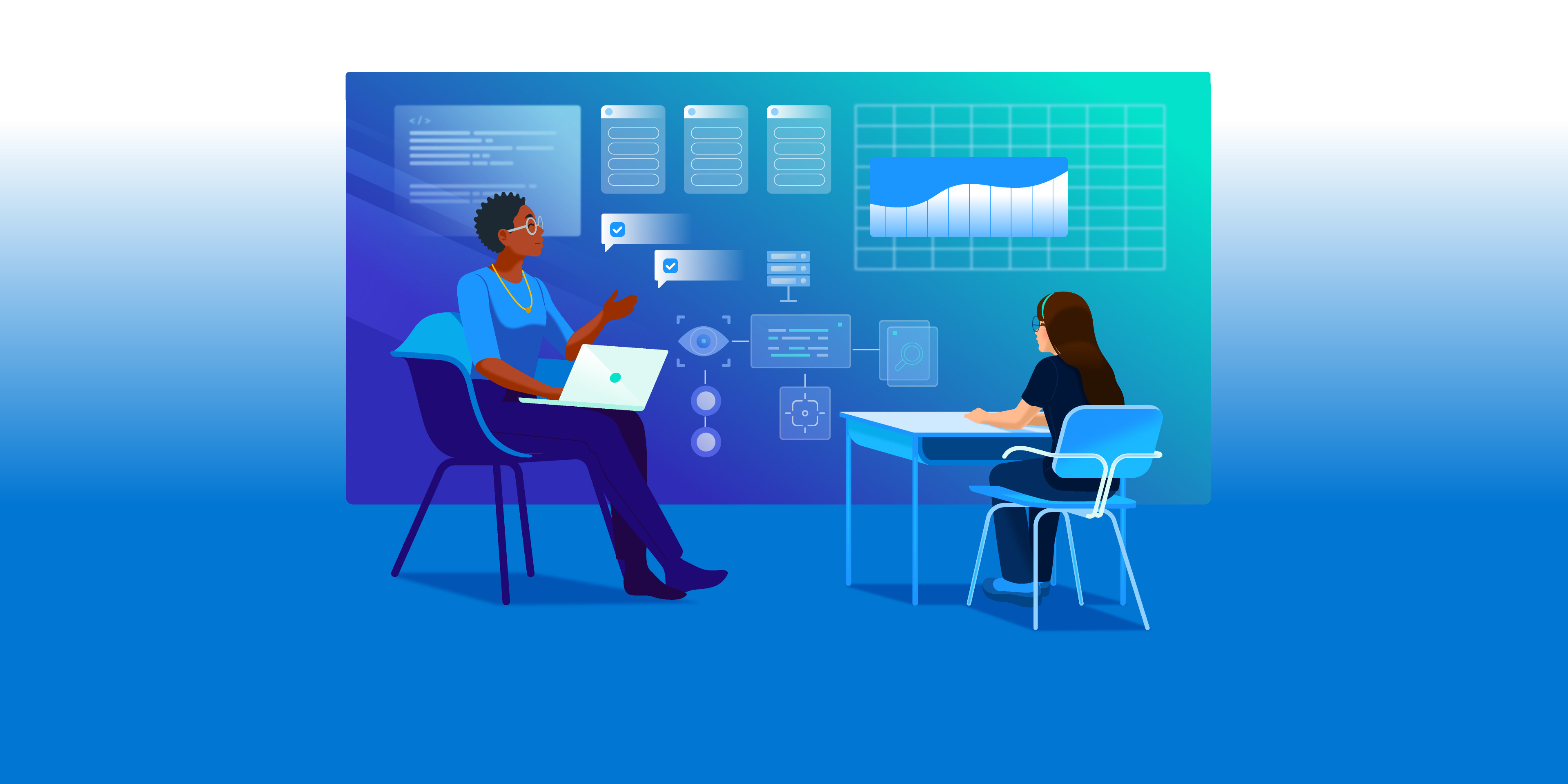
[Image credit: Aleona Pollauf/Salesforce]