


If you’re a small or medium business (SMB) owner, you’re probably asked this question quite a bit: what’s the AI strategy for your business? This question implies that if you don’t have a business strategy in place for artificial intelligence (AI) tools and systems, it’s time you had one – because it equips your SMB or startup for growth today. In this article, you’ll learn all about an effective AI strategy, and the top tips to develop one easily.
What is an AI strategy for small business?
An AI strategy for a small business is a focused plan that integrates smart tools and technologies into specific business processes to achieve measurable objectives, such as boosting productivity, enhancing the customer experience, or reducing operational costs. Unlike enterprise strategies, this strategy is more practical, and focuses on adopting affordable, off-the-shelf AI solutions (like a customer relationship management (CRM) tool) to manage all business data, address pain points, automate repetitive tasks, and data analysis.
An AI strategy for a small team would typically begin with identifying where it can save you time and money, so you can focus on growing your business and building customer relationships. Think of it as picking the right tools to manage the right jobs to be done. This could involve automating repetitive tasks, improving customer service through AI agents or AI-powered self-service portals (online platforms that address common customer concerns), or making data-driven decisions.
Benefits of having an AI strategy for smaller teams
According to Salesforce’s latest Small and Medium Business Trends Report, 78% of SMB leaders say that AI will transform their business operations. For an SMB, every hour and dollar counts — and that’s why a thoughtful AI strategy becomes your competitive advantage. When your AI strategy works, it leads to results like the following:
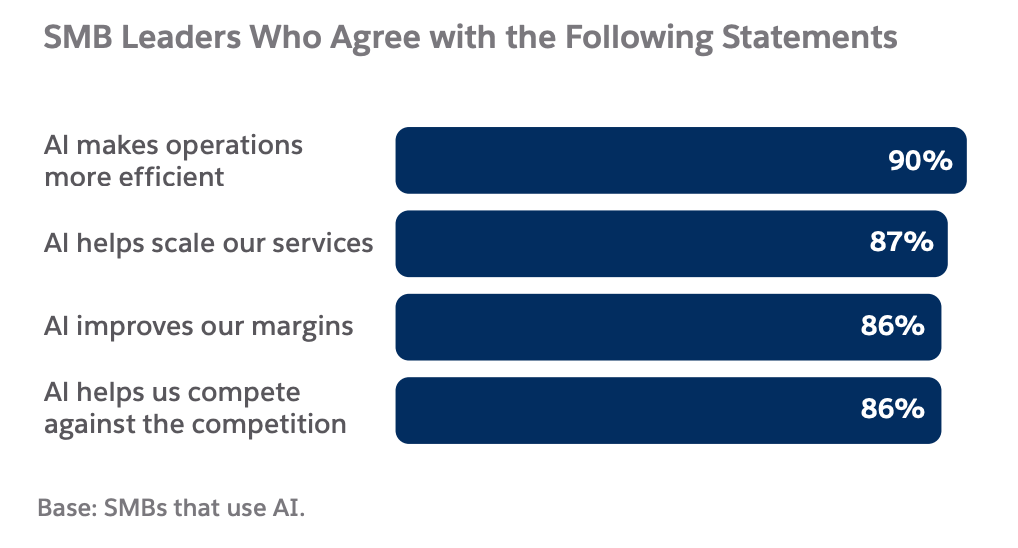
Here are the benefits of an AI strategy:
AI Tools for Small Business


- Aligns your goals: It acts as a roadmap for your AI adoption and enables it to support your core business goals. This keeps everyone on the same page.
- Boosts productivity: Your AI strategy helps identify your biggest, most repetitive pain points. This way, your time and budget are spent on practical AI tools that your team will use to boost productivity and improve business operations.
- Manages risk and ethics: An AI strategy outlines basic guidelines for data privacy, bias avoidance, and transparency with customers about AI usage. This builds your reputation and trust early on.
- Scales operations organically: It provides a defined plan for when and how to implement “next-level” features, like moving from simple automation to complex predictive analytics. This gives you clarity and better control over planning.
Common mistakes that kill an AI strategy
Even with the best intentions, many SMB owners stumble when implementing AI because they fall into predictable traps. Here are a few pitfalls to avoid:
Chasing shiny objects without a plan: Jumping on every new AI trend without thinking if it solves a real problem can lead to employee frustration and money wastage.
Underestimating change management: Rolling out AI tools without training your team or explaining how it helps them can lead to resistance, poor adoption, and tools that sit unused despite your investment.
Ignoring ethical and bias considerations: AI learns from data, and if that data reflects biases, and if you aren’t honest with customers about how you’re using their data, you could lose their trust and even run into legal problems later on.
Expecting magic overnight: AI is just like hiring another team member: it takes time to integrate, train, and optimize every tool. This is why investing in the right tool is the best strategy.
Copying enterprise strategies that don’t scale down: What works for a Fortune 500 company with huge budgets and big tech teams won’t work for SMBs. Your strategy should solve your unique challenges.
5 Steps to Implementing AI Agents for Small Businesses
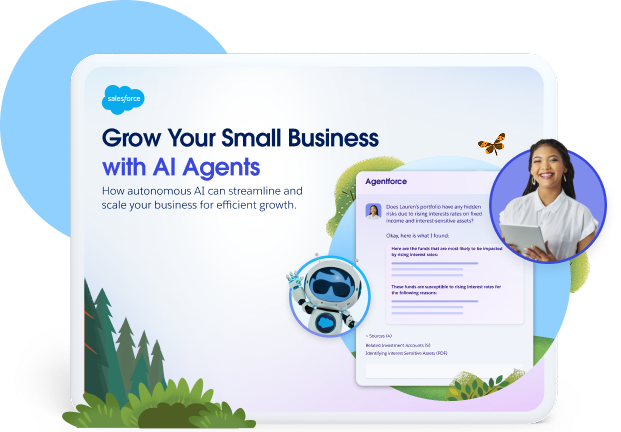
Learn how to get your AI agent up and running in no time with this free e-book.

Thank you for downloading the free e-book!
Here's your free e-book!Top 6 tips to implement an AI strategy for your startup
And now, you’re all set to move from “should we use AI?” to “which AI tools will be best for me and my business?” These six battle-tested strategies will help you implement AI the best way for business:
1. Start with high-impact, low-risk use cases
Don’t try to change your entire business on day one. Instead, select an area where AI can make a significant impact without disrupting your operations. Ask yourself: “What tasks can we automate and how can we better the customer experience?”
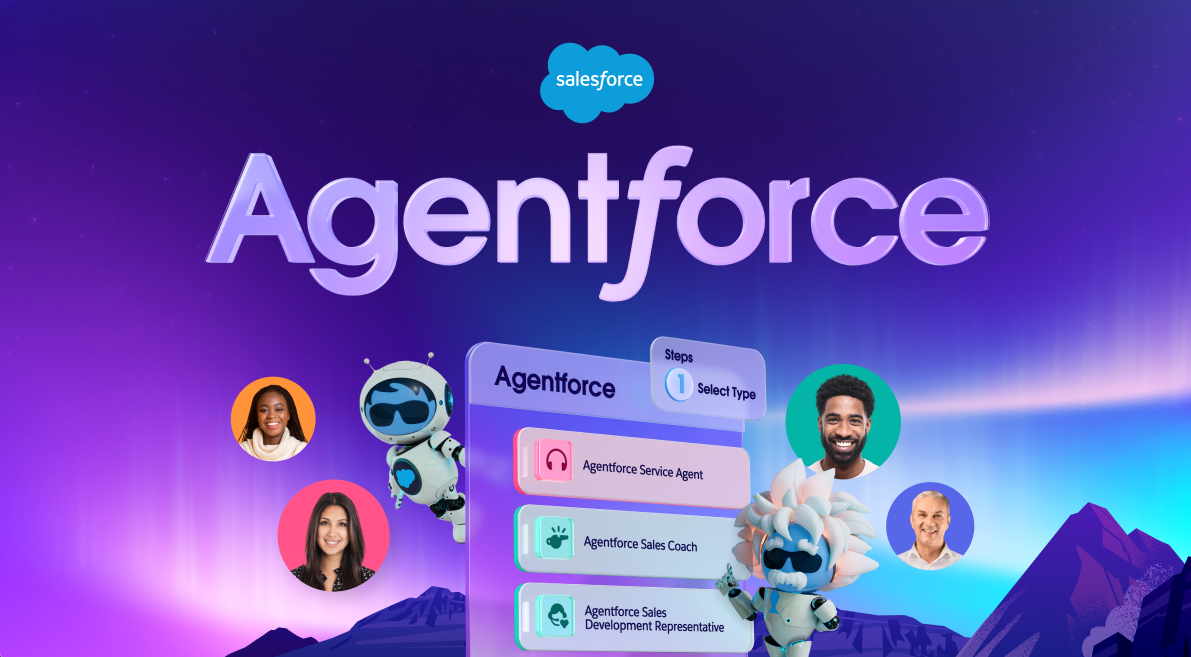
Are your customers frequently waiting for service to resolve their issues? Then, customer service might be the perfect starting point. Consider training AI chatbots or intelligent, autonomous agents, such as Agentforce 360, to handle common concerns and resolve customer issues, 24/7.
Trying to improve internal communication? Consider moving to an AI-enabled collaboration platform like Slack. It can summarize conversations, pull up relevant information, or automate routine updates. Slack also integrates with 2,600 out-of-the-box apps to reduce context switching and improve productivity.
These are just a few ideas to get started — there are sales, marketing, commerce, and more strategies with AI just waiting for you. Try these low-risk wins to build confidence, and get a quick return on investment (ROI) before tackling larger AI projects.
Boost team productivity with Slack
Bring together your team, your customers, and your tools to help take your business to the next level with Slack — it’s where business gets done.

2. Prioritize data readiness
According to Salesforce’s latest State of Data and Analytics Report, a whopping 84% of leaders say their current data strategies need a complete overhaul for successful AI implementation. AI is only as good as the data you feed it. So, if your customer data is messy, scattered across multiple systems, your tools will struggle to deliver value.
Where do you keep your customer interactions, sales history, and communication logs stored? Can you pull up a complete picture of any customer relationship with your team included in every thread? This is why data integration is so important and AI can help.
Look for an AI CRM like Salesforce, as it can unify both structured data, like sales figures and dates, and unstructured data, like emails and chat transcripts, to create a comprehensive customer view. And a smart CRM offers actionable insights, makes accurate predictions, and automates workflows across your entire business. Look for tools that operate with trusted AI, and secure data.
3. Use low-code or no-code tools
Today’s no-code and low-code tools put powerful AI capabilities directly in your hands through simple, intuitive interfaces. Your best bet is to start with a CRM for small business. It includes what you need to tie a business together. With the AppExchange, you can work with other departments and teams cohesively in one dashboard.
If marketing campaigns and content creation are your top priority, tools like Gemini can help with email marketing, social media, or video marketing. For automation and integrated apps, there’s Zapier, which acts as the glue between all your tools. It can automatically move data and create workflows (like adding form submissions to your CRM or sending welcome emails) without any coding required. These tools are designed for entrepreneurs like you to start small, learn as you go, and implement AI without the technical overwhelm.
Recommended starter tools for your AI strategy:
Starter Suite is the ideal cloud-based CRM for SMBs. It comes with all-in-one tools for sales, marketing, commerce, and service to simplify operations across your business. If you’re looking for more advanced features, Pro Suite is a flexible CRM suite that comes with drag-and-drop features and prebuilt workflows that you can customize in minutes. Whether you’re setting up a digital storefront or segmenting your customers for marketing activities — these tools can help you be more productive and scale efficiently.
Maximize Your CRM Productivity
Learn how small and growing businesses are taking productivity to new levels with Salesforce CRM in this free e-book.
Thank you for downloading the free e-book!
Here's your free e-book!4. Foster AI literacy across the team
Your AI strategy will only work if your team embraces a learner’s mindset and feels confident that you’re using AI to make them productive — not replace them. Create an AI literacy program for your team by scheduling regular training sessions to explore AI tools hands-on, ask questions without judgment, and share how they’re using AI to make their work easier.
Encourage experimentation by asking them to test AI tools for their specific roles — whether that’s using AI to draft responses (vibe marketing), analyze data, develop an app (vibe coding), or automate repetitive tasks. Have a shared space (like a Slack channel) where they can swap tips and wins. The goal is to build an environment of trust around AI within your team and stakeholders.
5. Set ethical and secure guardrails
Our latest research states that 41% of SMBs express security concerns around AI usage, and at least 25% of their customers don’t trust AI enough. So, it’s very important to set ethical AI guidelines, and be transparent to your customers about how you use their data and AI. Your AI strategy should involve using tools with enterprise-grade security features like encryption, regular security audits, and compliance certifications such as Service Organization Controls (SOC 2).
Make sure your CRM offers role-based access controls (so only the right people see sensitive data), audit trails that track who accessed what and when, and clear data privacy policies that explain how your information is stored and protected. Go for tools that transparently share their security documentation, incident response procedures, and how their AI models use your data. These guardrails protect your business from data breaches, build customer trust, and meet compliance regulations like General Data Protection Regulation (GDPR) or California Consumer Privacy Act (CCPA).
6. Create a 90-day AI strategy roadmap
Break your AI implementation into a clear 90-day plan with specific milestones so you’re not wandering aimlessly or trying to do everything at once. Here’s how to structure it:
- Month 1: Assessment and setup: Identify your pain points, choose the right tool that addresses them, and configure it with your existing data and systems.
- Month 2: Training and adoption: Roll out the tool to a small group, provide hands-on training, gather feedback, and refine your processes based on real-world use.
- Month 3: Measurement and scaling: Track key metrics like time saved, costs reduced, or customer satisfaction improved, then expand successful implementations to the rest of your team while planning your next AI use case.
A growing team’s AI success story
FigTree Financial, a wealth management firm, struggled with disconnected systems, like a separate case tool, help desk, and sales tracker. This caused significant manual effort and affected team productivity. With Pro Suite, FigTree unified these systems into a single CRM. This simplified their entire operation, leading to immediate, measurable results:
- 10% less busywork (reduced time-switching systems)
- Over 50% improvement in forecast accuracy and pipeline visibility
- 60+ client touchpoints automated monthly
From fragmented to focused
Learn how FigTree Financial set itself up for long-term growth by consolidating processes, automating tasks, and increasing efficiency with Pro Suite CRM.


AI strategies that work with Salesforce
When you’ve nailed that AI strategy down, your business growth will be the conversation starter at every event. With Salesforce, you get all the tools for sales, service, commerce, and marketing, unifying every experience right out of the box. There are more resources on the Salesforce Blog for AI, and Trailhead, the free online learning platform to help you scale. Good luck with your AI strategy, we’re always here to help.
Start your journey with the Free or Starter Suite today. Looking for more customization? Explore Pro Suite. Already a Salesforce customer? Activate Foundations to try out Agentforce 360 today.
AI supported the writers and editors who created this article.
Frequently Asked Questions (FAQs)
This type of business strategy is a focused plan to integrate affordable, smart tools into core business functions. It makes sure AI adoption directly aligns with and boosts your growth objectives, and improves team productivity.
Start by clearly identifying your biggest pain points or repetitive tasks (like customer service replies or content creation) that cost you time. Then, choose simple AI tools (often with freemium plans) that address those specific issues.
An AI strategy helps a small business compete with larger companies by handling routine tasks, personalizing customer experiences, while saving time and money. It makes sure your team uses AI tools to work smarter instead of getting buried in daily operations.
The best AI tools for small business are an AI CRM for sales and service, or a generative AI (Gen AI) tool like Gemini for content creation. Look for tools that deliver the highest measurable ROI for your team.
Yes, you can use AI to support and simplify every part of your small business, but you’ll need humans in the loop. Use AI to automate repetitive tasks, analyze data, and improve customer service, so your team can focus on complex tasks that require human attention.