Designing AI for Collaboration: The Future of Work is Multiplayer
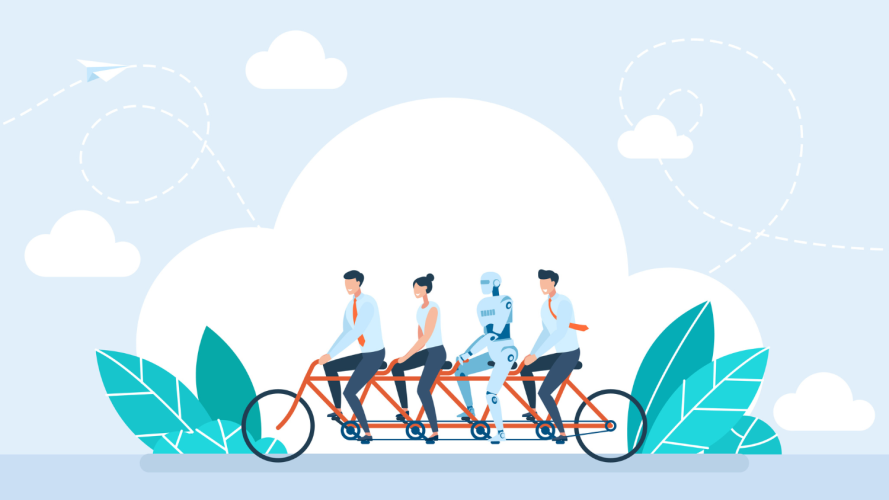
Understanding the patterns of human teamwork can help you design AI systems that support the way people work together.



Key Takeaways
How do people’s expectations of human collaboration influence what they expect from AI systems?
This question drove our research into the future of work with AI, a technology that often behaves more like a teammate than a static tool. What emerged were frameworks for understanding not just how humans collaborate, but how AI can support the creative, fluid, and sometimes messy ways teams actually work.
Let’s unpack how the patterns of human collaboration can inform the ways we design AI systems to help teams flourish.
What we’ll cover
Three takeaways about how humans collaborate
Shift from single to multiplayer mindset
Collaboration involves a range of modes and conditions
Specific conditions drive successful collaboration
To support fluid collaboration, AI must play multiple roles
AI helps humans work better together
Three takeaways about how humans collaborate
We wanted to explore how insights about human collaboration in the workplace can inform the design of AI systems and tools. We consulted with both internal and external workplace collaboration experts and conducted secondary research to gather a broad range of perspectives. We also scrutinized our own collaborative processes, mental models, and tools.
Our research offers a framework for understanding the core components of human collaboration, identifying what makes it successful, and exploring the diverse roles AI can play in supporting effective human-AI partnership. We aim for these perspectives on AI and the future of work to help teams and organizations design experiences where human-AI collaboration thrives.
- Modern knowledge work is inherently collaborative; it’s a team sport. Collaboration – the collective, interdependent efforts of a team – is the primary driver of value in organizations. As work becomes increasingly complex, effective collaboration becomes even more critical for solving the challenges organizations face.
- Collaboration is complex, but has distinct patterns. While inherently nuanced, collaboration has recognizable modes you’ve probably experienced: sharing information, coordinating actions, cooperating to make decisions, and co-creating something new together.
- Creating the right conditions makes all the difference. Sometimes collaboration feels magical. Other times, even the simplest shared task becomes a slog. Specific conditions drive successful collaboration, and AI has a key role to play in facilitating these conditions.
Shift from single to multiplayer mindset
The primary driver of value in modern organizations is the collective, interdependent efforts of a team, with knowledge workers spending the majority of their day in collaborative activities — sharing context, coordinating across teams, making decisions together, co-creating outcomes.
And as work becomes increasingly complex, effective collaboration becomes even more critical for solving the challenges organizations face. Although the market is evolving quickly, most AI tools today are built for individual activities and productivity, not team collaboration.
According to an Asana report on AI adoption, 49% of AI workflows are built for individual use — yet these individual-first workflows drive only 6% of downstream adoption by colleagues and peers. Many AI tools still lack basic multi-player functionality like simultaneous interaction with an AI agent or shared context across team members.
This is an opportunity. For AI adoption to scale and deliver organizational ROI, it must be designed for how teams actually work: the nuanced, complex, often irrational ways humans collaborate. That demands a deeply human approach — one that starts by understanding collaboration itself.

Collaboration involves a range of modes and conditions
To design well for collaboration, it’s important to understand how people actually work together.
Imagine you’re on a sales team that learns that a prospect just freed up budget for a new initiative — and they’re evaluating vendors this week. Within minutes, the team launches a range of parallel activities, sharing information about the prospect, deciding who’s doing what, coming up with a plan, and executing.
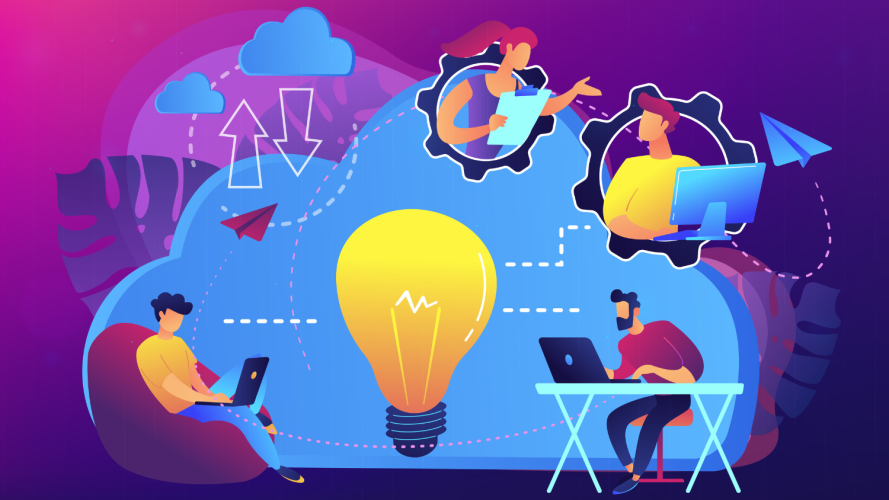
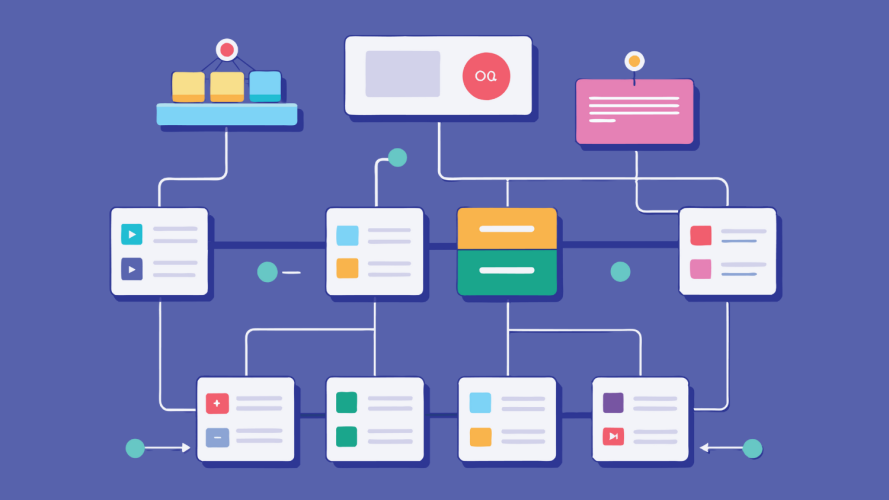
The collaboration happening in this example isn’t a single activity or set of linear steps. It’s a pattern of distinct behaviors: sharing, coordinating, cooperating, and co-creating. People move dynamically between these modes throughout their day, influenced by the task’s complexity, urgency, and risk.
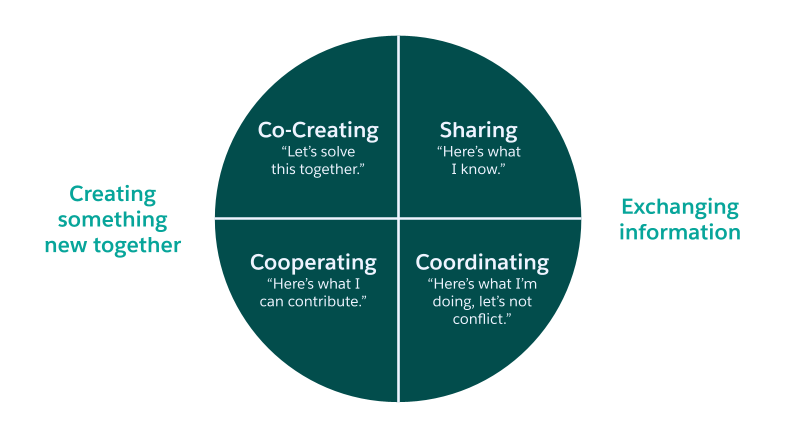
Sometimes working together requires simply exchanging information:
- Sharing what I know and learning what you know.
- Coordinating so we don’t conflict in the things we’re working on.
When people need to work together to create something new, they might:
- Cooperate to align resources and make joint decisions.
- Co-create to build alongside each other.
People move fluidly between these modes all day long. You might go from ideating to assigning tasks to finding a meeting time in the course of one meeting. AI’s utility may be limited if it doesn’t support this full spectrum of behaviors and the transitions between them.
Specific conditions drive successful collaboration
Think of a time when collaboration clicked. Maybe your team tackled a complex problem and everyone just meshed. Information flowed. People covered for one another. The work felt balanced. The Slack emojis were on point.
What made it so effective? Was it a rigid, step-by-step process you followed, or was it something more fundamental — a feeling of trust, a shared goal, effective communication?
While we can’t design a singular, perfect path for collaboration, intentional design can create the conditions for collaboration to flourish.
Our research showed that to flourish, teams need:
- Healthy relational dynamics – Trust, psychological safety, and the ability to repair mistakes enable teams to take risks and work through challenges together.
- Clarity and alignment – Shared goals, clear roles, and mutual accountability ensure everyone understands what they’re working toward and who’s responsible for what.
- Operating flow – Clear communication, shared resources, and adaptable processes help teams move work forward efficiently.
The importance of each condition is context dependent, but we’ve found that trust, clear communication, and shared goals are must-haves. You can’t collaborate without them.
These human dynamics set baseline user expectations for working with AI. AI experiences should help create and reinforce these conditions for both human-AI and human-human collaboration.
To support fluid collaboration, AI must play multiple roles
AI is often framed narrowly as a “digital teammate” or positioned in binary terms — either augmenting or automating tasks. These views can be too limiting when it comes to collaboration. Just as teams move dynamically across collaboration modes depending on context, AI dynamically plays multiple roles to support individuals and teams.
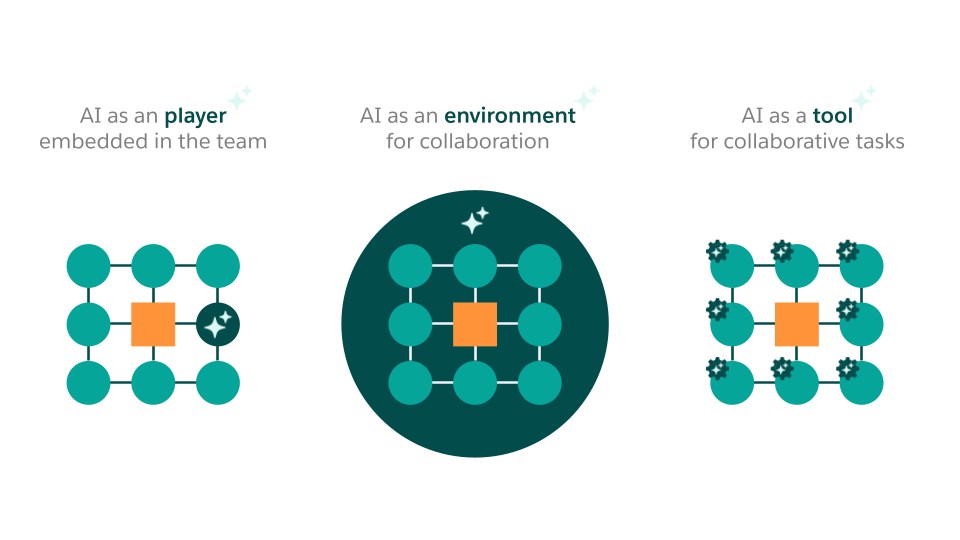
We can design AI to flex across three core roles depending on the situation and context:
- Sometimes AI acts as a player, an active participant embedded in the team, contributing to shared goals by contributing knowledge, generating scenarios, or evaluating options alongside human collaborators.
- Other times it functions as a tool, providing features and utilities that augment what individuals can do – like instant summaries, task tracking, or offering support with writing within collaborative work.
- Or AI becomes the environment itself: ambient intelligence that surrounds and shapes how teams work together, holding collective memory, surfacing relevant context, and dynamically orchestrating the collaborative space based on what teams need in real-time.
AI helps humans work better together
By the time you finish reading this, a platform will have shipped a new collaborative AI feature. In fall 2025, every major platform added multiplayer functionality within 30 days of one another. At Slack, we launched Channel Expert Agent which makes AI collaboration accessible to every team. When anyone asks Channel Expert a question, the agent responds publicly so the entire team can see both the question and answer, transforming how teams get answers, share knowledge, and keep projects moving.
The market validated what the research showed: modern work is collaborative. We’re constantly sharing context, coordinating across teams, making decisions together, and co-creating outcomes—between humans and AI. The value of new tools lies not in just helping individuals be more productive, but helping teams and organizations to operate more intelligently together.
We’re all figuring out what that means for the AI systems we build. How is your team thinking about collaboration—not just between humans and AI, but between humans with AI in the room?