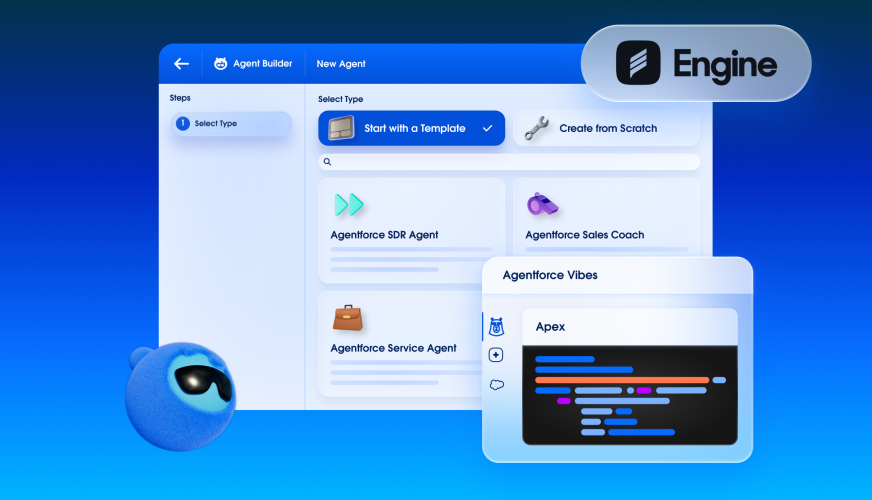
Engine is a modern travel platform built for small and medium businesses, and in the travel industry, speed and precision is critical. Engine’s engineering culture is built on a simple mantra: “ship fast, learn faster.” But as the $2.1B travel tech unicorn scaled from startup to over 1,000 employees, the company faced a critical paradox. Fielding over 800,000 customer service requests per year, operations needed to seamlessly scale to support an increasingly high volume of activity while maintaining their signature high-fidelity customer experience.
At the same time, their sales team was experiencing hypergrowth Internal teams like HR, IT, and Finance were managing an influx of repetitive FAQs, while the board expected sustained growth.
They knew AI agents were the key to scaling their operations, but their existing enterprise development tools made building those agents a bottleneck. Traditional enterprise development cycles — taking months to spec, develop, test, and deploy new capabilities — were fundamentally incompatible with hypergrowth demands. Yet cutting corners on quality, security, or testing wasn’t an option when building agents that would handle customer transactions, process refunds, and access financial data.
“We needed enterprise-grade AI agents that could execute real business processes,” explains Joshua Stern, Engine’s Director of Revenue Operations. “That meant complex integrations with our CRM, proprietary booking systems, payment processors, and data warehouses. But we couldn’t spend six months on each agent. We needed a development methodology that delivered both speed and technical rigor.”
Engine’s previous attempts with disparate development tools faced bottlenecks. Building required switching between separate low-code platforms and coding environments. Testing required external frameworks. Deployment required custom integration work. Data access required building connectors for each application. Every integration point introduced delays, complexity, and potential failure.
Engine’s leadership set a clear goal: deploy enterprise-grade applications in days, not months, using a unified development platform. They needed a platform supporting both rapid prototyping and production deployment, tools enabling both citizen developers and experienced engineers, and comprehensive ALM capabilities building quality in from the start. Most critically, they needed a headless architecture where a single, deeply secure enterprise agent “brain” could share modular, reusable code—enabling compounding velocity where each new capability accelerated future development across any interface.
How Salesforce Helps Engine
Engine chose Salesforce’s headless capabilities not only because of their deep integration with the Salesforce’s ecosystem, but also because it offered a true headless environment where low-code, pro-code, and vibe code tools worked seamlessly together, within a unified and trusted agent and app development process that already understands your business rules.
AIforce delivers true developer freedom, allowing teams to build with whatever coding agents or IDEs they choose, while natively inheriting Salesforce’s deep data context and governance directly within their preferred workspace. This eliminates the need for complex architectural middleware and allows low-code flows built in Agentforce Builder to seamlessly align with pro-code efforts, keeping everyone in the same development room. Using Agentforce Vibes, their developers can turn natural language into production-ready code within their chosen environment in just four days instead of weeks.
But speed wasn’t the only requirement; Engine needed their agents to meet customers wherever they were. By leveraging the Headless Experience Layer, Engine decoupled their business logic from the UI. This allowed a single ‘agentic brain’ to manifest natively in Slack for internal teams and as a high-fidelity web components and mobile components for travelers. To power these premium web experiences, Engine utilized Salesforce Multi-Framework, allowing their developers to run industry-standard React code natively on the platform. This combined architecture meant Engine could build a complex, secure financial rebooking and autonomous refund logic once and deploy it everywhere without rewriting a single line of code for different channels.
The 12-Day Development Cycle
When building their first production agent, Eva (Engine Virtual Assistant), the team was able to deliver the first version of the agent in just 12 days. They did this by establishing a rhythm that balanced velocity with rigor under a headless framework:
Days 1-3: Low-code foundation
Using Agentforce Builder, the team rapidly prototyped conversation flows, defined topics, and mapped user journeys. Salesforce Flow provides orchestration capabilities without writing code. This visual development allowed both technical and non-technical stakeholders to collaborate on design in real-time. Because the architecture was headless, this foundational setup was completely decoupled from the frontend presentation layer.
Days 4-8: AI-accelerated pro-code development
Engine didn’t just write code; they used Agentforce Vibes to generate the sophisticated, multi-system logic required for customer and financial transactions. By describing intent in natural language, Agentforce Vibes produced the modular, headless ‘invocable actions’ that allowed Eva to talk to payment processors, turning weeks of manual backend engineering into a 4-day sprint.
Days 9-11: Rigorous testing and refinement
The team used Agentforce Testing Center within their Salesforce Sandbox to validate changes without risk to live business operations. This was critical for Engine: they needed to test complex financial transactions, multi-system integrations, and permission models without any possibility of disrupting real customer bookings or payment processing.
Agentforce Testing Center ran hundreds of discrete tests against their Apex code—validating business logic, permission models, and integration points. Agentforce Vibes also assisted with creating comprehensive test classes, historically one of the most time-consuming aspects of Apex development. What might have taken days of manual test writing now happened in hours, with AI assistance ensuring edge cases were covered and test quality remained high. Running these tests in their Sandbox gave them the freedom to build and test aggressively, knowing they could validate every change before it touched production.
“We learned from past ad-hoc testing issues,” Stern explains.” Agentforce Testing Center allowed us to run hundreds or even thousands of tests at once, drastically improving code quality and confidence before anything reached production.”
Day 12: Production deployment
Following rigorous validation, Eva launched as an autonomous agent capable of managing the entire lifecycle of customer cancellations. By processing refunds and syncing systems independently, the agent achieved immediate impact. The automation allows Engine’s human agents to dedicate their expertise to high-value, complex tasks, such as managing critical last-minute rebookings.
But the key to Engine’s velocity wasn’t just the hybrid tools—it was architectural discipline. “We prioritized building recyclable, modular, invocable Apex,” Stern emphasizes. “Because our logic was entirely decoupled from the UI, each Apex action we built could be called by any agent or surface. That modularity meant our second agent took days, not weeks, because we could reuse existing building blocks.”
This approach transformed Engine’s development model from building isolated solutions to building an interconnected ecosystem where each new capability accelerated the next.
Protect with Built-In Governance
Crucially, accelerating deployment cycles via a headless approach did not mean compromising on enterprise security or creating compounding compliance risks. Previously, extending a tool to a new channel or surface required designing a completely separate governance model for each unique environment.
With AIforce, Eva natively inherited Engine’s existing Salesforce infrastructure, field-level security, and audit trails through the AI Trust Layer. Through Data 360 Zero-Copy architecture, Eva safely accessed over 10 million rows of live data inside Snowflake and Amazon S3 without the data ever leaving its original, secure source. Financial transaction data remained fully protected and recoverable at scale via Backup & Recover.
While executing autonomous financial transactions at scale typically introduces compounding risk for enterprise leadership, AIforce built a native safety net directly into the development pipeline. This unified guardrail allows technical and business teams to innovate without fracturing existing data protections.
“Knowing that our agent security is built-in, respecting our existing governance around access to Google Drive, Confluence, and Salesforce, gives us tremendous confidence,” says Demetri Salvaggio, VP of Customer Experience & Operations.
The Salesforce Difference
Salesforce provides a unified ecosystem where developers can design, code, test, deploy, and iterate their work while maintaining full context, all backed by zero data retention and enterprise-grade governance.
This integrated approach transformed how Engine scales beyond initial use cases. After deploying Eva, Engine faced a new challenge: internal employees needed the same high-velocity automation for IT, HR, and Finance support. Because of the way Eva was developed, Engine was able to build new agents to operate across the business quickly.
Because Engine used Agentforce Builder and Agentforce Vibes within Salesforce’s headless architecture, they didn’t have to start from scratch. To build a new employee support agent, they simply detached Eva’s existing backend logic and exposed it to internal employee environments. By describing new requirements in plain language Agentforce Vibes acted as an AI-powered coding partner, generating necessary Apex modifications in seconds. Developers then refined the code, and Agentforce Builder allowed the team to map out employee-specific flows in hours.
This transition from external support to internal operations proved that a unified platform doesn’t just launch agents; it scales an entire enterprise. This integrated loop has transformed Engine’s speed of iteration into a three-part competitive advantage:
- Real-time optimization: When Agentforce Analytics flags a drop in resolution, Sarah Morton (Sr. Salesforce Administrator at Engine) doesn’t wait for a sprint cycle. She updates the configuration in Agentforce Builder or uses Agentforce Vibes to generate updated logic, tests in a Sandbox, and deploys—often within a single afternoon.
- Compounding velocity: Every action built with Agentforce Vibes is a modular and “invocable” building block. With Headless Experience Layer, these blocks are instantly portable across channels. New agents were deployed in a fraction of the time by plugging in the same logic that powered Eva, while Salesforce Multi-Framework ensured the user experience remained high-fidelity and consistent across Engine’s custom React-based portals.
- Confidence at scale: By utilizing the platform’s native agent and app development framework and Agentforce Vibes’ ability to assist with complex test classes, the team can “ship fast” without the fear of breaking critical financial integrations.
By removing the friction between “the idea” and “the code,” Engine has turned its development process into a continuous flywheel of innovation. Now, Engine no longer views each project as a climb from zero. Every capability built is a reusable building block. Every deployment is one click. And every iteration makes the next one faster.
End-to-end AI development on one platform
Get to know the platform that enables rapid innovation with airtight security. Unlock AIforce in a free 30-day trial.