27 Days. $1 Million. What MrBeast’s Big Game Bet Reveals About AI That Actually Delivers.
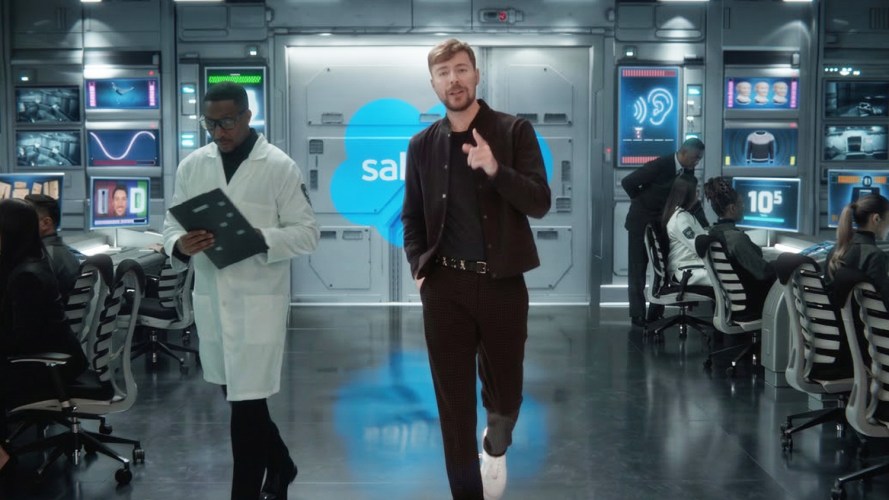
A real-world activation under national scrutiny reveals the four-system agentic enterprise architecture that turns AI from pilot-ready to production-ready — in days, not months.

In just 27 days, the team at Beast Industries, working in collaboration with Salesforce, conceived, built, and launched a $1-million interactive contest tied to a live activation during the biggest game in football.
Millions of Super Bowl viewers were invited, in real time, to solve a puzzle for a chance to win a seven-figure prize. Traffic surged the moment the ad aired. Contest logic had to perform flawlessly at scale. Fraud risk required constant monitoring. Creative and operational decisions had to evolve in real time. The experience had to be ready the moment the broadcast aired. There was no extended pilot. No margin for error.
Strip away the spectacle and what remains is something that should feel uncomfortably familiar to any business leader or executive: a high-stakes, compressed-timeline execution challenge conducted under public scrutiny.
The question worth asking isn’t why Beast Industries pulled it off. It’s why most enterprises couldn’t — and what, structurally, separates the ones that can.
Speed without the right operating model isn’t a competitive advantage. It’s a faster way to fail publicly.
Beast Industries is not what you think it is: It’s an agentic enterprise
Before we get to the lessons, let’s establish the subject clearly. Beast Industries isn’t a YouTube channel with a side hustle. It is a multi-hundred-million-dollar operating company with hundreds of employees, multiple divisions, and a reported valuation in the billions. Annual revenues reportedly exceed $400 million. Its Feastables consumer goods brand alone generates hundreds of millions in retail sales. The organization spans content production, technology ventures, global brand partnerships, and large-scale media.
This matters because the instinct to dismiss it as a “creator economy” story is exactly the instinct that will leave traditional enterprises flat-footed. The structural pressures Beast Industries navigated in 27 days mirror those bearing down on every modern enterprise. The difference is visibility — not operational reality.
The real challenge wasn’t creative, but operational
What aired during the game was a commitment — one that required simultaneous alignment across creative, production, engineering, operations, legal, and risk, all moving against an immovable national broadcast deadline.
The activation had to deliver:
- A seamless digital experience for millions of simultaneous participants.
- Real-time fraud detection and eligibility validation to protect contest integrity at scale.
- A conversational AI that helped participants test theories and stay organized without revealing puzzle answers.
- Live operational visibility into participation levels, system performance, and potential anomalies.
Any one of those requirements would stress a poorly integrated organization. All four simultaneously, under national scrutiny, with a seven-figure prize on the line — that is a genuine enterprise stress test.
Beast Industries brings world-class expertise in creating digital experiences that capture massive global audiences. Delivering an activation at this speed and scale, however, requires more than creative talent alone. It requires a connected architecture where data, execution, AI assistance, and human coordination operate together rather than in sequence.
For this activation, the Beast team was able to rely on Salesforce to provide that foundation — a trusted, connected platform designed to support exactly this kind of moment. Rather than stitching together disconnected tools, the teams operated within a single environment where humans and agents could work together in real time.
The strategic speed problem facing every enterprise
The 27-day timeline is not a quirk of the creator economy. It is a preview of how modern business must operate.
Customer expectations are no longer shaped by your industry’s norms. They are shaped by the best digital experience your customer had anywhere — in any context, with any brand. When someone experiences frictionless personalization in one domain, that standard migrates into banking, healthcare, retail, manufacturing, and B2B services alike.
Meanwhile, market windows are compressing. Product launches trend and fade within days. Competitive threats surface without warning. Brand-defining moments — positive and negative — resolve within hours.
The window to capture attention narrows even as the financial and reputational stakes increase.
In that environment, strategy alone is insufficient. Competitive advantage increasingly belongs to organizations that can execute at speed without sacrificing control. Most enterprises don’t lack ambition. They lack an operating model built for it.
That gap between intent and execution is now a board-level issue.
The architecture of the agentic enterprise
Before looking at the individual parts of the architecture, it helps to understand the constraint each one solves.
High-velocity execution in modern enterprises tends to break down for predictable reasons: teams lack shared data, processes cannot scale reliably, AI operates without sufficient context, and humans struggle to coordinate decisions in real time.
Salesforce’s unique four-system architecture addresses those constraints in sequence. Context establishes shared business and customer data. Work turns that trusted data into reliable execution. Agency allows AI to scale that execution intelligently. Engagement brings humans and agents together so the system can operate in real time.
Seen this way, the architecture is less a stack of technologies and more an operating model designed to remove the structural barriers that prevent organizations from acting at speed.
The organizations who succeed at the pace the market demands share a common characteristic: they have built four interconnected systems that work together. Raw intelligence alone does not produce results. The architecture that converts intelligence into coordinated work does.
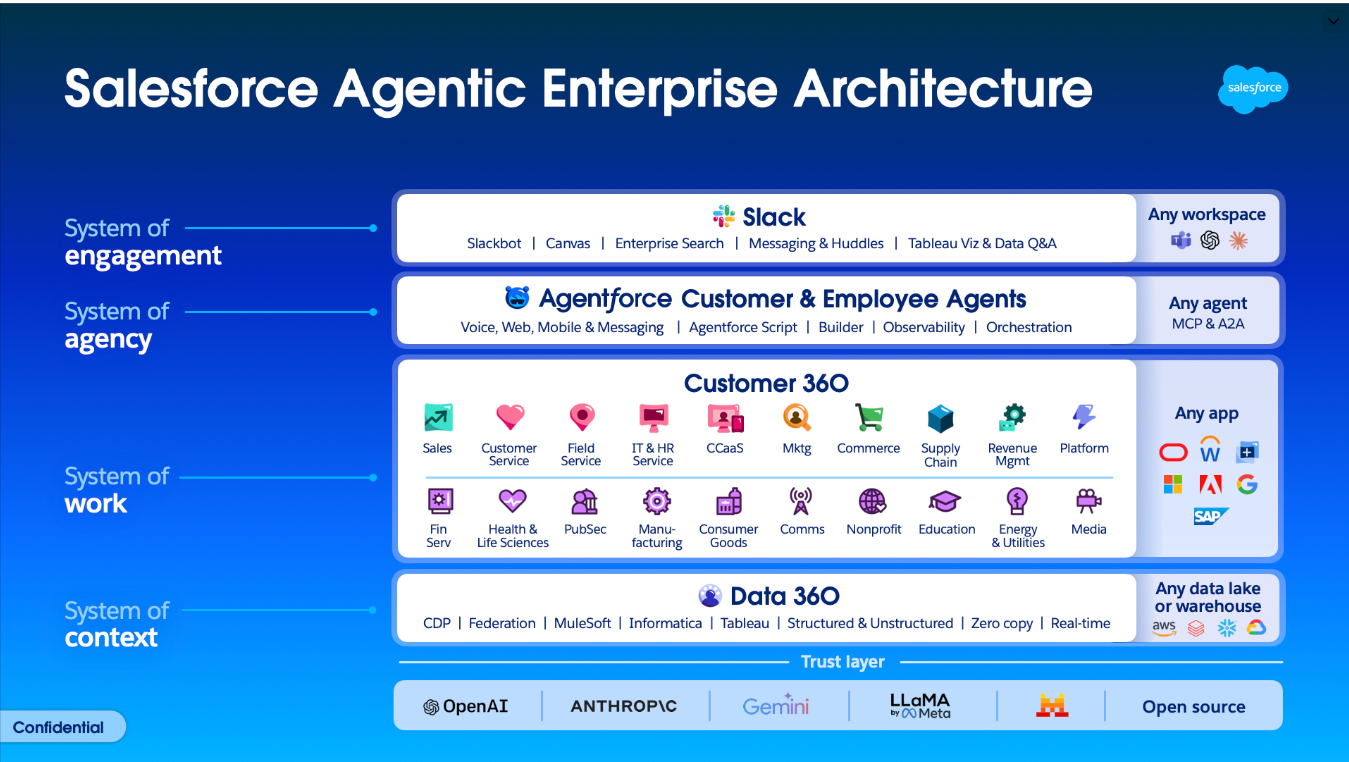
1. System of context
What do we actually know — and can every team, process, and agent act on the same source of truth?
Nothing intelligent happens without data and context. Not a reliable process. Not a trustworthy AI recommendation. Not a good human decision under pressure. Context is the foundation everything else is built on — and for most enterprises, it is exactly where the architecture quietly breaks down.
In the Beast Industries game day activation, shared context meant real-time visibility into participation data, eligibility status, fraud signals, and contest activity — consistently available to teams managing the experience as it unfolded. Not siloed by function. Not delayed by reconciliation. The same source of truth, everywhere, in the moment it was needed.
A System of Context unifies all of an organization’s data — customer data, business data, structured and unstructured, historical and real-time — and turns it into the unified intelligence that every downstream action depends on. This is what gives agents the context to actually work. It is what gives humans the confidence to trust what agents produce.
Without this foundation, every system built on top of it inherits its fragmentation. Speed, at that point, is not an advantage. It is just a faster path to the wrong answer.
Intelligence without context is noise. Context is what converts data into the foundation for action.
2. System of work
Can our processes execute reliably at scale — without heroics holding them together?
Context tells you what is true. Work is what you do with it.
This is the layer where decades of business logic, workflows, and operational rules live — the accumulated knowledge of how an enterprise actually functions across every team, every function, every industry it serves. In the past, that logic was executed by people. In the agentic era, it is increasingly orchestrated by agents working alongside people and within those established processes.
In an activation built in just 27 days, with millions of simultaneous participants anticipated, this meant contest logic that didn’t fail at scale, eligibility rules that applied consistently across every entry, and operational workflows that expanded instantly when traffic surged. No manual intervention. No heroic efforts. Systems that executed because they were designed to.
For the enterprise, this is the difference between a launch that runs cleanly and one that lurches forward on workarounds. A System of Work doesn’t just automate tasks. It turns shared data into governed workflows across sales, service, marketing, and operations — where applications and agents execute the real processes that keep the business running.
This is where strategy becomes operational reality. And it is only possible because the context layer beneath it ensures every process and every agent is working from the same foundation.
Heroics are not a scaling strategy. Engineered systems are.
3. System of agency
Where can AI act autonomously — and where must humans stay in command?
When data is unified and work is reliable, something genuinely new becomes possible: AI that operates inside those systems with real, trustworthy value.
This is the inflection point most enterprises misunderstand. They deploy AI on top of fragmented data and inconsistent processes, then wonder why it produces inconsistent results. The answer is architectural. AI can only be as reliable as the systems it operates within. A System of Agency is not AI bolted onto broken infrastructure. It is AI built into unified context and reliable process — with clear human accountability for every consequential decision.
In the Beast Industries activation, AI accelerated coordination, surfaced anomalies, and monitored participation patterns at a scale human teams could only dream to match. But humans retained authority over prize eligibility decisions, contest integrity checks, and participant support when unusual situations arose. The AI acted where it could add value. Humans stepped in where judgment mattered most.
AI built on a broken foundation doesn’t solve problems faster. It fails faster. The architecture is what makes AI agency trustworthy.
4. System of engagement
When your defining moment arrives, can your people and agents act together — in real time?
The engagement layer is where the entire architecture becomes usable — where humans and agents act on shared context, inside real workflows, at the speed the moment demands.
This is more than a communication tool. It is the command layer — the place where humans and agents collaborate in real time, where context surfaces in the flow of work rather than buried in dashboards, where the right information reaches the right person at the moment they need it rather than after the moment has passed.
In the Beast Industries activation, this meant cross-functional teams — creative, legal, engineering, operations, risk — working in the shared environment of Slack, where conversations, decisions, files, and approvals were visible to everyone with a stake in the outcome. No information locked in someone’s inbox. No decision delayed because context didn’t travel fast enough.
But this layer is more than human coordination. It is where humans and agents work together — where an agent surfaces a risk signal into a live conversation, where a team acts on AI-generated insight without switching systems, where the line between human work and agent work becomes fluid rather than fixed.
Connected data, made actionable. Reliable processes, made visible. AI agency, made trustworthy. All of it in the hands of the people — and the agents — who have to deliver results under pressure. Together, these four systems form the architectural foundation required for the Agentic Enterprise — the foundation Salesforce delivers through Data 360, Customer 360, Agentforce, and Slack.
4 questions for your leadership team
Strip away the big game spectacle and four diagnostic questions remain — one for each system — for any organization operating in compressed, high-stakes environments:
Does your organization share a single source of trusted truth about your customers and business?
If your teams are making decisions from disconnected data sources, you don’t have a System of Context — you have a coordination tax. Every process and every agent built on top of it inherits that fragmentation.
Do your processes execute reliably — or do they depend on someone holding them together?
A System of Work is built to perform under load, not to require heroic compensation when pressure arrives. If your organization’s execution depends on individual effort rather than engineered process, that is the gap to close before speed becomes an option.
Is your AI embedded in the architecture — or deployed on top of it?
AI layered onto fragmented data and inconsistent processes doesn’t fix them — it accelerates their failure modes. A System of Agency delivers value when it is built on unified context and reliable work, with clear human accountability for what matters most.
When your defining moment arrives, can your people and agents act together — in real time?
A System of Engagement is the layer that makes the other three visible and usable under pressure. Without it, even a well-built architecture fails to deliver. With it, your organization can move at the speed the market demands — and trust the output.
Beast Industries didn’t succeed because it operates in entertainment. It succeeded because it treated a cultural moment as an enterprise execution challenge — and had the architecture, and the right technology partner, to meet it.
Your next defining moment may not be a once a year game day activation. It may be a product launch, a regulatory shift, a market expansion, or a sudden demand surge. The question isn’t whether that moment is coming. It’s whether your four systems are ready when it does.
Sources
- Inside MrBeast’s business generating nearly $473 million in annual revenue (Business Insider)
- Beast Industries explores funding round at nearly $5-billion valuation (Yahoo Finance)
- Beast Industries valued around $5 billion with hundreds of employees (Business Insider)
- Feastables generating roughly $250 million in annual sales (Entrepreneur)
- MrBeast explains $1-million Super Bowl puzzle contest created with Salesforce (ABC News)
- $1-million puzzle challenge tied to the Super Bowl campaign (Newsweek)