Playbook
Become an Agentic Enterprise: A Refreshed Step-By-Step Guide


Introduction
Make our agentic learning yours
See what’s new in our refreshed, comprehensive playbook
Chapter 1
Align around your goal
Scale the AI capabilities that move your business forward
Chapter 2
Design your human-AI workforce
Remove blockers, inspire your teams, and set them up for success
Chapter 3
Begin with the right use case
Solve one problem well, then scale fast
Chapter 4
Rethink business processes for the agentic age
Redesign intelligent workflows on desired outcomes
Chapter 5
Ground agents in trusted, reliable data
Turn your data into a competitive advantage
Chapter 6
Never stop improving
Coach your agents, prove their worth
Introduction
Make our agentic learning yours
AI agents are transforming every industry — and it’s only accelerating
We’ve refreshed our guide to help you keep pace and win
In late spring of 2025, when we first published this guide, the agentic enterprise was still an emerging idea. Today, it’s the operating model most companies aspire to, and many are already building. In just one year, the question shifted from “What is an agentic enterprise?” to “How do we get there from here?”
We updated this step-by-step guide with our latest knowledge and lessons because the answer to “how” hasn’t gotten any simpler, and for many it’s become even more urgent.
Every business leader is staring down that impossible equation: deliver exponential growth on flat budgets, beat competitors moving faster every quarter, and meet customer expectations that reset higher every day.

What does it mean to be an agentic enterprise?
If you’re just starting out, you may wonder what qualifies as an agentic enterprise. The truth is, it means different things to different people, even among our own leadership. And that’s okay. Broadly put, the agentic enterprise is where humans, AI agents, and platforms work together to drive better business outcomes.
Far more than an investment in technology, or a productivity layer bolted on top of how you operate today, the agentic enterprise has an entirely different architecture, with connected systems for data, work, agents, and human collaboration underneath it. The chapters ahead show you what that architecture looks like and how to build it, one step at a time.
We’ve been exactly where you are
At Salesforce, our own AI journey has been filled with experimentation, breakthroughs, and hard-earned lessons. For years, customers have asked our leadership the same question: “How do you run your company?” With 80,000 employees, a rapidly evolving product stack, and customers in every sector across the globe, we don’t always get it right at first.
So how did we become the agentic enterprise we are today? Our answer is a philosophy and formalized program we call Customer Zero: We try every platform, feature, and process on ourselves before guiding our customers to do the same. This playbook draws on the lessons, experiments, and shortcuts from our own journey, and the experience of guiding thousands of customers, from innovative startups to Fortune 500 enterprises, through their own AI transformations. We’ve seen what works, what doesn’t, and the real benefits that emerge when AI agents are woven into everything from sales and marketing to HR and beyond.
Our biggest takeaway: The agentic enterprise isn’t a future state you prepare for. It’s a way of working you start practicing now.
How to use this guide
If you’re early on your agentic AI journey, read this playbook sequentially: It’s a step-by-step roadmap. If you’d rather jump straight to the chapter that addresses your immediate need, the structure supports that too. Each chapter includes:
How we’re doing it
An actionable summary of our recent Customer Zero techniques and learnings.
Customers getting it right
Wins, pitfalls, and no-holds-barred examples from real Salesforce customers.
Voices of the Playbook
Brief videos from our leaders with a micro-lesson that’s applicable to your business.
A downloadable worksheet
A way to reinforce the chapter’s key lessons and put them into practice with your team.
The bottom line? Start now. According to our 2026 study of more than 2,000 agentic AI decision-makers, 77% of organizations are already deploying or experimenting with agentic AI. For companies that have successfully deployed agents, customer satisfaction scores (CSAT) are up 29%, resolution times are 31% faster, and operating costs are down ~29%. What’s more, the median time to meaningful ROI among deployed organizations is now a mere eight months.
77%
of organizations are already deploying or experimenting with agentic AI
Source: The State of Agentic AI in the Enterprise
The distance between those finding value from AI agents and those still thinking about it is widening quickly. This playbook is designed to help you close the gap.
Let’s begin.
Chapter 1
Align around your goal
Scale the AI capabilities that move your business forward
There’s a version of AI adoption that looks good on LinkedIn: a company proudly announcing that its pilot successfully launched, agents deployed, metrics improving. The announcement garners a wave of likes, hearts, and comments. And then, six months later, silence. The initiative stalls. Agents go underused. Teams revert to old habits. What happened?
The technology was ready, the organization was not.
New research from the State of Agentic AI in the Enterprise report confirms it: Organizations that experienced a stalled or failed initiative were more likely to blame organizational factors than technology constraints.
In fact, the top barriers weren’t cost or budget (19%) — they were organizational resistance (29%) and a lack of AI fluency (29%). And when asked what they’d do differently, the most common answer had nothing to do with technology. It was: “invest in change management earlier.”
When we asked 2,000 AI decision-makers what they'd do differently, the most common answer was "invest in change management earlier.”
Source: The State of Agentic AI in the Enterprise
But these are solvable challenges, and we’ve learned a lot about how to get there. This chapter covers the attributes of leaders that turn pilots into lasting results, how to assess where your organization stands on its agentic journey, and how Salesforce is thinking of its own agentic transformation.
The CIO’s job description has been rewritten
Historically, the C-suite divided its responsibilities cleanly:
The CIO built and maintained infrastructure.
The CHRO managed people and culture.
The CFO protected the bottom line, etc.
Those mandates still exist. But in the era of agentic AI, none of them is sufficient on its own. As Shibani Ahuja, SVP of enterprise IT strategy, states, “Today’s CIOs are becoming educators. They’ve become collaborators. They’ve become translators. They are helping boards and business unit leaders understand not just what AI agents can do, but what it means for how the organization works. They are bridging the gap between technical possibility and business strategy.”
The most effective AI leaders have stopped asking, “What’s my role in this?” and started asking, “What kind of organization are we becoming — and how do we build it together?”

Agents don’t think in silos, and leaders can’t either
Andy White • SVP, Salesforce on Salesforce Technology
Agentic AI has a habit of exposing what businesses really need. As Andy White, SVP, Salesforce on Salesforce technology, puts it: Agents aren’t bound by org charts or technology silos — so the old logic of handoffs and rigid roles doesn’t hold. The leaders finding their footing fastest are building teams around opinionated, curious generalists: People who can go wider and deeper than any title used to allow.
Where are you on your agentic journey?
If you’re hesitant to answer that question, here’s something worth knowing: Most leaders are still in the early stages too. Our The State of Agentic AI in the Enterprise report found that while 30% of respondents have fully deployed AI agents, 47% are still experimenting with pilots, and 23% are shopping around or in the planning stage.
If you’re at the starting line, the first step is understanding your current AI readiness. Salesforce has created a multi-level agentic maturity model to help you understand where you are and where you can go. This progressive approach allows organizations to build capabilities incrementally while demonstrating business value at each stage.
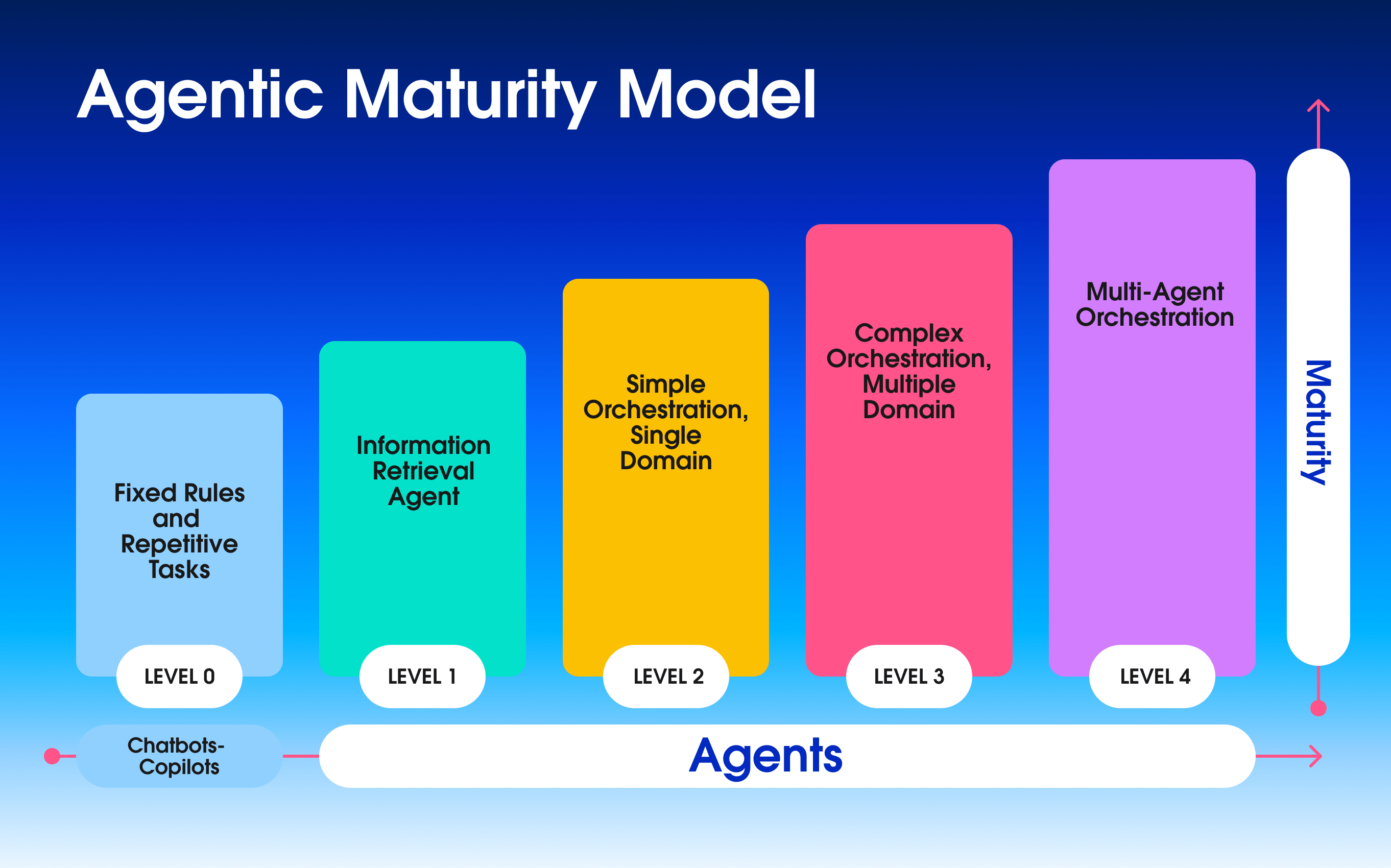
Level 1 is where companies define their AI strategy, establish guardrails, and begin connecting data sources. Think: an AI agent that answers common employee questions like “What’s our vacation policy?” or “How do I reset my password?”
As you progress to Level 2, agents evolve to execute tasks with a single specialized skill — like processing expense reports or automatically booking meetings when customers request demos.
At Level 3, agents can orchestrate complex workflows that span multiple departments and systems — such as managing an entire employee onboarding sequence that automatically creates accounts, schedules training, assigns equipment, and coordinates with IT, HR, and facilities teams.
Finally, Level 4 represents agents coordinating with other agents across your organization and even external systems — like your sales agent collaborating with your marketing agent and your vendor’s supply chain agent to automatically qualify leads, personalize outreach, negotiate pricing, and fulfill orders without human intervention.
Most organizations start at Level 1 and build incrementally. Today, many of our Agentforce customers — companies using Salesforce’s AI agent platform to automate complex tasks and augment their workforce — are well into Level 3. Understanding your maturity level helps you choose the right starting point for your organization. Armed with that knowledge, you’re ready to build your strategy for implementing AI agents.
Moving up the maturity curve, with Bionic
James Lomas is CTO of Bionic, a U.K. business services comparison platform that helps over 200,000 small businesses manage essentials like energy and insurance. In deploying Agentforce in live operations, he learned something every leader staring at an AI pilot needs to hear: The gap between delivery and value is real, and it doesn’t close on its own.
From resisting the urge to let a general-purpose model loose on narrow procedural tasks to building an intentional improvement cycle, it takes discipline to move up the maturity curve. His most important insight? Fifty percent of Bionic’s customer needs can be met agentically, but only because they were honest enough to ask which ones genuinely required a human first. Read more on Bionic’s agentic transformation here →
The Agentic Enterprise, in four layers
At Salesforce, we think about the agentic enterprise as an operating model that brings together data, models, workflows, and interfaces, with trust and governance built in. It’s crafted for humans, agents, and platforms to work together, each layer in tandem with the others.
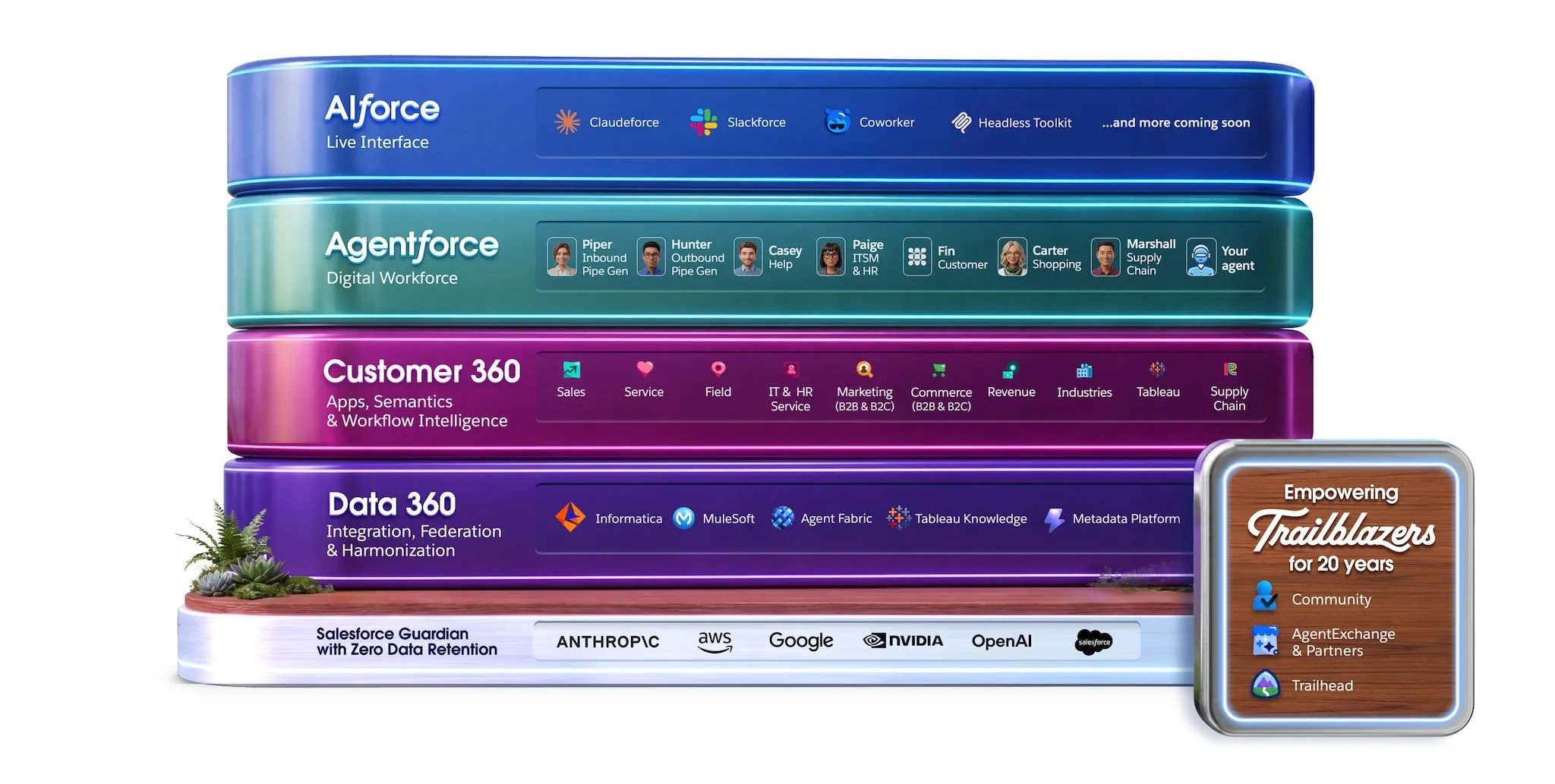
This architecture isn’t the whole of becoming an agentic enterprise; that also takes people and processes change too, but building on a unified platform is what sets you up for success.
- Integration, federation & harmonization: The data platform layer that unites structured and unstructured enterprise data using a zero-copy architecture. With this persistent, shared context, humans and agents operate from the same information at the same time.
- Apps, semantics & workflow intelligence: The operational background apps where work actually gets done — and the business logic to make it happen. The workflows, processes, approvals, rules, and governed semantic understanding that live within Customer 360 are used by both humans and agents working on service, sales, marketing, and commerce teams every day. With Tableau, these insights are served up instantly in the flow of work so they can be actioned immediately.
- Digital workforce: A central layer where agents are built, tested, managed, then deployed and governed at scale. Agentforce helps deliver custom and out of the box employee and customer-facing agents that take trackable and accountable action.
- Live interface: The platform that brings the full power of Salesforce to wherever humans and agents choose to work. That could be Slack, Claude, Microsoft Teams, and or Lightning. While the work may not happen in a Salesforce interface, AIforce makes sure permissions, governance, and business rules travel with the work wherever it happens.
With these core systems in place, everything your business runs on — your data, models, and workflows — are connected from the start with trust that is built-in, not bolted on.
Try these activities: Define your vision and map your foundation
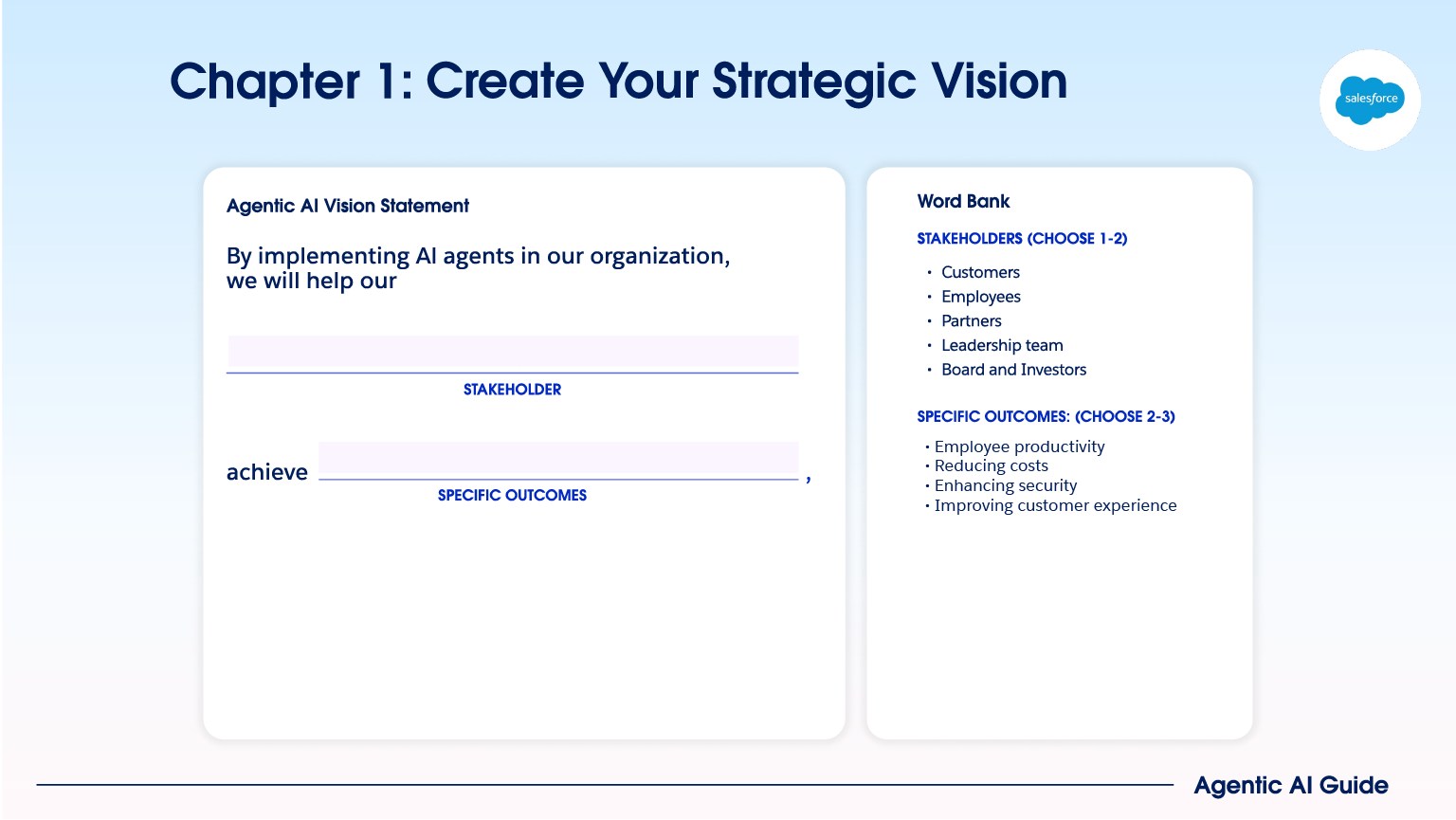
Every agentic AI journey starts with two questions: “Where are we going?” and “What are we building on?” This activity helps your team answer both. Download the worksheet below to complete with your cross-functional team.
Agentic AI Resource
Download the AI vision statement and system mapping worksheets
Use these worksheets to create a powerful vision statement for your AI journey and start to map the systems to build your agentic enterprise. Ask your cross-functional team members to help fill out the fields. You might be surprised by the results.


Chapter 2
Design your human-AI workforce
Remove blockers, inspire your teams, and set them up for success
Agents bring obvious advantages to any workforce. They can handle thousands of conversations at once; they’re fluent across languages; and they’re available around the clock. But as our The State of Agentic AI in the Enterprise report makes clear, giving full autonomy to agents remains rare – 99% of AI deployed organizations run agents with human oversight. Organizations are actively determining where humans belong in a workflow, rather than tagging them in when something breaks.
99%
of AI deployed organizations run agents with human oversight
Source: The State of Agentic AI in the Enterprise
Organizations that trust agents with consequential work build their agents around how their people already work. This engineering is the hard part. It means building AI fluency across your workforce before it’s needed, creating the conditions where employees see agents as force multipliers rather than threats, and designing how humans and agents succeed together.
What we’ve found, both in our own journey and across the organizations we work with, is that the companies building lasting human-agent workforces are doing it deliberately: redesigning roles, reskilling broadly, and treating human oversight not as a constraint on AI — but as the design principle that makes it work.
In this chapter, we’ll show you how to build that kind of workforce.
The transformation mindset
Successful agentic enterprises view agents as an opportunity to elevate human work.
This mindset must be actively championed by leadership and reinforced through consistent messaging, success demonstrations, and recognition of employees who work effectively with agents. Leadership buy-in must span the business for a holistic approach, including technology leaders who oversee implementation; business leaders tracking strategic objectives; and HR leaders advising on career pathways and learning programs.
Here are a few practical approaches for leadership to champion this mindset:
- Have leaders openly discuss their own AI learning experiences, including successes and challenges.
- Map KPIs, incentives, or goals to the specific behavior you actually want. Avoid making the goal broad like “AI adoption.” A generic mandate without a matching incentive turns into a check-the-box exercise instead of real behavior change.
- Develop pathways for high performers to become “citizen developers,” encouraging them to build and implement agents to tackle repetitive tasks.
- Encourage managers to host regular “Agentic Success Showcases” where teams demonstrate what’s working and learn as a collaborative group.
- Incorporate AI collaboration skills into performance reviews and promotion criteria.
- Create internal communities where employees share best practices.
- Establish recognition programs that celebrate employees who work with agents in new ways.
The 4Rs to building the human and agent workforce
Capturing the AI opportunity means moving beyond static job roles and redesigning work at a more granular level. At Salesforce, we used a four-step framework we call the 4Rs to reimagine our organization into a workforce that’s truly agentic by design:
- Redesign how work gets done
- Reskill people for the agentic era
- Redeploy talent into growth areas
- Rebalance to ensure humans and AI each focus on what they do best
REDESIGN how work gets done
Break roles into tasks. Identify what agents can handle and redesign roles so humans focus on judgment, creativity, and relationship-building.
Salesforce’s approach: Support engineers shifted from routine inquiries to complex cases and consultative customer work, then retrained into forward-deployed engineering roles as Agentforce took on more than 1 million requests.
RESKILL your people
Equip every employee with the skills to guide, lead, and scale with agents — human, business, and agentic skills in equal measure.
Salesforce’s approach: Trailhead offers reskilling across all three skill types. Support engineers trained into forward-deployed engineering roles.
REDEPLOY talent into growth areas
Move beyond static roles. Match employee skills to new opportunities in fast-growing parts of the business — retaining institutional knowledge while unlocking agility.
Salesforce’s approach: Career Connect matches employees to new roles based on skills.
REBALANCE human and agent work
Orchestrate the right partnership between agents and humans so each does what they do best — and continuously optimize that mix as agents mature.
Salesforce’s approach: Agentforce Observability gives teams visibility into agent performance, including escalation and handoff rates, so leaders can see where agents are handling work autonomously and where humans step in.
Want to dive deeper?
The 4Rs are a proven framework, and Salesforce has lived every step of them as Customer Zero. In the Workforce Innovation Playbook: The 4Rs to Building the Human + Agent Workforce, we break down the exact tools, programs, and lessons learned from doing it ourselves.
How we’re doing it
In our own agentic journey, the employees successfully adopting AI into their work come from every part of the business. As Andy White, SVP of Salesforce on Salesforce technology, revealed in the last chapter, that includes not just deep AI specialists, but “opinionated generalists” too — people who are curious by nature, able to move across domains, and now, with AI tools, newly capable of taking on responsibilities that exceed their job description. For Salesforce, one of the highest-leverage moves has been bringing that capability to life through our System of Engagement: Slack.
Our System of Engagement: Slack
Slack is where every layer of the agentic architecture surfaces in the flow of work, including Salesforce records, past conversations, and connected agents — all without asking employees to leave the interface they’re already in. Slackbot functions as a concierge at the center of that experience: The built-in personal AI agent every employee turns to throughout their day, introducing them to the agents they need and orchestrating work across disciplines. In terms of usage, the results speak for themselves: Just a few months after deployment, 80% of employees who tried Slackbot kept using it, saving up to twenty hours a week, with satisfaction rates hitting 96% — the highest of any AI tool Slack has shipped.

A workplace built for human-AI teams
Rob Seaman • EVP and General Manager, Slack
The Slack interface may look familiar, but the workforce inside it is something new. Rob Seaman has watched the definition of a Slack user change in real time. “We used to say, ‘Let’s be a great host to our users,’” he says, “but our users are humans and agents now.” Some companies building on Slack already have as many agents as they do employees, collaborating on products, creative briefs, and cross-system actions alongside their human counterparts. Seaman sees it as a positive sign of what’s to come, “In the near future, all of us are going to be managing teams of agents.”

Humans at the helm
Redesigning work for AI means the human roles shift from performing routine tasks to overseeing them. It’s what Salesforce calls becoming an “agent manager.” Humans provide guidance, make high-stakes calls, and ensure agents are acting in line with business goals. Andy White shares a tenet of our approach, “Every successful agent needs a human owner — someone who wakes up every day asking, ‘How do I make this agent work better?’”
Agentforce gives teams full observability into how agents are performing with live transcripts, sentiment signals, and the ability to step in or redirect at any point. Trust between humans and agents isn’t assumed; it’s built incrementally, through transparency and demonstrated results. The organizations that get this right treat human oversight as the design principle that builds trust and makes AI work.

AI is a tool for focus, not fear
Vanessa Tabbert • VP, Agentic Transformation and Sales Development
The biggest barrier to agent adoption by your human team is trust. Vanessa Tabbert’s answer to that is simple: show people what they’re getting out of the deal. By building the first hybrid team at Salesforce, she gave her sales development representatives (SDRs) more of what they actually wanted: qualified conversations, faster ramp time, and meetings with C-level executives.
Tabbert’s team now reaches 3.5 times the number of monthly leads it did before. In her words, “Agentforce is a tool for focus, not fear. I need my SDRs to trust this technology and know that it’s going to allow them to do the parts of their job that they love.”
The architecture is in place. The workforce mindset is shifting. What comes next is the most consequential decision of the whole journey: where to start. Not every problem is the right first problem, and not every agent is the right first agent. The organizations that build lasting momentum don’t begin with the biggest opportunity — they begin with the clearest one.
Agentic AI Resource
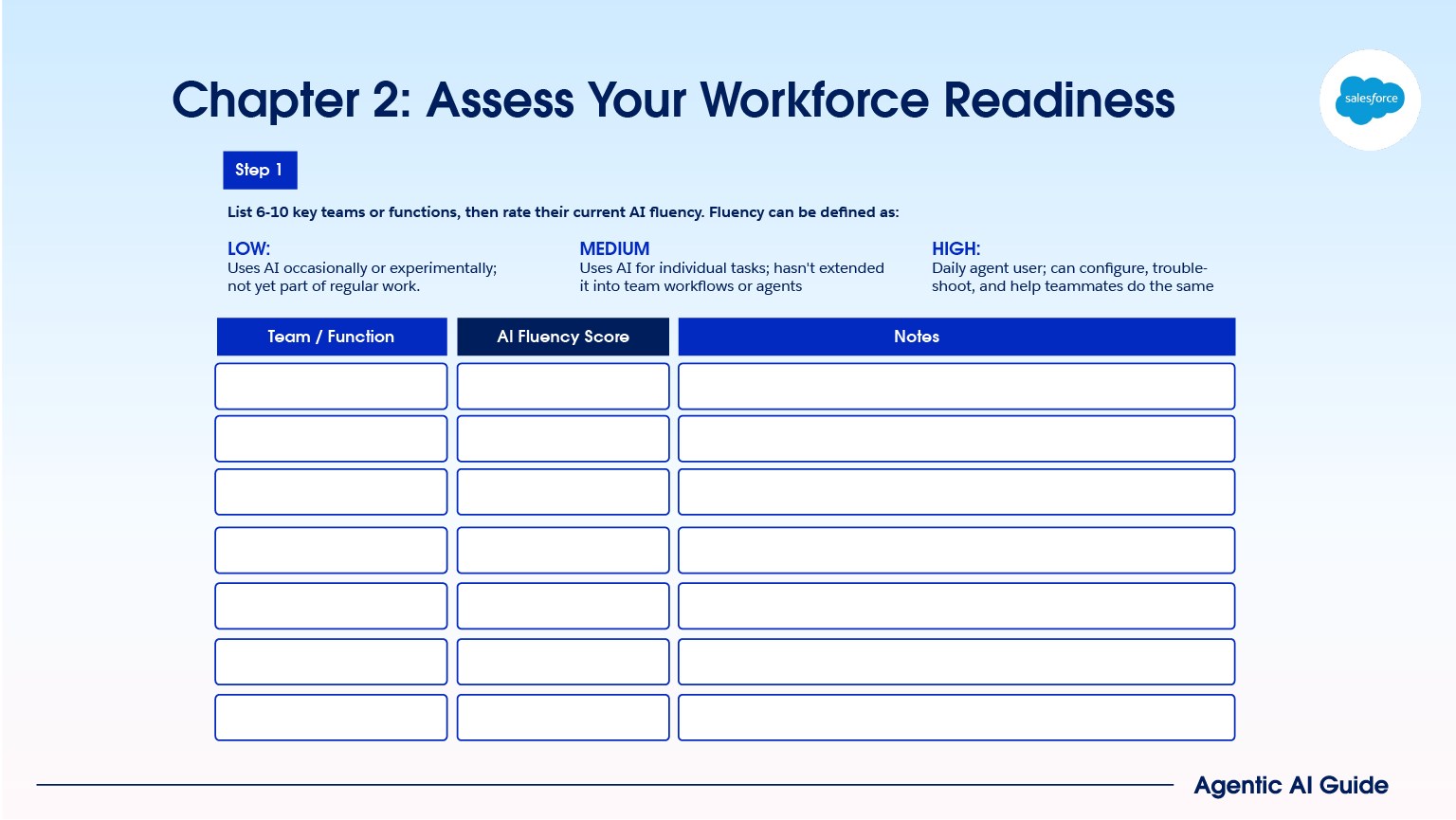
Download our workforce readiness worksheet
Before deploying agents, it helps to take stock of where your people actually are. Use this worksheet to map AI fluency across your organization and identify where resistance is most likely to surface.



Chapter 3
Begin with the right use case
Solve one problem well, then scale fast
Innovation this big — this seismic — has a way of making everything feel urgent. The good news: You do not have to transform everything at once for your company to get real value from AI.
Of the hundreds of organizations we’ve seen navigate this moment, the ones that succeed bring together cross-functional teams to dig deep into problems, assess needs, and align on what an agent can solve that would make an immediate difference.
In our The State of Agentic AI in the Enterprise report, 36% of deployed organizations point to a narrowly scoped use case as a top success factor.
36%
of deployed organizations cite a narrowly scoped use case as a top success factor
Source: The State of Agentic AI in the Enterprise
It’s evidence that you don’t need to reinvent the wheel, and you don’t have to do everything at once. Start with a clearly defined problem that promises tangible value. That’s the foundation everything else is built on.

Small business wins, enterprise lessons
Tommy Stricklen • VP, SMB Global Productivity
Surprisingly, some of the smartest examples of choosing the right use case come from organizations working with far fewer resources. Tommy Stricklen, VP of SMB global productivity, has observed that small and medium-sized businesses are often leading examples of successful agentic AI adoption because they have more clearly defined problems. They don’t try to use AI to fix everything. They zero in on a single problem that presents a clear challenge to the business and tackle it.
A strategic starting point
When determining your first use case, bring team members from across disciplines together to brainstorm. Start with four essential questions that separate successful implementations from failed experiments.
- What specific problem will this address? Focus on small, focused use cases tied to measurable problems, not abstract possibilities. Look for pain points, bottlenecks, or routine tasks that prevent your team from focusing on strategic work.
- What’s your organization’s risk appetite? If you’re in a highly regulated industry with low risk tolerance, consider internal agents first to build confidence.
- What data does the agent need to succeed? The simpler and cleaner your data requirements, the faster your path to value.
- How will teams actually engage with this agent? Map where your teams already work, then make the agent easy to reach in their day-to-day. Agents that live in the flow of work get used; agents that don’t become expensive demos.
These questions might seem basic, but they’re where most organizations stumble. By answering them, you’re discovering opportunities and getting clear answers up front, helping avoid costly pivots in the future.
Get inspired by top Agentforce use cases
Discover how leading organizations are working with Salesforce to transform workflows, empower teams, and unlock new value with agents within our Agentforce platform. Browse customer examples across sectors and geographies to find inspiration for your own transformation. Explore use cases.
How we’re doing it
When it came time to choose our first agent use case, we made a decision that surprised even ourselves: We went straight to a customer-facing one. Agentforce on our Help Portal would answer real customer questions, in the open, from day one.
There was some nervousness in that. What happens if the agent gets it wrong in front of a customer? But we chose it deliberately, for two reasons. First, we knew we’d learn far more from a live, customer-facing agent than from any internal pilot. Second, the ROI was clear and easy to measure. We’ve learned more in the months since launch than any behind-the-scenes test could have taught us.
The key was to start small. We limited the agent to a slice of our traffic, watched closely, and expanded as we built confidence. That approach let us discover early on that being correct wasn’t enough. The agent’s first answers were factually right but cold and robotic — so we built in what we call the “head and the heart”: the technical knowledge to answer accurately, and the tone, empathy, and judgment to know when to hand a frustrated customer straight to a human. A high-visibility, high-stakes use case forced us to get both right, fast.


Building Agentforce from the inside out
Bernard Slowey • SVP, Customer Success
Customer Zero is Salesforce’s commitment to going first — using its own products so it can learn faster, build better, and share what it finds with customers. Bernard Slowey leads that work on the Salesforce Help portal, and what his team discovered early is that technical accuracy alone doesn’t make an agent feel trustworthy. That’s when they stopped coaching the agent on what to say and started coaching it on how to be.
Engine’s secret weapon: continual agent improvement
Engine is an all-in-one travel and spend platform for small and medium businesses fielding over 800,000 customer service requests a year. Their engineering culture runs on a simple mantra: “ship fast, learn faster.” The second half of that equation, “learn faster,” is what makes good agents great.
While they had deployed a chatbot that could answer basic questions, it couldn’t take action — so every request, even “cancel my reservation,” required a rep to review details, search across multiple systems, and complete the update manually. This put pressure on the team as volume grew to 800,000 annual requests. To tackle this, they built their first agent, Eva, in just 12 days. Eva has now autonomously resolved 50% of incoming chat cases, cut average handle time by 15%, and lifted CSAT by 16%.
But Eva’s bigger contribution is what it unlocked. Because every action is built on Agentforce, each one is reusable. Building their second agent took days, not weeks. Today, Engine’s agents span support, IT, client services, and sales — and agentic capabilities are built right into Slack via Slackbot. Read more on Engine’s agentic success here →
Measuring what matters
Success requires more than good intentions. It demands rigorous measurement from day one. Organizations that track both efficiency gains and business impact create compelling narratives that build support for expansion.
Focus on metrics that resonate with different stakeholders.
- For executives: ROI, revenue impact, cost savings, competitive advantage.
- For operations teams: Time savings, error reduction, capacity expansion.
- For customers: Response times, resolution rates, satisfaction scores.
- For employees: Task automation, skill development opportunities, job satisfaction.
To learn more about how to define and measure agentic metrics that build ROI, adoption, and trust, visit Chapter 6: Never stop improving.
Try this activity: Select the right use case
Now it’s time to apply these principles to your organization. Gather six to eight stakeholders from various functions (operations, customer service, sales, marketing, IT, and executive leadership), block a few hours for deep discussion, and follow the steps below.
Step 1: Opportunity brainstorming
Each participant identifies two to three potential use cases from their domain.
Capture:
- What specific problem will this address?
- Key metrics that would improve
- Rough complexity estimate
Step 2: Framework mapping
Plot all opportunities on the use-case matrix (download below). Discuss placement until you reach consensus.
Step 3: Prioritization and sequencing
Select three to five use cases for immediate consideration based on your organization’s goals. Create a sequenced roadmap showing how you’ll progress from initial implementations to more ambitious applications.
Step 4: Action planning
For your top-priority use case, define your KPIs. Build in both leading and lagging indicators, including the early results you’ll see in month one, and the deeper outcomes that may not surface until month six. Socialize with your team:
- KPIs and required resources
- Key stakeholders and governance structure
- Next steps, timeline, and accountability
Agentic AI Resource
Download our use case selection worksheet
Brainstorm potential AI use cases with a cross-functional team, then plot each one on the matrix by honestly assessing its implementation complexity and business impact. By assessing your use cases through these categories you can prioritize where to start.


Chapter 4
Rethink business processes for the agentic age
Redesign intelligent workflows on desired outcomes
Remember when a phone was just a phone? You called people. Patiently texted using T9. But look at it now: It’s your camera, your wallet, your map, maybe even your house keys. The “phone” is the least interesting part. But that wasn’t automatically how we thought about it; it took us years to get there.
Agentic AI is at that exact moment. Many companies are treating agents as a phone with some extras, bolting it on to existing workflows. The companies who win do the opposite. They ask, “What does the work look like now that I have this?” and embed AI natively into their workflows. The returns from this action are real. Companies gain 55% employee adoption versus 47% for bolted-on tools. They also post the strongest gains in resolution time, at 34%, versus every other approach. Among leaders, 94% agree: embedding AI into core workflows beats running it standalone.
94%
of leaders say embedding AI directly into workflows delivers more value than using AI as a separate tool
Source: The State of Agentic AI in the Enterprise
In the previous chapter, you learned how to choose the correct use case. Now it’s time to build the workflows to make your agents successful. Here you’ll learn how to shift your thinking from steps to outcomes and create workflows that improve over time. By the end, you’ll have a framework for redesigning your most critical business processes — and the tools to keep refining them once they’re live.
Intelligent workflows that adapt
Agentic AI focuses on desired outcomes rather than fixed procedures. Instead of programming every possible scenario, you define what success looks like and allow the agent to determine the optimal path.
Consider the traditional approach to a customer service interaction.
Procedure-driven: A chatbot follows a fixed sequence of scripted questions and decision trees, frustrating customers with unique needs.
Outcome-driven: An agent understands a customer’s request and automatically asks further questions, pulls documents, and takes action to resolve the situation.
The outcome-driven approach enabled by agentic AI delivers several significant advantages:
- Adaptability to exceptions: Instead of breaking when encountering unforeseen scenarios, intelligent workflows can recognize novel situations and adapt.
- Continuous improvement: By focusing on outcomes, systems can learn from both successes and failures to refine their approach over time.
- Reduced cognitive burden on employees: Workers are freed from rigid procedures to pitch in where human capabilities are needed, such as a complicated service call.
How to start building your workflows
From our own experience, these are strategies that helped us rethink our workflows for the agentic era:
- Focus on what you want to achieve rather than scripting every step; otherwise, your workflows will break when they encounter situations you didn’t anticipate.
- Don’t over-engineer workflows upfront. Begin with basic requirements and allow your agent to learn from real usage patterns; otherwise, you’ll build overly complex systems that cause user drop-offs and miss opportunities for improvements.
- Create ways for agents to improve from both successes and failures, and for humans to provide feedback on agent performance; otherwise, your agents will stagnate.
- Define precisely when complexity, stakes, need for empathy, or time sensitivity should transition control from agent to human; otherwise, you’ll either over-rely on AI for sensitive decisions or waste human time on routine tasks.
- Ensure humans receive all necessary context and information when taking over from agents; otherwise, valuable time gets lost reconstructing what already happened and decisions get made with incomplete information.
How we’re doing it
At Salesforce, our managers run large, multi-layered teams. As responsibilities grew, the workflows to manage those teams started to buckle. Managers were spending too much time on clerical work — requesting feedback, chasing down stragglers, then reading and consolidating it all into something useful. We redesigned the admin-heavy workflow by building the Manager Agent on Agentforce. It gives every manager a single place to surface sentiment, initiate promotions, and request 360-degree feedback.
Now, a manager initiates a request, and the agent handles the work in between including gathering information, chasing down feedback, and synthesizing it into a clear picture. The manager still owns the final step: making the judgment call. As Pallavi Sebastian, SVP of agentic talent experience at Salesforce, puts it, “AI doesn’t get the vote. AI just aggregates the information and presents it. The manager is the one making the decision.”
That’s the shape of a hybrid workforce. The workflow is redesigned to empower both sides to do what each individually does best.

Measuring the human outcome
Pallavi Sebastian • SVP, Agentic Talent Experience
The old scorecard for AI was usage: who logged in and how often. Pallavi Sebastian, SVP of agentic talent experience, describes how that is now shifting. The question is no longer whether people are using AI, but whether it’s actually redesigning the workflows underneath the work.
For managers, rather than simply speeding up the old process, the agent reshapes the role. It absorbs the administrative weight and aggregates the information, while the judgment, the approvals, and the decisions stay human.
Designing around the answers, with UChicago Medicine
Andrew Chang, chief marketing officer of UChicago Medicine, had a blunt way of describing the gap between healthcare patient services and consumer expectation: “You can order a burger in seconds, but to schedule care, you’re on hold or waiting for a call back.” With over 2.5 million patient inquiries fielded every year, they needed a fundamentally different way of approaching their patients’ needs.
To do so, they’re using technology to transform the patient experience outside of the exam room. They deployed Agentforce, the agentic layer of the Salesforce Platform, to automate everyday workflows like scheduling appointments, managing prescription refills, and providing directions to the hospital.
Equally important, they defined what the agent would never do: diagnose, answer clinical questions, or collect sensitive data on patient details or medical records. With these agentic workflows in place, they deliver instant answers to their patients and their families instead of funneling them into automated systems that leave patients stranded without a solution or needing to repeatedly start over. Read more on UChicago’s agentic transformation here→

Workflows built for agents
Joe Inzerillo • President, Enterprise and AI Technology
For most companies, automated workflows only change when something breaks badly enough to force a greater fix. Change takes time because people need to adapt and humans need to get on board.
Agentic workflows are the exact opposite. Their adaptation time is zero – adjust the instructions and the workflow updates immediately and is executed faithfully from that moment on. Joe Inzerillo, president of enterprise and AI technology, explains how that changes the way work gets divided. When you encode human reasoning and judgment into the workflow and let agents carry the tireless tasks, you keep people on the decisions that actually need them. It’s humans for impact, agents for scale.
Anticipate technical challenges
Implementing agentic workflows comes with technical challenges: integration, governance, and resource requirements are a few we’ve experienced ourselves. Consider addressing these challenges proactively with these five core architectural principles.
- Scalability: The platform must handle growing computational demands as usage expands.
- Flexibility: The architecture should support seamless integration with existing systems and adaptation to evolving AI capabilities.
- Data accessibility: Agents need reliable access to accurate data sources, including databases and APIs.
- Trust: Implement guardrails, evaluations, and observability to ensure reliability and continuous improvement.
- Security and compliance: Implement strong measures to protect data with granular access controls and monitoring.
Workflows are shaped by every handoff, every exception, every moment a human steps in and improves what the agent couldn’t handle. But that evolution is only as good as what the agent knows. An agent working from incomplete, conflicting, or poorly described data won’t get smarter — it’ll just get faster at being wrong. In the next chapter, you’ll learn how to ground your agents in the data that makes them worth trusting.
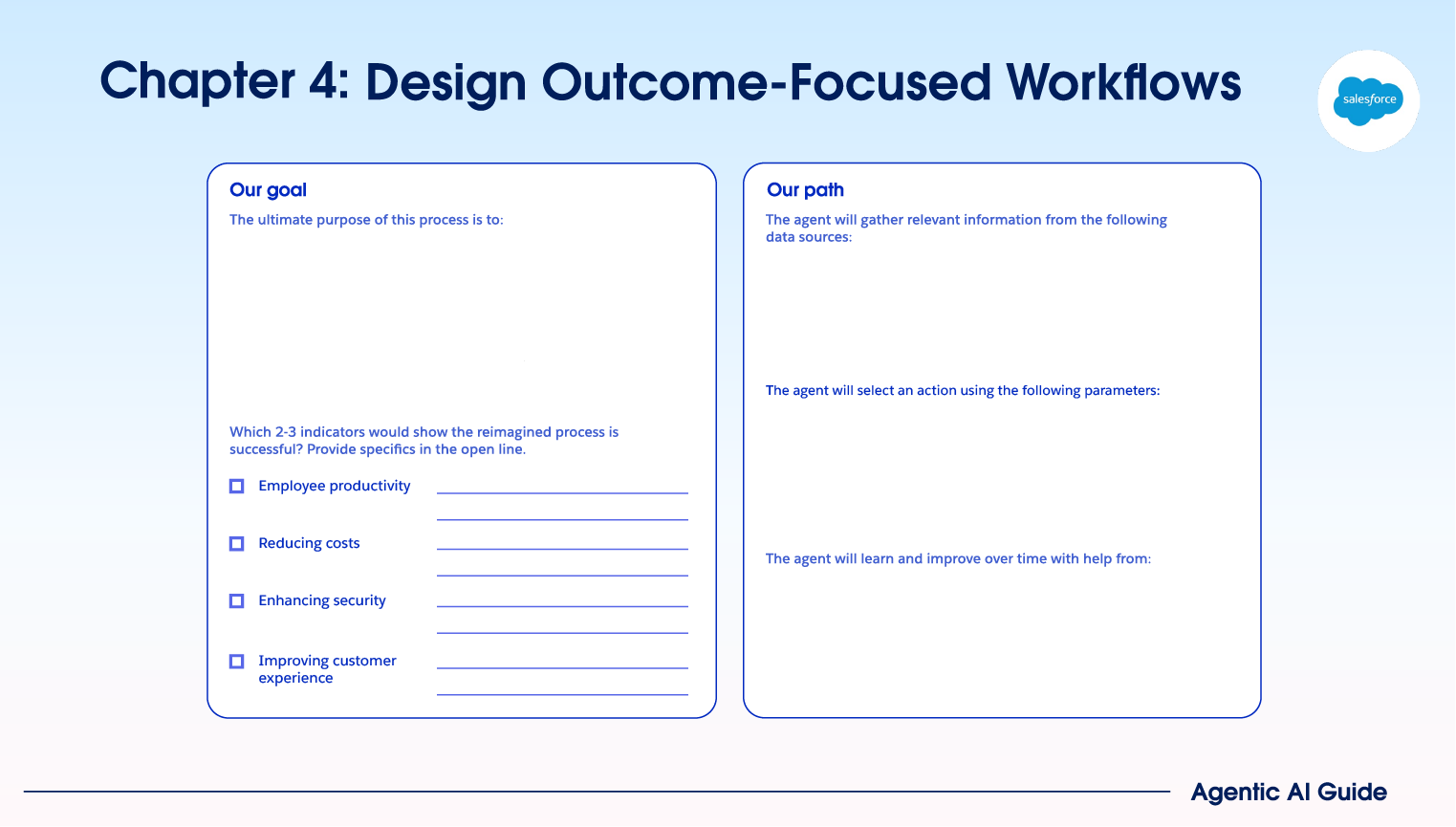
Try this activity: Design outcome-focused workflows
This activity walks you through the mapping (and potentially redesigning) of a workflow so humans and agents work together toward the outcome you’re after, not just the procedure you’ve always followed.
Complete these statements:
- What’s the ultimate goal of your workflow?
- Which two to three indicators would show the reimagined process is successful? Provide specifics.
- Time savings
- Improved accuracy
- Greater adaptability to exceptions
- Customer satisfaction
- Employee experience
- The agent will gather information from the following data sources: [List key data sources]
Agentic AI Resource
Download our Outcome-Focused Workflows worksheet
Before you build an agent into your workflow, define what success looks like. Use this worksheet to map your goal, your data sources, and how your agent will learn and improve over time. Then, use it as a baseline to measure against once the agent is live.


Chapter 5
Ground agents in trusted, reliable data
Turn your data into a competitive advantage
The philosopher Voltaire missed the AI era by a couple of centuries, but he understood the trap when it comes to getting started: Perfect is the enemy of good. In our The State of Agentic AI in the Enterprise report, we learned data readiness alone doesn’t determine who deploys AI successfully. Every level of data maturity is represented in the deployment camp, but what separates the successful from the unsuccessful is what happens after launch.
Organizations that prepared intentionally before deploying reached ROI nearly a month faster. Those that didn’t were significantly more likely to discover their data problems the hard way — in front of a customer. Among organizations that experienced a customer-facing incident, 79% point to their agents’ struggle to reliably access current, accurate data as the primary driver.
79%
of organizations report their agents struggle to reliably access current, accurate data
Source: The State of Agentic AI in the Enterprise
This is where ontology, the map of relationships between your data, deeply matters. In the chapter ahead, you’ll find a practical framework for assessing your data, closing any data gaps, and building a foundation that lets your agents perform when it counts.
The data reality check
It’s 12:23 a.m. on the East Coast and a customer is locked out of their account. They’re messaging your customer service agent, hoping for a quick fix. Your agent responds confidently, but the record it’s pulling from shows an old email address, not the one flagged for a recent security review. Your agent is blocked, your customer is frustrated, and a fix will have to wait until a human signs on in the morning. This is what a data failure looks like, and often, it’s caused by a lack of data connectivity.
By the time a human picks up the thread in the morning, the customer is frustrated and taking it out on a human rep. This is what a data failure looks like from the outside and often, it’s caused by lack of data connectivity.
The way most enterprise systems store data has fields and records on one side and then definitions, rules, and context on the other. Agents are caught in the middle with no connective tissue between the two, retrieving facts without knowing what those facts mean. That gap is where customer-facing failures are born.
The good news: it’s a closeable gap. Here’s where to start.
A unified knowledge foundation
Creating a comprehensive data foundation for AI agents requires structured and unstructured data from across your organization. This process involves more than simply connecting systems.
Structured data preparation:
Structured data is usually organized in tables, databases, or spreadsheets. Sounds pretty organized, right? It is — for humans. But challenges come up when AI models try to understand rows and columns effectively. That’s why the “text-to-SQL” task, how we translate natural language questions into database queries, requires specific preparation:
- Semantic mapping: Create clear metadata descriptions for your database schemas that explain not just field names but their business meaning and relationships (e.g., “customer_id” links to “Customer records in CRM system”).
- Query patterns: Document common query patterns your business uses to answer specific questions (e.g., “How do we typically calculate customer lifetime value?” or “What data points indicate churn risk?”).
- Data validation: Implement consistent validation rules to ensure data accuracy and completeness (e.g., required fields, data format standards, acceptable value ranges).
Unstructured data preparation:
Unstructured data (PDFs, images, videos, emails, chat transcripts) represents 78% of all stored enterprise data and often contains valuable information, but requires additional preparation.
- Content extraction: Use AI-powered tools to automatically extract text, entities, and relationships from various file formats (PDFs, Word docs, images, etc.), making previously locked information searchable and usable.
- Semantic organization: Apply consistent tagging and categorization to make content discoverable (for example, tagging customer support transcripts by issue type, product, or resolution status).
- Versioning control: Establish clear processes for handling document versions and updates to ensure agents always access the most current, authoritative information.
Connecting data sources
Creating a unified knowledge foundation requires connecting structured and unstructured data through consistent, repeatable methods. This is where the Model Context Protocol (MCP) comes in.
The MCP is a shared standard that lets AI connect to the data (and tools) it needs to get work done, while maintaining all the business rules and governance attached to the data. To understand how it works, imagine an AI system as an artist with the skill and inspiration to create a masterpiece, but all the necessary brushes, paints, and canvases are spread out across different locked workshops. MCP acts as a standardized master key system. It allows the artist to effortlessly access and use any tool or material from any workshop, no matter where it is located — while keeping track of where it came from, what other works it’s been used to paint, and which types of paints it can and can’t be used for. MCP allows AI agents to dynamically discover, query, and act on data sources, wherever they live.
How we’re doing it
When we built our Engagement Agent to reach the 75% of inbound leads our sales team couldn’t get to, we learned quickly that deploying the agent was the easy part. Knowing whether it actually worked took a different kind of investment. We started by tracking activity — emails sent, leads touched — but activity doesn’t tell you if an agent is performing. So we shifted to value metrics tied directly to business outcomes: emails opened, leads converted, meetings booked, revenue generated.
To get there, we analyzed six million of our own human-written SDR emails spanning six years — a precise record of how our best reps engaged prospects and what actually moved deals forward. Those patterns became the foundation for custom email quality scoring across dimensions like personalization, tone, and call-to-action strength. Every draft the Engagement Agent generates is now evaluated automatically, with specific critiques and scores returned before the email is ever sent.
The agent learns and self-corrects continuously, without requiring constant human review — and the results reflect it. The Engagement Agent generated nearly $120 million in pipeline in just the first few months of operation and booked more than 10,500 meetings from leads that previously received no human outreach at all.

The win is in your data
Sanika Goleria • EVP, Global GTM Planning and Prospect to Cash Innovation
Sanika Goleria, EVP of global GTM planning and prospect to cash innovation, has witnessed that organizations with strong data cultures and good data hygiene have more successful agentic transformation experiences.
Her advice: use the transformation as the moment to de-clutter. Bring all your content into one platform, and align on what you actually need and how it should be measured. The companies with an organized data framework, she says, will find this journey significantly easier than those without one.
With SharkNinja, the data came first
When SharkNinja set out to deploy Agentforce, they knew success depended on getting their data organized. Customer orders, service histories, and product catalogs lived in separate systems, siloed by region and brand, which meant duplicate customer profiles, inconsistent product names, and no reliable, cohesive foundation for an agent to reason from. To fix it and ensure every piece of customer interaction from the past – and present – is grounded in the latest data point, they unified Salesforce data, third-party systems, and website activity in Data 360.
Agentforce now handles 20,000 SharkNinja customer chats per week in the U.S., and since launching Commerce Cloud, they’ve seen a 14% year-over-year increase in items per cart. Its success that’s made possible by unifying and organizing their data. Read more on SharkNinja’s agentic transformation here →
Data governance and trust
Remember the fictional customer from earlier, locked out of their account? Organizations that build in data governance from the start are significantly less likely to experience a similar incident.
Here’s what to keep top of mind when building your system:
Data access controls
Implement the following governance measures:
- Role-based access: Define clear roles for agents just as you would for employees.
- Attribute-based access: Control access based on data attributes and classification.
- Purpose limitation: Restrict data usage to specific, documented purposes.
- Audit trails: Maintain comprehensive logs of all agent data access.
Privacy safeguards
Ensure appropriate privacy protections:
- Data minimization: Limit agent access to only the data necessary for their function.
- Anonymization/pseudonymization: Apply appropriate techniques for sensitive data.
- Retention policies: Implement clear data retention and deletion procedures.
- Consent management: Ensure proper consent tracking for data use.
Security measures
Implement these security best practices:
- Encryption: Protect data in transit and at rest with appropriate encryption.
- Multi-factor authentication: Apply strong authentication for sensitive system access.
- Backup and recovery: Ensure comprehensive backup procedures for all data.
- Security awareness: Train teams on security practices for AI systems.
Data quality determines outcome quality
The organizations that reach ROI fastest aren’t necessarily the ones with the cleanest data on day one. They’re the ones that treat data preparation as an ongoing discipline: building intentionally, fixing what deployment reveals, and deepening governance as they scale.
Bottom line:
- Clean and connect your data.
- Build a unified knowledge architecture your agents can reason from.
- Govern access with the same rigor you’d apply to any employee.
The quality of what goes in determines the quality of what comes out — for your agents, and for every customer they serve
Try this activity: Score essential data sources
Use the Essential Data Sources activity to assess your data readiness and identify the highest-impact improvements you can make today.
Step 1: Identify three to five essential data sources for your agent. These might include:
- Customer profiles
- Product information
- Transaction history
- Support case records
- Knowledge articles
Step 2: For each data source, rate its current state across four key dimensions.
- Accuracy: How correct and up to date is this data?
- Accessibility: How easily can agents retrieve this data when needed?
- Security: How well protected is this data from unauthorized access?
- Governance: How clearly defined are the rules for using this data?
Step 3: Based on your assessment, commit to ONE high-impact improvement action for each data source and assign a primary owner to that action.
Agentic AI Resource
Download our Essential Data Sources worksheet
For each data source your agents will need, score its readiness from 1 (needs significant improvement) to 3 (well established). Then identify an action to close that gap, and assign an owner to see it through.

Chapter 6
Never stop improving
Coach your agents, prove their worth
There’s a well-worn line from the early-’90s film Glengarry Glen Ross that every sales professional in your orbit probably knows. When it comes to making a deal, the mantra holds: “Always be closing” — never let up when you’ve got a big fish on the line.
When it comes to agentic AI, we could craft a similar phrase, just with a different turn. “Always be iterating” – because the organizations that win, after their agents are deployed, never stop improving upon them.
This chapter closes the loop on everything you’ve built so far, in two connected moves. The first: the discipline behind continuous improvement. We show you how to coach agents long after they go live. The second: proving to your people, your leadership, and eventually your board that the investment is paying off.
Put simply, iteration is how agents get better; measurement is how you prove it. You can’t sustain one without the other.
Launching is the starting line
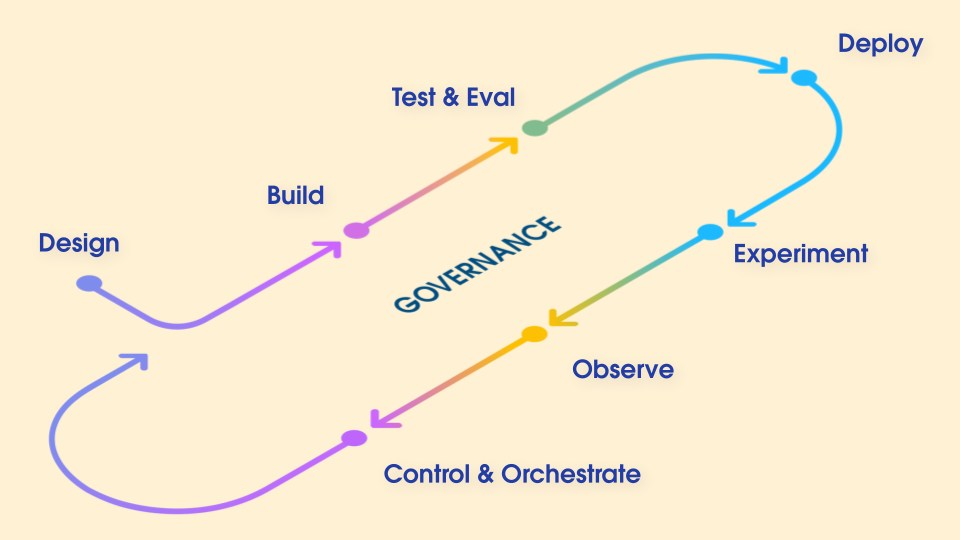
The agents that keep delivering are those that keep getting coached, then put back in the game. We call this process the Agent Development Lifecycle (ADLC), and it’s what separates agents that deliver lasting value from ones that plateau. At Salesforce, we’ve seen it play out in our own deployments: agents that start out just OK, get coached, and progressively improve until they are genuinely transforming how work gets done.

The agent development lifecycle
Derya Isler • VP, Machine Learning Platforms and Applications
As a VP of machine learning, Derya Isler built the Agent Development Lifecycle (ADLC), the iterative system that keeps Salesforce’s own agents improving long after launch. The ADLC is a flywheel that moves from design, building, and testing to agent deployment, experimentation, observation, then control and orchestration, before circling back into development again.
The cycle matters because real-world performance rarely matches what you see in a controlled testing environment. Every deployment generates new signals about where agents succeed, where they fail, and how they should improve. The agents that keep delivering are the ones that continuously learn from those real-world outcomes and feed those insights back into development. As Derya puts it: “Ideally, agents should learn from their failures and improve themselves over time — and that’s the direction the entire industry is going through now.”
Asymbl’s growth engine: one agent, compounding returns
Workforce orchestration startup Asymbl couldn’t keep pace with demand. They had one sales development rep managing hundreds of prospects across a fragmented tech stack with no clear source of truth. To handle the workload, they built Theodore, an Agentforce agent that qualifies leads, schedules calls, and manages outbound prospecting around the clock. Even though Theodore was a successful agent, Asymbl didn’t “set it and forget it.” Every week, Asymbl’s sales team reviews Theodore’s outreach in coaching sessions, learns from his messaging, and feeds improvements directly back into the agent. That feedback loop is the engine behind their success: 1,000+ leads handled per week, $1.5 million in cost savings, and 3,789% ROI. The agent performing today isn’t the one they deployed — it’s the one they kept improving. Read more on Asymbl’s agentic transformation here →
Four ways to keep your agents getting better
- Measure impact, not just functionality
Don’t just track whether an agent works. Measure its business value: adoption, efficacy, performance, and tangible outcomes. Without meaningful metrics, you won’t know whether your agent is improving or quietly degrading. - Treat iteration as the job
Launch is the beginning, not the finish line. Collect real-time user feedback, monitor interactions, and refine agent behavior continuously. Treat agents like employees: teach them, correct them, and update them based on what real-world use reveals. - Start small, expand strategically
Begin with a focused use case, then gradually expand capabilities as agents prove their value. Feed them richer, more structured data over time; improvement compounds when scope and data quality grow together. - Govern sensibly, not defensively
Implement guardrails to prevent errors, but resist the urge to over-restrict. Governance that’s too tight kills the innovation it’s meant to protect. Joe Inzerillo, who leads enterprise and AI technology, draws on Salesforce’s Customer Zero experience to share his “progress versus perfection” perspective: “Good enough to learn is the bar. Define agent guardrails sensibly, but don’t overbuild them to the point where you kill the innovation.”
Measure with metrics that build ROI, adoption, and trust
As you’re working through your agentic transformation, the pressure to prove AI is working can feel relentless. The good news: you’ll never have to build your defense on a house of cards. Agentic results are both quantitatively and qualitatively measurable, and they show up across every dimension that matters.
Here’s what it looks like in practice: In The State of Agentic AI in the Enterprise report, eight months into deployment, organizations report, 53% employee adoption, 29% CSAT improvement, 31% faster resolution times, and 29% reduction in operational costs.
These kinds of results make the business case for deployment and set a concrete benchmark for organizations still weighing the investment.

Agentic success has two scorecards
Ruth Hickin • SVP, Workforce Innovation
Ruth Hickin, SVP of workforce innovation, believes that measuring success in the agentic enterprise requires two ways of keeping score.
The business case is the more visible half: more revenue closed, higher quality code shipped, and efficiency gains appearing on the balance sheet. The other half isn’t as visible but is just as critical: employee experience. At Salesforce, this means tracking how AI is reducing bureaucracy, how employees feel about their work, and how many people are moving into new and better roles.
Internal mobility, she says, is one of the most telling indicators. Salesforce currently has an internal mobility rate of around 50% – a figure she sees as evidence that the workforce is adapting well.
How we’re doing it
For more than a year, Salesforce Help has been giving customers faster answers and expert guidance when they need it. To understand what’s working on the platform, we track key support metrics and use those insights to continuously improve the experience.
Help Agent metrics fall into two categories: adoption and effectiveness
#1. Adoption Metrics
Before Agentforce can be effective, customers need to use it. Adoption shows whether customers are turning to the Help Agent and gives us early indicators of reduced case volume and cost savings.
We look at:
- Help Portal Sessions: How many customers visit Salesforce Help.
- Conversations: The number of times customers initiate a conversation by submitting a question.
#2. Effectiveness
Once adoption is established, the next question is the most important: Is Agentforce helping customers?
Customer interactions typically fall into three buckets: resolution by Agentforce, escalation to a human support engineer, or abandonment.
To understand how well Agentforce performs in each area, we monitor:
- Abandons: A customer starts a session but leaves before asking a question.
- Resolutions: A customer interaction concluded without a handoff to a human.
- Customer-confirmed resolution: A customer confirms that Agentforce solved their issue.
- CSAT: A customer provides a customer satisfaction score at the end of an Agentforce interaction.
- Hand-offs to human (escalations): A customer is transferred from Agentforce to a support engineer.
Together, these support metrics show how Agentforce contributes to faster resolutions, higher customer satisfaction, and stronger trust.
Agentic metrics that matter most
Like humans, agents have varied skills and areas of expertise. That’s why there’s no “one-size-fits-all” rubric for measuring their performance. The metrics that matter most will depend on your specific agents, your use cases, and your goals. However, a few key indicators apply across almost any agentic deployment:
Response accuracy
How often your agent provides correct or contextually appropriate answers. Track confidence scores to catch inconsistencies early. These scores could include:
- Benchmark datasets
- Manual review
- Validation tools
User satisfaction
How effective and trustworthy the AI feels to its audience. Track completion rates and repeat interactions to gauge genuine helpfulness. These rates could include:
- CSAT surveys
- Interaction ratings
- Engagement rate
Response time
How quickly your agent processes a query and delivers an answer. By monitoring and optimizing latency, you can meaningfully improve the user experience for everyone it serves. These times could include:
- Latency monitoring
- Real-time feedback
How Pandora turned every handoff into a data point
Pandora knew that becoming an agentic enterprise meant measuring every step of the journey. When they built Clara, their Agentforce-powered customer service agent, they tracked performance and scaled only as confidence in the results grew.
The discipline extended to how Clara handed off as well. When a request exceeded Clara’s scope, it was transferred to a human agent — always with a full conversation summary. This allowed reps to get up to speed instantly and ensured customers would never have to repeat themselves. With Clara, every handoff is tracked and every interaction is a data point. Clara now handles 40,000 conversations a month, autonomously deflects 60% of cases, and has driven a 10% lift in net promoter score. Read more on Pandora’s agentic transformation here →
Your moment is now
One year ago, we told you the companies defining the next decade weren’t waiting for perfect conditions. And now, with a year more of experience, it’s only added more dimension to our outlook: The window of possibility is wider than you think.
Joe Inzerillo, president of enterprise and AI technology, puts it plainly: “For the first time in the history of technology, scale isn’t the problem. You can have as much scale as you can afford. What you can’t afford is inaction.”
This is what makes this moment genuinely different from every previous technology shift. The leaders who moved early are compounding their advantage. And with the incredible innovation in AI over just the past year alone, the organizations coming in now can catch up in ways that simply weren’t possible before. If you have a learner’s mindset, this is a catalyst moment and it’s available to anyone willing to get their hands dirty and persist in a new world full of incredible technology.
What you build from here is up to you.
Try this final activity: Audit the lifecycle, score the outcomes
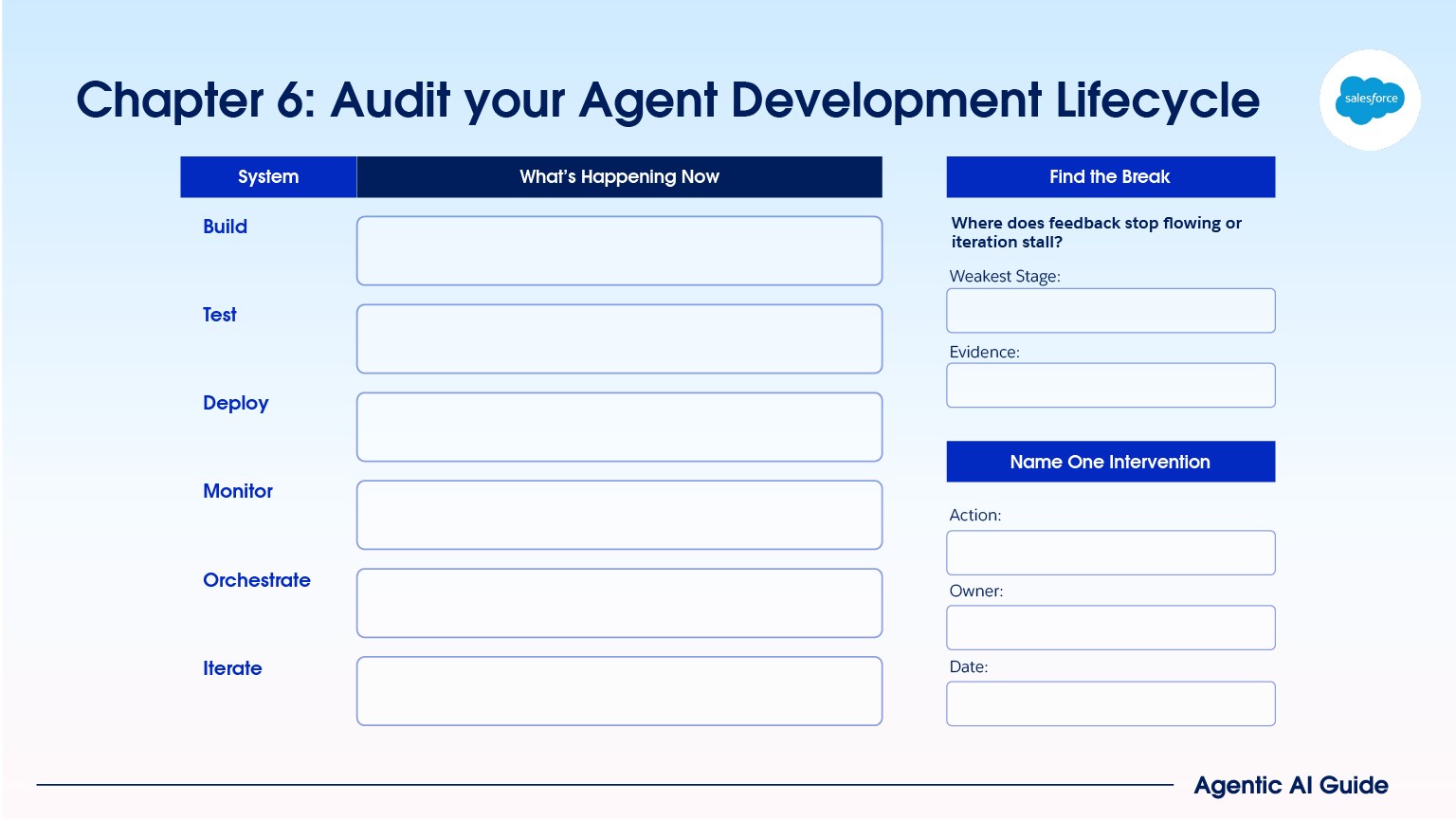
We couldn’t leave you without a final bit of (voluntary) homework. As you learned, an agent’s work is never really done. In this activity, use the Agent Development Lifecycle (ADLC) to give your agent a progress report. Then, based on your agent’s performance, score the agent on each stage.
Step 1:
Map the six stages
Walk your agent through each stage of the ADLC and note what’s actually happening at each one:
Build · Test · Deploy · Monitor · Orchestrate · Iterate
Step 2:
Find the break
Pinpoint where feedback stops flowing or iteration stalls. Ask at each stage: Is data moving to the next stage, or does it dead-end here?
Step 3:
Name one intervention
Commit to a single, specific action to close the lifecycle at your weakest point. Assign an owner and a date.
After you’ve audited your agent, score each measurable dimension.
Step 1:
Rate your agent
Rate your agent 1–3 on each dimension (1 = needs significant work vs. 3 = well established):
Adoption · Efficacy · Performance · Business value
Step 2:
Access each dimension
Answer one diagnostic question per dimension. For each score, note why — what’s the evidence behind the number?
Step 3:
Commit and assign
Choose one improvement action per dimension and assign an owner.
Agentic AI Resource
Download our Agentic Development Lifecycle worksheet
You can use our Agentic Development Lifecycle (ADLC) worksheet to create a “Never Stop Improving” plan for every agent you deploy. Download and assign this activity to your humans at the helm of your agents.
Get the agentic AI guide delivered to your inbox.
Sign up for weekly lessons over 5 weeks and learn to:
- Choose the right use cases
- Prep your teams
- Structure your data
- Scale smarter
At Salesforce, we’ve guided startups to Fortune 500s through AI evolution. Get our practical roadmap and navigate this exciting era with confidence.
Thank you for signing up! Stay tuned for your weekly lessons.