Playbook
Scale Your Agentic Enterprise: A Step-By-Step Guide


Introduction
How to start scaling agentic AI
You’ve built the agents. Now build the enterprise that puts humans and agents to work, side by side.
Chapter 1
Empower everyone to build
Create a crew of builders.
Chapter 2
Redesign processes and systems for agentic scale
Move at the speed of agents.
Chapter 3
Turn wins into scaled impact
Scale agents without starting over.
Chapter 4
Shaping a future-ready workforce
The next horizon? Human-AI partnership.
Chapter 5
What’s Next in Enterprise AI
Welcome to the dawn of the Self-Evolving Enterprise.
Introduction
How to start scaling agentic AI
You’ve built agents. Now build the enterprise that puts humans and agents to work, side by side.
You went all in on agentic AI and it paid off. Your first agents are deployed, and as you iterate, redeploy, and monitor them, you’re seeing real, measurable outcomes. The promise of our first AI Playbook, Become an Agentic Enterprise: A Step-By-Step Guide — getting your first agents into production and running successfully — is now reality.
But your success is raising new questions:
- How do you keep the momentum going?
- How do you turn a couple of successful agents into an impact that transforms your entire business?
This is where scaling comes into play.

What’s the difference between becoming an agentic enterprise vs. scaling one?
In our first guide, we covered how to start building your agents, get your team on board, and commit to a constant state of agentic improvement. Now for the next step: scaling. Scaling is when humans and agents coordinate across every system and workflow, making work move autonomously. This is when the agentic advantage compounds, customer needs are anticipated, employees can elevate their impact beyond their job responsibilities, and companies can unlock their biggest ROI. But it requires courage! Here, our leaders share their own perspective on what it takes to scale and how it looks slightly different for everyone.
We’ve hit the ceiling of human scale
For twenty years, the constraint on almost every business was the same: how much a human team could carry. How many cases one rep could close, how many deals one AE could work, how many tickets one engineer could reasonably resolve in a day. Everything about how modern companies are organized — pods, sprints, escalation ladders, quarterly plans and reviews — was designed to squeeze the last drop of productivity out of finite human bandwidth.
That ceiling has been reached.
Joe Inzerillo, president of enterprise and AI technology at Salesforce, puts it plainly: “We’ve hit the capacity of human scale. Now we get to use AI to redesign the underlying processes that have been holding us back.”
This is the reframe on the future of work that we believe is worth reflection and discussion amongst teams in every industry. The point of AI agents isn’t to replace people in the workforce. It’s to finally do something about the human-scale processes that have been quietly straining every function in the business. Adding more agents on top of broken workflows doesn’t scale a company. Rebuilding the workflows underneath so that humans and agents can each do what they do best? That’s what actually scales.
How to use this guide
If you’re already running agents and starting to feel the growing pains, you’re in the right place. If you’d rather jump straight to the chapter that addresses your immediate bottleneck, our guide supports that too. And, if you are not ready to scale, are still piloting, or could use a refresher on the basics to share with your teams, start with our first step-by-step guide: Become an Agentic Enterprise.
The chapters in this guide include:
How we’re scaling it
A look into our recent Customer Zero techniques and learnings that we build, test out, and implement internally before rolling it out to you.
Customer stories
Wins, pitfalls, and no-holds-barred examples from real Salesforce customers further along their agentic journey.
Voices of the Playbook
Brief video insights from our leaders with a micro-lesson on what breaks — and what holds — as agent programs grow.
A downloadable worksheet
A way to reinforce the chapter’s key lessons and put them into practice with your team.
You’ll start by building the crew that can operate at agentic speed, for jobs that didn’t exist three years ago. From there, you’ll learn how to redesign the processes and systems underneath your agents, so scaling doesn’t mean rebuilding from scratch every time. Then, discover how to turn early wins into a system where agents find each other, talk to each other, and hand off work without you needing to stand in the middle. And finally, get an honest look at what’s coming next, so you’re building today what you’ll need tomorrow. The result is a foundation that acts as a single source of truth, one that empowers everyone in your org to be a builder.
Ready to scale agentic AI throughout your organization? Let’s dive in.
Chapter 1
Empower everyone to build
Create a crew of builders
For three decades, Harvard Business School’s Linda A. Hill has studied what actually makes organizations innovate — research that culminated in her latest book, Genius at Scale: How Great Leaders Drive Innovation. Her conclusion, after tracking innovation leaders from Pixar to Pfizer to our own AI Research team at Salesforce, is disarmingly simple: “Leading innovation isn’t about getting individuals to follow you into the future. It’s about building an environment in which they will co-create the future with you.” That reframe matters more than ever now. In an era where any company can rent frontier intelligence off the shelf, the durable advantage isn’t the AI you deploy, it’s the people you empower.
To build the most sophisticated agent orchestration system in the world, you need humans. You need them to, of course, design it, monitor and manage it, but you also need them in the weeds. A partner that collaborates with your agentic system as AI itself rapidly evolves. As we discussed in Chapter 2: Design your human-AI workforce in our first guide, part of this requires building AI fluency across your workforce before it’s needed, creating the conditions where employees see agents as force multipliers rather than threats, and designing how humans and agents succeed together. The other part? It’s about hiring people specifically for this work, for jobs that didn’t even exist three years ago. We know this isn’t easy (we’re building an AI-first workforce too) and the majority of businesses are figuring this out in real time as well. In our recent The State of Agentic AI in the Enterprise report we found that 89% of deployed organizations are already rethinking or reworking their workforce model to formally account for AI agents — and not one said they had no plans to.
89%
of deployed organizations are already rethinking or reworking their workforce model to formally account for AI agents
Source: The State of Agentic AI in the Enterprise, 2026
This chapter teaches you how to build the team AI needs to succeed. We’ll look at how Salesforce is filling roles by hiring directly for this work. We’ll delve into what changes when you craft an agent-native workspace instead of having those “skills” bolted on to existing roles, and what it actually takes to lead a team where everyone is expected to build with AI.
IT lays the foundation
Probably like you, before our agentic transformation, IT owned everything end-to-end with no shared infrastructure. Now, we’re living in a different world. We give teams from every discipline the tools to build what they want. But before doing so we had to ask ourselves, “How do we enable everyone to be a builder but still protect the integrity of everything that matters for running a company at scale?”.
Our solution: IT still owns systems of record, integrity, SOX, trust, and compliance. The complex foundations are under their control so everyone can safely build. This gives our teams a safe place to tinker without having to route what they build through IT. The teams own whatever they’re building and shifting this ownership to the people closest to the problem makes speed compound.
How we’re scaling it
As agentic adoption accelerates, the industry is realizing the full value of AI depends as much on the underlying operational fabric as it does on the agents themselves. In The State of Agentic AI in the Enterprise report, we’ve found among the top ranked success factors that predict agentic success are well-governed and accessible data, clearly defined agent scope, and human-in-the-loop escalation paths.
The foundation for our agentic scale is our architecture: AIforce. We’ve built AIforce to give a business complete control and accountability over agents. It brings Salesforce into the tools people already use every day, like Slack, Claude, or Microsoft Teams. Now, employees can act on shared data and work without ever opening a Salesforce tab. And through Model Context Protocol (MCP) tools and Agent Fabric, they can easily add capabilities without adding one-off integrations (which can create operational silos and diminish performance).
Within AIforce, every action an agent takes is automatically traceable back to a single, unified view. This replaces manual trust checks, where a human would have to investigate and vouch for each agent. Trust is now a data question that can be easily monitored on a dashboard.
Building is now a team sport
Crafting an agentic workforce goes beyond hiring and redesigning roles. We’ve learned it also requires a shared workspace where your people can build and work together with agents as teammates. For us, that shared workspace is Slack and within it, Slack Code empowers everyone to build, right in the flow of work.
Unlike in the past, when being a technologist was a solo endeavor and required a specialized skill set, Slack Code is open to all skill levels and lets a team build an agent collaboratively, right in a Slack code channel. Once deployed, agents built in Slack Code can simply be mentioned, like a human teammate, and work with you. It also runs on the same enterprise-grade security and permissions as the rest of Slack, so there’s always a final human say before anything goes live.

How to lead when everyone’s a builder
Adam Johnson • SVP, Small Business Sales
Adam Johnson, who leads transformation and productivity for Salesforce’s small business sales team, has watched what happens when every employee suddenly has the tools to build their own AI solutions. His advice: Let small, personal tools stay small if they only help one person or one team work better. But anything you want to scale across the whole organization needs centralized conviction — a real decision, made deliberately, about what the best practice actually is.
Skip that, he says, and you end up competing with your own employee-builders, each convinced their version is the right one. However, by building enough conviction, backed by real results, you can rally people behind one approach instead of defending their own.
The jobs that don’t exist on your org chart yet
If you’ve deployed agents, you know the work has changed. Agents don’t fail in the way software does. Unlike software where a crashed service can get engineering involved at 3am, an agent that’s messing up doesn’t throw up any alarms. It just keeps confidently doing its job, until a customer angrily complains on social media or someone internal catches it being inaccurate.
To combat this from the start, Salesforce built a framework for this called the Agent Development Lifecycle (ADLC). You may remember it from our first playbook in Chapter 6: Never Stop Improving.

ADLC requires ongoing human management from an agent’s first day on the job. But successful agent management depends less on traditional job titles and more on the mastery of specific jobs to be done (JTBD).
How these jobs are staffed depends on two dimensions: the size of your company and the size of the job. A nimble startup might have one or two agentic technologists covering all nine functions. A large enterprise might have dedicated teams for each. A smaller org deploying a complex, high-stakes agent might need to flex a big team to support delivery. But all functions are critical to success in ADLC.
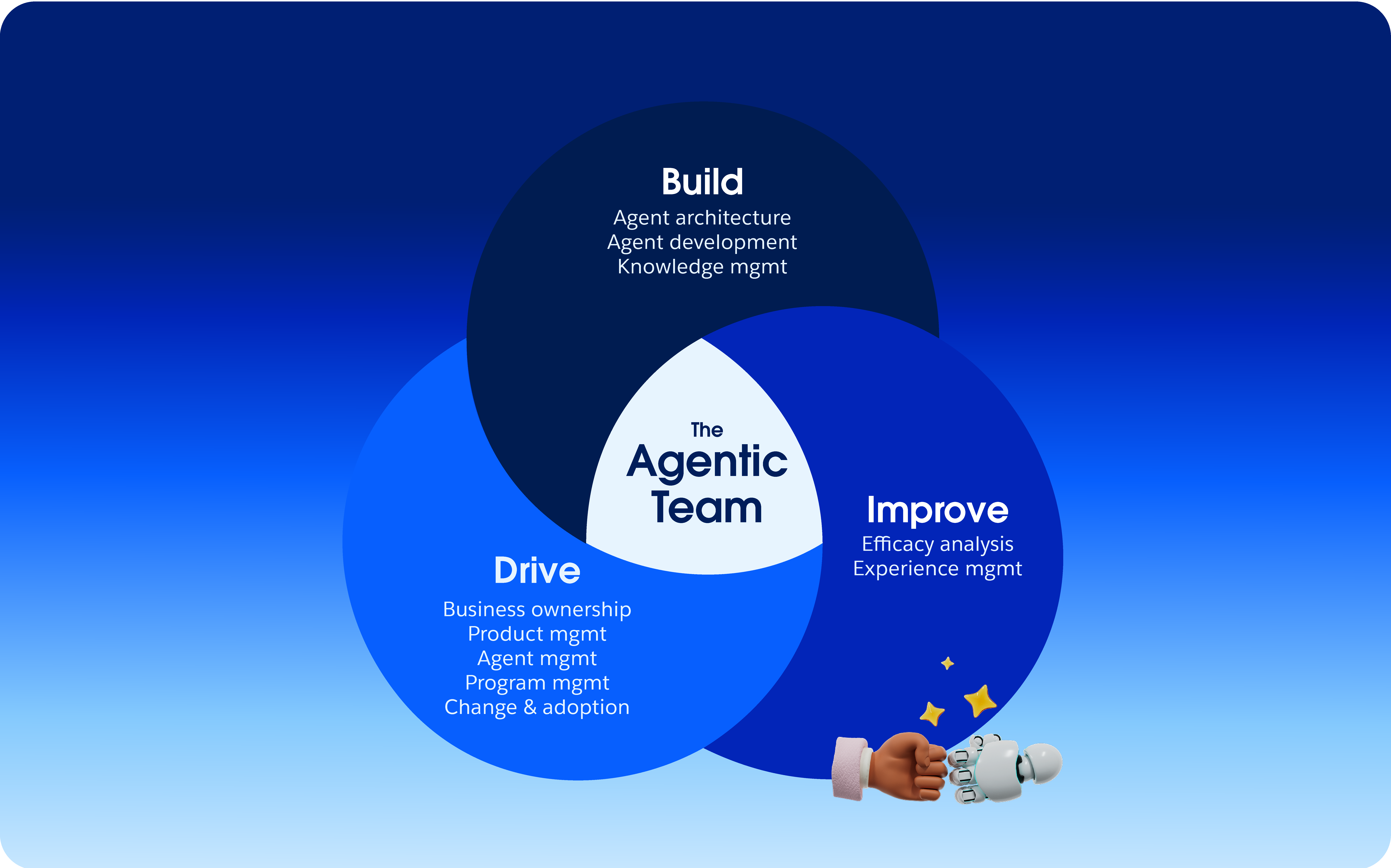
Through our work building and deploying agents at scale, we’ve identified ten critical JTBD that every organization must address:
Building functions
- Agent architecture: Designing the technical framework, including capabilities, boundaries, and the placement of “deterministic fences” around probabilistic reasoning.
- Agent development: Translating architecture into working behavior by configuring topics, actions, and custom code integrations.
- Knowledge management: Managing the data and content strategy, such as CRM records and knowledge articles, that provide the agent with the factual grounding it needs to reason accurately.
Improvement functions
- Efficacy analysis: Monitoring quality metrics and analyzing session data to identify performance gaps and run “performance reviews” for agents.
- Experience management: Designing the conversational framework and natural language “job descriptions” to ensure agent interactions feel intuitive and consistent.
Driving functions
- Business ownership: Defining business outcomes, setting ROI targets, and prioritizing which JTBD is worth an agent’s time.
- Product management: Owning the agent’s roadmap and feature prioritization — translating business strategy and user feedback into a backlog of capabilities, defining success for each iteration, and serving as the connective tissue between business ownership and building functions.
- Agent management: Providing human-in-the-loop oversight, monitoring live sessions, and handling real-time operational triage and escalations.
- Program management: Coordinating ADLC across cross-functional teams to manage timelines, dependencies, and the calibration loop.
- Change and adoption: Designing the training and stakeholder communication necessary to integrate agents into new workflows and shift user behavior.
The organizations that lead in this era will be those that staff these critical functions intentionally, ensuring every JTBD has a seat at the table.
How we’re scaling
At Salesforce, we’re building agentic teams of “expert generalists” who flex and blur the lines between traditional roles to support both technical builds and skills coaching. Organizations don’t necessarily need to hire net-new people; instead, they can upskill existing teams to handle these core functions. But another one of our answers to “Where do you find people built for this work?” is to grow them. In May 2026, we committed to hiring 1,000 AI-native graduates and interns through a new Builder program, run out of Futureforce, our university recruiting engine.
We discovered that emerging talent is four times more likely to use AI daily, and building that talent internally is one-third the cost of hiring experienced workers externally. Our chief people officer, Nathalie Scardino states “Businesses can’t afford to wait for their workforce to catch up to AI. That’s why we’re betting on Builders now — to redesign how we work and redefine our business from the inside out.”
In a short period of time, we’ve already seen incredible results. For example, a Futureforce graduate named Raymond Dinh built a Lightning web component for Agentforce’s chat interface, then went on to co-demo a live Agentforce build in front of the entire company at Salesforce’s FY27 Kickoff. Another, Rebecca Hampton, caught a design flaw in an onboarding agent that years of institutional habit had made invisible to everyone more senior than her because she was willing to ask “Why do we do it this way?” out loud.
We packaged what we learned building this pipeline into a framework we call the 3As:
- Attract talent early with hands-on AI experiences.
- Assess for AI fluency and adaptability rather than pedigree.
- Activate through real projects with real accountability.
Go deeper into our strategy for future-proofing work with our Emerging Talent Playbook.

Four modes for a company full of builders
Shibani Ahuja • SVP, COFO Data & AI Strategy
Ten jobs to be done is a lot to staff, and not every AI deployment needs all ten. Shibani Ahuja, who leads data and AI strategy for Salesforce’s corporate functions, developed the Four Modes of Enterprise AI as a working vocabulary for right-sizing that investment. It’s a way to classify whatever AI is being built or used at any given moment, so leaders can match the level of oversight to what’s actually at stake, without over-governing what’s meant to be light or under-governing what could affect an entire function.
The four modes can coexist. Most enterprises operate in all of them at once, and each one calls for a different builder profile, a different owner, and a different level of oversight.
- Mode 1: Assistive AI for everyone. Everyday tools every colleague can use in the flow of work. Universal access, low governance by design.
- Mode 2: Builder tools. Environments where a smaller group creates skills and lightweight agents. Governance means cataloging what’s built so it can scale.
- Mode 3: Contained agents. Agents that automate a single, well-defined process inside one department. One clear owner, contained blast radius, moderate governance.
- Mode 4: End-to-end agents. Agents that span multiple departments and handoffs across a full functional process. Broader blast radius, dedicated management, shared governance.
Use the modes as a lens for staffing a builder culture: who should be building in each mode, what oversight belongs at each level, and who is accountable if any of it goes bump in the night.
The team is the thing
Creating a culture of builders is an exercise that only becomes more cohesive with time. As we illustrated in this chapter, attracting AI-native talent through a designated, outreach program, hiring and redesigning more senior roles to cater to specific stages of the ADLC, and giving both groups a shared place to build, like Slack, is a multi-pronged approach that we’ve seen work.
The design of your team will be unique to your business. But you still want to bring in talent that’s ready right now, show commitment to developing your existing ambitious employees, and create a working environment where experimentation and new ways of working can happen transparently, in service of what the business is trying to achieve.
Try this activity: building with purpose
Start designing the team your AI needs to succeed by answering the below questions.
Pillar #1: Roles and ownership
- Does every phase of your agent lifecycle — design, build, test & evaluate, deploy, experiment, observe, control & orchestrate — have a manager?
- If an agent starts drifting in production, is there one person whose job is to notice, or does it depend on who happens to catch it?
Pillar #2: Sourcing
- Are you filling AI-native roles by hiring new people? Or are you filling them by redeploying people already on staff?
Pillar #3: Conviction
- Can you tell the difference right now between something an employee is experimenting with, a personal tool that only helps one person, and something that’s quietly becoming load-bearing for a whole team?
- Who has the authority to say “this is now the way we do it” — and is that decision ever made out loud, or does it happen by default because no one stopped it?
Scaling the Agentic Enterprise Resource
Download our building with purpose worksheet
As you’re scaling, conduct a small audit of how your system is set up to build, run, and improve your agents. Work through the three pillars with the people who’d actually own the answers, and pick one agent (or your program overall) to hold in mind as you go. If the honest answers are things like “No one,” “It depends,” or “We’ve never decided,” you’ve found your first design decision.

Chapter 2
Redesign processes and systems for agentic scale
Move at the speed of agents
Just three years ago, the limits on how quickly work could get done were set by a human team’s capacity. Things like: How much can one person excel across different disciplines, or how many handoffs can one team navigate before it becomes a bottleneck? But these limits are starting to vanish. We’re now entering a working world no longer bound by how deep one person’s expertise runs, or how many handoffs a team can coordinate before it stalls.
With AI, even the meaning behind the words we used to describe fast-moving teams is becoming outdated. Nimble used to mean a team that could ship in a two-week sprint. Now, with agentic capabilities, two-week sprints have been condensed into two days. At Salesforce, Robbie Birbeck, VP of business technology, puts it plainly, “The cycles are shrinking. We’re experimenting with week-long cycles, but I think almost every day starts to feel like its own cycle.”
Teams still gather for something that looks like an agile scrum or stand-up meeting, but the work they take on is reactive, built on what got shipped yesterday, not what got planned two sprints ago. If you try to plan a week or two of work in advance, you’ll find yourself living in the past, because the team accomplished more than anyone predicted the day before.
Some are thriving in this new pace of work. Others are struggling, often on the same team. Salesforce didn’t try to solve that tension universally. Instead, we identified who was already operating at this new rhythm, captured what was working, and replicated it across the company.
This chapter is about that redesign. You’ll see where Salesforce points its newfound speed, and the small-team model built to capture it: the Rapid Innovation Squad, or RIS. You’ll see the discipline that keeps its results honest, and how to build a version of RIS on your own team.
Go after green space
The speed at which agents can deliver is astounding. However, they need well-defined problems to pursue so they can produce meaningful value. In Chapter 3 of our first guide, we explored how to find the right first use case to put AI to work. Now that we’re scaling, we can go bigger and look for green space.
Green space is an area with problems that have limited or no solutions. It’s an arena of pure potential that reduces risk and empowers action. Andy White, SVP of Salesforce on Salesforce technology, puts the importance of staking out green space in blunt terms: “Who’s your business stakeholder that’s really going to stand up and say I want to disrupt some things? Because what we’re talking about here is disruption.”
Two examples of our first green spaces: Salesforce Help and our Engagement Agent. For Salesforce Help, our customer service program, we had case volume growing 20% year over year and needed a more sustainable model. We created Agentforce to solve customer inquiries at scale. For our Engagement Agent, in sales, 75% of leads were getting zero follow-up at all. We chose to take on the pipeline risk of an agent working leads humans hadn’t touched.
Enter the RIS — Salesforce’s agentic “test kitchen”
If green space is the playing field, our Rapid Innovation Squads (RIS) are the teams at Salesforce that are “playing to win.” The RIS is our small-team model for building software alongside agents, rather than through a traditional enterprise roadmap. The structure is deliberately small: a three-person unit built from a business leader, a product-builder mindset, and an integrated engineer. Joe Inzerillo, president of enterprise and AI technology, who has helped scale RIS from a couple of squads to nearly fifty individual ones running in parallel, describes the calculus behind that size: “A typical squad’s two to four, maybe five people. It’s humans and agents working together, but in especially close coordination because the team size is so small.”
70%
Rapid Innovation Squads (RIS) shrink problems to deliver 70% faster than traditional methods
When a team adopts this model, business and builders become one. Handoffs disappear, and decisions happen 10x faster. And because feedback comes back in days instead of months, you know faster what’s actually worth scaling.
How RIS patterns up-level traditional sprints
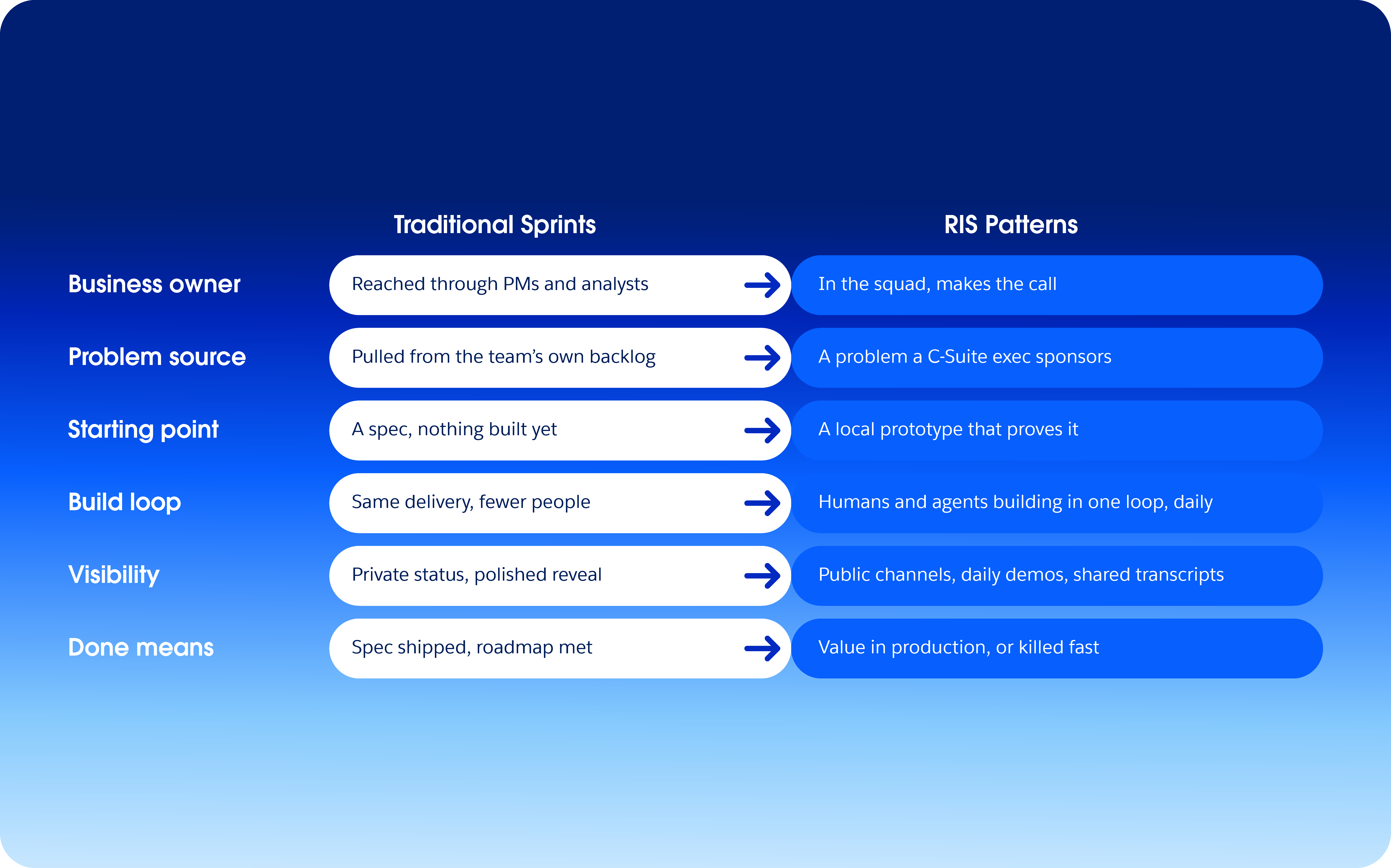

Enter the RIS (Rapid Innovation Squad)
Seth Roe • VP, Agentic Transformation
Seth Roe joined Salesforce as VP of agentic transformation and, within weeks, was leading what he only half-jokingly calls “the Rizzlers,” the Rapid Innovation Squad. His framing for the model has become one of the clearest ways to explain what these teams actually do: turn Salesforce’s “at-home builders’ ideas,” his term for people quietly prototyping on their own, into shipped software, without routing them through a traditional enterprise roadmap.
Every idea that enters the test kitchen moves through four phases of increasing fidelity: desirability, feasibility, value, and finally go-to-market. Each phase raises the bar on the UI, the data governance, and the security posture, maturing in step with the size of the audience testing it.
The RIS organizational mindset
When staffing a RIS, Salesforce looks for a tinkerer, someone comfortable with ambiguity. Seth Roe described the litmus test he uses when staffing a squad. It’s not “does this person have a six-month roadmap in their head,” but whether they can sit with not knowing. That, Seth says, is the mindset the model needs — someone who can identify what’s in their control right now and go build it, rather than waiting for a fully-formed plan.
The business side matters just as much as the technical side. Seth frames it through a “pioneer” model. The enterprise needs pioneers willing to chart uncharted territory, and it needs them willing to be player-coaches rather than pure managers. “The days of just being purely a manager are quickly disappearing,” he says. As for who ends up strongest in the seat: “The best teams we’ve seen so far are the engineers who have good business sense, and the business people who have good product sense.”
The RIS in action: SMB Signals
Seth’s own track record makes the case for the model better than any framework could. At Salesforce, in his first month on the job, Seth’s RIS shipped Small Business Signals (SMB Signals) in three weeks.
The problem SMB Signals solves is simple to describe and, until now, hard to build quickly. From Slack to email to Tableau, small business sellers had their leads, incoming customer data, and more evergreen customer information living in multiple places at once. It made them spend endless hours hunting for customer signals that should have notified them automatically like, for instance, license upgrade opportunities or abandoned cart patterns.
Through the RIS, the team built SMB Signals. Every action a seller needs is ranked and routed directly to them in Slack, with the context already there. From there, sellers take action with one click: logging the call, creating the opportunity, everything pre-filled.
To develop Small Business Signals, it moved through the RIS four-phase validation model we outlined above:
- Desirability
- Feasibility
- Value
- Go-to-market
Phase by phase, the prototype was tested with a slightly larger, more representative group of sellers, and each pass added fidelity (better UI, more mature data access, tighter security) before the team invested further. Crucially, someone from Slack’s core product team was embedded in the project from day one, not brought in at the handoff. That was one of the biggest lessons from month one: know where a solution is going to live long-term, and make sure the team that will own it there has a hand in the decisions from the start, so the RIS can eventually hand it back to be maintained and scaled.
The results came almost as fast as the build. In its first cohort, SMB Signals hit 100% adoption, sent more than 1,600 signals, and surfaced over $461,000 in open pipeline that sellers would otherwise have missed entirely.

Scaling needs governance
Cynthia Kaschub • Senior Director, Human-AI Collaboration & Workforce Transformation
While speed is essential to a RIS, setting up governance ensures that speed is sustainable. As Cynthia Kaschub, who leads workforce innovation, conveys, the same agents that are shortening your time to a response are also raising the cost of skipping the slower work up front. Ship one agent without governance and you’ll see ROI in that slice of the business, but if you ship a whole system without governance, you’ll never get the compounding return the system was built to unlock.
Try this activity: Build your own RIS
We’re not gatekeeping the RIS. AI empowers us all to be builders. Use this exercise to help create your own. First, figure out if your team is ready and, if they are, find a problem that would make an excellent first use case.
Part #1: Get ready
Before you staff anything, be honest about whether the conditions are right. Check what’s already true:
☐ You have (or can get) a small group of internal users willing to try something rough and give honest feedback (your own “Customer Zero”).
☐ Someone senior enough (maybe you!) can grant the squad license to make decisions and act without a steering committee sign-off.
☐ You can find at least one or two people who are comfortable with ambiguity and do their best work when they are given an open canvas, not a strict quarter plan.
☐ You find success in learning, not just in launching a perfect, widely-adopted solution.
All four checked? Terrific. Proceed to the worksheet below. Fewer than four checked? It usually means the gap is authority (nobody’s granted the license to act) or mindset / access (no Customer Zero-like group exists yet). Fix that first, as the squad model won’t compensate for it.
Scaling the Agentic Enterprise Resource
Download our Build Your Own RIS worksheet
You’ve determined the conditions to build your own RIS group are right. This worksheet will take you through the next two steps:
– Finding the right problem to solve for
– Staffing the squad

Chapter 3
Turn wins into scaled impact
Scale agents without starting over
When it comes to scaling agents, no one is sitting on their hands –– even from the start. We recently discovered in our State of Agentic AI in the Enterprise report, organizations are piloting an average of 10.4 agents at once.
10.4
Average number of agents organizations are piloting today
Source: State of Agentic AI in the Enterprise, 2026
It seems obvious that your second deployed agent is where scaling actually starts. However, adding more agents to your roster doesn’t automatically equal scaling. How so? Think about the efforts that would go into building dozens of agents if every one gets built from scratch. You’d have to design its own data connections, its own guardrails, its own way of handling errors. You’d be repeating the same setup cost over and over. Scaling is about sequencing your agents so each makes the next agent easier to build and deploy. The organizations getting scaling right are building systems where agents can find each other, talk to each other, and hand off work without a human stitching it together manually.
This chapter is about what it actually takes to build that system, so you’re running a group of specialized agents that work together instead of a pile of agents that are each on their own path, doing it alone.
From deployed to orchestrated
As you may know from reading Becoming an Agentic Enterprise: A Step-By-Step Guide, Salesforce’s Agentic Maturity Model has five stages — starting with simple chatbots (Level 0) up through multi-agent orchestration (Level 4).
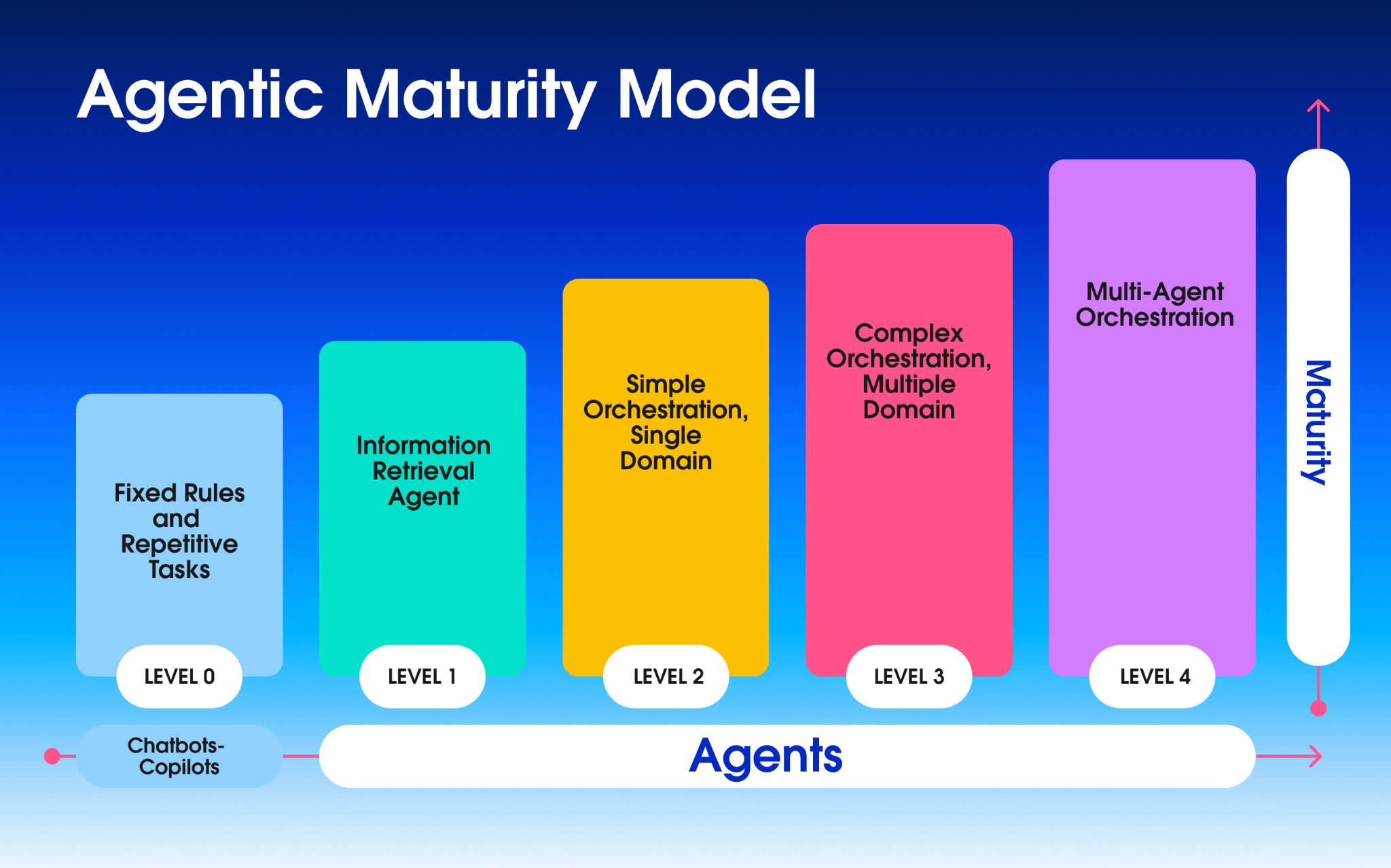
Many organizations reading this are already sitting at Level 3: Complex Orchestration, Multiple Domains (but if you’re not, visit our first playbook to help you get started).
At this level, agents work across departments like sales, service, and finance, pulling from a harmonized data source instead of pulling data from siloed buckets.
The jump from Level 3 to Level 4 is what this chapter is about: agents that autonomously orchestrate multiple workflows with harmonized data across many domains. A good example of this: an agent handling complex cross-department workflows, such as managing a sales pipeline while pulling data from multiple sources to create a holistic customer view.
The three most important factors in advancing from Level 3 to Level 4:
Maturing to Level 4 requires defining how agents talk, how they find each other, and how you keep “any-to-any” (meaning agents that should be collaborating together) from becoming “any-to-everything” (meaning agents pulling any unrelated agent in to collaborate with and potentially risk sharing sensitive information with):
There are three technical pillars that will help you achieve these objectives:
- Shared communication layer
Agents that can’t talk to each other can’t hand off work. They need a shared way to communicate – a common protocol to exchange messages, state what they are individually capable of, and coordinate multi-step work with another agent using the same rules. That protocol needs to work across vendors and it needs a lightweight way for agents to describe themselves to each other so that discovery and communication aren’t two separate problems.
Now, a shared protocol lets agents exchange information, but it doesn’t automatically mean they can do everything. A shared protocol alone doesn’t allow agents to negotiate terms, verify each other’s claims, or know when to stop and escalate to a human. Organizations building toward Level 4 need to solve for both the protocol layer that lets agents talk at all, and the trust layer that lets them collaborate on anything that actually matters.
- Dynamic agent discovery
Once an organization has agents built by different teams on different platforms, someone has to actually know what each agent does, what data it touches, and whether five teams just built the same agent under five different names. Without a system that does this automatically, agent “discovery” becomes a spreadsheet someone updates when they remember to (spoiler: this is low on a priority list).
You need a system that continuously detects new or updated agents the moment they go live, with data extraction detailed enough to know what an agent can do and what it’s authorized to touch. Plus, deduplication logic that catches redundant agents before they multiply; and a live, queryable catalog that both humans and other agents can check at runtime.
- Control and governance
Once agents start handing work to other agents across systems, access control stops being a single checkpoint and becomes something that has to hold at every step of a chain. A gap anywhere in that chain is enough for an agent to take an action it shouldn’t.
This requires:
- Identity that travels: If an agent acts on a user’s behalf, that user’s identity and permissions govern every downstream step. If an agent acts autonomously, its own identity is just as traceable.
- Least-privilege enforcement: Agents only get the access a specific task needs, not standing access to everything they might someday touch.
- Centralized policy enforcement: Ensure the same rules apply whether a request comes through an API, a UI, or another agent along with a complete audit trail, so every action can be reconstructed after the fact.
Salesforce’s own platform is one live example of this operating together rather than as separate bolted-on layers. Identity and authorization propagate through every step of a multi-system agent workflow. Data access is enforced centrally, no matter how many systems or agents are involved. And every interaction generates trace data for audit. The result: identity, data governance, API enforcement, and AI trust operate as one system instead of four.
How we’re scaling
Salesforce has already put this to work inside Agentforce. Multi-Agent Orchestration, generally available since the Summer ’26 release, brings a shared-communication principle inside a single org. Through it, a primary agent connects to specialized subagents within an org and routes work between them automatically. This is put into action when a customer asking a cross-domain question gets one continuous conversation instead of being bounced between separate bots. Our own Customer Zero program is proof this orchestration model works at scale, on both sides of the business. Customer-facing, our Help Agent on help.salesforce.com uses global instructions in Agent Builder to orchestrate specialized subagents — including support subagents and more success-related ones like Adoption and Renewals. Our 1-800 line implementation is also a great representation of orchestration anyone can experience easily today. It will orchestrate help based on what you say you need without having to navigate a phone tree or be transferred around to the right team.

Build the API, scale everything
Robbie Birbeck • VP, Digital Enterprise Experience
Robbie Birbeck, who leads Salesforce’s digital enterprise experience team, has watched teams default to building narrow, end-to-end agents that each hold their own slice of domain knowledge. His advice: Stop building agents first, and build the API and data layer underneath them instead. That foundation makes them governable and grounds every builder in that trusted layer before they start prototyping. The organizations that get this right will find their agents far easier to trust than those still building one at a time.
Twenty agents, one foundation
SaaStr runs the world’s largest community for SaaS founders with only three full-time employees but more than 20 AI agents. These agents span an assortment of roles including: sales, marketing, and event operations — but they all have the same mind.
To do so, SaaStr made Sales Cloud its system of record, bringing nine years’ worth of customer interactions, event registrations, engagement signals, and account records into one single source of truth. Then, they used Salesforce’s AIforce architecture to give every agent, including the ones built outside Salesforce, direct access to the same customer data. The result is that adding agent #20 didn’t require rebuilding what the first 10 already had. Each new agent inherits years of customer history, event data, and engagement signals on day one with no custom integration, no new connector, no starting over necessary.
The clearest proof it’s working is in Hexi, SaaStr’s SDR agent. Hexi runs outreach to more than 3,000 previously unresponsive leads with a 72% open rate. It’s the highest open rate across SaaStr’s entire AI stack. Why? Because Hexi draws on the same continuously updated customer profile every other agent contributes to, instead of working from fragmented data. Read more on SaaStr’s agentic success here.
Turning wins into a system
The real difference between having a pile of agents and a system of agents is about making sure they can find each other, talk to each other, and hand off work without you standing in the middle. However, to build that system, you need a human team to design it. That’s not a job for whoever on your team happens to have bandwidth. It takes a team built for this work. That’s where we go next.
Try this activity: Level 4 readiness check
Get a gut check on whether your agentic enterprise is ready to move up on the maturity model. Ask yourself these questions based on the three technical pillars Level 4 requires below.
Pillar #1: Communication
- Can two of your agents exchange information today without a human relaying it?
- Do your agents use a shared protocol, or does each integration get built individually?
Pillar #2: Discovery
- Could someone new to your org find out what every agent does and what it touches, right now, without asking five different people?
Pillar #3: Governance
- If an agent acts on a user’s behalf, does that user’s identity and permissions travel with it through every downstream step?
- Is there a single point where you could audit any agent’s action after the fact?
Scaling the Agentic Enterprise Resource
Download our Level 4 readiness assessment worksheet
Use the worksheet below to record your answers to determine if you’re ready to move up on the maturity model or what’s missing. When applicable, if your answer is “yes,” expand upon your answer by listing which agents can get work done together or any other applicable details.

Chapter 4
Shaping a future-ready workforce
The next horizon? Human-AI partnership
Two shifts are unfolding at the same time, and they only make sense together.
- Humans are becoming builders, coaches, and taste-makers inside their own companies.
- Agents are becoming ambient, adaptive, and able to continually learn and grow.
What’s exciting about this moment is that neither shift can exist without the other. Agents without human judgment produce confident nonsense at scale. Humans without agentic leverage stay trapped at the ceiling of what a pre-agentic team could carry.
At Salesforce, we’re working every day to scale our own enterprise to match the pace of a world of business that reinvents itself every quarter. We’ve hired some of the best AI research scientists in the world. Here’s our honest read on where this is going — and where humans and agents go together from here.
The skills that matter most are the ones agents can’t fake
Ask any leader running agents in production what worries them most, and you’ll hear a version of the same answer: It’s not that agents can’t do the work. It’s that they can do it confidently wrong. An agent that hallucinates a policy, misroutes a customer, or writes a beautifully-worded email based on a misread of the situation doesn’t sound broken. It actually sounds fluent. “AI slop” is, at best, lengthy prose that’s light on meaning or value, and at worst, downright inaccurate. It’s a challenge we never had to consider before the advent of generative AI. Which is why one of the human skills that will matter most in an agentic company isn’t prompting. It’s taste. Discernment. Expertise grounded in their own intellect, curiosity, and experience. The best workers in an agentic enterprise have the ability to look at a plausible-sounding agent output and say, “That’s wrong, and here’s why.”
It’s what a great editor does with a draft, what a senior engineer does at a code review, what a seasoned rep does when a lead sounds promising but feels off. Joe Inzerillo says it more simply: “AI can only take you so far. What you need on your team right now are people with deep knowledge and really good taste.”
AI fluency is the leverage point
If discernment is the individual skill, AI fluency is what compounds it across a company. And the data is clear on where the leverage lives.
Salesforce research on the future of work has found that AI-confident managers are 20% more likely to lead AI-fluent teams. AI confidence, in turn, is one of the strongest single predictors of a team’s ability to innovate, ship, and retain talent through this transition. Which means the highest-return investment most companies aren’t making right now is around building the confidence of the managers who set the tone for everyone reporting to them.
20%
Managers who report they are AI-confident are 20% more likely to lead AI-fluent teams.
Source: Salesforce, The Future of Work
Building that confidence means giving every employee access to agentic tools by default (not by request), giving them a shared workspace where they can see peers building alongside them, and giving them role-specific guidance for how their work is actually changing — not in the abstract, but this quarter, in their function. If that sounds familiar, it should. It’s the foundation the 4Rs framework was built on.
We’ve noticed a pattern, as have some of our customers; a “shadow version” of AI fluency creeping into workplaces that is worth keeping an eye on as we scale: Employees who forward an agent’s output along to a colleague without reading it themselves, treating a first draft as though it were finished thinking. Most of the time this isn’t laziness so much as a natural instinct to trust a tool that seems to know what it’s doing. Still, it’s worth naming and discussing, because it can hinder agentic progress – not to mention employee satisfaction. Open dialogue about these should be encouraged. It helps remind teams what real AI fluency actually looks like: judgment on top of speed, not speed instead of judgment.
A quick note on the 4Rs
In our first playbook, Becoming an Agentic Enterprise, we introduced the 4Rs: Redesign how work gets done, Reskill your people, Redeploy talent into growth areas, and Rebalance what humans and agents each do best. That framework is still the foundation of how Salesforce is approaching workforce transformation, and it’s still really relevant. If you haven’t worked through it with your team yet, check out check out Chapter 2: Design your AI-human workforce.
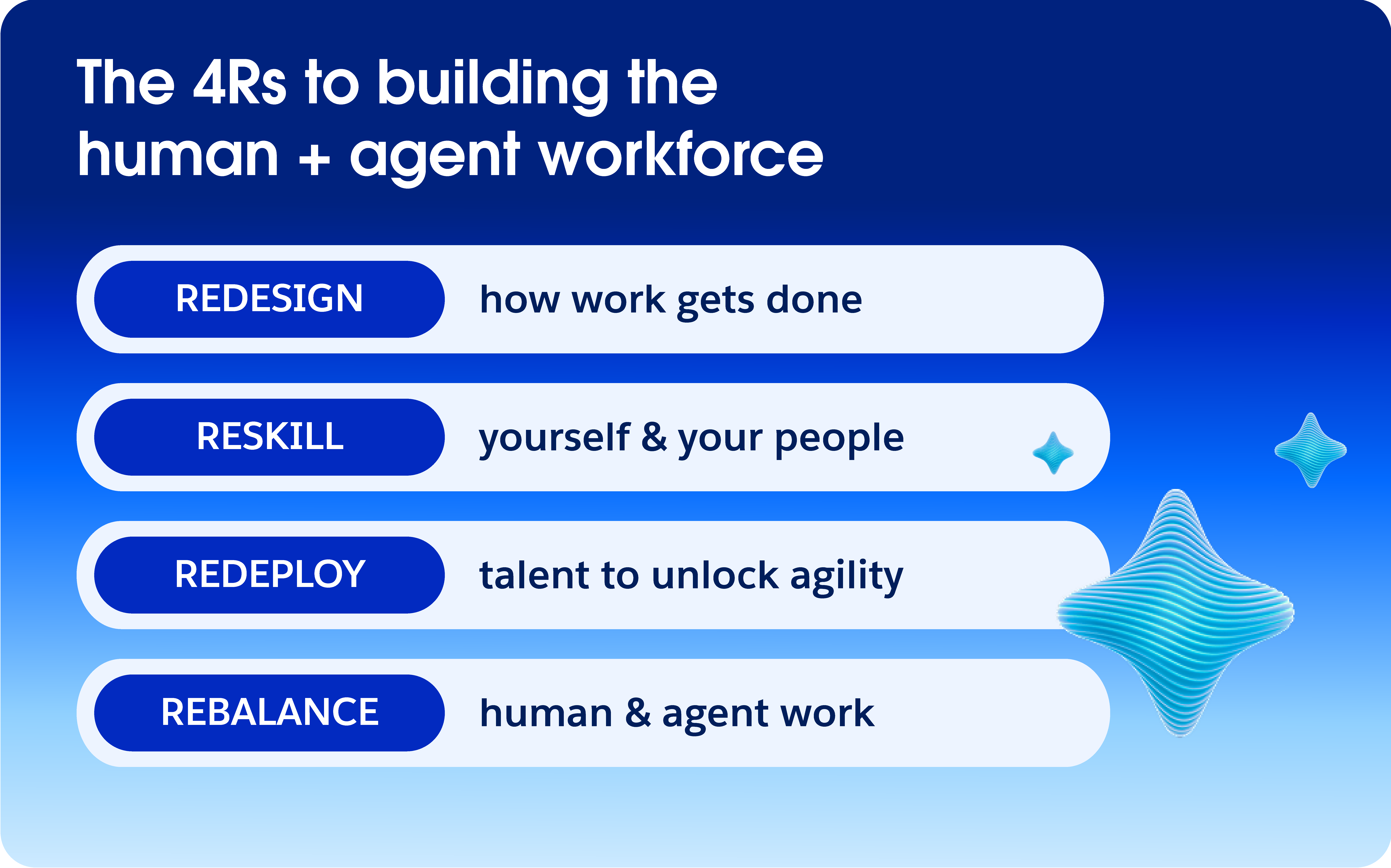
What’s changed since we published it is the texture: the everyday, in-the-flow-of-work examples of what the 4Rs actually look like when they’re running. As agents scale across the organization, tasks for humans will inevitably look different. The 4Rs will remain a guidepost for leaders in every department to align and aspire to.
How we’re scaling: the Mid-Year Check-In skill
One of the clearest examples of a redesigned workflow living at Salesforce today is our Mid-Year Check-In Slackbot skill, currently the #2 most-used Slackbot skill company-wide.
The mid-year check-in used to be a chore. Managers spent hours chasing feedback, pulling data from five different systems, and trying to synthesize themes across a team of directs. Employees, on their side, opened a blank doc and stared at it, trying to remember what they’d shipped six months ago, whether they’d hit their V2MOM goals, and how to frame it.
Now, the skill does the heavy lifting for both sides. For managers, it uses collaboration signals to identify the right feedback providers for each direct, pulls data from five systems to synthesize themes and gaps, and elevates the quality of feedback through a guided conversation. For employees, it gathers their wins, challenges, and V2MOM progress automatically, suggests topics for the discussion with their manager, and prepares a document they can walk into the conversation with.
Automating the form is the smaller half of the story. What matters is what the automation made room for: the check-in itself — the actual conversation between a manager and their employee — got better because both sides came in prepared, grounded in the same data, and ready to talk about what matters instead of what’s missing. Agents don’t take the human moment away. Done right, they clear the runway so the human moment can actually happen.
Agentic enablement: an ongoing climb
Nobody becomes an agentic pro in a single training session. The organizations getting real leverage out of agents treat enablement the way a climbing team treats a mountain: as a steady ascent with distinct pushes along the way, each one building on the last. You start at the base by getting people set up on the tools. Then you help them see what AI actually looks like for their specific role. Then you go deeper on how the role itself is evolving. And at the peak, you shift the conversation from individuals to teams — how small, cross-functional, AI-enabled groups operate together.
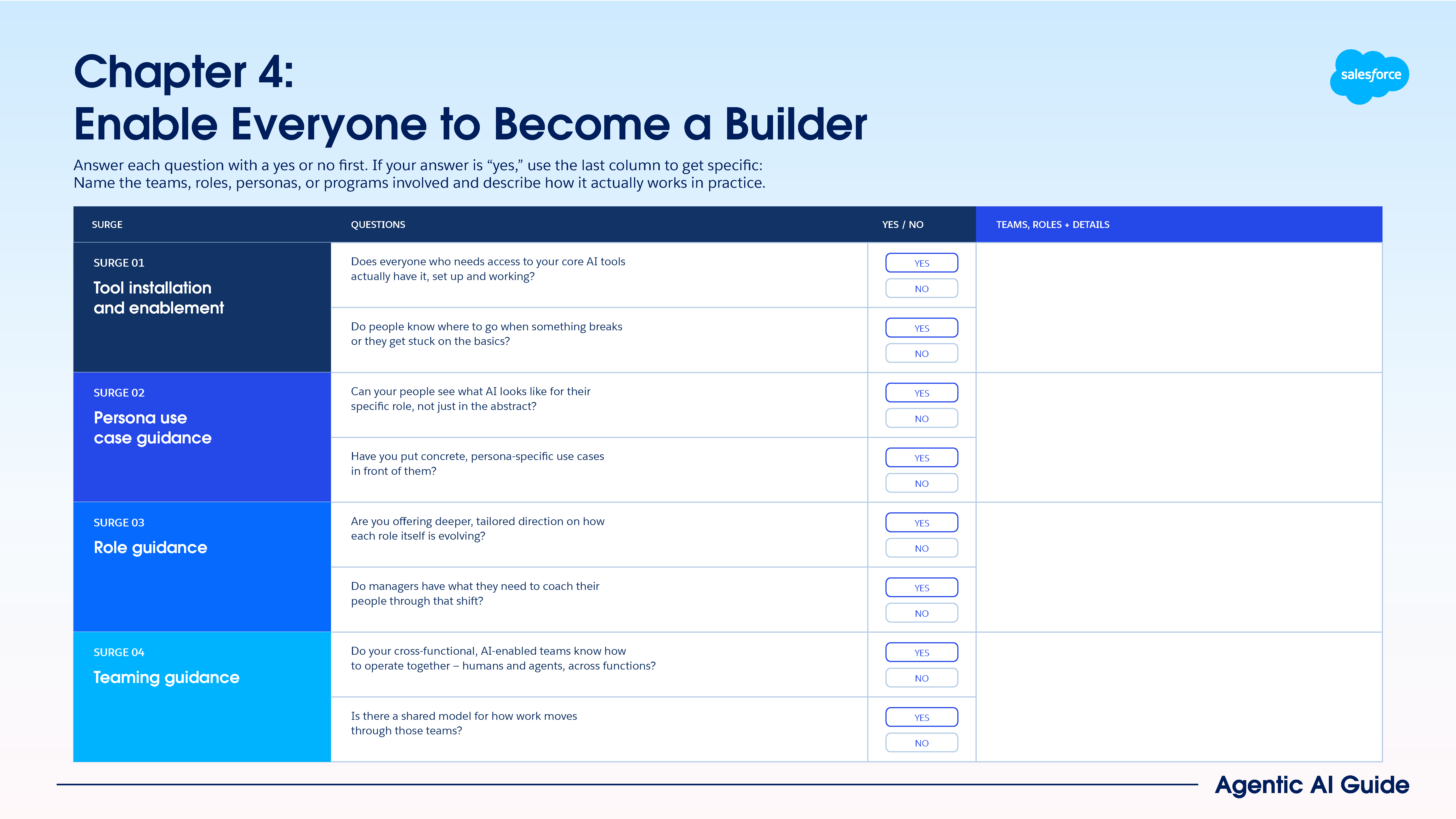
The real work is figuring out which surge your people need next and meeting them there in the flow of work. Use the readiness check below to figure out where your organization is on the climb, and where to invest the next push or “surge.”
Try this activity: Enablement “surge” readiness check
Get a gut check on whether your people are actually climbing the enablement mountain, or stuck at base camp with tools they don’t quite know how to use. Ask yourself these questions across the four surges below.
Surge #1: Tool installation & enablement
Does everyone who needs access to your core AI tools actually have it set up and working?
Do people know where to go when something breaks or they get stuck on the basics?
Surge #2: Persona use case guidance
Can your people see what AI looks like for their specific role, not just in the abstract?
Have you put concrete, persona-specific use cases in front of them — the kind that make someone say, “oh, that’s for me”?
Surge #3: Role guidance
As people get more comfortable, are you offering deeper, tailored direction on how their role itself is evolving?
Do managers have what they need to coach their people through that shift?
Surge #4: Teaming guidance
Do your cross-functional, AI-enabled teams know how to actually operate together — humans and agents, across functions?
Is there a shared model for how work moves through those teams at the top of the mountain?
Scaling the Agentic Enterprise Resource
Download our enablement surge readiness assessment worksheet
Use the worksheet below to record your answers and see where your people are on the climb, and which surge to invest in next. When applicable, if your answer is “yes,” expand on it by naming the teams, personas, or programs involved.
Chapter 5
What’s Next in Enterprise AI
Welcome to the dawn of the Self-Evolving Enterprise
A little over 100 years ago, a French artist named Jean-Marc Côté made a series of lithographs he titled “En L’An 2000” (In the Year 2000), predicting what daily life would look like at the turn of the next century. He was working with the only visual vocabulary he had: brass telephony gear and hand-cranked machinery. And still, he got eerily close.


We’re going to do something similar in this chapter. No one has a crystal ball, Salesforce included. But we do have a decade of research in the space behind us. Salesforce AI Research has been publishing and shipping enterprise AI research for over ten years, with more than 250 million downloads of our models and datasets on Hugging Face. That vantage point, combined with the patterns we’re already seeing in production with our own customers, gives us a real view into what’s coming next.
The agentic foundation you’re building today is exactly what makes the next horizon reachable.
Here’s how we see it unfolding, and what you can start doing now to be ready.
Three shifts to watch
1. How we’ll interact with technology: the agent becomes the interface
The phone in your pocket hasn’t fundamentally changed in almost 20 years. It’s still a grid of app icons, each one a separate destination you have to navigate to. Imagine a device with only two apps on it designed to communicate with friends and co-workers, for example. iMessage and Slack. Everything else: your calendar, your bank, your shopping, gets handled by a personal agent that has access to all of it in the background, mostly through voice.
We’re already starting to introduce this model with a personalized AI teammate for every Slack user in Slackbot. It’s the direction Apple and Google are quietly building toward with new device concepts. The user interface as we’ve known it for the last three decades is starting to fade into the background, and personal agents are becoming the primary way work gets done.
How to prepare: Think about where your employees and customers still hit friction with a traditional UI. As feedback comes in, consider how agents might reduce friction in the user flow. These are the places a personal agent is likely to land first.
2. How we’ll make decisions: from guesswork to foresight
For most of the last two decades, business intelligence has been about looking backward. Dashboards, reports, quarterly reviews. Agents are turning our attention toward the future. Anyone in the company, not just the analytics team, is starting to have access to the power of foresight: the ability to model scenarios, compare outcomes, and make informed choices between options that a human alone couldn’t have surfaced in time.
And a growing share of those decisions are being made autonomously. According to our recent State of Agentic AI in the Enterprise 2026 report, 36%of agentic workflows are autonomous. This is not to say there isn’t a human at the helm; it means that humans are in the workflow alongside them, monitoring decisions made. This is the shift we’ve been calling operational intelligence: intelligence woven through the entire operation, informing decisions at every level, and increasingly making some of them on its own.
This doesn’t mean humans are excluded from decision making. Every agent will have at least one person accountable for it. If you own the agent, you own the decision. What’s changing is that the human at the helm is increasingly comfortable letting the agent make the call without checking in first.
How to prepare: Identify the decisions in your business that are currently slow, repetitive, or bottlenecked by human bandwidth. These are your first candidates for autonomous decision-making, with the right human accountability wrapped around them.
3. How we’ll drive innovation: agents that teach themselves
The third shift is one that has a major influence on how companies will innovate in the future. Agents are starting to learn continuously and evolve on their own through a method called recursive self-improvement. Frontier models are already accelerating past human speed in helping to design and develop their own successors. What that looks like inside an enterprise is agents that don’t just execute a fixed capability, but get better every time they run, grounded in your company’s proprietary knowledge, your workflows, your integrations, and the traces of every interaction they’ve already had.
This is the piece that turns a collection of agents into a Self-Evolving Enterprise. The company itself, not just the model layer, becomes the source of intelligence. And because every enterprise’s data is unique, that intelligence compounds into a real competitive advantage that no one else can copy.
How to prepare: Take stock of your proprietary data, especially the “dark data” you’re sitting on without utilizing: transcripts, traces, interactions, business logic. That’s the fuel your self-evolving agents will run on.
How we’re scaling it
These aren’t predictions we’re making from the sidelines. Salesforce AI Research is building toward all three right now, in our AI Research organization, with customers, and inside our own products. Here are three examples of what that looks like in practice:
Voice as the new interface. Our research team is working on voice agents that can actually hold up to enterprise interactions, understand accents, handle interruptions, work in noisy environments, and stay grounded in your data. Our proprietary voice models are already powering blazing-fast dictation in Slackbot, bringing both context and accuracy into Slack’s agentic, conversational interface.
Ambient, forecasting intelligence. Large language models are extraordinary at text and reasoning, but they struggle with forecasting over a time series, which is exactly what you need in a service center trying to balance staffing against next week’s call volume, or in a supply chain trying to anticipate demand. Our research team built the world’s most popular time-series model, Moirai, to close that gap. Unlike traditional LLMs, which predict the next word, time-series models predict the next event by creating a forecast of the future. Moirai’s open-source research version has already crossed 30 million downloads on Hugging Face, and is one of the most popular models we’ve ever released.
Learning agents, at scale. For many organizations, much of the institutional enterprise data is locked inside expert employees’ heads, and not properly documented. Salesforce AI Research is incubating a new breed of “learning agents” that work hand-in-hand with human experts to learn on the job and improve. Every deployment becomes a system that gets better with use, rather than one that drifts with age.
Each of these advancements is incubated with real customers before it becomes generally available through our AI Foundry program. Together, they’re the closest concrete look you can get right now at what the Self-Evolving Enterprise actually feels like from the inside.

The Self-Evolving Enterprise: our bet on what comes next
Itai Asseo • VP, Strategy and Incubation, Salesforce AI Research
Itai Asseo leads strategy and incubation for Salesforce AI Research. His framing of the next horizon is that we’ve moved from asking “which model is best” to asking “what kind of enterprise do we want to become?” The source of competitive advantage has shifted from the model layer to the system built around it: the orchestration, the memory, the feedback loops, and the “dark data” (according to Forrester, roughly 70% of enterprise data that today sits unused by analytics). These are the elements that makes your company yours.
We’ll build this next chapter with you
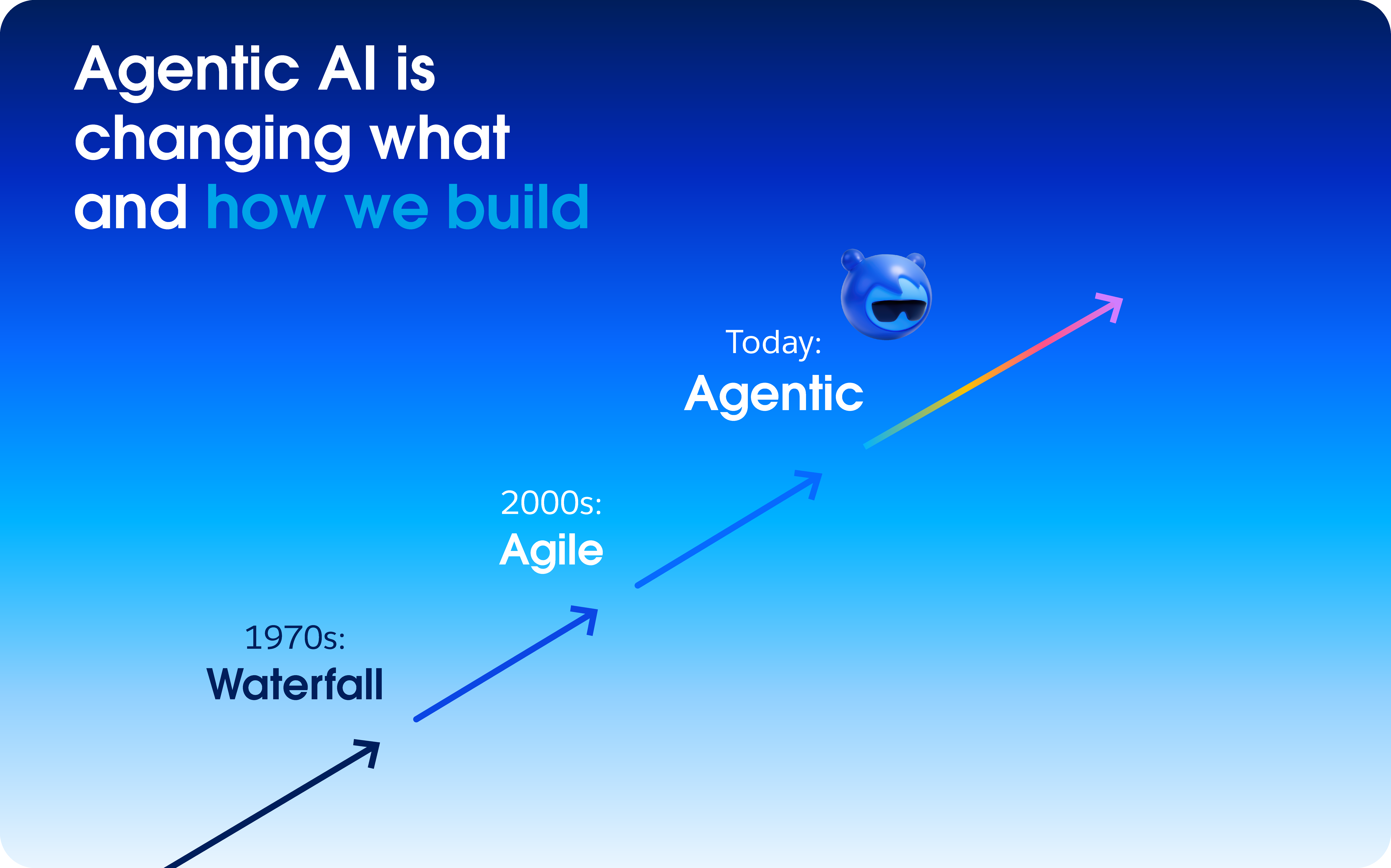
The pace of change is the story now. Waterfall, the sequential, plan-everything-upfront approach born in 1970s manufacturing and formalized for software soon after, took roughly thirty years to become the default operating model of the enterprise. Agile, which broke that plan into two-week sprints and put working software in customers’ hands sooner, took another twenty to move from the 2001 manifesto through a generation of certifications, coaching, and org redesigns before it truly stuck.
Agentic didn’t get thirty years, or twenty. It arrived in months. The frameworks and change-management playbooks that carried companies through the last two transitions were built for a slower world, one where you could plan a quarter, run the pilot, form the committee, and still be early. The one we’re in now runs on a different clock entirely, where the cycle from idea to shipped, learning, evolving software can be measured in days.
We hear the anxiety in the industry. We choose to lead differently. We think this is a time of empowerment. It’s a chance to give every employee access to leverage that used to be locked away in a few departments, and to build companies where humans do the work only humans can do, while agents handle the rest.
This playbook is here as a symbol of Salesforce’s partnership with you. It’s designed to grow. We’ll keep updating it as we learn, as the workforce transformation gets more concrete, as the self-evolving enterprise moves from research to production, as our customers show us patterns we haven’t seen yet. We are on this journey too. And we will be here with you every step of the way.