



Every week, commercial and medical affairs teams face an agonizing reality: millions of dollars and hundreds of hours are spent creating regulated content, only for it to stall in Medical, Legal, and Regulatory (MLR) review. The average promotional review cycle is 50-60 days, but the problem isn’t the reviewer; it’s everything that happened before it reached them.
Instead of catching issues at the end of the creation process, Regulated Content Management (RCM) takes a different approach to MLR: compliance is moved upstream. Claims, evidence, references, and obligations are connected to the content throughout its lifecycle as living data, not a static document. This compliance intelligence helps teams identify issues earlier and enter MLR significantly more review-ready.
Built on Salesforce’s agentic platform, RCM combines governed compliance intelligence with agentic assistance across authoring, review, and lifecycle management while keeping human accountability at the center.
Once approved, channel-specific content can move into the appropriate downstream channels and experiences through Salesforce, like HCP interactions in Agentforce Life Sciences or email journeys in Agentforce Marketing, as well as connected content platforms. The governed claims, evidence and compliance context remain connected to the content, helping preserve traceability as content is activated and managed across channels.
Get an early look at Regulated Content Management
Join our live webinar to see how RCM builds compliance into every step of content creation.

Moving from document-centric to connected compliance
For years, regulated content processes have been built around documents, repositories, and downstream review workflows. Claims, evidence, references, obligations, and content often exist as disconnected objects (if at all), leaving teams to reconstruct context during creation and review. RCM introduces a different model: a connected compliance foundation that can work across existing content and authoring ecosystems.
When market needs change or clinical evidence updates, teams need a way to update every affected asset in order to avoid costly recalls and compliance risk. Regulated Content Management makes this possible with two foundational innovations:
- Compliance Intelligence: RCM is built on an extensible compliance graph that treats claims, supporting evidence, references, and channel- or region-specific obligations (such as Fair Balance or Important Safety Information), and localized assets as living, interconnected data. Agents can use this trusted context to surface expiring or changing substantiations, identify compliance gaps, and determine which downstream content may require reassessment. This enables RCM to understand not only whether something has changed, but what claims and downstream content may be affected.
- Open, Federated Content Ecosystem: Content shouldn’t be locked in a single system, or separated from the context that shapes it. RCM is designed to work with content wherever it is authored, managed, or activated. Customers can use Salesforce’s authoring experiences, including agentic capabilities, or continue to create content in existing third-party authoring tools. Salesforce-native experiences can sit alongside existing DAMs, CMS, authoring platforms, and downstream channels, all while RCM provides the foundational compliance intelligence behind the content.
Future-proof your Life Sciences content strategy now
Get practical guidance on modernizing regulated content before compliance gaps become costly.
How Agentforce Streamlines Content Operations
Regulated content creation requires more than providing an agent compliance rules. The agent also needs to understand the brand strategy, campaign objectives, audience, market, and channel it is creating for. Within the broader marketing lifecycle, business and marketing context informs the authoring experience, while RCM adds the governed Life Sciences compliance intelligence.
Here’s how creators, compliance teams, reviewers, and Agentforce, together scale the content lifecycle:
- Claims Management: Agents streamline what is typically a manual claims management process by scanning content to extract claim statements and automatically link them to the appropriate claim records. They suggest approved claims from a pre-approved library, complete with calculated match scores, helping creators and reviewers quickly find the claims they need.
- Content Authoring: Agentic authoring helps teams generate and refine content, grounded in brand strategy, campaign context, audience, and channel objectives from the broader marketing lifecycle. RCM provides the compliance foundation with governed claims, evidence, references, and obligations. This enables brand and compliance considerations to be addressed during content creation, helping to reduce re-work needed during review.
- Obligations Assistance: Agents can identify applicable market, audience- and content-specific obligations, and surface potential impacts when regulatory requirements or internal policies change, all with appropriate human oversight.
Watch Regulated Content Management take the stage at Dreamforce
See how life sciences compliance teams turn static documents into living, connected content.

Key Platform Innovations at a Glance
Regulated Content Management establishes a connected compliance foundation for the regulated content lifecycle. Its first Life Sciences application focuses on MLR, with capabilities spanning upstream readiness, governed claims and obligations, review, and lifecycle management. In addition to agent-first capabilities, key platform highlights include:
Compliance management
- Proactive claims management: Manage claims as governed, connected objects throughout their lifecycle, linked to supporting evidence, references, approved use, product and indication context, and downstream content. Agents can assist with matching, expiry monitoring, and claims traceability across variants and markets. A central intelligence repository calculates compliance scores and flags expirations, streamlining the claims lifecycle.
- Localized regulatory and obligations engine: RCM connects across regulatory, market, channel, and organizational obligations, allowing agents to evaluate the relevant content requirements in context. Centralized rules management stores regulatory requirements by content type, market, and channel to maintain region-specific compliance across localized variations.
- Trusted evidence ecosystem: Regulated Content Management is also designed to connect to a broader trusted evidence ecosystem. Partners can provide licensed, peer-reviewed, full-text scientific evidence that agents can use alongside internal knowledge. That evidence can become part of the same connected compliance intelligence used to substantiate claims and maintain provenance throughout the content lifecycle.
Intelligent review and auditability
- Digital review: Review content as it will actually appear in the intended digital experience, rather than relying on static representations or PDFs. Reviewers can evaluate the rendered experience alongside connected claims, evidence, references, obligations, and annotations, helping preserve both regulatory context and the reality of the customer experience.
- Agentic tier-based reviews and digital signatures: Content risk and compliance context can inform the appropriate review path, helping focus human review where it adds the most value. Supports evidentiary electronic signatures and approval capture appropriate to regulated review processes – 21 CFR Part 11-compliant.
- ALCOA+ immutable audit reporting trail: Attributable, Legible, Contemporaneous, Original, Accurate, and Complete. Maintain a traceable history of content changes, annotations, review actions, approvals and other governed activities throughout the lifecycle.
Content creation and management
- Persona-specific workspaces: RCM brings the relevant content, tasks, compliance context and connected systems into a unified experience for marketers, creators, coordinators, and compliance teams and reviewers. Using Salesforce’s AIforce architecture, users can work across content and data that may live in different systems without constantly switching tools or losing the governing context. For marketers in particular, this means relevant planning context, content, review status, and downstream activity can be surfaced in the flow of work, even when the underlying content or services sit elsewhere.
- Governed reuse: Approved claims, evidence, references and reusable content can be discovered and reused in context, helping teams avoid recreating compliant content from scratch.
Content distribution
- Connected distribution: Once approved, channel-specific content can be made available to downstream Salesforce and third-party channels. Salesforce channels include Agentforce Life Sciences, Agentforce Marketing, Salesforce CMS, and Contentful. Distribution retains its relationship to the governed claims, evidence, and the approvals behind it, ensuring alignment between all messages and the latest directions and evidence.
Learn more about proactive intelligence for life sciences
Discover how Salesforce unites content, compliance, and care signals before risks escalate.
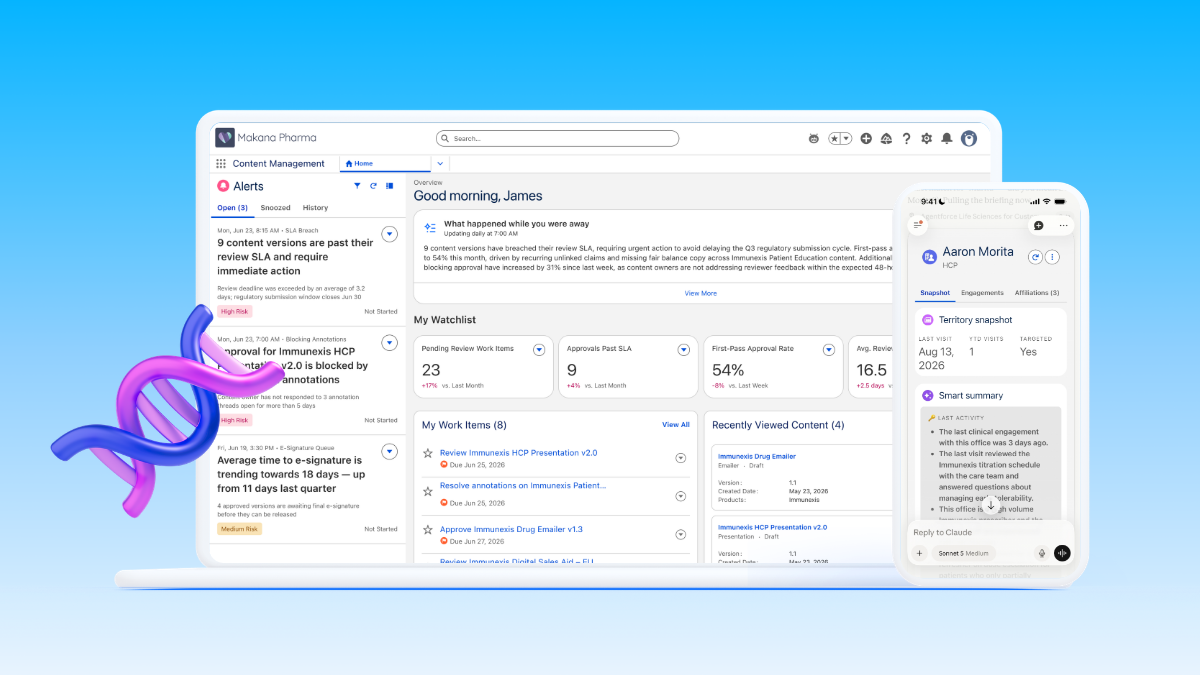
RCM’s shift from governing static documents to governing the intelligence behind them means content teams are no longer limited by bottlenecks of human capacity and can create more personalized and tailored messaging. As compliance moves upstream and becomes part of how content is created, not something checked at the finish line, life sciences teams gain more than speed. They gain the ability to trust that every claim, reference, and approval stays connected and current, no matter how content changes or where it travels next. That’s the foundation for a life sciences enterprise that can move at the pace modern science demands.
This article may include references to services or features that are still in development and are unreleased. Customers should make their purchase decision based on fully released and available features. Regulated Content Management is available to early adopters in October 2026 and generally available in 2027.