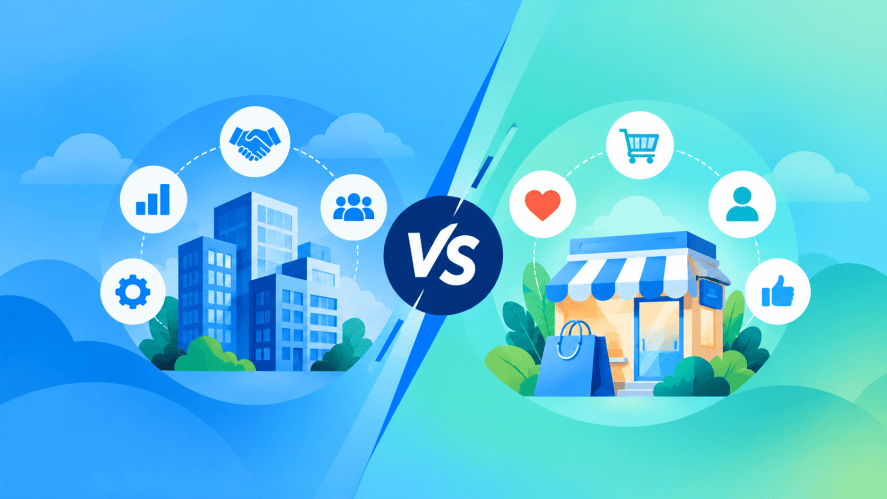


If you sell to other businesses in the morning and to everyday shoppers by afternoon, you already know the whiplash. One buyer wants a spec sheet and three approvals before they’ll even take a call. The other wants a scroll-stopping offer they can act on in ten seconds. Trying to write one marketing playbook for both is how small and medium business (SMB) teams burn a week producing content that satisfies neither audience.
That gap between B2B vs B2C marketing isn’t a technicality — it’s the whole game. Get it right, and your lean team can run circles around competitors who are still sending the same email to everyone on their list. Get it wrong, and you’re spending your limited budget convincing a bulk buyer with a flashy discount code, or losing a browsing shopper to a five-step nurture sequence built for a procurement committee.
B2B and B2C marketing terms defined
Understanding key marketing terms helps clarify how B2B and B2C strategies differ in practice:
Business-to-Business Marketing (B2B): Focuses on selling products or services to other companies and decision-makers. B2B features a longer, multi-step buying process. Messaging prioritizes logic, efficiency, problem-solving, and return on investment (ROI).
Business-to-Consumer Marketing (B2C): Focuses on selling directly to individual consumers. B2C features a much shorter, streamlined sales cycle. Messaging centers on emotion, personal benefits, experience, and driving faster, impulse-driven purchasing decisions.
1. Know who you’re talking to
B2B buyers research for weeks, loop in coworkers, and want proof before they commit — the kind of process you’d expect from a customer relationship management (CRM) buyer evaluating vendors. B2C shoppers move fast, often deciding in a single sitting, and respond to emotion as much as logic. Salesforce research on B2B vs B2C ecommerce found that B2B buying involves heavier research and less marketing-driven purchasing than B2C, which is exactly why a single messaging template rarely works for both.
- B2B Tip: Focus on how your product solves a real work problem and saves time for the team.
- B2C Tip: Highlight clear personal benefits and make buying quick and simple.
2. Map who each buyer answers to
Pay attention to who each buyer has to answer to. While a B2C customer can usually buy on a whim or for personal convenience, a B2B buyer is rarely making a decision alone. They have to justify the cost to their boss, stay within team budgets, and answer to other decision-makers. That’s why B2B content needs to give them clear proof of value and peace of mind to share with the rest of their team.
- B2B Tip: Give buyers short sheets or guides they can easily pass along to their manager.
- B2C Tip: Speak directly to the shopper’s immediate wants or practical everyday needs.
3. Build separate content tracks for each audience
You don’t need two marketing departments to run B2B and B2C campaigns well — you need content that’s built for how each buyer decides. For B2B, that means case studies, comparison guides, and detailed FAQs that hold up under scrutiny. For B2C, that means punchy copy, social proof, and offers that create urgency.
- B2B Tip: Create helpful guidebooks and detailed product comparisons that prove value.
- B2C Tip: Use short videos, customer photos, and quick lookbooks to catch attention.




4. Case studies win B2B trust, urgency wins B2C
Case studies win B2B trust. A detailed customer story shows a skeptical buyer exactly how the product performed under real conditions. Limited-time offers and clear, simple language move a browsing shopper to act before they close the tab. B2B buyers use them to vet you before a sales call; B2C shoppers use them to remove last-minute doubt at checkout.
This is where AI-supported marketing automation earns its keep for a small team — it lets you build both tracks without doubling your headcount, tailoring content and cadence to each buyer type instead of forcing one journey to fit everyone.
- B2B Tip: Share real customer success stories to show clear results to skeptical teams.
- B2C Tip: Run simple, time-sensitive promotions to encourage immediate orders.
5. Personalize without a big data team
For B2B, personalization looks like referencing a prospect’s industry and past interactions in your outreach. For B2C, it looks like recommending products based on browsing history or past purchases. Both rely on the same foundation: A CRM that keeps your sales, marketing, and service data in one place instead of scattered across spreadsheets and inboxes.
- B2B Tip: Mention the client’s industry and past notes whenever you reach out.
- B2C Tip: Suggest related items based on what buyers recently viewed or bought.
6. Match your channels to how each buyer shops
B2B buyers live in their inbox and on LinkedIn, reading long-form content between meetings. B2C shoppers are on their phones, scrolling social feeds and comparing prices in real time. Sending the same message to both channels wastes reach on the wrong audience.
Pick one or two channels per audience and go deep instead of spreading a small team’s budget thin across everything. A single well-run email sequence for B2B leads and a focused social presence for B2C shoppers will outperform a scattered attempt to be everywhere at once.
- B2B Tip: Focus your efforts on professional networks like LinkedIn and email updates.
- B2C Tip: Meet shoppers on social media feeds and mobile-friendly websites.
7. Use AI agents to stretch a lean team further
This is where a lean team’s biggest constraint — hours in the day — gets solved. AI agents can draft campaign variations, segment audiences, and test subject lines while your team handles the strategic calls only a person should make.
Salesforce’s marketing research on B2B vs B2C marketing has found this same pattern across its Connections sessions: teams selling to consumers use AI to generate personalized content variations at scale, so every customer feels like the message was written just for them, while B2B teams lean on it to speed up research-heavy nurture sequences without losing the depth buyers expect.
- B2B Tip: Use AI to speed up background research and draft detailed follow-up emails.
- B2C Tip: Use AI tools to quickly write multiple versions of ad copy and promotional posts.
Try the Marketing CRM for small business.
No credit card required, no software to install.

8. Let AI handle the busywork, not the strategy
While AI agents can generate content variations and automate execution, marketing strategy and CRM oversight must remain human-led. Marketers define the core value proposition, audience segmentation, and brand voice within the CRM, while AI tools process customer data to personalize interactions at scale.
- B2B Tip: Set your own strategy first, then let software help organize client details.
- B2C Tip: Let automated systems send routine order confirmations and deal alerts.
9. Track different metrics for different buyers
A B2B campaign might take months to convert, so pipeline velocity and deal size matter more than click-through rate. A B2C campaign converts fast, so cart abandonment and average order value tell you more than a long-term nurture score ever could. Reporting on the same metrics for both buyer types will tell you the wrong story about what’s working.
- B2B Tip: Measure deal sizes and how quickly sales conversations progress.
- B2C Tip: Track sales numbers, website checkouts, and average spend per order.
10. Make your CRM the shared source of truth
Whether a lead comes in through a demo request or a checkout page, it should land in the same system your sales and service teams already use. That’s what keeps a five-person team from losing track of who’s talking to which customer, and it’s the difference between a CRM system that just stores contacts and one that helps you sell.
- B2B Tip: Keep all notes and company interactions logged in one shared system.
- B2C Tip: Store order histories together to keep support and marketing coordinated.
Grow your ambitions with the #1 AI CRM.
See what’s possible with the AI-powered CRM suite for growing teams.
Get started with Starter Suite for free or activate Foundations to try out Agentforce today.
AI supported the writers and editors who created this article.
What’s the biggest difference between B2B and B2C marketing?
B2B buyers research for longer, involve more people in the decision, and expect proof before committing. B2C shoppers decide faster and respond more to emotion, urgency, and price. Your content, channels, and metrics should reflect that instead of treating every buyer the same.
Can a small team really run both B2B and B2C marketing at once?
Yes, but not with one undifferentiated campaign. Build separate content tracks for each buyer type and lean on AI-supported marketing automation to manage both without adding headcount.
Which channels work best for B2B versus B2C?
B2B buyers respond well to email and LinkedIn, where longer-form content fits their research process. B2C shoppers are more reachable through social feeds and mobile-first content built for quick decisions.
Do B2B and B2C marketing need separate CRMs?
No — one CRM can serve both, as long as it captures the right data for each buyer type. What matters more is that sales, marketing, and service all pull from the same customer view, so no one’s working off stale information. Salesforce’s state of marketing research found unified data is the biggest differentiator for small teams using AI well.
How do I measure success differently for B2B vs. B2C campaigns?
Track pipeline velocity and deal size for B2B, since those cycles run longer. Track conversion rate, cart abandonment, and average order value for B2C, since those decisions happen fast. Keeping the two sets of metrics separate keeps you from misreading either one.