




Key Takeaways
“Look around this room — this is what critical mass looks like.”
Opening the Trailblazing Women Summit (TWS) 2026, Arundhati Bhattacharya, Chairperson and CEO of Salesforce India, reflected on how far corporate representation has come.
While India produces 43% of the world’s female STEM graduates, translating that talent into senior leadership roles remains an ongoing journey. TWS 2026 was designed to accelerate that momentum — bringing together leaders from across industries to talk honestly about navigating careers, breaking barriers, and shaping the future of tech.
Here are some of the most honest, practical, and powerful insights shared from the stage.
1. Choose fearlessness even when the fear is real
Every leader who has ever taken a meaningful risk has felt it: the uncertainty, the self-doubt, the voice that says wait a little longer. The difference between the leaders who act and the ones who stay still is rarely confidence. It is the decision to move before the feeling catches up.
The willingness to act in the presence of fear is also, quietly, a skill you teach the people around you. When your team sees you step forward through something uncertain, they learn from it, they carry it forward, and the culture you build becomes one where bold moves are expected and supported rather than the exception.
2. Lead with emotional intelligence in the age of artificial intelligence
As AI takes on more of the analysis, synthesis, and process work, what’s left at the center of great leadership is irreducibly human: the ability to listen well, build trust, use your judgment, and make people feel seen. The skills that once felt secondary are now the ones that matter most, and the leaders who understand that are already ahead.
“Empathy is your superpower. Women have been in the listener’s role for millennia — that ability to truly hear people, to understand what they’re going through and respond with care, is a profound strength. It’s not something AI will develop anytime soon. The human element in you is the one thing you must guard with everything you have.” — Arundhati Bhattacharya, President and CEO, Salesforce India and South Asia

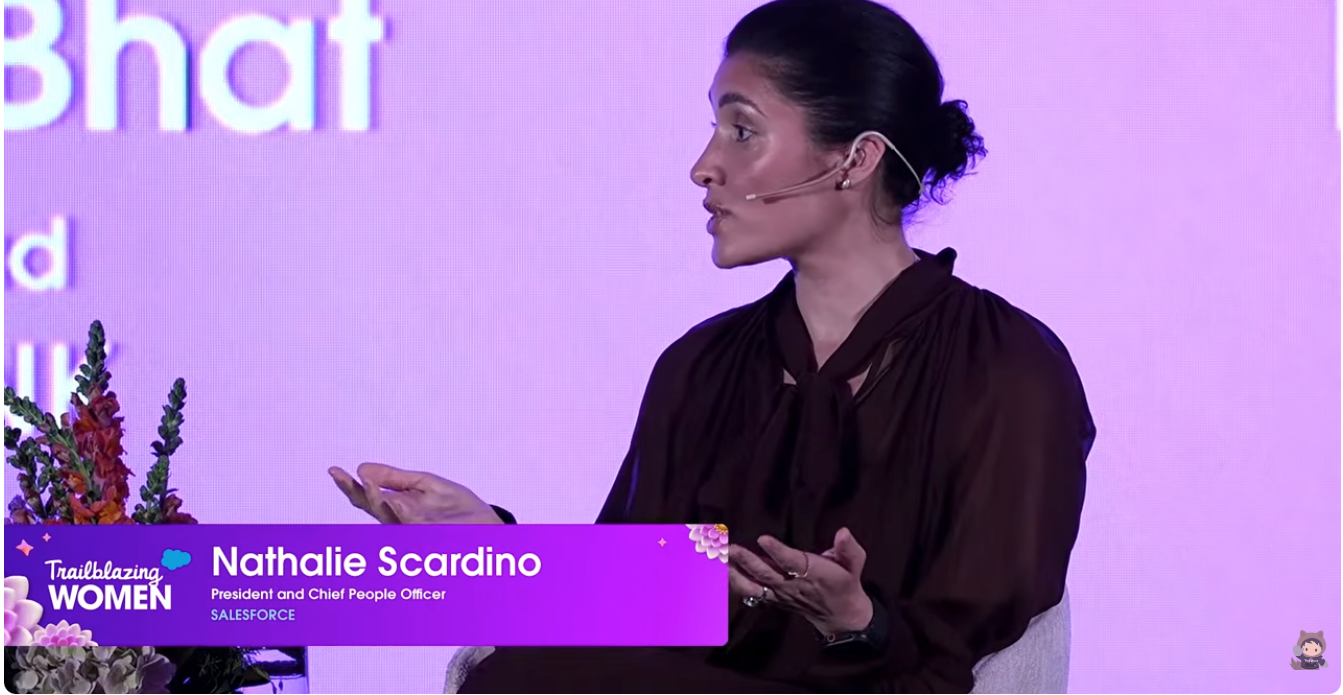
“At the leadership level, the number one skill has to be empathy and active listening. The strongest leaders are the ones who listen — for signals, for cues, for feedback. The voice of the customer and the voice of the employee live in those signals.” — Nathalie Scardino, President and Chief People Officer, Salesforce
If you’ve spent your career developing these skills without being told they counted, it turns out they were building the most important leadership capability there is. Empathy, judgment, and the ability to act on both — that is the heart of leadership right now.

Learn more: The case for keeping human judgment at the center of AI-powered work is stronger than ever — here’s what leading with discernment actually looks like in practice.
3. Protect your curiosity and never stop experimenting
The urge to wait until you feel ready is understandable, and right now, it is also the one thing holding you back. In a world changing faster than any training program can keep up with, curiosity is the edge that compounds, and learning and leading belong together, not in sequence but in step. The leaders pulling ahead aren’t the ones with the most credentials. They’re the ones who never stopped asking what comes next and kept going while they figured it out.
“There is no taking time off to learn and then lead — both have to go together. I’m a woman who sits at her desk on weekends, playing around with OpenAI, Gemini, and Claude, then comes in Monday morning asking my solution engineering team how many of them had tried running the same prompt five times to see whether the answers got better or worse. That is precisely how you will succeed today.” — Arundhati Bhattacharya, President and CEO, Salesforce India and South Asia
Curiosity is a discipline, and like any discipline, it sharpens the more you practice it. Start with the next question you ask, the next prompt you run, and the next answer you refuse to take at face value. Move forward before you feel fully ready, and trust that the work of getting ready happens on the way.

Learn more: AI fluency isn’t a developer skill anymore — it’s a leadership signal. Here’s what hiring teams are actually looking for, and how to demonstrate it.
4. Invest in yourself before anyone else does
The most career-defining moments rarely come from a formal training program. That kind of learning is personal, driven by ambition rather than a curriculum, and it almost never arrives on a schedule. Curiosity gets you moving; this is what turns that momentum into deliberate choices that compound into a career.
“More often than not, we wait for the organisation to sponsor us, to train us, to send us to a program. But it’s time to take that into our own hands — don’t wait for someone to do it for you. Do it for yourself.” — Piya Haldar, Chief Compliance Officer, Honeywell India
“No one is going to tap you on the shoulder and hand you your destiny. Throughout my career, the consistent feedback from mentors has been: advocate for yourself. Be proud to say, I just finished this course. Go ask a question to someone you don’t know. Don’t wait for permission to ask.” — Nathalie Scardino, President and Chief People Officer, Salesforce
The practical version looks like finding the course before anyone suggests it, making the connection before you need it, and building the skill before it becomes urgent. Start with one thing this week and treat it with the same commitment you bring to everything else. Small moves, made consistently, are how careers accelerate.
Learn more: The skills at the top of every hiring team’s list right now might surprise you. Here’s what to build, and where to start.
5. Measure success by how far ahead you can see, not just how far you’ve come
The leaders who will define this era aren’t the ones who perfected what already exists — they’re the ones who started preparing for what’s coming before anyone asked them to. Looking ahead doesn’t mean leaving the past behind, though. The best forward-looking leaders use where they’ve been as the foundation for where they’re going, reading patterns, connecting dots, and telling the story of what the data is pointing toward before anyone else sees it. In a moment this fast-moving, that ability to bridge past and future isn’t a soft skill. It’s the sharpest strategic tool in the room.
“If I look back five or ten years, success meant delivering a project at scale on tough timelines, and you emerged as the hero. Today, it’s about seeing around the corner: spotting where the future is headed and bringing people along with openness. It’s your ability to think ahead, prepare for what’s coming, and build something sustainable, then show others that this is how leadership must evolve. That’s what changes in this era.” — Annapurna Vishwanathan, Head of Digital, Airbus India
“The numbers alone will not move anyone. AI might surface that an account is down 12% because there’s a new CFO and a reorganization underway, but the connection, the context, the meaning — that’s what a storyteller brings. Add a personal touch and it resonates. Leave it as numbers and it fades.” — Sridevi Rao, SVP, Customer Success, Salesforce
It’s a change in what leadership means. Start mapping the future your team will need to face, build your thinking around where things are heading, and make sure that when the data tells part of the story, you’re the one who tells the rest of it.
6. Scale your people strategy as fast as you scale your tech
The easiest question to ask about AI agents is what can we automate. The better question is what can we make better for the people doing the work. When leaders start with outcomes, AI agents become a lever for better work, and the people alongside them get more space to do what only they can.
“The shift for me has been moving from managing execution to orchestrating outcomes, marrying the speed of AI with human creativity. AI handles the mundane — data crunching, research, analysis — while the team focuses on what it cannot replicate: relationships, negotiation, and reading exactly what a client needs.” — Praneet Sidhu, Head of Sales, WeWork India
“We are deeply investing in our frontline managers to be empathetic to the cognitive overload we’re placing on our teams. We’re asking people to learn, upskill, and apply — all at once, and fast. Outcomes and productivity matter, but so does how we’re taking care of our people.” — Sridevi Rao, SVP, Customer Success, Salesforce
“My role is creating an environment where innovation happens every single day — where it’s safe to act on a brilliant idea, okay to fail, and important to celebrate it.” — Annapurna Vishwanathan, Head of Digital, Airbus India
The teams that adapt fastest aren’t defined by the technology they adopt. They’re defined by who you hire, how you lead, and what you’re willing to unlearn alongside the people you’re asking to grow. When AI is everyone’s reality, innovation has to be everyone’s job.
The room that once seemed impossible is now full
The advice shared at TWS 2026 wasn’t aspirational. It was operational. These leaders are living it right now, navigating the same pace of change, the same pressures, and the same moments of uncertainty that you are. The difference is they moved anyway, and they came back to share exactly how.
Take the insight that stayed with you longest and act on it this week. Have the conversation you’ve been putting off. Raise your hand for the role that feels slightly out of reach. Start building the skill before anyone asks you to. Lead the room you’re already in with everything you have.
The room that once seemed impossible is now full, of women who proved it could be done and who are determined to make it easier for every woman who comes after them. You are part of that story now. Make it count.
If you heard something today that made you think this is where I want to be, we’d love to have you.
Explore open roles at Salesforce, join the Talent Community to stay close to what’s happening, and start building on Trailhead whenever you’re ready.
Related Articles



AI supported the writers and editors who created this article.