




Overview
In today’s data-driven economy, businesses generate and collect data at unprecedented rates. While structured data has long been the foundation of business intelligence, unstructured data — such as emails, social media, customer reviews, images, videos, documents, and sensor logs — now makes up over 80% of all enterprise data. Despite its volume and richness, unstructured data remains largely untapped in many organizations. Unlocking its potential is no longer optional — it’s a competitive necessity.
Significant innovation in Data 360 has focused on Generative AI and Agentic AI, which empowers autonomous decision-making and task execution. While these technologies offer powerful on-demand capabilities, there remains a critical need for solutions that allow businesses to detect and act on changes in unstructured data in near real time across diverse use cases.
The Power of Vector Search in Unstructured Data Using Data Actions
The need to efficiently search, understand, and act on the unstructured data has become critical to discovering new opportunities. Vector search combined with near real-time Data Actions make those discoveries possible.
Vector Search
Vector search uses LLM models to represent unstructured data as high-dimensional vectors (embeddings). This allows systems to understand semantic meaning, find conceptually similar content across varied formats and sources, enable natural language queries, and retrieve contextually relevant results.
Data Actions
Salesforce Data 360’s Data Actions empower customers to leverage the rich data and insights within Data 360 in both near real time and real time. It utilizes advanced change detection mechanisms, grounded in Change Data Capture (CDC), to identify data updates as they occur. By integrating these change detection events with intuitive visualizations, Data Actions can deliver significant business value by enabling timely, precise, and actionable insights that drive operational efficiency, elevating customer experiences, and supporting data-driven decision-making.
Here are few key business scenarios from our customers where this powerful combination can make a real difference:
- Proactive Property Risk Assessment for Real Estate Sector
A real estate firm analyses data from house inspection reports to assist buyers in making informed decisions by providing detailed diagnostic reports on seller properties. Among the various assessments they generate, like gas, termite, and electrical inspections, an asbestos diagnosis report is a critical component. These reports are stored as PDF files in cloud storage. Prospective buyers want to analyse these documents in near real time to determine whether asbestos was detected during the inspection. If asbestos is found, the company aims to proactively create a Case to address the issue promptly and reach out to the homeowner to explore potential opportunities for remediation, decoration, and budgeting for necessary work.
- Automated RFP Evaluation for Energy Sector
An energy company processes high volumes of complex RFPs in unstructured PDF formats. To reduce manual effort and improve decision-making, the company automates scorecard extraction and analysis, enabling near real-time “Go/No Go” CRM updates. This streamlines vendor management and enhances operational efficiency.
- Loan Eligibility Automation for Financial Services
A financial institution analyzes CIBIL reports in PDF format to assess loan eligibility. By extracting credit scores and automating CRM updates and customer notifications, the bank accelerates lending decisions, reduces risk, and improves customer communication.
- Contract Management Automation for Insurance
An insurance company uses DocuSign to send home insurance contracts in PDF format. It automates CRM updates based on signing status by due date, marking contracts as “Active” or “Terminated.” The contract data also supports smarter, faster responses to customer service cases.
- Near Real-Time Compliance Monitoring with Watcher Agent
Salesforce Industries Cloud is developing a “Watcher Agent” to detect and flag high-risk customer interactions in near real time. By proactively correcting interactions and monitoring for policy violations, the solution helps automate compliance to reduce risk, cost, and regulatory exposure in highly-regulated industries.
Driving Innovation and Competitive Advantage Using Vector Search in Data Action
In this blog post, we’ll give you a detailed walk-through on how Data 360 solutions drive optimal business outcomes for our real estate customers.
The journey of the real estate firm starts with a few simple steps. It begins with ingesting the diagnosis report that is unstructured data into Salesforce Data 360 and subsequently creating the Search Index. The next step is to create the Data Action target and Data Action using ‘Vector search Data Action’ capability.
Create a Salesforce Platform Event target by navigating to the Data Actions Target tab in Data 360.
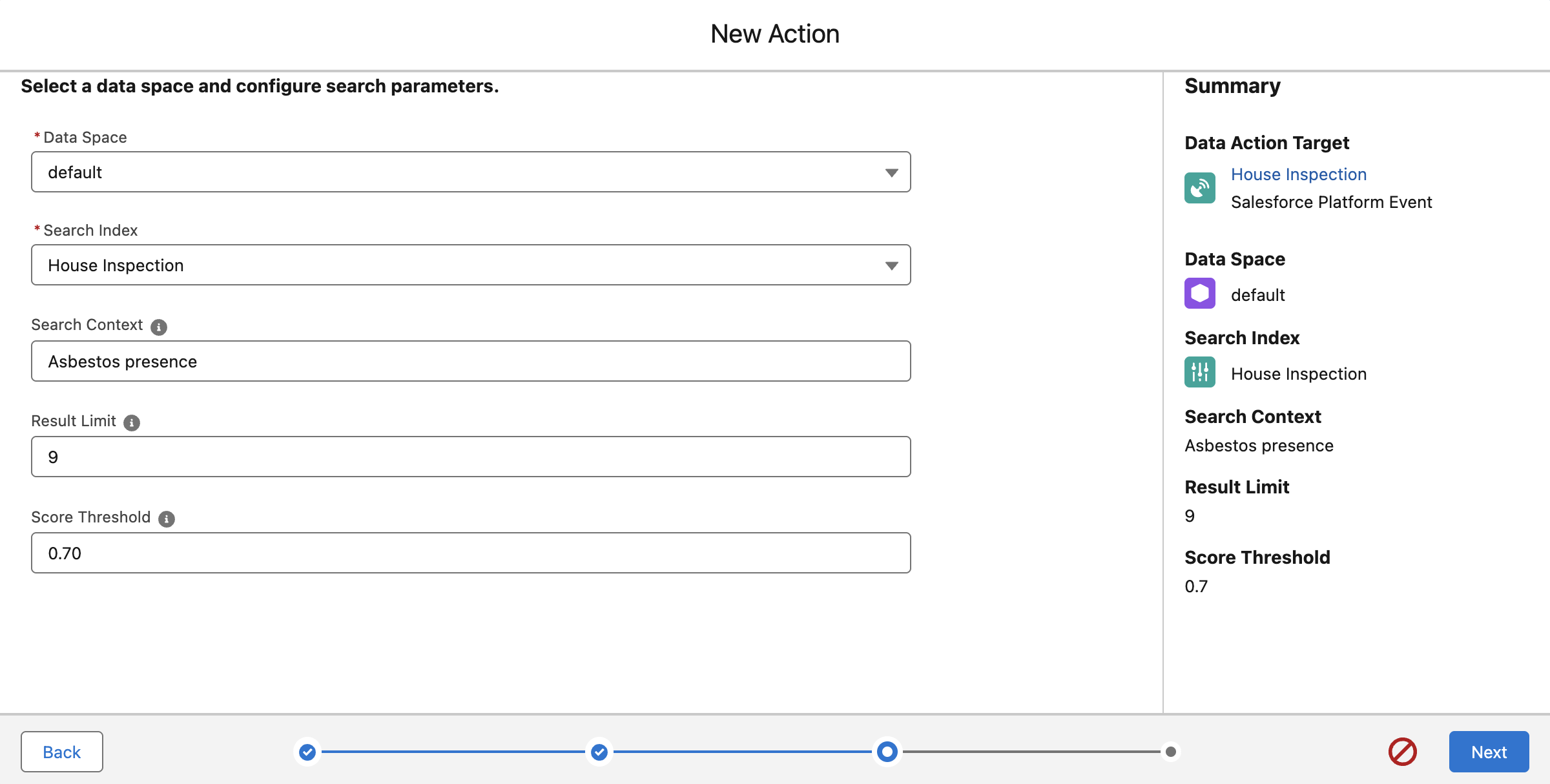
Next step is to create Vector Search in Data Actions by navigating to the Data Actions tab in Data 360. By gathering the following inputs, Data Action is now set to listen to unstructured data and start triggering the events as they occur:
Search Context: The search text that returns the relevant results based on the use case.
Results Limit: The number of top results to return from the search.
Score Threshold: The threshold similarity score for vector search.
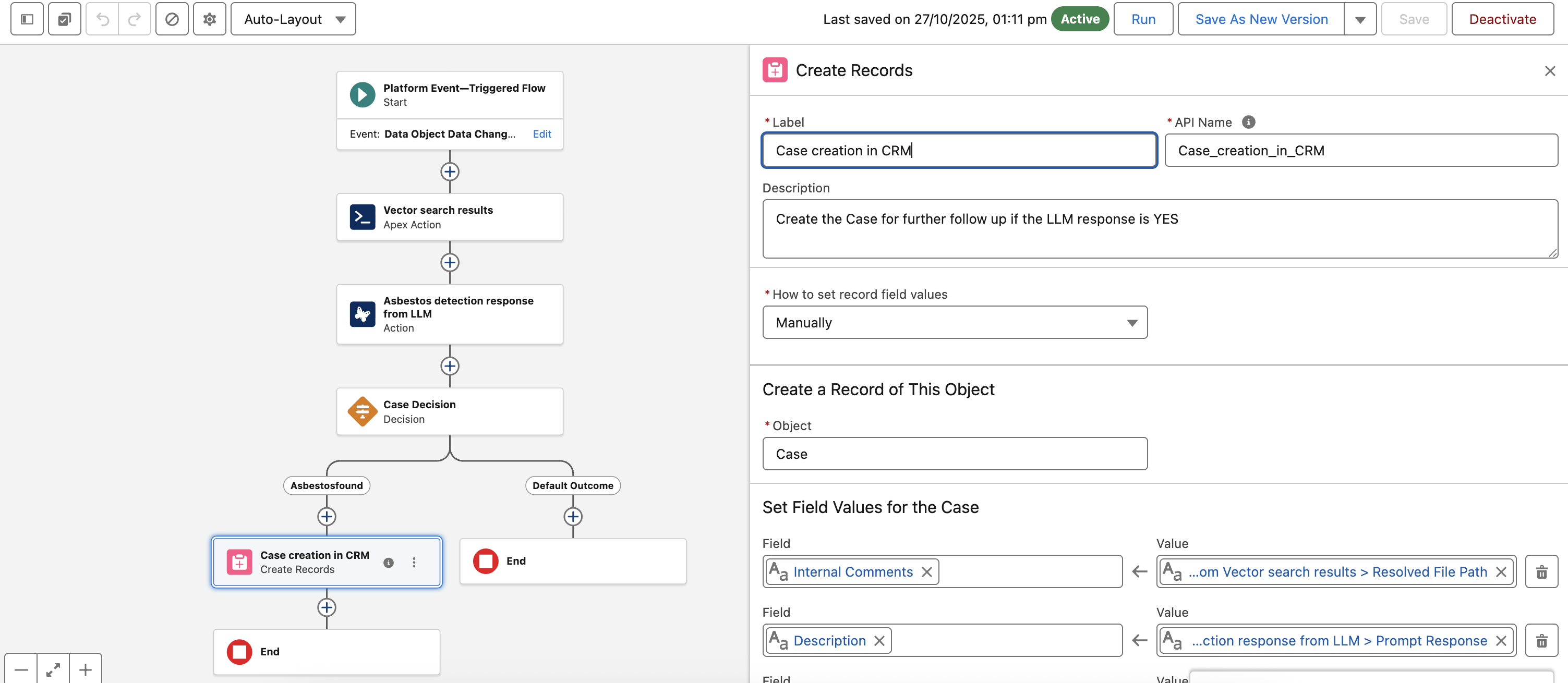
With the power of Platform event triggered flows, they begin the next step by extracting the payload from Data Action and integrating with Salesforce CRM seamlessly. By mapping the values from Data Action to Case object, they are successfully able to create the Case with enriched values from Salesforce Data 360.
Deeper and More Diverse Insights
The launch of Vector search in Data Action represents a pivotal step in our commitment to giving you seamless access to your unstructured data — no matter where it resides and power to act on the data. By searching your data and triggering a Data Action, we’re opening the door to a new era of gaining a nuanced picture of customer needs and preferences. By exploring patterns and acting on unstructured data, organizations can discover and respond quickly to market demands and customer needs.