
As businesses rush to adopt agentic commerce, development teams are typically up against one of two predicaments. Some struggle with commerce platforms they have outgrown. What was once an ‘easy’, lightweight solution has become a web of fragile third-party apps that lack the data cohesion required for impactful AI. Alternatively, some teams are fighting against the crushing weight of technical debt from their ‘enterprise’ platform. The pivot to agentic workflows feels like an impossible engineering feat. According to Salesforce’s forthcoming State of Commerce report, US commerce leaders list implementing and expanding AI capabilities as their number one challenge this year.
Forced tradeoffs make it harder to grow
Whether you’re trapped by an overly simplistic solution or an overly complicated monolith, the result is the same: Tech becomes a bottleneck and hinders business growth.
Signs you’ve outgrown your “easy” solution
- Performance degradation during peak shopping and sales events
- Siloed commerce agents that can’t talk to commerce or marketing
- Fragmented data across multiple third party apps
- Inability to customize your own checkout experience
- High penalty fees to use your own third-party payment provider
- No access to staging and dev instances where you can safely test and collaborate on site changes
- Managing a different product catalog for every site and market
Signs you’re trapped in an enterprise burden
- Technical debt prevents you from moving quickly or adopting the latest technology
- Your architecture is built around an ERP instead of customer data
- You are forced into painful, expensive upgrades
- Security breaches put your customer data and reputation at risk
- Sunsetting technologies force you to replatform
Introducing Storefront Next: Built for the agentic commerce era
Success in the agentic commerce era requires a new kind of solution that doesn’t just layer AI on top, but builds it in from the get-go. This is the philosophy behind the introduction of Storefront Next and a new era for B2C Commerce. Storefront Next unlocks the best of both worlds: enterprise power with out-of-the-box simplicity. It’s built to be AI-first for merchandisers, developers, designers, and shoppers.
Partners and pilot customers are already reporting success with the platform. According to Sam N, Director of Ecommerce at Homemakers, “Storefront Next is the foundation we were looking for to build an AI-first website architecture for the next chapter of ecommerce. It simplifies our integrations, streamlines developer operations, and accelerates our path to market.”
Traditional replatforming carries too much risk, high costs, and exhausting timelines. Storefront Next completely changes the economics of commerce implementations. We deliver faster time to value and a lower total cost, without ever compromising on enterprise capability.
Storefront Next is built to be:
- Quick to launch, easy to manage
- Fast and high-converting
- Enterprise-grade, without the complexity
Quick to launch, easy to manage
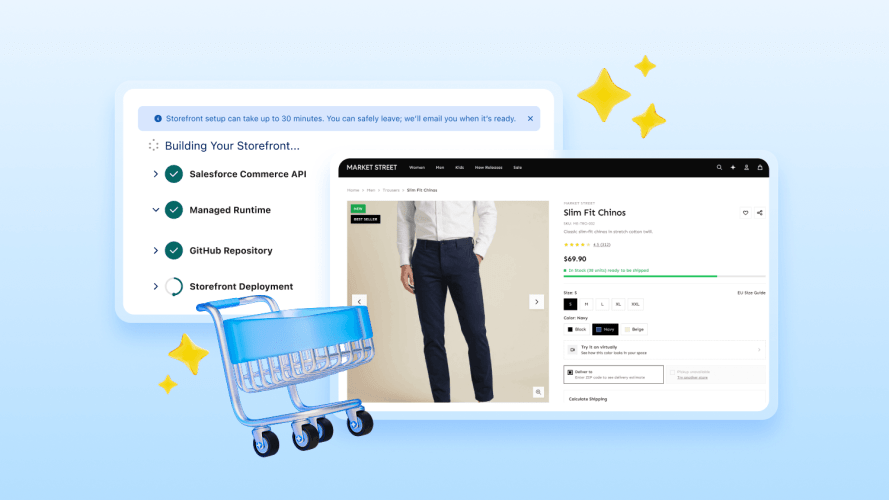
Merchants can now stand-up a storefront template, storefront hosting, connected APIs, and a GitHub code repository with just clicks — in less than 30 minutes. Then, developers can use that code and drastically reduce implementation timelines with the new Agentic B2C Developer Toolkit, which connects the platform to AI assistants like Claude Code, Agentforce Vibes, GitHub Copilot and more.
Luke Barber, Head of Ecommerce Technology at Iceland Foods, says “As a team driven to work at the forefront of emerging technology, being selected as a pilot partner to help shape Storefront Next, Salesforce’s new frontend platform built with performance and AI development at its core, is exactly where we want to be. It’s fast to run, easy to adopt, and already delivering better than anticipated progress. This is the kind of pioneering work that truly brings out the best in our engineers.”
To further accelerate implementations, our new Commerce Apps framework offers a plug-and-play packaging model designed to eliminate the complexity of third-party integrations. For merchants, this means a clicks-based setup experience directly within Business Manager for faster implementation timelines and lower costs. You can install leading ISV solutions and native Salesforce features as unified packages — complete with intuitive configuration tasks that minimize the need for custom development. This isn’t just about adding features; it’s about a streamlined architecture that lets you extend your storefront capabilities without the traditional integration headache. Our ISV launch partners include Adyen, Avalara, Bazaarvoice, Contentstack, ESW, Forter, Mirakl, Noibu, Stripe, and Zenkraft, with many more to come.
Fast and high-converting
Every millisecond of latency is lost revenue, so Storefront Next is engineered for performance from day one. Our templates vastly outperform the gold standard for performance metrics as defined by Google. For example, the Storefront Next product display page (PDP) loads 66% faster than Google’s recommended 2.5 seconds. These high performance scores lead to lower bounce rates and better SEO, as well as ample performance budget for your own extensions.
The functionality in the templates is also rich by default. It includes media galleries, ratings shells, variant selection, fulfillment messaging, BNPL, express payment options and much more. The streamlined checkout template even includes embedded authentication to reduce friction and increase conversions.
Enterprise-grade, without the complexity
Storefront Next is built on a high-availability infrastructure engineered to handle massive traffic spikes with ease, ensuring your brand stays online and performant during your biggest moments.
We’ve brought forward the deep multi-site management capabilities our customers depend on — including dedicated development and staging environments — to give you total control over global operations. Jason Sanchez, Ecommerce Product Owner at Colony Brands, shares, “Managing 16 distinct brands requires incredible agility. Storefront Next gives us the enterprise power we need with the simplicity to move fast. Theming across our multiple sites has been easy and extensible, and integrating APIs with the existing structure has worked exceptionally well for our team.”
This enterprise-grade foundation is paired with a headless architecture and a streamlined developer experience using the modern web tools that both developers and AI platforms prefer. By building with the latest enterprise standard tech, we’ve created a development environment that’s faster for your teams to code in and optimized for AI agents to understand and extend. This is enterprise power without the traditional weight, giving you the freedom to innovate at the speed of the current market.
Industry-leading partners are changing the economics of commerce implementations
We’re working side-by-side with industry-leading partners like 64 Labs, Accenture, Amblique, Astound Digital, Capgemini, Deloitte Digital, DEPT, Forward, Grace Brigade, Merkle, OSF Digital, Positive Minds, Publicis Sapient, Slalom, Space Dinosaurs, and Studio Science to bring the Storefront Next vision to life and dramatically reduce the time and cost of commerce implementations. Here’s what our partners are saying:
Rob Smith, SVP Commerce at OSF, says “Storefront Next has really enabled the next level of our AI driven methodology. Using it in our workflow has allowed us to carve our front-end development cycle time in half, which is exactly what the market needs right now. Combined with OSF’s AI-driven delivery accelerator, Commerce Forge, we have a platform built for speed and lower TCO, helping customers move from commerce strategy to execution faster and with less friction, without the complexity and long implementation cycles traditionally associated with enterprise commerce.”
Kyle Montgomery, Commerce Lead at Astound Digital, puts it this way: “AI is changing the game, and Salesforce is meeting the moment with Storefront Next. Retailers can now enjoy end-to-end vibe coding abilities on Salesforce, and we’re already seeing 30% improvements in our implementation timelines and costs using Storefront Next. For our Launch360 Salesforce accelerators, which took years for us to build, we used AI-assisted development to migrate them in weeks.”
Thomas Förster, Senior Solution Architect at Positive Minds, shared: “We have worked with Salesforce B2C Commerce since the early days—building on SiteGenesis, SFRA, and PWA Kit—but getting our hands on Storefront Next feels like entering a new era. Most of all, it delivers on the original promises of SaaS e-commerce by speeding up implementation and allowing clients to focus on their core business. Fully AI-driven, Storefront Next will help businesses pivot toward true agentic, omni-channel sales.”
Bruno Braes, Founder and CEO at Forward, shared: “Storefront Next is the first Salesforce B2C Commerce foundation whose architecture genuinely clicks with how AI-native teams build. Our FastForward accelerator took six developers six months on PWA Kit. Porting it to Storefront Next took just over a week with six agents. The numbers are why we’re bullish on this release.”
Aaron Hutten, CTO at Studio Science, says: “Storefront Next won’t save bad teams. Nothing does. But for people who actually understand Agentforce Commerce, it takes a lot of the old drag out of the work. That matters.”
Agentic commerce that makes a meaningful impact on your business
The ultimate goal of this architectural shift is to bridge the gap to agentic commerce so you don’t have to choose between enterprise and easy. By unifying your data and commerce logic on a single, streamlined platform, you remove the friction that prevents AI from working effectively. You stop paying for integration debt and start investing in the right capabilities for future-proof growth.