


Strategising without a plan is anything but easy. According to McKinsey, only 57% of respondents say their company makes quality decisions, largely because teams rely too heavily on intuition instead of structured processes. This leads to blind spots and missed opportunities.
One way to beat this decision-making ambiguity is through a SWOT analysis, a structured method for understanding your current market position and your prospects for growth.
Although it’s been around since the 1960s, SWOT is still one of the best ways to learn more about your company, competitors, customers, and prospects. In this article, we’ll explore how it works, how to do it right, and how technology can level up the framework to meet modern-day standards.
What is SWOT, and how is it structured?
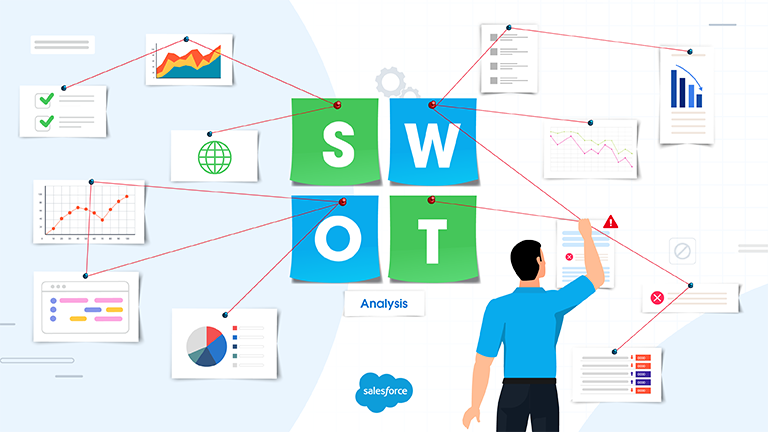
SWOT stands for strengths, weaknesses, opportunities, and threats. It’s an assessment and planning framework to help you understand where your business currently stands and the factors that could influence your future decisions. Let’s break down that acronym further.
What is SWOT?
| SWOT | What it means | Examples |
| Strengths | Internal attributes that give you a competitive edge | Unique resources, key skills, assets, brand perception |
| Weaknesses | Internal limitations that can hinder your performance | Limited budget, outdated tech, skill shortages |
| Opportunities | External trends and openings that you can use for growth | Customer buying habits, new technologies, new markets |
| Threats | External risks or challenges that could impact performance | New competitors, economic downturns, regulation shifts |
When you conduct a SWOT analysis, you’ll typically display the findings in a matrix with four quadrants, with each section representing one part of the acronym. Here’s an example:
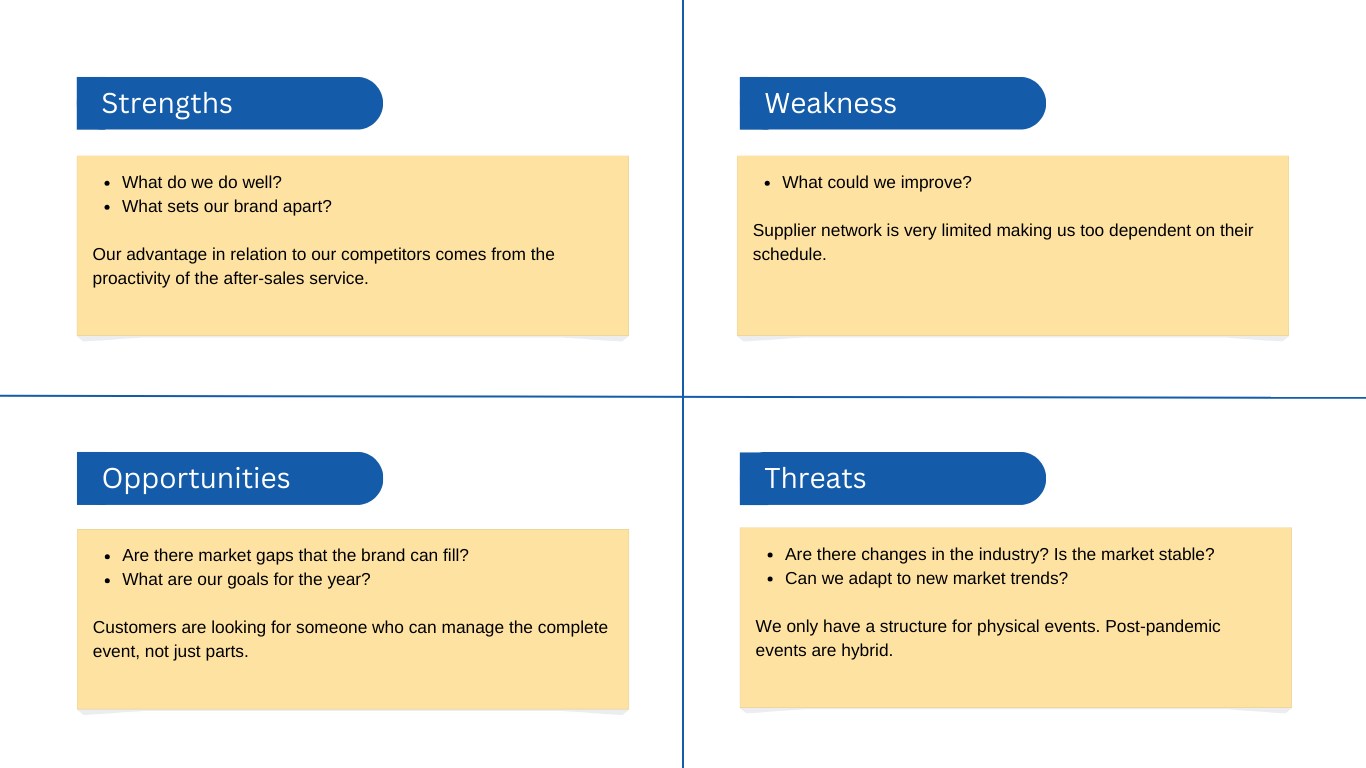
The matrix above follows a specific pattern to ensure it’s consistent and easy to understand:
- The top of the matrix is for internal elements (strengths and weaknesses)
- The bottom of the matrix covers external elements (opportunities and threats)
- The left side of the matrix identifies positive elements (strengths and opportunities)
- The right side of the matrix is for negative elements (weaknesses and threats)
Visualising your findings in this way makes sure the matrix is recognisable, repeatable, and easy to analyse and share with others in your organisation.
Do more with your data with scalable insights from Tableau
As the world’s leading AI-powered analytics platform, Tableau makes it easy to see, understand and act on data wherever you work.


How is SWOT used? SWOT analysis explained
The ultimate goal of a SWOT analysis is to help teams strategise and get a complete picture of their business, competitors, and customers. This makes it invaluable for various use cases:
- Making decisions: SWOT provides a structured framework for evaluating risks versus opportunities, helping stakeholders make strategic decisions.
- Improving performance: Identifying internal weaknesses lets teams create focused plans to address gaps, remove obstacles, and improve skillsets.
- Maximising potential: Understanding strengths and opportunities lets organisations develop growth-oriented strategies that build on what they already have.
- Preparing for challenges: Recognising threats early lets businesses anticipate risks and take steps to mitigate them before they escalate.
Ultimately, SWOT creates a foundation for setting business goals, allocating resources, and building forward-thinking strategies while avoiding risks along the way.
A SWOT example for business decision-making: Vegemite
To show you how SWOT could be used in practice, let’s create a hypothetical example for Vegemite. We’ll also explain how they might use this information to make key decisions.
SWOT Analysis Example
| Vegemite SWOT Analysis |
| Strengths – Uniquely distinct taste – Strong brand loyalty – Affordability | Weaknesses – Polarising flavour – Limited global appeal – Limited product variety |
| Opportunities – Expanding internationally – New product formats – Marketing to younger generations | Threats – Cheaper ‘knock-off’ brands – Preference for healthy breakfast alternatives |
Using their findings, Vegemite could decide to:
- Use their strong brand recognition domestically to introduce Vegemite internationally
- Build new products, such as snack-sized kits or fusion products, to target new demographics
- Create marketing campaigns that play on Vegemite’s polarising flavour (something the UK’s Marmite brand has done particularly well)
While this is a simplified example, you can see how a SWOT analysis provides a foundation for strategic decision-making. By understanding how to build one, you can create a framework for identifying priorities, managing risks, and uncovering new growth opportunities.
5 key benefits of SWOT analysis
Before we look at how to perform a SWOT analysis in more detail, let’s recap the benefits. Here are five reasons why understanding your strategic position and external landscape is worth the effort:
- Evidence-based planning: SWOT encourages you to reflect on your true strengths, weaknesses, performance metrics, competitors, and customers. This means all of your planning is based on careful thought, which leads to smarter decisions.
- New revenue opportunities: By identifying your opportunities, SWOT can uncover untapped markets, trends to capitalise on, and ways to build upon your strengths, revealing new revenue streams for your business.
- Risk mitigation: The better you understand your weaknesses and external threats, the better prepared you are to tackle them proactively. This approach helps protect your business from unexpected challenges and potential losses.
- Increased collaboration: SWOT is a proven framework that anyone (from stakeholders to frontline teams) can understand. This makes it easy for teams to discuss, align on, and prioritise strategies together.
- Cost-effective strategising: A SWOT analysis is easy and affordable to carry out, requiring minimal upfront investment. It also helps you prioritise where to invest your time and assets, reducing wasted resources.
Taken together, these benefits make SWOT a simple, affordable, powerful tool to align your teams, make smarter decisions, and tackle challenges proactively.
Grow fast with the #1 CRM for small businesses.
Get started and scale fast with the #1 AI CRM for small businesses in any industry. Connect marketing, sales, service, and commerce on one platform. Save time with simple setup and built-in guidance. Set the foundation for growth with unified data and AI.
How to do a SWOT analysis
Now that you understand how a SWOT analysis can support your decision-making, it’s time to build one. We’ve broken down how to create a SWOT analysis into five essential steps:
- Step 1: Define your objective
- Step 2: Create the SWOT matrix
- Step 3: Brainstorm internal and external factors
- Step 4: Analyse and prioritise
- Step 5: Develop an action plan
Let’s get into each of these steps one by one.
1. Define your objective
First, you need to define your objective to keep your brainstorming grounded and actionable. Here are three key questions to discuss with your team:
- What are we trying to achieve with our analysis?
- Are we assessing the business as a whole or focusing on a specific product or project?
- Who will use the results, and what decisions will they inform?
For instance, if you want to launch a new product, you might create a SWOT analysis that focuses on opportunities and threats in your target market, as well as weaknesses that could slow down production and marketing. Or, if you want to improve the customer experience, your SWOT could focus on the strengths and weaknesses of your internal processes and the shifting trends in customer expectations.
This step will help you focus your efforts on the area that matters most and avoid targeting ideas that won’t be relevant to your final objective. It will also ensure you can choose the right team members for the job when it’s time to brainstorm.
Pro tip: Write your objective at the top of your matrix before you start brainstorming to keep your team focused and ensure each point moves towards your goal.
2. Create the SWOT matrix
Next, it’s time to visualise your SWOT analysis. Follow these steps to create your matrix:
- Divide a square into four equal sections.
- Label each quadrant clearly (strengths, weaknesses, opportunities, threats).
- Be sure to leave space to brainstorm your ideas.
Alternatively, here’s a simple SWOT analysis template you can copy to get started.
SWOT Matrix Template
| Objective: |
| Strengths | Weaknesses |
| | |
| Opportunities | Threats |
| |
3. Brainstorm internal and external factors
With your framework created, you’re ready to start filling in your matrix. To start, gather team members who are relevant to your objective. For instance, if your goal is to enter a new market, you’ll want input from marketing, sales, product, and operations teams.
After you assemble the right team for the task, collaborate to fill out your matrix. Below, we’ve outlined questions for each section to kickstart your discussions:
Questions to Ask For Your SWOT Matrix
| Strengths | Weaknesses |
| What do we consistently do well? What resources, skills, or product strengths give us a competitive advantage? What feedback do customers praise us for? Where do we outperform competitors? | Where do we lack resources, skillsets or capabilities? What do our competitors do better than we do? What internal factors slow us down? What have customers criticised? |
| Opportunities | Threats |
| Are there any market trends to leverage? Are there underserved markets we could target? Is there any new technology that could help us reach our goal? Is there a gap in our industry that we can fill? | What trends could harm our performance? Are there new competitors to be aware of? Are there any new economic or regulatory changes to consider? Could supply chain or technology issues create a roadblock? |
At this stage, your goal is to get everything relevant to your objective on the table. Don’t filter or prioritise ideas yet; just encourage open input from everyone involved.
It’s also worth remembering that not every opportunity or threat will be obvious from your initial discussions. Market research, customer feedback, competitor analysis, and trend reports will help you uncover external factors that your team might miss.
Pro tip: Be detailed here. The more complete and well-informed your list is, the stronger your business analysis methods will be. Capture anything that could influence your objective.
4. Analyse and prioritise
You’ve gathered your ideas. Now, you need to separate the interesting from the truly important. Your business can only focus on a select few areas at once, so you need to choose the factors that will have the biggest impact.
To start, review each quadrant and ask yourself which point(s) will have the biggest impact on your objective. What strengths truly set you apart? What weaknesses could really hold you back? What are the biggest opportunities? Which threats are most likely to disrupt?
Here are some tips to help you prioritise your ideas based on their potential impact:
- If multiple points highlight the same problem or advantage, that’s a sign it carries weight
- Focus on the things that you can influence rather than those out of your control
- Where possible, validate your findings with data like performance metrics and insights
This step can often lead to debates among your group, so it can be helpful to bring in management when needed to rank the most important actions.
Pro tip: Assign each idea a simple score to keep tabs on which ideas matter most.
5. Develop your action plan
Now, it’s time to turn what you’ve learned into a clear, actionable strategy. Here, you’re looking for the specific actions that will help you maximise your strengths, fix your weaknesses, seize opportunities, and protect your business against threats.
It might be tempting to take each segment in isolation, but this isn’t a good approach. Each component of the matrix is typically interlinked. Consider this example:
- Your company’s strength is that you’re a highly recognised brand
- There’s an opportunity to enter a new market and capitalise on customer trends
- However, there’s the threat of two fast-moving competitors
- Your weakness is that you’re slow to enter new markets
So, while it may appear like entering the new market would be easy, there’s a high likelihood that your competitors will get there before you. This means you need to consider whether your brand identity is strong enough to enter the market late or whether you need to prioritise improving your time-to-market first before reassessing opportunities in the future.
You can see how a SWOT analysis helps you make informed, realistic decisions. By considering each component in unison, you can prioritise actions and develop strategies that are focused and attainable.
Pro tip: Assign an owner, timeline, and success metric to each action point you create. This will keep everyone accountable and ensure you have a way to track and measure progress.
Common SWOT mistakes (and how to avoid them)
A SWOT analysis may be a simple tool, but it still has its pitfalls. Knowing what to watch out for (and how to fix any problems) will ensure your analysis leads to consistently actionable insights:
Common SWOT Analysis Mistakes and Solutions
| Mistake | Solution |
| Being too vague with your ideas | Back up all of your ideas and examples with real data, such as performance metrics and customer feedback |
| Ignoring external factors | Conduct market research, analyse competitors, and review trends to uncover opportunities and threats |
| Letting bias creep into your ideas | Encourage diverse perspectives from all relevant team members, and base points on facts rather than intuition |
| Losing sight of your objective | Define your objective first and note it down at the top of your matrix to keep it top of mind |
| Skipping the collaborative process | Gather relevant team members before you start brainstorming to get a complete, balanced view |
| Trying to do everything at once | Prioritise your SWOT analysis and focus on the critical factors that will influence your objective most |
Practical applications of SWOT analysis
Now that you’ve learned about SWOT Analysis, you might be wondering how to put it to use. Let’s explore some ways to use this technique:
Where SWOT Can Be Applied
| Application | How it’s applied |
| Business strategy | Identifying internal capabilities and external trends to make smarter long-term decisions |
| Marketing planning | Assessing market position and customer behaviour to refine marketing campaigns |
| Project management | Evaluating resources and risks to allocate resources effectively and execute projects efficiently |
| Competitor analysis | Comparing strengths and weaknesses against competitors to find opportunities for growth |
| Performance evaluation | Understanding where teams are performing well and where they can benefit from support |
| Personal development | Reflecting on your own personal skills and areas for growth to further your career progression |
Let’s briefly touch on these areas one at a time with examples.
Business strategy
SWOT helps organisations decide which strengths to capitalise on, which weaknesses to fix, where opportunities lie, and which risks they need to address. This lets them prioritise strategic moves that will create the biggest short- and long-term impact.
Example: A retailer uses SWOT to decide which product categories to expand or discontinue, based on their internal strengths and market trends.
Marketing planning
By using SWOT analysis to create a marketing plan, you can assess your company’s positioning in relation to the market and its competitors, helping you develop campaigns that deliver consistent results.
Example: A fashion brand explores sustainability trends and evolving customer preferences to refine its messaging for a new marketing campaign.
Project management
Project teams can use SWOT to find constraints and resource gaps that could be putting their projects at risk. This helps them plan proactively to avoid delays and unwelcome surprises.
Example: An engineering team identifies limited staffing (internal) and tight deadlines (external) as two potential risks and plans ahead to request more time and increased resources on the project.
Competitor analysis
SWOT lets you compare your capabilities versus your competitive landscape. This will help you patch up any potential vulnerabilities and invest more heavily in strengths that could give you a competitive edge.
Example: A SaaS firm spots its competitors’ slow response times and invests in its own customer service to get an edge.
Performance evaluation
Managers can use SWOT to evaluate what’s working internally and what isn’t. This gives them insights they can use to refine training plans and invest in key skills for teams.
Example: A company compares declining customer satisfaction with internal weaknesses to create a training plan for sales teams.
Personal development
SWOT isn’t just for broad business plans. Individuals can use a personal SWOT analysis to reflect on skills and career goals, helping them focus their efforts where they’ll have the biggest impact.
Example: A manager reviews their leadership strengths and weaknesses to guide their development plan.
Tips for getting your SWOT analysis off the ground
SWOT analysis is a strategic planning tool, but it’s only helpful if the company knows how to analyse the information it has gathered, develop a plan and put it into practice. To leverage the full potential of your SWOT analysis, incorporate these proven techniques into your strategic planning process:
- Prioritise strategies: Prioritise strategies by identifying the most crucial actions for your business. Consider starting with achievable goals or focusing on high-impact initiatives. Engage your team in a thoughtful discussion to create a well-reasoned priority list.
- Set goals and objectives: Ensure that your goals and objectives align with the company’s mission and vision.
- Develop an action plan: Break down your goals into manageable steps. Figure out who’s best suited to handle each part and put them in charge.
- Monitor and evaluate progress: Implement regular reviews to assess the execution of your action plan. Analyse key performance indicators and milestones achieved. Based on these assessments, make timely adjustments to strategies and tactics as needed.
Read more: Project Management: Your Comprehensive Guide
How technology can enhance your SWOT analysis
SWOT analysis is a solid starting point for strategic decision-making, but it does have a weakness. Without concrete evidence to justify your decisions and support the decision-making process, it can still rely too heavily on intuition and best guesses.
Fortunately, modern technology can help you fix that. Let’s discuss some of the different ways you can amplify your SWOT analysis with the support of advanced tools and processes.
Data collection and visualisation
Instead of relying on debates and assumptions, tools like Tableau can pull in real performance data, trends and customer insights directly from your CRM. Visual dashboards then make patterns easier to spot and evaluate.
This lets you connect every strength, weakness, opportunity and threat to real evidence, ensuring each of your ideas is accurate and free of bias.
AI-powered insights
Well-known AI tools like ChatGPT and Gemini can help you brainstorm SWOT ideas, explore feedback for trends, and identify external shifts you might have missed.
Asking AI the right questions is a learned skill. However, here are some example prompts you can try:
- ‘Based on this data and customer feedback, what are our top strengths and weaknesses internally over the last three months?’
- ‘What external trends could impact our growth in our industry over the coming year, and what can we do to plan ahead?’
The next level up is artificial intelligence (AI) that’s connected directly to your CRM. For example, Agentforce can surface insights from directly within your Salesforce ecosystem, spot trends you’d normally overlook, and highlight external opportunities or risks before they emerge, and it’s all grounded in your actual business data. This makes it simple to find focus areas at scale without relying on guesswork or manual analysis.
Tracking progress and impact
One of the biggest benefits of modern tools is that you can use them to track progress towards your SWOT goals over time.
For instance, let’s say you identify an opportunity to refine your messaging for an upcoming campaign. Agentforce Marketing will let you A/B test different approaches, track how each message lands with your audience and continually optimise your approach for the best results.
Or, if you’ve recently provided training to sales reps based on an identified internal weakness, Agentforce Sales will give you real insights into performance, helping you see whether your actions are having the intended impact on conversion rates.
Essentially, this turns SWOT from a one-time event into an iterative process that you can review, refine, and improve with time.
Empower every employee to do more with Agentforce Assistant.
Sales, service, commerce and marketing teams can get work done faster and focus on what’s important, like spending more time with your customers. All with the help of a trusted advisor — meet your conversational AI for CRM.
Level up your SWOT framework with Salesforce
SWOT analysis is a simple and effective tool that can help businesses of all types and sizes stay competitive and achieve their goals. By identifying your company’s strengths, weaknesses, opportunities, and threats, you’ll open the door to better decisions across all business areas.
However, you’ll realise the true value of SWOT is when you can tie intuition and discussion to real business data. For that, you need the right SWOT tools at your disposal. Here’s how Salesforce can help:
- Data 360 to unify your business data from all sources
- Tableau to visualise that data, making it easy to spot trends and opportunities
- Agentforce to surface insights from your data through groundbreaking AI
- Agentforce Marketing and Agentforce Sales to track progress towards your objectives
Together, the Salesforce CRM will transform your SWOT analysis into a consistent, evidence-backed process that will give your business an accurate and real-time view of your strengths, weaknesses, opportunities and threats. All of this makes it easier to turn insights into strategic actions that drive measurable results.
Try Salesforce for free today to get started.
FAQs
Why is it called a SWOT analysis?
It’s an acronym that stands for strengths, weaknesses, opportunities, and threats (SWOT). The name simply reflects the four categories you examine to understand your current position and potential for growth.
What are the origins of SWOT analysis?
SWOT analysis has been in use since the 1960s, when researcher Albert Humphrey led a team at the Stanford Research Institute in a study to determine why strategic planning often failed. This led to the creation of a simple SWOT analysis to assess internal and external factors influencing business success.
Can I do a personal SWOT analysis?
Yes. A personal SWOT analysis is a powerful tool for self-development. It will show you what you’re good at, where your weaknesses lie, what opportunities you should seize, and which challenges you’ll need to prepare for. This makes it useful for everything from career planning to setting personal goals.