



A year in the world of AI feels like a decade of progress in any other industry. Last year, we focused heavily on the art of the prompt. We spent our time trying to coax large language models into behaving predictably through careful word choices. Today, the conversation has shifted toward building autonomous systems that reason, plan, and act with precision.
To keep pace with this evolution, we refreshed our popular Agentforce Guide. Here’s what changed.
Blending Probabilistic Reasoning with Deterministic Control
We realized early on that prompt engineering has its limits. Relying solely on natural language to guide an agent often leads to inconsistent results. Our customers told us they needed more reliability for high-value business tasks. This feedback drove the development of hybrid reasoning.
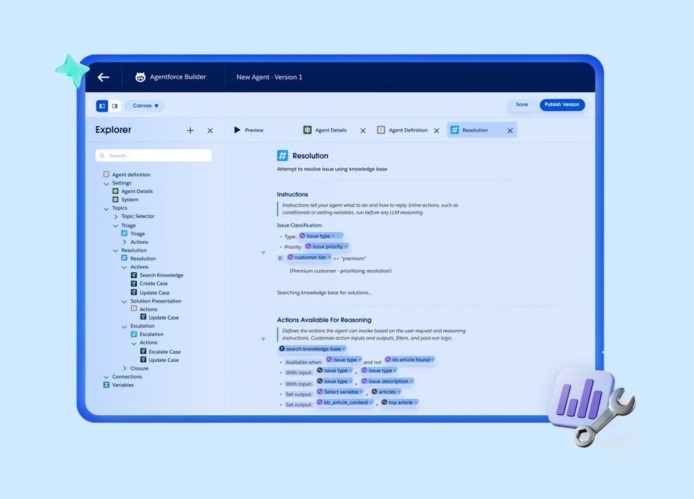
This approach combines the creative flexibility of generative AI with the rigid reliability of Agent Script. We sometimes describe this as a deterministic sandwich (hold the mayo). You use structured code to handle how an interaction starts and ends. This ensures your business rules remain intact while the AI handles the natural conversation in the middle.
Grant Roberson, an admin at Datasite said, “It’s probably one of the bigger joys to know that what you think is going to happen actually happened,” he said. “That’s where we are with Script. It really takes away the frustration because you know, without a shadow of a doubt, it’s going to run 100% of the time every time.”
The updated guide also centers our move from prompt engineering to context engineering – the holistic practice of providing an agent with the exact information and boundaries it needs at the current stage of the interaction. Instead of doomprompting, you design a system of instructions and actions. This prevents the common trap of creating overloaded prompts that confuse the model.
Aligning Our Language with the Industry
If you’ve been using Agentforce for more than a few months, you’ll notice a significant terminology change in the new guide. We renamed topics to subagents to better reflect their role as specialized agents with specific expertise. When a customer sends a message, the Reasoning Engine determines which subagent should handle the request. This alignment with broader industry standards makes the platform more intuitive for architects and admins alike. Katherine Mains of Conagra Brands calls this the “Goldilocks Zone” of design because it’s advanced enough for technical experts, and accessible for those who prefer low-code tools.
Embrace the New Way to Build
The updated guide offers a deep dive into Agentforce Studio. This is our unified workspace where you can build, test, and monitor agents in one place. We encourage every builder to move away from rigid chatbots or pure prompt-driven reasoning, and embrace the hybrid logic of Agent Script. Small and separate scripts for tasks like identity checks make your system easier to maintain and scale.
You can explore the full interactive experience at our new guide page. It includes technical breakdowns of the reasoning engine flow and best practices for writing effective instructions.