

Artificial intelligence (AI) is now part of everyday business life. It drafts emails, summarizes research, analyzes performance, and answers complex questions in seconds. Used well, it can feel like a force multiplier. Used carelessly, it can feel like a very confident intern with excellent formatting and poor judgment. For small and midsize businesses (SMBs), bad outputs can lead to wasted spend, flawed strategy, confused teams, and decisions built on fiction dressed as fact.
So the question isn’t whether AI can be useful — it clearly can. The real question is whether you can make it useful without letting it become a slick generator of expensive nonsense. We’ll look at how the right frameworks, prompts, and review habits can make AI far more reliable and dependable. And in business, dependable is what scales. Let’s dig in.
What AI hallucinations are — and why they matter
Before you can prevent AI hallucinations, it helps to define your terms.
An AI hallucination is an output that appears fluent and authoritative but is factually wrong, misleading, or impossible to verify. It’s the digital equivalent of a smooth-talking consultant who’d rather improvise than say with all honesty, “I don’t know.”
That’s what makes hallucinations risky. They rarely announce themselves. They don’t arrive waving a red flag they arrive polished, composed, and ready for the meeting.
The goal, then, isn’t simply to get a well-written answer. Plenty of bad answers are beautifully written. The goal is to get a grounded answer: An output supported by relevant, reliable, and reasonably current information that fits your specific business context. You aren’t asking the AI to sound smart. You’re asking it to be accountable. And accountability, unlike eloquence, requires a system.
The AI hallucination defense pyramid: A practical framework
If you want to reduce hallucinations consistently, luck isn’t a strategy, hope isn’t a workflow, and “it sounded right at the time” isn’t a sentence that will work here. What you need is a structure that catches weak reasoning before it turns into bad decisions.
The hallucination defense pyramid creates that structure through three layers of protection. Together, this framework helps you shape stronger requests, get more reliable outputs, and verify what matters before the answer starts influencing strategy.
Here are the AI hallucination defense pyramid primary layers:
- Foundations — What you ask (the prompt)
- Workflows — How you ask it (the way you prompt)
- Final Checks — How you verify the answer (the result)
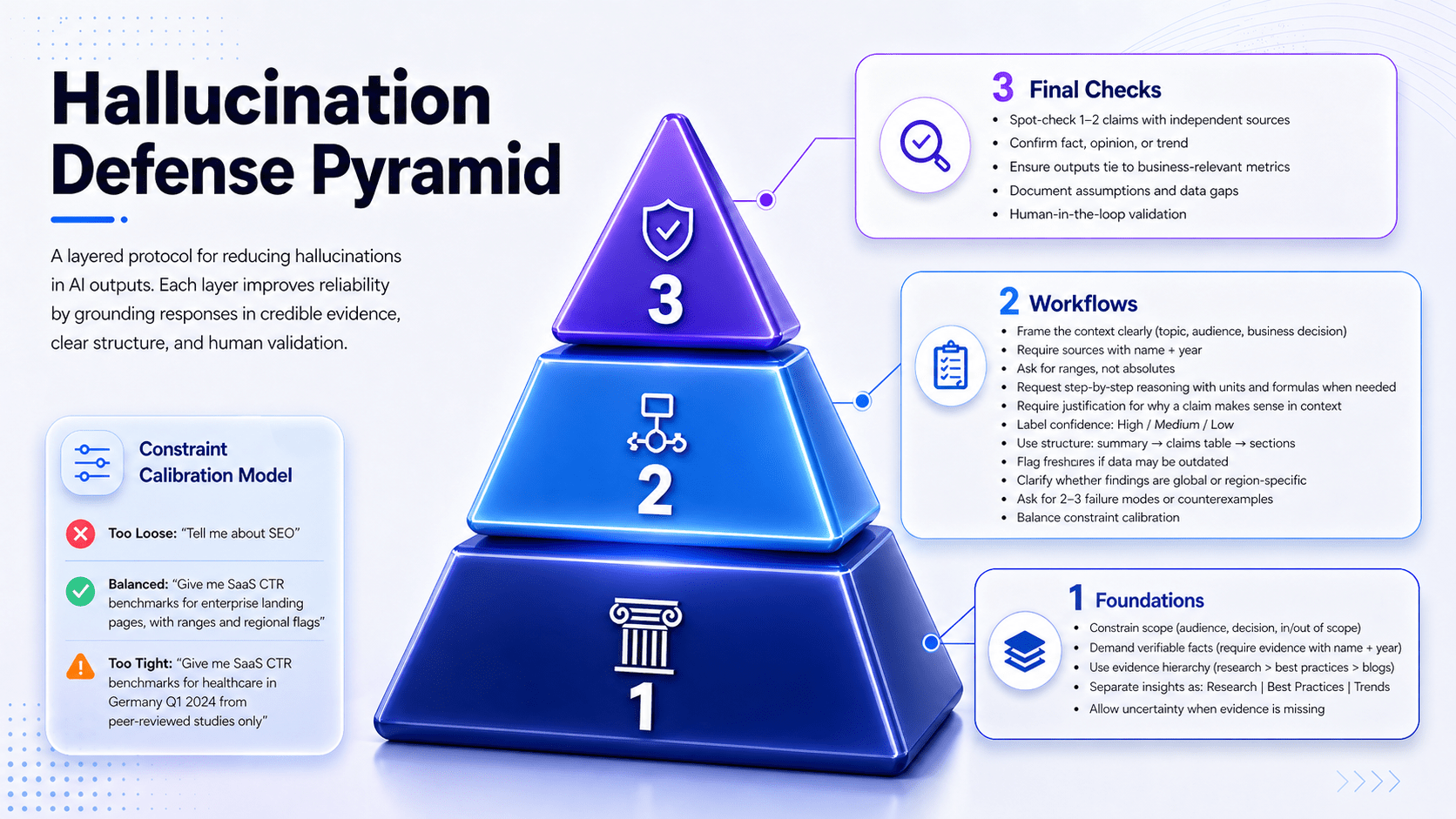
Layer 1: What you ask (Set the standards before you prompt)
Everything begins before the real prompting starts. This first layer is about setting boundaries for what counts as an acceptable answer.
Start by constraining the scope of the request: Define the audience, the business problem, and the decision the answer is supposed to support. AI tends to drift when prompts are vague. Open-ended prompts may feel flexible, but they also leave the door wide open for generic filler, false confidence, and answers that sound useful without being useful.
Then raise the bar for evidence: Require claims tied to a named source, organization, or publication year. If a claim can’t be traced, it should not be treated as reliable. Set an evidence hierarchy, too: verified research first, strong industry benchmarks, second, informed best practices third, and random blog folklore much further down the ladder.
One of the most underrated tactics: Make room for uncertainty. If uncertainty feels unacceptable; the model will often compensate with synthetic confidence, which is a very elegant way of being wrong. Before asking for conclusions, check for sufficiency first: “Do you have enough information to answer this accurately, or do you need clarification?” It isn’t flashy. It’s just effective.
Layer 2: How you ask it (Structure prompts for better results)
Once the foundation is in place, the next layer focuses on the structure of the request itself. This is where prompting becomes operational.
Start by framing the context clearly: State the topic, audience, use case, and business decision involved. AI performs better when it understands the job it’s being asked to do and, just as importantly, the job it isn’t. Then ask for ranges instead of absolutes. In business environments, neat single-number answers often have the suspicious cleanliness of something that hasn’t met reality. Benchmarks vary by industry, region, company size, maturity, and channel. Asking for ranges leads to more realistic output and less false precision.
Then make the model show its work: Not with a dramatic monologue, but with the logic, assumptions, units, formulas, or decision criteria behind the recommendation. If there’s no visible structure underneath the answer, there may not be much structure there at all. This is also where constraint calibration matters. Too broad, and the output becomes generic. Too narrow, and the model may invent specifics to satisfy an impossible request. The goal is the Goldilocks zone: specific enough to be useful, realistic enough to be answerable.
For example:
- Too loose (output becomes generic): “Tell me about SEO.”
- Too tight (the model may invent specifics to satisfy an impossible request): “Give me SaaS CTR benchmarks for healthcare in Germany in Q1 2024 from peer-reviewed studies only.”
- Balanced (specific enough to be useful, realistic enough to be answerable): “Give me SaaS CTR benchmarks for enterprise landing pages, including realistic ranges and regional differences where relevant.”
Layer 3: How you verify the answer (Verify what matters before you act)
The final layer is where discipline takes over from optimism. A strong prompt isn’t a substitute for verification. It’s simply a better starting point.
Start by spot-checking claims using independent sources: You don’t need to verify every sentence to catch trouble. Often, checking the most consequential numbers, names, or recommendations is enough to tell you whether the answer is grounded or merely well dressed.
Then confirm the difference between fact and interpretation: AI is very good at presenting a trend, assumption, or widely repeated opinion as though it were settled truth. A polished tone doesn’t magically convert inference into evidence. It just makes the inference sound more comfortable.
Be sure to treat this as a founding principle of AI use: Human judgment and AI support are both necessary. Not one after the other, not one replacing the other — both. If the output is shaping strategy, spend, customer communications, or executive decisions, it should be strong enough for a machine to accelerate and important enough for a person to challenge. This is how you get speed without surrendering judgment.
Get the AI Anti-Hallucination Playbook
Put AI to the test. Give your team a practical framework to strengthen AI prompts and keep working moving forward.

Five practical strategies for building better AI prompts
The pyramid gives you the architecture. Now let’s make it practical. If you want better answers, you have to ask better questions. Anti-hallucination prompting turns good instincts into repeatable habits. Here are five practical strategies to build into everyday AI use:
1. Frame the task as fact-driven
Start with a simple instruction such as: “Answer this as a fact-driven analysis of [topic], grounded in verifiable facts and established [industry] best practices.”
This sets the standard early. It tells the model that polished filler won’t be mistaken for insight.
2. Block fabrication explicitly
Say it plainly: “If reliable data is unavailable or insufficient, say so clearly. Do not guess, invent, or answer without a sound basis.”
It sounds obvious, because it is. Explicit permission to stop, qualify, or decline is one of the strongest ways to reduce hallucination.
3. Anchor the answer to real metrics
Tie the output to the measurements that matter in your domain. For search engine optimization, that might include click-through rate (CTR), search engine results page (SERP) position, traffic quality, and conversion impact. For SaaS demand generation, it could include pipeline, customer acquisition cost (CAC), activation rate, or demo conversion.
A useful prompt might be: “Evaluate this using the metrics that matter most for this goal, and explain the likely performance range, tradeoffs, and business impact.”
Metrics force the answer out of abstraction and into decision-making territory, which is where business content needs to live.
4. Classify the findings
Now it’s time to verify your results. Ask the AI model to distinguish between:
- Verified research: Credible studies, published data, or clearly sourced findings
- Best practices: Broadly accepted methods that teams commonly use because they work
- Emerging trends: Newer ideas or patterns that may be promising but are still evolving
A useful prompt might be: “For each major claim, label the evidence as verified research, best practice, or emerging trend.”
This helps separate what’s known, what’s commonly practiced, and what’s still in play.
5. End with a self-check
Finish with a prompt like: “List two to three failure modes or counterexamples, and explain how they would change the recommendation.”
This is where the AI stops trying to sound invincible and starts becoming genuinely useful. Used together, these five strategies make AI output easier for people to challenge, refine, and trust — which is exactly the point. These five strategies are a strong start.
How to handle common AI edge cases
Even with a strong framework, some domains are naturally messier than others. That doesn’t mean the process is failing. It means reality has declined to become tidy for your convenience.
Take the software as a service (SaaS) digital strategy. Benchmarks for pipeline contribution, conversion rate, or annual recurring revenue (ARR) can vary widely depending on segment, pricing model, deal size, go-to-market motion, and market maturity. That’s why it’s so important to ask for ranges and segmentation — small business versus enterprise, self-serve versus sales-led, region by region, and so on.
For example: If the AI tells you “a conversion rate is always 5%” that’s your cue to become professionally skeptical. Push for a range instead and ask what factors move conversion performance up or down.
Generic filler is another common problem. If the advice sounds like it belongs on a motivational poster in a coworking kitchen (write better blogs, improve my strategy, or focus on quality) it needs more operational detail. Ask for named frameworks, benchmark ranges, decision criteria, sample metrics, or practical examples. The more concrete the request, the less room there is for fluff to stroll in wearing a blazer and introduce itself as strategy.
Build a more trustworthy way to use AI
Eliminating hallucinations isn’t about making AI less powerful. It’s about making it trustworthy enough to use for your growing business. If your business is using AI for research, planning, content, or decision support, grounding isn’t optional. It’s the difference between faster insight and faster nonsense.
Ready to build a more trustworthy AI workflow? Get the free AI Anti-Hallucination Playbook to explore grounded technology solutions, and sign up for our newsletter for more practical guidance you can put to work right away.
AI supported the writers and editors who created this article.
What’s an AI hallucination?
An AI hallucination is an output that appears fluent and authoritative but is factually wrong, misleading, or impossible to verify.
Why are AI hallucinations a problem for small businesses?
Bad outputs can lead to wasted spend, flawed strategy, confused teams, and decisions built on fiction dressed as fact, especially since hallucinations rarely announce themselves and arrive polished.
What’s the primary goal when using AI?
The goal is to get a grounded answer: An output supported by relevant, reliable, and reasonably current information that fits your specific business context. You’re asking the AI to be accountable.
What’s the Hallucination Defense Pyramid?
It’s a three-layer structure designed to consistently reduce hallucinations by helping you shape stronger requests, get more reliable outputs, and verify what matters before the answer influences strategy.
What are the three primary layers of the AI hallucination defense pyramid?
The three layers are: 1. What you ask (the prompt), 2. How you ask it (the way you prompt), and 3. How you verify the answer (confirming the result).