



Have you been searching for the right tools for your consulting firm? Are you looking for something that connects sales, client service, and marketing in one place? In this article, you’ll find five small consulting firm customer relationship management (CRM) tools worth considering, what makes each one stand out, and how to know when you’re ready to level up.
What’s a professional services CRM, again?
A professional services CRM is a centralized platform designed to help consulting and service-based firms manage the entire client lifecycle, from initial lead tracking and proposal management to ongoing engagement and relationship maintenance. By unifying data — such as client interactions, project details, and communication history — into one system, it allows teams to deliver consistent, personalized service and simplify operations.
What to look for in a CRM for your consulting firm
Before comparing platforms, it helps to know what features actually matter for a services business. 76% of small and medium businesses (SMBs) that increased their tech spending are growing — and the ones pulling ahead are doing it with smart tools. Unlike companies with high transaction volumes, consulting firms run on relationships, repeat clients, and referrals. Your CRM should reflect that. Here are some core features to look for:
Features to consider for consulting firms
- Unified client view: Every touchpoint — emails, calls, proposals, invoices — in one place so no one on your team ever walks into a client meeting cold.
- Pipeline management: Track where each engagement stands from first conversation to signed contract, with visibility into revenue forecasts.
- Automation that respects your voice: Follow-up sequences, proposal reminders, and onboarding workflows that run without you — but still feel like you.
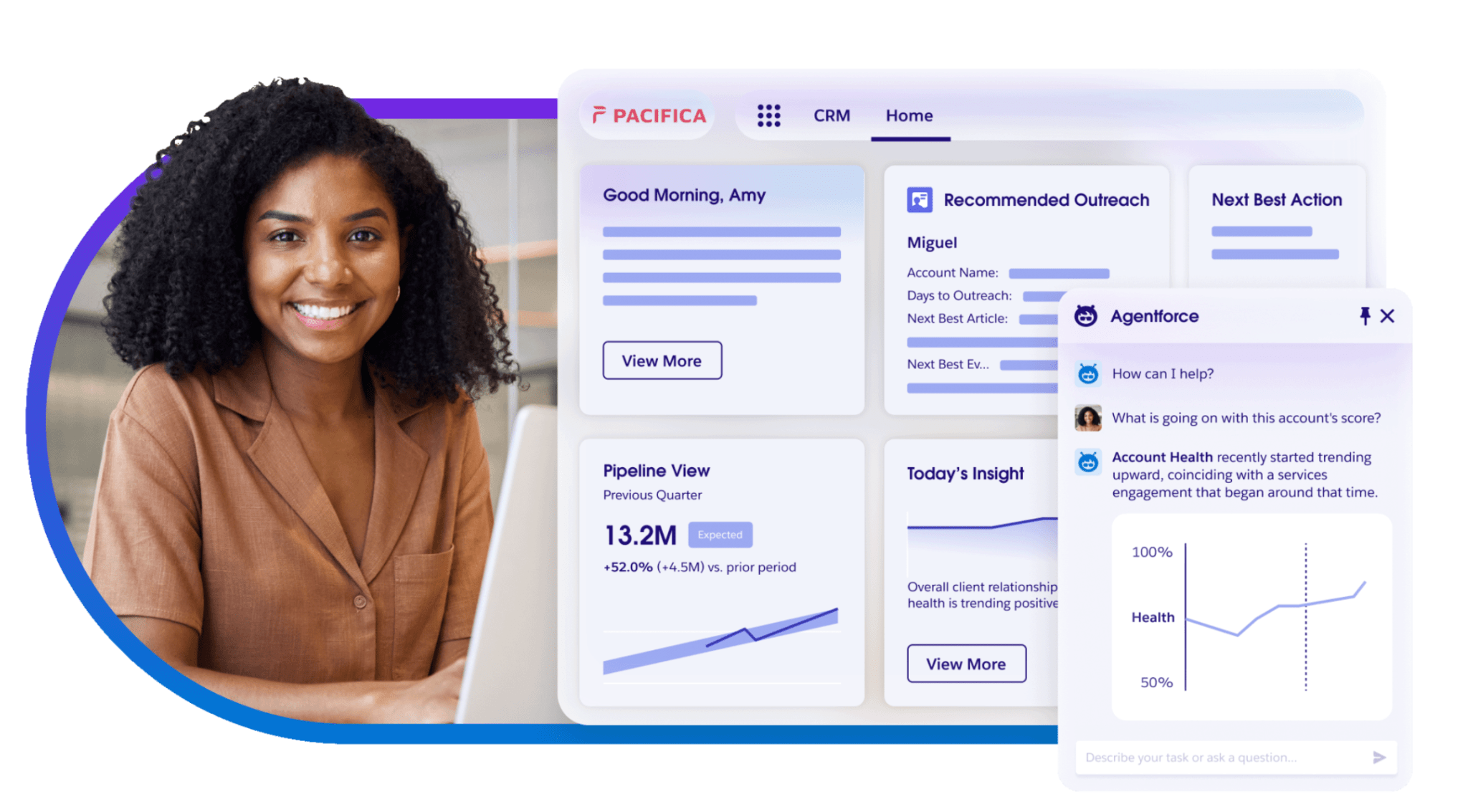
- Scalable AI: Artificial intelligence (AI) that surfaces the next best action, drafts outreach, and summarizes client history so you spend less time chasing context.
- Integration-ready architecture: Your CRM should connect to your calendar, email, project management tools, and billing software without a custom build.
How to choose the right CRM for your consulting firm
The best CRM for a professional services startup is the one your team will actually use — and that grows with you. Here’s how to evaluate your options honestly:
Start with your biggest problem
What’s the thing that’s costing you clients right now? If it’s leads not getting followed up on, you need pipeline management. If it’s inconsistent client service damaging your reputation, you need a unified service channel. If it’s your team working off different information, you need a single source of truth. Lead with the problem, not the feature list.
Think two years ahead, not just today
A CRM that’s perfect for two consultants today can become a migration nightmare when you hit ten. Platforms like Salesforce are built to scale alongside your growth — you don’t have to rebuild your operations every time you grow. Professional services firms specifically value detailed reporting and the ability to manage different client processes — capabilities that get more important, not less, as you grow.
Ask the right questions before you commit
- Does it integrate with the tools you already use?
- Can you customize it to match how your firm actually runs proposals and projects?
- What does onboarding look like — and who handles it when something breaks?
- Is client data secure, and does the platform give you control over how AI uses it?
Top 5 professional services CRMs to consider for your growing firm
1. Salesforce Suites
Salesforce Suites are topping the charts as the #1 AI CRM built for growing firms. Starter Suite makes it accessible to small and startup consulting teams from day one. It brings sales, service, marketing, and Slack together in a single platform, with guided onboarding so you’re up and running in minutes, not months. Consulting firms using Salesforce have reported a 38% increase in employee productivity, a 37% improvement in client satisfaction, and a 42% increase in sales revenue.
For a small consulting firm, Starter Suite offers email marketing, case management, pipeline tracking, and a conversational AI assistant — all starting at $25 per user per month. And when you grow, upgrading to Pro Suite is seamless for more customization and automation.
Best for: Startup consultants and lean teams ready to build a professional-grade client operation from day one.
Grow your ambitions with the #1 AI CRM.
See what’s possible with the AI-powered CRM suite for growing teams.
2. Pipedrive
Pipedrive is a sales-focused CRM built around visual pipeline management. It’s intuitive and fast to set up, making it a good fit for small teams that are primarily deal-tracking — rather than managing full client lifecycle experiences.
It’s lighter on service and marketing capabilities, which means consulting firms that also want to manage ongoing client relationships or run nurture campaigns will likely need additional tools alongside it.
Best for: Consulting firms in an active growth phase where pipeline visibility is the top priority.
3. Zoho
Zoho CRM is a strong mid-range option for SMBs that want broad functionality at a competitive price. It covers sales automation, email campaigns, analytics, and AI-powered lead scoring, with enough customization to adapt to a services workflow.
The learning curve is steeper than simpler platforms, and the user experience can feel fragmented when pulling in multiple Zoho apps. But for a price-conscious consulting firm that needs more than the basics, it’s worth a look.
Best for: Budget-focused consulting firms that need a feature-rich platform and have someone willing to configure it.
4. Monday
Monday.com’s CRM layer builds on its project management roots, making it an interesting option for consulting firms that live inside Monday for client work already. It handles contact tracking, lead management, and deal pipelines — and the visual boards are intuitive for teams that think in workflows.
It’s not a full-service CRM, though. If you need deep sales automation, marketing tools, or AI-powered client insights, you’ll hit the limits quickly.
Best for: Consulting firms already using Monday for project delivery who want light CRM functionality in the same place.
5. HubSpot
HubSpot’s free CRM is an entry point for solo consultants and early-stage firms. It handles contact management, deal tracking, and basic email marketing without an upfront cost. The interface is clean and approachable, which helps teams adopt it quickly.
The catch: as your firm grows, costs scale sharply and the free tier’s customization is limited. Consulting firms with complex service lines or multiple team members often outgrow it faster than expected.
Best for: Solo consultants or brand-new firms testing out CRM for the first time.
Growing fast? Try Agentforce 360 for Professional Services
Now, Agentforce 360 for Professional Services helps generate and summarize research, guide strategy, manage proposals, personalize outreach, and handle the routine work so your team can focus on what they’re actually great at. With 88% of SMBs already engaging with AI and 74% saying their AI investment generated strong ROI, the question for your consulting firm isn’t whether to adopt an agentic CRM — it’s how quickly you can get started.
Try Agentforce 360 for Professional Services
Personalize client and talent engagement, enhance firm operational efficiency, and unlock revenue with a deeply unified platform for professional services.


The CRM for consultants: Built for ambition
For a growing consulting firm, the right small professional services business tools aren’t about finding the cheapest option — they’re about finding the one that makes your best work scalable. That means a platform where every client interaction is tracked, every follow-up is automated, and every team member — and every AI agent — is working from the same complete picture of your client.Get started with Salesforce for free or activate Foundations to try out Agentforce today.
AI supported the writers and editors who created this article.
What is a professional services CRM for small business?
A professional services CRM for small business is a platform that helps consulting firms and service-based businesses manage client relationships, track proposals and pipelines, automate follow-ups, and centralize all client data in one place.
How much does a CRM for a small consulting firm cost?
Costs vary widely. Salesforce starts at $25 per user per month and includes sales, service, marketing, and AI tools in a single platform. Some options (like Free Suite) offer a free tier with limited functionality, while others charge per feature or module.
Do I really need a CRM as a startup consultant?
If you have more than a handful of active clients or prospects, yes. A CRM prevents leads from falling through the cracks, ensures consistent communication, and gives you the data you need to make smart business decisions.
What’s the difference between a CRM and project management software for consulting firms?
Project management tools help you deliver work; a CRM helps you win and retain clients. They solve different problems. Some platforms blend both, but they typically do one thing well and the other at a basic level. For consulting firms managing active business development and ongoing client relationships, a dedicated CRM is the stronger foundation.
Can a small consulting firm CRM scale with my business as it grows?
The right one can — and that’s one of the most important things to check before you commit. Salesforce is designed to grow with you with different tears to support your different growth stages of your business.