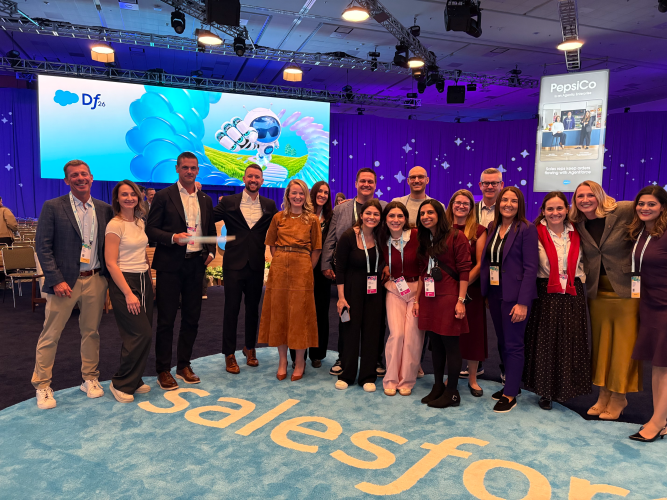

Learn how to move from fragmented data to coordinated action with insights from the Life Sciences Keynote at Dreamforce 2026.

Life sciences organizations are navigating an industry landscape that’s changing faster than the systems used to service them. Supply chain fragility, precision medicine, patent cliffs, M&A, cybersecurity risks, new care models, and rising regulatory costs are putting pressure on organizations to do more, fast.
Patients pay the price with longer wait times and rising care costs. Today, it takes more than 10 years to bring new therapies to market, HCPs are dissatisfied, and 64% of patients say they would give AI agents access to their medical history if it meant faster treatment.
For years, the prescription for every new challenge was another application. But no longer. No more parity plays. No more point applications stitched together and hoping they hold. No more unruly LLMs promising magic with no foundation underneath. The opportunity for life sciences organizations is not simply to add AI to existing processes. It’s to move from fragmented systems and administrative noise to coordinated action.
The new script activates the Agentic Enterprise through a three-pronged approach:
- An agile, compliant foundation helping organizations innovate without compromising trust
- Turning industry-specific insights into outcomes so patients have access to treatment faster
- Orchestrating human and agent collaboration at scale from any surface, anywhere
Salesforce has spent the past 27 years building the trusted data, workflow, security, and industry foundation this requires. Now, more than 150 customers on Life Sciences Cloud are using it across pharma and medtech, not to add more software, but to remove friction from the work. Together, organizations like McKesson Medical Surgical, Fresenius Kabi, Takeda, and AstraZeneca have served more than 1 billion patients in the past year. See how they’re shortening the distance between innovation and patient impact in this Dreamforce 2026 Life Sciences Keynote recap.
1. Connecting data, workflows, and agents on a trusted foundation
Trusted AI starts with trusted data, context, and workflows together on one foundation. But instead of adding another layer of technology to an already complex environment, pharma and medtech organizations must connect the pieces they have for a more coordinated way of working.
McKesson builds an agentic foundation for faster, more efficient customer service.
As McKesson Medical Surgical becomes Wellverse, the company is using its transformation as an opportunity to build the right technology foundation for the future. This includes using AI for order tracking, inventory lookups, and returns processing. Agents have already achieved about 2x faster case handling for more than 536 cases without human intervention. Additionally, agents have reduced handling times for provider name and address changes by 77%, a process that was previously manual and document-heavy. One trusted foundation makes work simpler, enabling employees to serve healthcare providers with greater speed and ease.
Salesforce provides this trusted foundation for the new life sciences operating model, bringing industry-ready data, workflows, and AI agents together on a single, interoperable infrastructure that’s built to be compliant, secure, and adaptable. As needs change, teams can bring AI into the workflows where it can have the most impact, while maintaining the governance and flexibility required in a highly regulated industry.
The result is an enterprise that’s better equipped to connect clinical, medical, commercial, and operational teams and turn all that information into coordinated action.
Fresenius brings global teams together with a unified approach.
As a design partner and one of the first customers to commit to Life Sciences Cloud for Customer Engagement, Fresenius has unified 100+ countries and four business units around one operating model, shifting from siloed priorities to greater global alignment. AI helps the organization deliver the right content to the right stakeholder at the right time while balancing global governance with local needs.
For Fresenius, the transformation ultimately comes back to its mission, “Committed to Life.” By helping HCPs get the right information faster and shortening the path from prescription to patient support, AI can elevate its people and help make care more human.
2. Turning administrative noise into action
When life sciences data points like patient signals or new clinical insights are spread across so many systems, teams, and departments, connecting the dots can take time. And by the time the right people have the right context, the moment to act may have already passed.
That’s where an agentic approach flips the script.
This year, we announced Salesforce’s new Command Center for Life Sciences, allowing organizations to go beyond simply seeing what’s happening. Command Center helps identify the root cause behind a signal and coordinate the next steps across teams. Like a nerve center for the agentic enterprise, it brings clinical, medical, and commercial data together so people and AI agents can work from the same context. This gives care teams the space to do what they do best: focus on the patient.
The experience doesn’t have to live in yet another application either. With AIforce, organizations can bring trusted experiences and actions directly into the places where their teams already work, from Slack and Claude to proprietary mobile apps. Instead of spending days coordinating a response, now life sciences teams can act in minutes. Whether it’s field reps, FRMs, MSLs, trial managers, clinical specialists, or KAMs, they’re working alongside trusted agents, meeting them where they are and elevating them to do the work only humans can do.
AstraZeneca gives care teams more time to focus on patients.
AstraZeneca is using agentic capabilities to help its care teams reduce administrative burden and get time back to focus on patients. As part of its Customer 2030 vision, the company is working toward a truly patient-centric experience—one that connects commercial and R&D teams around a shared goal: getting the right science to the right patient at the right time.
As a design partner for Salesforce, AstraZeneca is helping shape Command Center and Agentforce to bring intelligence directly into the flow of work across 80+ markets. For example, teams can use insights from care gaps and screening data to help facilitate earlier diagnosis and keep patients on track. Then, Agentforce delivers that intelligence in real time without forcing teams into another application.
The result? A tighter feedback loop between insight and action, with more personalized support, faster onboarding, and better patient experiences at global scale.
3. Building compliance into the content lifecycle
Traditional processes often treat compliance as something that happens toward the end of the content lifecycle when materials reach medical, legal, and regulatory (MLR) review. But compliance and speed don’t have to be competing priorities anymore.
Salesforce is rethinking that process with Regulated Content Management, an agent-driven approach that brings compliance upstream. Instead of treating content as a static file, Regulated Content Management views it as structured data, connecting claims, references, and regulatory obligations across assets. Agentforce can help extract claims and pre-validate content against regulatory guardrails during creation.
That means identifying potential issues earlier, before content reaches an MLR reviewer. The result is a shift from a reactive approval process to a proactive, unified content lifecycle, helping organizations move through content, review, and distribution more efficiently while maintaining the compliance guardrails required.
Takeda reduces R&D contract review cycle from 90 days to 90 seconds.
By connecting data, patient services, HCP engagement, marketing, and operations, Takeda is creating a more connected ecosystem where agents can help teams make smarter decisions and deliver more relevant interactions. Already, the company’s next-best-action agent has achieved an adoption rate over 90%, with reps using it an average of two to three times per day.
The impact goes beyond efficiency. By using Agentforce to tackle contract intelligence and portfolio analysis, Takeda has cut its R&D contract review cycle from 90 days to 90 seconds, giving researchers more time to focus on solving complex challenges and helping make every interaction more meaningful for patients.
Build the agentic enterprise for life sciences.
The agentic life sciences enterprise isn’t about replacing people or adding another layer of technology. It’s about giving people the context, intelligence, and automation they need to move faster.
Salesforce is building toward that future with a full architecture for Life Sciences, extended by Command Center, AIforce, and Regulated Content Management, helping organizations connect data and workflows, turn signals into action, and bring trusted experiences into the flow of work.
With Salesforce for Life Sciences, you can:
- Connect industry-ready data, workflows, and agents on a trusted foundation.
- Turn fragmented signals into coordinated action across teams.
- Bring intelligent, trusted experiences into the flow of work.
- Build compliance into content creation from the start.
- Help teams spend less time on administrative work and more time on what matters.
But we aren’t just giving you a platform. We’re giving you a plan to get past the trial phase, as well as support through our new Acceleration Hub, a team of specialists who don’t just implement software; they deploy the same agentic frameworks that are already working for other leaders. Combined with our network of 2,000+ certified partners, you’ll have a whole team in your corner to train on the same consistent framework as Professional Services and Customer Success tooling and build an agile, AI-ready operating system to drive better outcomes.
Now is the time to move from AI experimentation to action. The future of life sciences isn’t just about what AI can do. It’s about what your people can accomplish with it.
Stream life sciences content on Salesforce+
Watch keynotes, customer interviews, and select breakout sessions that bring the future of AI and Agentforce to life. Watch now.