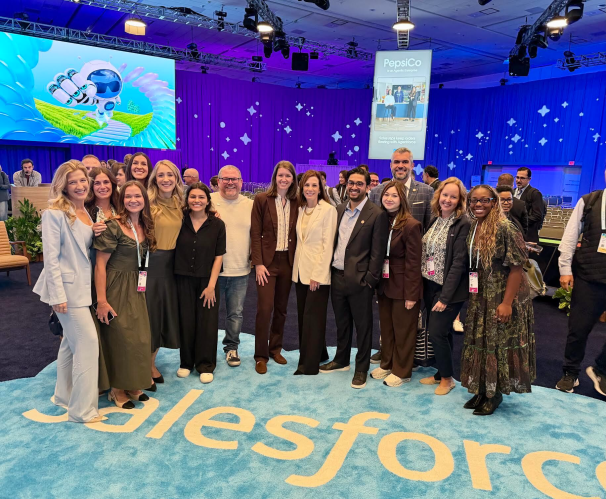

Learn how to build an Agentic Health Enterprise through trust, context, and action with insights from the Health Keynote at Dreamforce 2026.
Healthcare professionals are doing more than ever. Simultaneously, fragmented systems and administrative complexity are making it harder to keep people and processes moving forward. Rising costs. Razor-thin margins. Disconnected data. Administrative work that keeps piling up.
And behind each of these operational challenges is a human consequence: clinicians burning out, patients delaying care, and members feeling more like policy numbers than people.
For years, the answer to every new problem has been another system, another login, or another workflow. The humans behind these systems have become the glue holding it all together by finding information or reconciling data.
Enter the agentic health enterprise to transform those legacy patterns. Instead of adding another layer of technology, agents coordinate work across the systems healthcare organizations already have, handling routine steps so people can focus on the judgment, care, and connection that matter most.
At Dreamforce 2026, we demonstrated what that shift looks like in practice through pillars of trust, context, and action. See how organizations like UCLA Health, Highmark Health, and Select Health are leading the way with real agents, real workflows, and real outcomes.
1. Build trust into every AI interaction.
When patient safety, regulatory compliance, and complex care workflows are on the line, a generic AI model isn’t enough. The stakes demand an AI infrastructure where trust is at the foundation.
That’s why Salesforce has spent 27 years building a healthcare infrastructure designed around governance. Agents operate with role-based controls, defined boundaries, human oversight, and observability across workflows. Encryption, audit trails, and HIPAA compliance are built into the platform.
This gives healthcare organizations something generic AI can’t: the confidence to move beyond the pilot stage and deploy agents across their highest-priority workflows, from expanding access and elevating service to transforming care delivery and supporting the workforce.
UCLA Health puts AI at the front door.
UCLA Health wanted to rethink the first interaction patients have with its organization. Its previous chatbot couldn’t hold an end-to-end conversation or dynamically route patients to the right place. Now with an Agentforce-powered digital front door that can answer questions, guide patients to providers, and operate 24/7 in multiple languages, UCLA Health has achieved:
- 75,000+ patient interactions in six months
- A 4.6/5 patient rating
- Patient answers in under 60 seconds
Even better, 40% of conversations directly support faster access to care.
2. Give AI the context to understand the whole person.
Trust makes an agent safe to deploy, but context makes it useful.
Salesforce brings together Informatica, MuleSoft, Data 360, and Salesforce for Health to connect data, unify it around the person, and give it meaning. This creates a more complete picture across care and coverage, bridging the divide between the patient and the member that healthcare has long struggled to close. This way, agents not only understand what’s happening, but what’s relevant to the person in front of them. With zero-copy integrations and partnerships with Viz.ai, Verily, Innovaccer, and HealthEx, healthcare organizations can fuel journeys with enriched social and clinical data to better treat the whole person.
Now, that trusted context can follow people wherever they work. AIforce acts as the control plane beneath the experience, carrying trusted intelligence directly into the tools teams already rely on, from Slack to Teams, so the work comes to them instead of the other way around.
Highmark Health makes data work harder.
Highmark Health’s data was previously fragmented and siloed, with no single source of truth for information about its members. Different teams could arrive at different answers about eligibility, dependents, or communication preferences.
Today, Highmark is addressing this challenge with a “Data as a Product” approach and a concept called “Person 360,” standardized data elements that capture key indicators and moments in a member’s journey. Anchored in their Salesforce ecosystem, these data products can then be used across Salesforce to give teams more self-service access to trusted insights and member segments.
The payoff is empowerment. Members now receive more relevant outreach, while employees spend less time solving for fragmented data and more time creating better experiences. And as that trusted data foundation matures, Highmark can scale agentic AI with greater confidence and minimize agent sprawl.
3. Turn context into action.
Context becomes more valuable when it drives action—a referral scheduled, a provider onboarded, a care gap closed.
Salesforce for Health brings together industry-specific agent skills, healthcare apps, and pre-built workflows so organizations don’t have to build every piece of orchestration from scratch. An open, interoperable ecosystem connects Salesforce with the technology and partners healthcare organizations already rely on.
At Dreamforce 2026, Salesforce announced new capabilities designed to put that action to work, including:
- Omnichannel Payer Contact Center with assistive sub-agents to help serve members faster
- Health Engagement Journeys designed to keep people from falling through the cracks
- Autofilled, Voice-Powered Assessments, which can turn a spoken member conversation into a completed structured assessment
Plus, there’s more on the way. Coming October 2026 are Medicare Sales, Voice-Activated Payer Contact Center, Autonomous Member Self-Service, and Care Gap Analytics.
Select Health reduces friction for members and providers.
Select Health has been on a transformation journey for years, building on Sales Cloud and expanding into Health Cloud for provider network management and its call center. Along the way, the company has tackled practical challenges, from multi-screen call center experiences to provider credentialing.
One result stands out. Provider credentialing, which once took at least six months, now averages just six days. Select Health also uses Salesforce to better understand members and coordinate messaging without having to pull information from other systems.
Now, the organization is building on that foundation with AI, including Agentforce, Next Best Actions, global search answers, article recommendations, work summaries, and conversation catch-up. Together, the technology will be used to reduce administrative expenses and help people live their healthiest lives possible.
Reconnecting humans to health
Salesforce is helping health organizations move from fragmented systems and disconnected workflows to a more connected, agentic health enterprise with Salesforce for Health. Built on a trusted foundation of data, AI, and industry-specific capabilities, the platform helps organizations:
- Deploy AI with trust thanks to built-in governance, guardrails, human oversight, and the controls needed for healthcare.
- Connect context across systems to give agents and teams a more complete view of patients, members, providers, and their journeys.
- Turn insight into action by orchestrating workflows across agents, people, and systems to move health outcomes forward.
- Give teams more time for what matters by automating routine work and bringing AI-powered assistance into the tools and experiences they already use.
Together, these capabilities help health organizations create a foundation where humans, agents, data, and systems work together to deliver more connected experiences. This is the Agentic Health Enterprise: moving from outputs to outcomes. Hours back to care teams. Care gaps closed. Prior authorizations in seconds. Results that matter.
Stream healthcare content on Salesforce+
Watch keynotes, customer interviews, and select breakout sessions that bring the future of AI and Agentforce to life. Watch now.