

There’s a question every boardroom is stuck on right now: are we moving fast enough? It’s the wrong one to ask. I hear it constantly from CIOs, and in our first State of Agentic AI in the Enterprise report, we finally have the data to answer it properly.
We looked at what more than 2,000 leaders are actually doing with AI agents today. The honest answer is that what separates the organizations getting real returns from the ones stuck in expensive pilots has little to do with speed. It comes down to what they did before they launched: the data they made trustworthy for the job in front of them, the point where a person stays in the loop, and the guardrails they built before they needed them, not after.
You don’t need perfect data. You need the right data.
Perfect data isn’t a prerequisite. Only 31 percent of organizations that deployed AI agents fully unified their data beforehand, reaching ROI in 7.3 months. Another 34 percent deployed iteratively, starting with what they had and integrating more over time, and still reached ROI in 8.2 months, a real gap but a modest one, not a reason to freeze.
I used to sit on the other side of this exact decision. Less than a year before I joined Salesforce, I was in the CIO’s office at a large financial services company, and I was skeptical that another platform would fix what felt like a data problem, not a tooling problem. What changed my mind wasn’t a pitch. It was watching what happened once data got scoped and governed for a specific job instead of treated as one giant migration to finish before anything could start.
We experienced this exact tradeoff at Salesforce. Help Agent, our own AI agent on help.salesforce.com, was built on Data 360 and scoped to one job only: support resolution. It didn’t wait for a fully unified view of every customer system. It has handled close to five million customer conversations across seven languages and three portals, resolving 68 percent without a person, for $100 million in annualized savings.
What separates AI that delivers from AI that stalls?
Find out in the State of Agentic AI in the Enterprise report, based on a global study of over 2,000 AI decision-makers.
The best model won’t save a bad setup
The lesson we took from running Help Agent ourselves wasn’t to prepare everything. It was to prepare the data that specific use case needed, and start. That lines up with what the research found across the board: of the ten success factors we measured, the three most predictive have nothing to do with the underlying technology. Clean, accessible data and a narrowly scoped use case tie for the top spot at 36 percent each, ahead of escalation paths defined before launch at 35 percent, and well ahead of model quality, platform choice, and a unified orchestration layer, which each land around 30 percent.
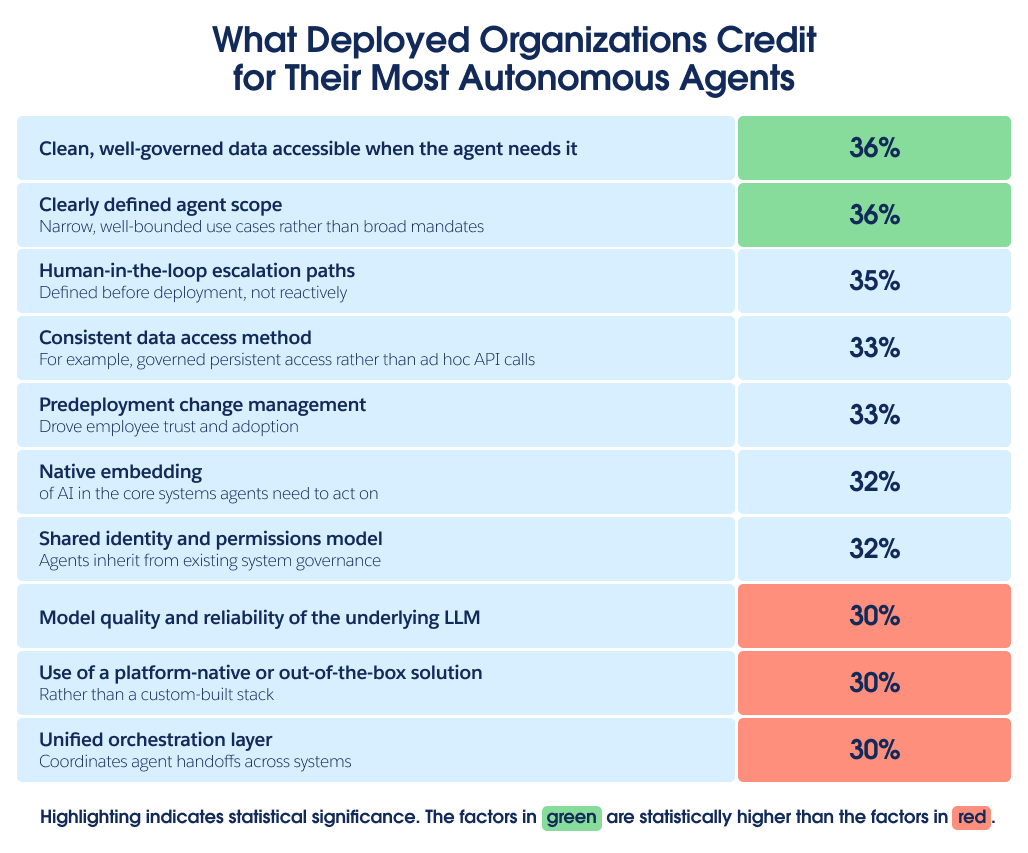
Most deployed organizations already work with capable models and platforms. The distance between strong and weak performers shows up in what gets built around that foundation, not the foundation itself. This tracks with what I’ve been mapping in the Agentic Maturity Model: the companies that get furthest aren’t the ones with the fanciest model. They’re the ones who met their own organization at its actual maturity level instead of assuming everyone was ready to run agents unsupervised on day one. That’s the case for Agentforce: agents built to be scoped tightly to a job, with a human handoff designed in from the start rather than bolted on when something breaks.
Looking to turn your AI potential into business reality?
Follow this free guide with step-by-step instructions, the latest use cases, expert interviews, and interactive worksheets for your team.

Agents are already in the highest-stakes work
Agents built on large language models are probabilistic: they reason through ambiguity the way a person does, weighing possibilities instead of following a fixed script, which is exactly what makes them useful for messy, unstructured work. But probabilistic reasoning can’t be the whole system a business runs on. It has to be grounded in something deterministic, structured logic and governed workflows that behave the same way every time, so “the agent decided to” never becomes an unanswerable question when something goes wrong.
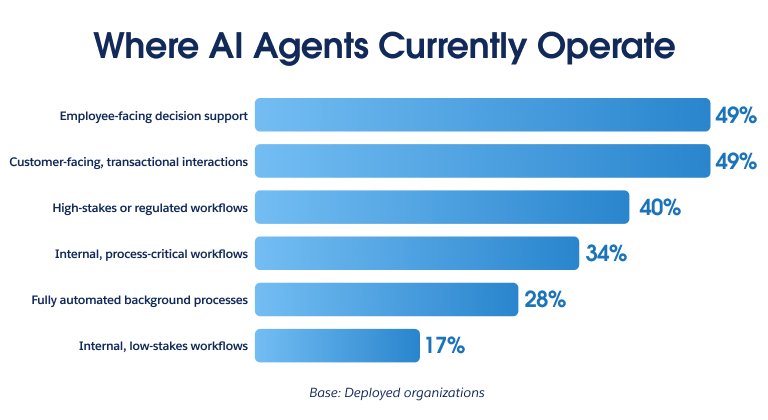
That grounding matters more, not less, as agents take on bigger jobs. Employee-facing decision support and customer-facing transactional work are already the most common places agents operate, each at 49 percent, well ahead of internal, low-stakes workflows at just 17 percent. Forty percent of deployed organizations run agents in high-stakes or regulated work: financial transactions, compliance-sensitive processes, decisions where a wrong answer carries legal or financial weight. This finding is echoed in findings from our Agentic Enterprise Index that shows agents are increasingly tackling more complicated tasks. Today, the average agent can act on six skills, up from two at the beginning of 2025. Agents are already live where the business impact is greatest, and the deterministic guardrails around them have to be there from day one, not added after something breaks.
The advantage isn’t speed. It’s what you do with the time you have.
Every organization in this data started from the same place two years ago: no playbook, no precedent, agents that didn’t exist yet. The ones ahead now didn’t get there by moving faster. They got there by being specific about a short list of decisions before launch: which use case, whose data, where a person stays in the loop, what happens when something breaks.
That list is the whole advantage, and it’s repeatable starting today. Being behind right now is a much smaller problem than it looks like from the boardroom, but only if you start making those decisions instead of waiting for a clearer moment that won’t come.
The full breakdown of what separates the two thousand organizations we studied, including the decisions that mattered most at each stage, is in the State of Agentic AI in the Enterprise report. Get it before your next planning conversation, not after.
No. Only 31 percent unified their data first, and the ROI advantage over iterative deployment was modest, about a month. Most successful organizations scoped data readiness to the specific use case instead.
Very rare. Only one to two percent of deployed organizations report agents that run without any human involvement.
Clean, accessible data and a narrowly scoped use case are the top two predictive factors, each cited by 36 percent of deployed organizations. Learn more about how Agentforce is built around this principle.