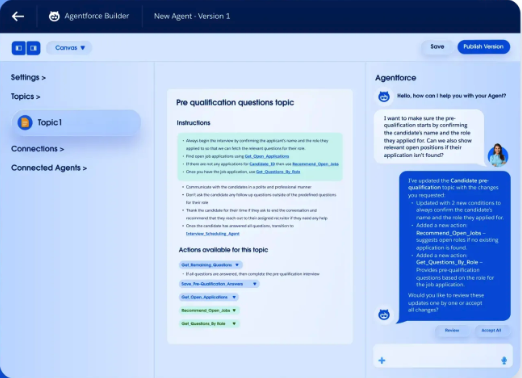
Agentforce Builder is Now Easier to Use – No Coding Required

People expect to interact with AI in a natural way. We designed the builder to enable you to describe the type of agent you want in plain language.


Key Takeaways
What if building an AI agent could be as simple as describing what you want it to do – in plain language? Traditional agent development requires deep technical expertise, extensive testing, and countless iterations to get it right. But it doesn’t have to be that way.
We know that ease of use is essential when it comes to adopting technology, but it sometimes takes some iteration before a product or feature functions optimally. With the latest Agentforce Builder innovations, we’re making it easier for you to use natural language and no-code ways to create reliable agents. Let’s dig into how this all works.
Here’s what we’ll cover:
Why building effective agents is uniquely challenging
How natural language creation transforms the building experience
Innovations that ensure reliable, predictable outcomes
Real-world examples of Agent Builder in action
Why building effective agents is uniquely challenging
Creating effective AI agents presents a fundamental paradox: agents have to understand people, but act like software. They need to interpret natural language with all its ambiguity, recognize user intent across different contexts, execute actions with software-like precision, and present results in ways that feel natural and helpful.
This creates a “double-edged sword” of large language models. Their flexibility is incredible — they can understand context, adapt to different scenarios, and communicate naturally. But that same flexibility can undermine consistency, which is exactly what you don’t want in mission-critical business scenarios.
Imagine an agent handling financial calculations that gives slightly different answers each time, or a customer service agent that interprets policies inconsistently. In healthcare, finance, or any regulated industry, this kind of variation doesn’t just frustrate users – it breaks trust entirely.
People now expect to interact with software the same way they interact with one another through conversation and natural language. The challenge is designing systems that feel human while performing with machine-like reliability.


How natural language creation transforms the building experience
This is where Agentforce Builder transforms the experience. Instead of wrestling with complex configuration screens or learning specialized syntax, you can describe your agent like you’re explaining a task to a colleague.
Want an agent that helps sales reps prepare for customer meetings? Just tell Agentforce Builder: “Create an agent that reviews upcoming meetings, pulls relevant account history, identifies recent cases or opportunities, and suggests talking points based on the customer’s industry and past interactions.”
The magic happens through conversational refinement. As you test and iterate, you can refine your agent’s behavior through natural dialogue:
- “Add more support for handling returns.”
- “Include instructions for early check-out.”
- “Focus on high-priority opportunities.”
- Add a check for overdue renewals.”
Each conversation improves the agent’s performance without requiring you to dive into technical details.
Our in-line AI assistant acts like an intelligent design partner, offering suggestions, identifying potential improvements, and helping you think through edge cases. And for common scenarios, template-based starting points get you up and running immediately — whether you’re building a customer service assistant, a data analyst, or a project coordinator.
Innovations that ensure reliable, predictable outcomes
The real breakthrough comes in how we’ve solved the consistency challenge. We’ve moved far beyond the early days of prompt engineering where developers would write instructions like “ALWAYS respond in ALL CAPS” and hope for the best. This might work sometimes, but sometimes isn’t good enough.
With Agentforce Builder, you can add conditional steps alongside LLM instructions so that the agent behaves deterministically when needed, and non-deterministically otherwise.
The best example is user authentication. Agent Script allows agent designers to add a check to see if the user has provided their email and order number before it ever allows the agent to make changes to their order.
This is an extremely important security check so that we’re not accessing or modifying information that doesn’t belong to the user.
Real-world examples of Agentforce Builder in action
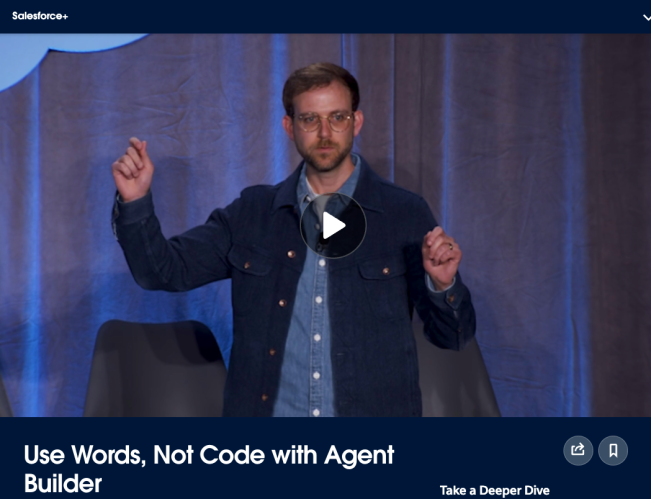
This approach represents something bigger than just easier software. We’re democratizing AI agent creation, making it possible for domain experts – the people who best understand business problems – to directly build solutions.
Sales managers can create agents that understand their specific sales processes. Customer success teams can build agents that know their unique escalation workflows. Finance teams can develop agents that handle their particular reporting requirements. All without waiting for development cycles or translating requirements through multiple stakeholders.
The business impact is immediate: faster time-to-value, reduced technical barriers, and solutions that fit how people work. Most importantly, it changes who can participate in AI transformation within organizations.
When building agents becomes as accessible as having a conversation, every team can explore what’s possible. Every domain expert becomes a potential AI innovator. Every business challenge becomes an opportunity to experiment with intelligent automation.
Build reliable, powerful agents
Use natural language and Agentforce assistance to get started quickly, then apply advanced logic and controls to deliver agents you can trust in production.