
Key Takeaways
The moment your startup begins gaining traction, your support inbox can quickly become unwieldy. Handling customer inquiries across email, chat, and social media with just a shared inbox or individual email accounts is a recipe for missed tickets, slow response times, and frustrated customers.
So, a dedicated help desk software isn’t really a luxury; it’s an investment that organizes your service operations — for you and your customers. Stop settling for messy service inboxes — a purpose-built help desk is the foundation for high-quality customer service. Let’s get into the features.
Top features to look for in help desk software
When evaluating help desk software tools, startups should prioritize features that maximize agent efficiency and the customer experience — without requiring a full IT staff. Here are five criteria to keep top of mind:
- Affordable: It needs a low-cost entry point and the ability to grow with your user base.
- Easy to use: The onboarding process not only needs to be smooth, but capabilities and training on new features should be intuitive as well.
- An integrated ticketing system: Automatically converts all incoming queries from different channels (email, web form, chat) into trackable tickets, ensuring nothing is missed.
- A knowledge base and self-service portal: Allows customers to find answers on their own, drastically reducing the number of repetitive tickets your agents handle.
- Automation and AI: Automated routing tickets to the right agent, auto-suggesting responses, and providing AI-backed insights for teams all save time and provide faster service.
Small business service at your fingertips


The 8 best help desk software options for small teams
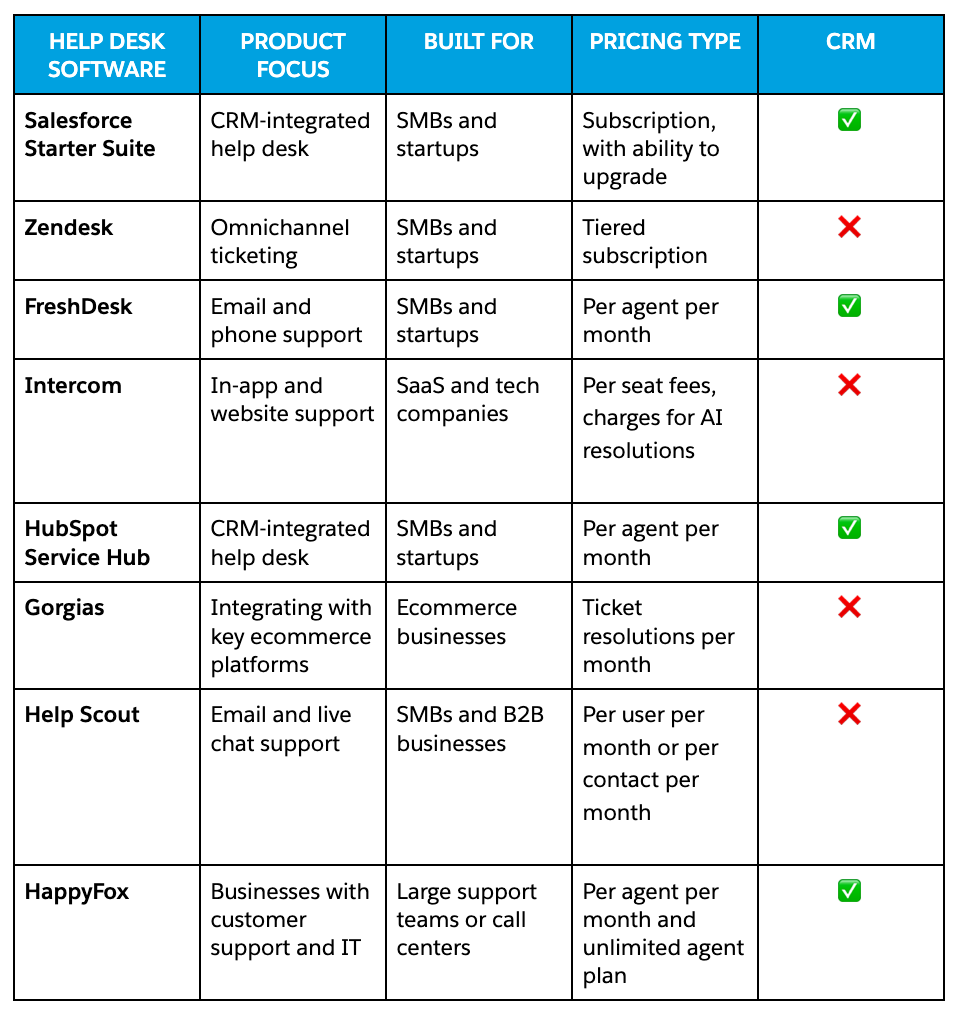
Here’s the lineup for the best help desk tools for small teams, including who they are tailored for, key features across service, and scalability:
1. Salesforce Starter Suite
Salesforce’s Starter Suite is specifically designed as the CRM suite for small business, and includes sales, marketing, service, commerce, and Slack integration.
For customer service, Salesforce provides Knowledge Management, where you can host knowledge articles, processes, and procedures for complex issue resolution, empowering service representatives to handle cases quickly and efficiently. Externally, these articles can serve as a customer self-service portal, deflecting common tickets. And, to enhance team collaboration, the suite allows you to connect Slack via Salesforce channels directly to a contact record, enabling your team and cross-functional partners to collaborate on an issue without switching between different tools.
This makes it the clear choice for a startup that plans to scale beyond just basic ticketing, providing a full portfolio perspective from the start.
- Service advantage: It unifies service tools with your customer data, giving agents the full context of a customer’s history across marketing, sales, and commerce.
- Scalability path: Start with Starter Suite and, as you grow and require advanced capabilities, easily transition to Pro Suite for the scalable CRM suite with advanced capabilities in marketing, sales, service, commerce, and team collaboration.
- Pricing: Starts at $25 per user per month, with an upgrade to Pro Suite available when your team is ready.
Wherever you are — just get started.
No matter where you are on your journey as a business owner, you can get started with Starter Suite for free — the CRM made for growth.

2. Zendesk
Zendesk unifies customer interactions across all channels into a single, agent-driven workspace. It serves high-growth startups and mid-market businesses that anticipate significant scaling and require an enterprise-grade architecture for complex support operations.
- Service advantage: Zendesk offers a comprehensive, unified agent help desk experience across channels, meaning that a customer can start on chat, switch to email, and then call, and the agent has the full history in one place.
- Scalability path: Zendesk offers a path for growth, especially for large, complex, and international organizations. However, this robust architecture often leads to a steeper learning curve.
- Pricing: Zendesk’s pricing is typically higher than many competitors at similar feature tiers. The cost can escalate quickly as you move up to unlock key features.
3. Freshdesk
Freshdesk is a help desk solution that’s part of the Freshworks family of business software platforms. It balances functionality — omnichannel support, AI, and self-service — with agent-based pricing and a focus on speed of setup and ease of use.
- Service advantage: Focuses on ease-of-use and fast setup with robust core ticketing features. It’s built for teams that rely heavily on email and phone support.
- Scalability path: Clear progression for teams needing more complex automations, artificial intelligence (AI), and multi-lingual support.
- Pricing: Agent-based (per agent per month). Costs rise moderately for advanced features.
Build a loyal customer base with smarter, faster service solutions.


4. Intercom
Intercom is a messaging-first help desk. It focuses on real-time, in-app messaging, automated bots, and targeted outbound communication, rather than traditional email-heavy ticketing. It is primarily built for software as a service (SaaS) and tech startups that prioritize fast, proactive support and user engagement directly within their web or mobile applications specifically.
- Service advantage: Designed to handle modern, real-time channels like in-app chat and messaging, with a focus on AI-driven instant resolution.
- Scalability path: Scaling involves adding more advanced features and seats. Costs are driven by the number of human seats and the volume of successful AI resolutions (pay-per-resolution model).
- Pricing: A combination of per-seat fees and charges for successful AI resolutions ($0.99 per resolution) and high-volume outbound messaging.
5. HubSpot Service Hub
HubSpot’s Service Hub is designed as a service solution that integrates traditional help desk functions like ticketing, live chat, and knowledge base creation into the rest of your sales and marketing efforts.
- Service advantage: Its defining feature is the integration with the HubSpot CRM, providing agents with a complete, 360-degree view of the customer’s sales, marketing, and service history before answering the ticket.
- Scalability path: It scales by adding other HubSpot “Hubs” (Marketing, Sales, Operations) to create a unified customer platform. Ideal for companies prioritizing alignment across all customer-facing teams.
- Pricing: Priced per agent per month, but the total cost is heavily influenced by which Hubs and subscription tiers (Starter, Professional, Enterprise) you purchase.




6. Gorgias
Gorgias is a help desk solution built exclusively for the ecommerce sector. It focuses on integrating with ecommerce platforms making it a potential tool for direct-to-consumer (D2C) brands aiming for efficient, sales-driven customer service.
- Service advantage: Laser-focused on the D2C and ecommerce sector. Its key advantage is deep integration with other ecommerce platforms, allowing agents to modify orders, process refunds, and issue discounts directly from the ticket.
- Scalability path: Unlike most competitors, its prices are based on the number of support tickets handled per month, not the number of agents. Great for small teams with huge seasonal volume spikes.
- Pricing: Priced by the number of included tickets per month (e.g., Starter, Basic, Pro). Overage fees apply if you exceed your monthly ticket limit.
7. Help Scout
Help Scout is a customer service platform that primarily serves small to mid-sized businesses and B2B companies that prioritize a clean, uncluttered user interface and internal collaboration. It offers features like a shared inbox, knowledge base, and live chat.
- Service advantage: Advocates for “invisible” support that feels like a personal email. Excellent for smaller teams and business-to-business (B2B) companies prioritizing simplicity, a friendly user interface (UI), and strong internal collaboration.
- Scalability path: Newer pricing model is often based on the number of unique contacts helped per month (not users). Unlimited agents on some plans simplify internal team growth.
- Pricing: Per user per month or per contact per month depending on the chosen plan.
Accelerate your startup success with Salesforce Launchpad
We believe that business is the greatest platform for change, and success should be for everyone on Earth and the planet itself. Because the new frontier? It’s right here.



8. HappyFox
HappyFox is another cloud-based help desk solution known for its customizable platform, serving both external customer support and internal IT service management (ITSM). It’s suitable for large support teams, call centers, or companies with complex internal help desk needs.
- Service advantage: Known for being highly customizable and offering unique options like an Unlimited Agent Plan for call centers or large teams with high turnover.
- Scalability path: Scales either through increasing the number of agents (agent-based plan) or increasing the included ticket volume (unlimited agent plan).
- Pricing: Offers both agent-based (per agent per month) and Unlimited Agent plans (fixed monthly fee with ticket caps). This flexibility requires careful calculation based on team size vs. ticket volume.
The best help desk software for startups lets you scale, too
The initial choice of help desk software has a huge impact on your startup’s ability to retain customers and scale efficiently. The best solution provides a strong ticketing system, excellent self-service, and AI-powered efficiency, while also letting you scale without any constraints.
Ready to build a professional, scalable service operation?
Start your journey with the Free or Starter Suite today. Looking for more customization? Explore Pro Suite. Already a Salesforce customer? Activate Foundations to try out Agentforce 360 today.
AI supported the writers and editors who created this article.
Frequently Asked Questions (FAQs)
A shared inbox often lacks tracking, automation, and a knowledge base, leading to agent collision and missed tickets. A help desk converts emails, chats, and other messages into trackable tickets, provides workflows, and offers self-service options, ensuring accountability and efficiency.
Artificial intelligence (AI) can power an AI agent to answer common questions (deflecting tickets), suggest reply drafts for agents, automatically tag and route tickets, and analyze customer sentiment, allowing a small team to handle a larger volume of inquiries faster.
You should consider upgrading when your team begins to feel overwhelmed, when you need more advanced analytics/reporting on service performance, or when you need tighter integration between your service data and your CRM, sales, and marketing efforts.
Even a single-person startup can benefit. If you handle more than five to ten customer interactions a day, a help desk can save you time by organizing tickets, providing canned responses, and setting up a basic knowledge base for self-service. It’s less about the number of agents and more about the volume and complexity of customer inquiries.
For lean startups planning to scale, choosing a help desk that is part of a broader CRM suite (like Salesforce) is often better. This approach ensures your service data is instantly connected to your sales and marketing data, giving you a full 360-degree customer view. Standalone products may offer deeper service-specific features but require more effort and integration work to connect with other business systems later on.