


Every small and medium business (SMB) owner knows the feeling of a quiet inbox and the pressure of a shifting market. You spend your morning managing operations and your afternoon trying to find new customers, often leaving very little time for actual growth strategy. This constant balancing act makes it hard to focus on high-value tasks because you’re too busy manually tracking down every potential interest.
The good news is that you can stop chasing every lead and start attracting the right ones by working smarter. By setting up a system that captures and nurtures interest automatically, you free up your schedule to focus on closing deals and building relationships. We gathered a few lead generation tips that may interest you as you grow — and spoiler alert: You don’t work harder to get them.
11 Lead generation tips for your growing business
Each lead counts. But they don’t have to count against your time or resources. Here are the top lead generation tips and smart tools we found to help your business grow, while keeping your sanity intact:
1. Optimize your website for hotter leads
Your website should be more than just a digital business card or landing page. To turn visitors into prospects, you can boost your website without needing to spend a bunch of money. Here are a few ways to optimize for hotter leads:
- Perform keyword research and integrate your key terms into your product titles, descriptions, and meta tags to attract more organic traffic.
- Compress large images and videos, and ensure your website is mobile-friendly to reduce bounce rates and improve the customer experience.
- Use clear calls to action (CTAs) and simple forms to capture visitor information and provide a clear path for them to become a customer.
Pro tip: Try using artificial intelligence (AI) tools to craft lead-generating powerhouse CTAs. Actionable words like, “Get it for free” or “See what’s possible” generate more engagement than “Subscribe now”.
2. (Hyper) Personalize your email outreach
Generic emails often end up in the trash, but (hyper)personalized messages build trust with your audience. You can use a marketing customer relationship management (CRM) tool to group your contacts based on their interests or past purchases. By sending relevant content to specific groups, you show that you understand their unique needs. This level of care makes your lead generation more effective because you’re providing actual value rather than just noise.
With a basic marketing CRM, you can:
- Send up to 2,000 marketing emails per month.
- Create multi-email campaigns that send automatically based on selected criteria.
- Build and reuse custom email templates for consistent branding.
- Use out-of-the-box marketing layouts to create emails faster.
3. Activate social selling (and have fun with it)
Social media is obviously a powerful place for startups to find new fans and future buyers. Instead of just posting ads, try joining conversations and answering questions in groups where your target audience hangs out. Sharing helpful lead generation tips on LinkedIn or Instagram positions your brand as a helpful expert in your field. This organic approach builds a community around your business, which naturally leads to more inquiries over time.
And remember, to have some fun with it by sharing your story, or a few client successes through the lens of a social entrepreneur. The more authentic your brand is, the more trust you build.
4. Create short-form content as a lead magnet
Content is the ultimate lead magnet. Create a blog, guide, or checklist that solves a specific problem for your customers to give them a reason to connect. When you offer something useful for free, people are much more likely to provide their email address in exchange. Here are a few ideas to get started:
- Blogs about your founding story and business values
- A white paper or deep-dive report on current industry trends
- Gated “How-To” guides or instructional ebooks
- Customer success stories and detailed case studies
- Interactive templates, calculators, or checklists
Try AI research to analyze which pieces of content are performing the best. This data helps you double down on the topics that your audience cares about most.
5. Automate your entire lead generation process
Speed is everything when a new prospect reaches out to your business. If you wait too long to reply, they might move on to a competitor who was faster to respond. Setting up automated workflows ensures that every new inquiry gets an immediate “hello” and helpful next steps. This keeps the conversation going even when you’re busy running other parts of your company.
- Automatically capture and add new leads from website forms, social media, or marketing campaigns directly into your CRM.
- Use AI lead scoring to prioritize prospects based on their likelihood to convert, focusing your team on the most promising opportunities.
- Trigger automated follow-up email nurturing campaigns as soon as a lead is captured or hits a specific engagement score.
- Set up automatic reminders and task creation within your CRM for timely follow-ups, ensuring no potential customer falls through the cracks.
6. Host a webinar or live Q&A
Live events are a fantastic way to show off your product and answer questions in real time. For a small business, this creates a personal connection that a standard advertisement simply can’t match. You can record these sessions and use them as ongoing tools to educate future prospects. These events also provide a wealth of data about what your customers are currently struggling with.
Here are some examples of our webinars we have hosted for small business owners like yourself:
- Real Results with AI Agents: Inside SaaStr’s Strategy to Scale GTM Efficiency and Revenue
- Measuring AI’s Impact: 5 Tips to Prove Business Value
- How to use Slack and Salesforce to win new deals and deliver better customer service
7. Partner with complementary businesses
Look for other companies that serve the same audience but don’t compete with you directly. You can co-host an event or swap mentions in your newsletters to reach a whole new group of people. This strategy allows you to tap into an established audience that already trusts your partner. It’s a cost-effective way to expand your reach without a massive advertising budget.
8. Run a contest or poll
Contests and polls are highly effective for capturing attention and gathering valuable data about your audience’s preferences. By offering an incentive — like a prize or exclusive access — you encourage visitors to share their contact information in a way that feels rewarding rather than intrusive.
Use interactive polls to gauge customer sentiment or identify common pain points. This not only boosts engagement but also provides your sales team with specific insights to personalize future outreach, ensuring you provide real value at every touchpoint.
9. Create a referral program
Your existing customers are often your best salespeople because they can speak to the quality of your work. Create a referral program, and encourage them to spread the word by offering a discount or a small gift for every new client they send your way. This turns your loyal fans into a motivated growth team that works on your behalf. Word-of-mouth remains one of the most trusted ways for any company to find high-quality prospects.
10. Enlist AI agents to engage leads
As your business grows, you might find it hard to keep up with the volume of questions coming in. AI agents, or autonomous AI assistants, can help you organize, manage, and respond to your leads. Train these agents to respond, learn, and prioritize hot leads to get them in front of your team right away.
This is where Agentforce can step in to help by handling routine tasks and qualifying prospects. These smart agents can talk to visitors at any time of day, ensuring your lead generation tips are working even while you sleep. By letting technology handle the first few steps, your team can focus on the final handshake.
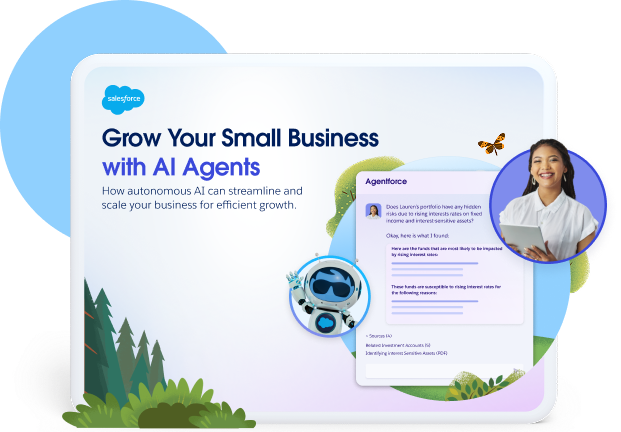
Grow Your Business With AI Agents
Learn how autonomous AI can scale your small business for free in our latest e-book.
11. Use analytics to track success
You can’t improve what you don’t measure, so make sure you’re looking at your data regularly. Check which sources are bringing in the most traffic and which ones are actually resulting in closed sales. This insight allows you to stop spending money on things that don’t work and invest more in the winners. Having a clear view of your metrics is what separates a guessing game from a growth plan. Here are a few metrics you can track with a CRM:
- Conversion rate: The percentage of visitors who complete a desired action, such as making a purchase.
- Lead-to-customer ratio: The percentage of marketing leads that eventually become paying customers.
- Cost per lead (CPL): The total cost of a campaign divided by the number of leads it generated.
- Lead response time: How long it takes to respond to an inbound lead.
- Sales pipeline value: Total potential revenue from every active deal being managed.
- Win rate: The percentage of opportunities that turn into closed deals.
- Average deal size: The typical value of a successful sale.
- Website traffic: The total number of visitors to your website.
Get Salesforce free for 30 days.
No credit card required, no software to install.

Generate leads like the pros with Salesforce
You can implement these lead generation tips for your small business today. By the end of the week, we hope you see some results. And, of course, we’re here for you, every step of the way.
Get started with Salesforce for free or activate Foundations to try out Agentforce today.
AI supported the writers and editors who created this article.
How do I know if my lead generation tips are working?
The best way to measure success is by tracking your conversion rate from visitor to lead. You should also look at the quality of those leads to see if they’re actually becoming paying customers. Check out the State of Sales Report to see how other businesses are measuring their growth and discover easy-to-use lead management software with Starter Suite.
Can a small business really benefit from AI?
Yes, because it helps you automate the repetitive tasks that usually take up a small team’s entire day. It allows you to provide 24/7 service without needing to hire a massive support staff. This technology makes it possible for a small team to compete with much larger organizations.
What’s the difference between a lead and a prospect?
A lead is someone who has shown initial interest by sharing their contact info, while a prospect is a lead that has been qualified. Qualification means they have the budget and the need for your specific solution. Moving someone from lead to prospect is a key part of the sales process.
Is email marketing still effective for startups?
Email remains one of the highest-returning channels because it allows for direct and personal communication. When you send relevant content instead of spam, you build a long-term relationship with your audience. It’s a very cost-effective way to keep your brand top-of-mind.
How often should I update my lead generation strategy?
You should review your results every month and make larger adjustments every quarter. Markets and customer behaviors change, so your tactics need to evolve to stay effective. Constant testing and learning is the secret to long-term success in any industry.