



As teams across an organization spin up agents on different platforms, visibility disappears and IT leaders lose any real governance handle. Multiply that across hundreds of thousands of organizations, and the result is predictable: an agent built on one platform can’t discover or trust a tool built on another.
That’s the gap the new Agentic Resource Discovery (ARD) specification is designed to close. ARD gives agents a standard way to answer three questions at runtime: where does the right capability live, which one should I use, and is it safe to connect to.
Salesforce is proud to be a founding partner of ARD alongside Google and other industry leaders, helping shape a secure, open, decentralized agentic web. Here’s what ARD is, why it matters, and how we’re natively integrating it to help you scale safely.
ARD and Why It’s Important
ARD is an open, standards-based specification that gives any AI discovery service a unified way to catalog, index, and surface agent and tool information — a shared protocol for the agentic era, similar to how DNS provides shared rules no single company owns.
The mechanics are simple. An organization publishes a static ai-catalog.json manifest — either publicly on their own domain or privately within their own infrastructure — listing what’s available: agents, MCP servers, APIs, even nested catalogs. Domain ownership doubles as the root of trust. Registries crawl and index these manifests, letting any agent ask “what’s available for this task?” in plain language and get back ranked, verified results.
This solves two problems at once. First, trust and discovery across organizations: agents built on one platform have had no reliable way to find or verify tools built on another. ARD’s federated model fixes that — anyone can run a registry, and registries can reference each other, so the network grows without centralized control. Second, context-window scaling: instead of loading every tool description into the model, ARD moves selection into a dedicated search layer, so agents can draw on thousands of capabilities without the bloat.
What This Means for Agentforce
For Agentforce, Salesforce’s enterprise agent platform, ARD represents a significant step forward for external collaboration and actionability.
Agentforce allows your business teams to build, run, and optimize autonomous agents with deep Customer 360 context. Because Salesforce believes in open ecosystem interoperability, the ARD standard ensures that public Agentforce agents can be securely exposed and discovered by other partners and customers — allowing them to find, trust, and invoke Agentforce directly from their own platforms and workflows without custom integrations.
But the vision doesn’t stop there. By anchoring our strategy around standard registry endpoints, Salesforce’s roadmap includes future capabilities that will allow enterprise customers to curate and securely publish their own Agentforce agents externally. With the appropriate role-based access controls and corporate safeguards in place, you can make Agentforce agents discoverable to your public-facing partners and customers via ARD catalogs.
How Agent Fabric Supports ARD and Broader Discovery
Discovery has always been the prerequisite to everything else. Before an agent can act, orchestrate, or deliver value, it first has to find the right capability — and know it can trust what it found. As the agentic ecosystem scales, that prerequisite becomes the bottleneck.
Agentforce is Salesforce’s platform for building and deploying AI agents natively within the Salesforce ecosystem. Agent Fabric is the enterprise control plane for your full agentic network. It’s where organizations discover, govern, orchestrate, and observe AI agents and tools regardless of where they were built — whether that’s a homegrown agent, a third-party MCP server, or an agent running on Amazon Bedrock or Gemini Enterprise Agent Platform. It’s also where Agentforce agents can live alongside that broader ecosystem. Agent Fabric gives teams a single, governed view of their entire agent landscape — Agentforce and third-party agents registered, managed, and discoverable together.
That architecture maps directly onto what ARD standardizes at the web level. Agent Fabric is built on the same principles: agents should find and consume capabilities regardless of protocol — MCP, A2A, or traditional APIs. Identity and trust should be verifiable, not assumed. And governance controls should travel with agents as they cross organizational boundaries.
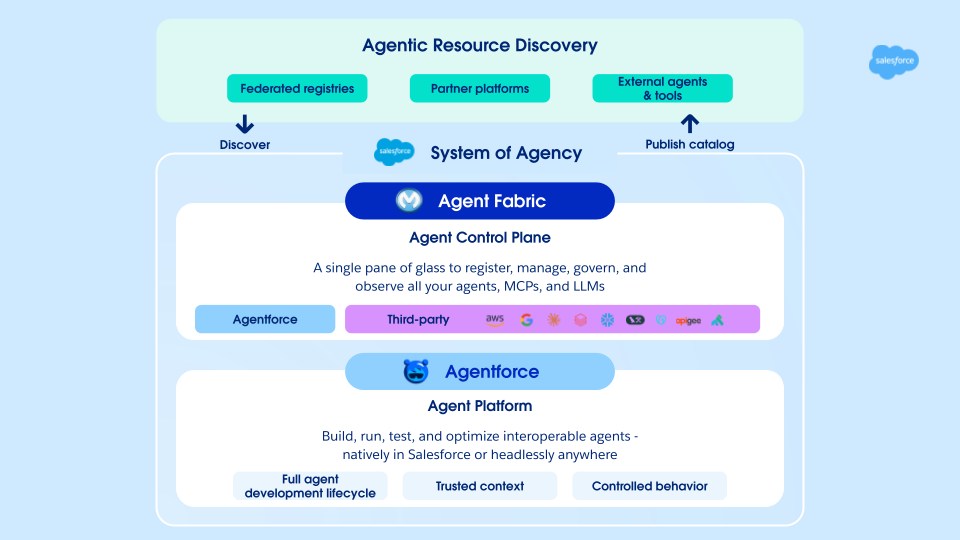
ARD gives Agent Fabric a shared, open standard to build on. This means a new source of discoverable resources customers can tap into, and tooling to let organizations publish their own capabilities into the federated network — managing the manifests that make their agents and tools findable by anyone participating in the standard.
The broader point is this: the value of any agent is a function of what it can reach — and Agent Fabric has already been expanding that reach before ARD arrived. For example, Agent Fabric’s Scanners automatically discover agents, MCP servers, and APIs running across providers and catalog them into a unified registry. To govern this expanded reach, Agent Fabric manages secure, governed collaboration across protocols and models. And its trust and identity frameworks verifies agents before they’re invoked.
ARD makes all of this more discoverable. By publishing your agent network through ARD-compliant manifests, the capabilities you’ve already built and governed inside Agent Fabric become findable by any ARD-enabled agent or platform — inside your organization or across the broader agentic web. The foundation is already there. ARD is what opens the door to the rest of the ecosystem.
The Agentic Web Is Being Built Now
Standards that land early tend to stick. ARD is arriving while the ecosystem is still taking shape — which means the organizations that invest in discovery infrastructure now will have a compounding advantage as the network grows. Every capability you publish becomes findable. Every new tool that joins the standard becomes immediately accessible.
The promise of an open agentic web isn’t just better agents. It’s a better-connected enterprise. Salesforce is committed to helping you get there — with the open standards to make it possible and the enterprise platform to make it practical.
Ready to build and manage agents that can reach the full agentic web?
- Learn more about the Agentic Resource Discovery specification
- Get started with Agentforce
- Want to connect your broader agent network? Explore Agent Fabric
- Join the discussion on social