


As Senior Director of AI Product Growth at Salesforce, my role oversees a wide variety of customer engagements. From troubleshooting an escalation, to navigating a strategic framework to accommodate AI agent initiatives. During these conversations, customers are often experimenting with multiple AI vendors and reluctant to trial more. They’re sometimes surprised when I say, “Keep using who you’re using.”
Let me explain.
Depending on which source you read, there are somewhere between 70,000 and 90,000 AI vendors out there. We encourage you to experiment and keep using what works — we do the same internally. With our open, agnostic, interoperable platform, Salesforce wants customers to use what matters most for their outcomes.
Use your tech (and humans) more efficiently with Salesforce
One of our internal AI testers — a specialist seller here at Salesforce — ran a simple experiment and wrote about it on LinkedIn.
The setup: meeting prep with minimal Salesforce data. When the LLM called Salesforce externally through MCP servers, token usage stayed high. Agentforce Actions called the same MCP server but used only one-third of the tokens — because the heavy lifting is baked into our own infrastructure.
And it’s not just internal users seeing the gains. Jim Ryan, Chief Information Officer at AAA Washington, said he sees Agentforce the same way.
“We look at Agentforce as an absolute augmentation strategy that makes our agents more effective,” Ryan said. “Just imagine having a workforce that can spend more quality time with our members during peak moments of need — it’s a big deal.”
“You all sound the same”
The tech landscape is moving fast, and common terms can sound duplicative and repetitive. Where does Salesforce start and other vendors stop?
“You’re all sounding the same,” a customer vented to me the other day.
I agreed, and drew this overview of how similar our talk tracks can be.
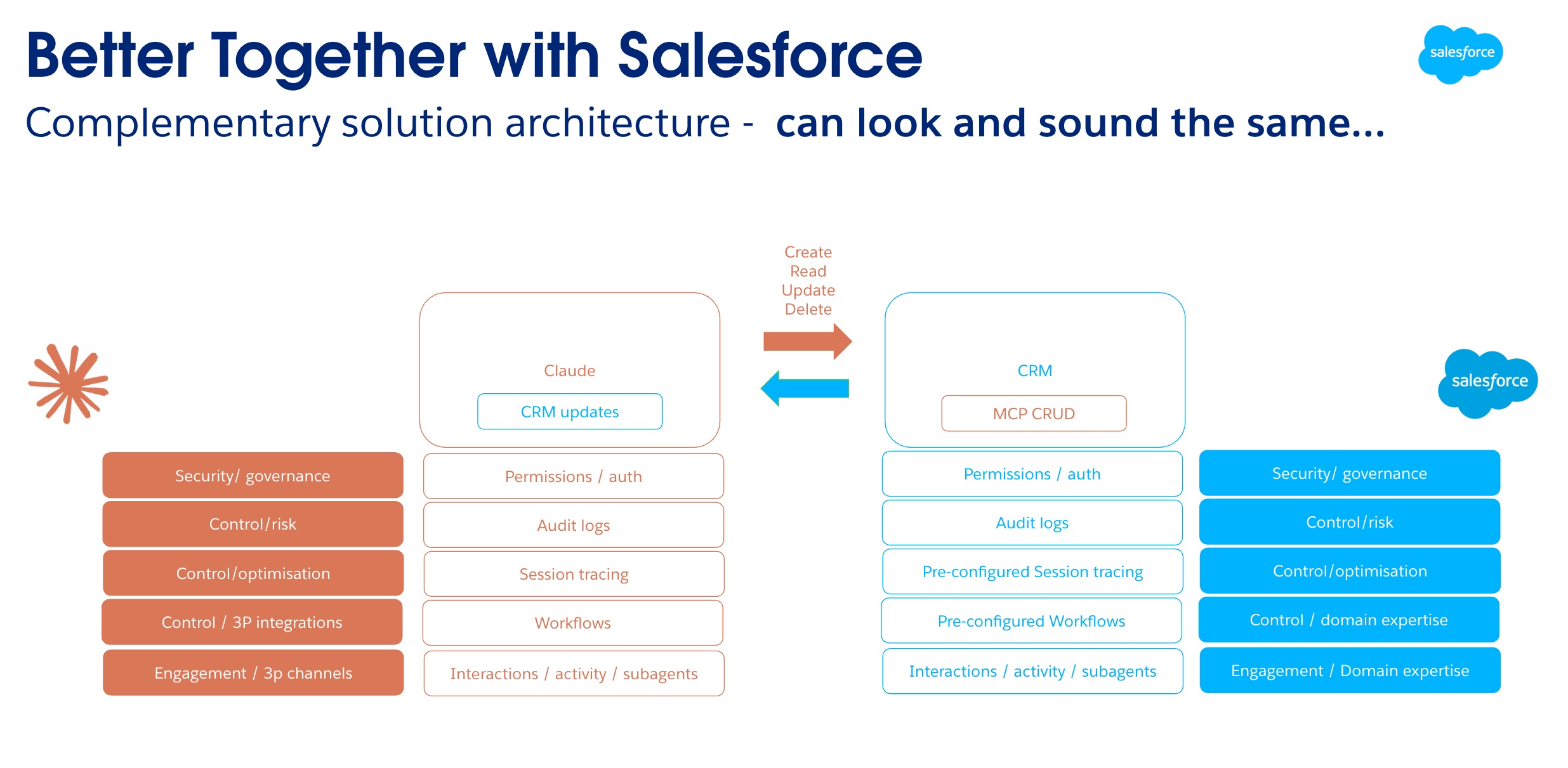
Once you dive into the details, the differences become clearer. The illustration below shows how Salesforce helps you do more with your existing AI tools.
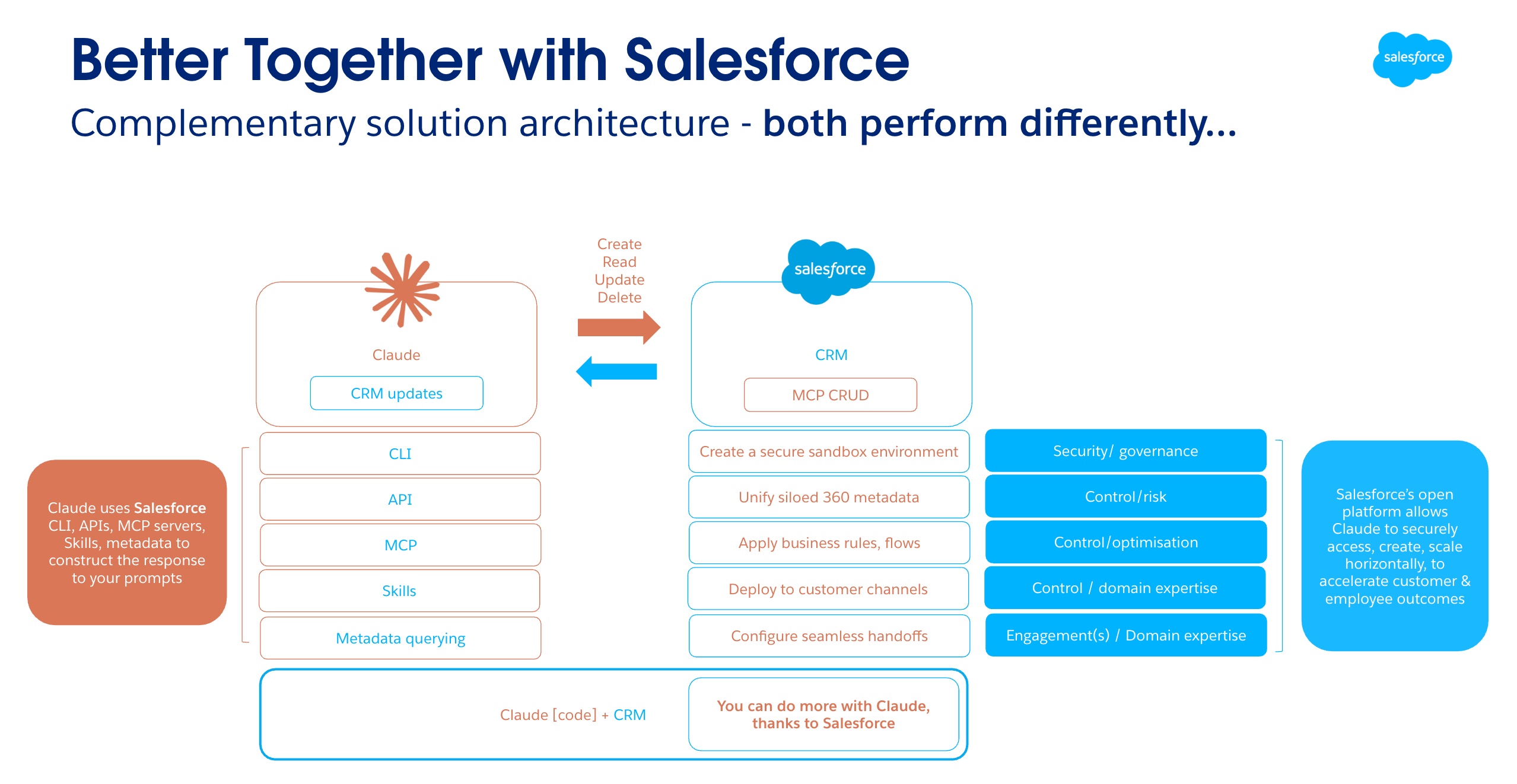
The Salesforce difference is thanks to Salesforce’s CLI, APIs, MCP servers, and skills available in GitHub. Working in Salesforce? You’ve got it. Working in Claude or another AI tool? You’ve got it there, too — same data, same rules, same guardrails.
Salesforce’s open, agnostic, interoperable platform lets you use AI tools like Claude to:
- Create a secure sandbox environment
- Use your customer data securely, and only when needed
- Toggle existing product knowledge
- Configure predefined business rules
- Deploy on multiple customer channels and surfaces
- Conduct handoffs and interact downstream with different (sub)agents
…all without clicking through dozens of setup screens, so you can ship an enterprise-grade solution faster.
Salesforce gives your AI tools business context
I wrote this post so you can put your tech stack to work more meaningfully. So how does your AI tech stack come to know your business better with Salesforce? When you’re ideating on agentic AI outcomes, ask: what data would your AI agent require to get the right job done? The benefit of incorporating Salesforce into this process is the relevant business context — the right authentication keys, customer IDs, customer types, channel types, surface IDs, and more.
Our team is excited for you to keep using the AI vendors you want to test — and to use them better with your existing Salesforce stack. Join customers like Equinox, Fujitsu, and OpenTable to put your agentic AI to work. For a deeper look at how Salesforce’s Agentforce Builder and Agent Script work with AI tools like Claude, read our guide to hybrid reasoning on the Salesforce Architect site.