
If you’re already moving fast with artificial intelligence (AI), there are a few things to keep up with. But speed without a few ground rules means you’re guessing about where your data goes and who’s accountable when something goes wrong. This guide walks you through what AI governance is, why it pays off, and the tips and tools that make it manageable for a lean team.
What is AI governance?
AI governance is a set of policies, processes, and best practices that help you use AI in a responsible way while getting the benefits and keeping the risks in check. Trailhead, Salesforce’s free online learning platform, offers a trail on AI governance that describes it as the foundation of trust in AI. For a small and medium business (SMB), think of it as the house rules for AI: Who can use it, with what data, and who checks the results.
Governing AI sounds like something with a committee attached. It doesn’t have to be. If one person can answer “what AI are we using?” you’ve already started.
Where does AI fit next to data governance? AI is only as trustworthy as the data behind it, so the two go hand in hand. Salesforce’s own take on data governance for AI explains why accurate, secure, and private data matters before you ask AI to act on it.
Why governing your AI pays off early
According to Salesforce research, 68% of customers say advances in AI make it more important for companies to be trustworthy.
Adoption is already high. 88% of SMBs are engaging with AI, and 74% say their investment has generated strong returns. Meanwhile, 64% of customers think companies are reckless with data. Put those together and you can see the opening: The small business that handles AI carefully earns trust the bigger players are struggling to keep.
Here’s what a little structure gets you:
- Fewer surprises: You know which tools are in use, so nobody finds out about a risky one after the fact.
- Safer customer data: Clear limits on what goes into AI tools protect the relationships you’ve worked hard to build.
- Faster yes or no: When a new tool shows up, you’ve got a simple checklist instead of a debate.
- Easier hiring and onboarding: New teammates learn the rules on day one, so good habits spread without you in every conversation.
AI governance tips you can start this week
You can build a working version in an afternoon. Here are five AI governance tips, in the order we’d tackle them.
1. Take inventory first
List every AI tool your team uses, including the free ones people signed up for on their own. Ask around — you’ll likely find two or three you didn’t know about.
2. Sort your data into buckets
Mark what’s public, what’s internal, and what’s off-limits for AI, like payment details or health information. Keep it to one short page that everyone can read in a minute.
3. Choose your AI owner
Pick one person who approves new AI tools and answers questions. At a startup that’s often the founder or whoever runs operations, and that’s fine.
4. Keep a human in the loop
Anything that goes to a customer, a contract, or a bank account gets a person’s review before it goes out. AI can draft the reply, but you still decide whether it sounds like your business.
5. Review it often
Tools change fast and so will your list. Put a 30-minute check on the calendar, look at what’s new, and retire what nobody uses. If you want a broader frame, the NIST AI Risk Management Framework is a respected, plain-spoken reference for thinking about AI risk, and you can borrow just the parts that fit a team your size.
Tools that make governing AI easier
You don’t need a stack of new software to get going. A shared doc for your inventory and rules is plenty, and your customer relationship management (CRM) system can help keep customer data in one place, so your whole team works from the same view instead of scattered spreadsheets.
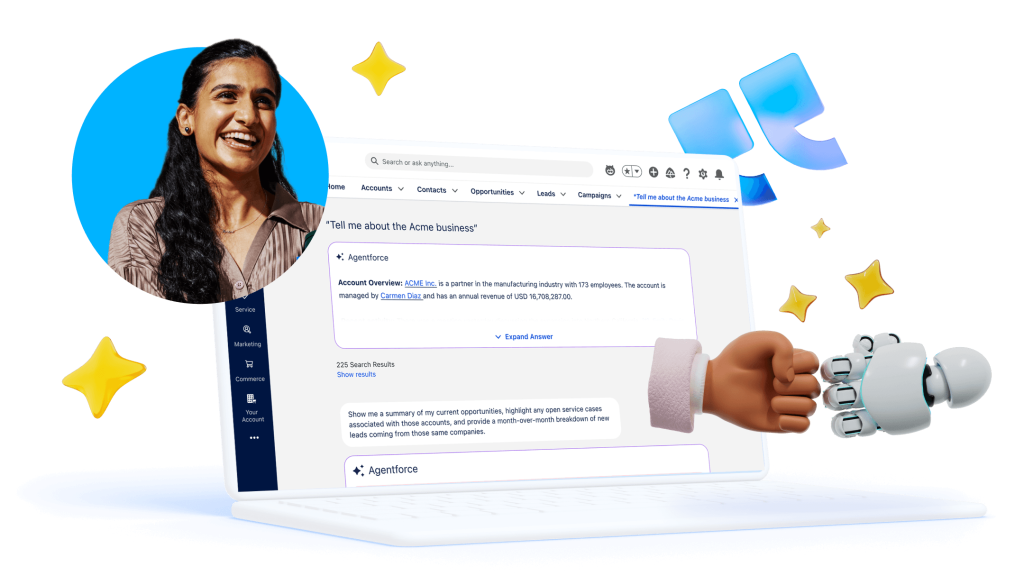
As you start using AI agents that can take actions on their own, guardrails matter even more. Agentforce lets you set what an agent can and can’t handle, and Trailhead’s module on trusted agentic AI shows how those safeguards work in plain terms. Think of it like onboarding the best hire you’ll make: You give them clear responsibilities and a manager to check in with.
Get the AI Anti-Hallucination Playbook
Put AI to the test. Give your team a practical framework to strengthen AI prompts and keep working moving forward.
Make AI governance for your business a habit, not a project
Start small. Inventory your tools, write your one-page data rules, name your owner, and put the quarterly check on the calendar. That’s real AI governance for small business, and you can finish it before your next team meeting.
Ready to keep learning? Take Trailhead’s AI governance module for a free, hands-on walkthrough, then come back and tighten up your rules.
Get started with Starter Suite for free or activate Foundations to try out Agentforce today.
AI supported the writers and editors who created this article.
What is AI governance in simple terms?
It’s the set of rules your business follows to use AI safely and responsibly. It covers which tools you use, what data goes into them, and who reviews the results.
Do small businesses really need AI governance?
Yes. Even a five-person team handles customer data, and one careless upload can damage trust. A short, simple policy gives you protection without slowing anyone down.
How do I start AI governance for startups with no dedicated IT team?
Begin with an inventory of the AI tools your team already uses, then write a one-page rule set and name one owner. Salesforce’s AI tools for small business guide covers the privacy and security basics to keep in mind.
How often should I update my AI rules?
Review them every quarter, or any time you add a new tool. AI changes quickly, so a short regular check keeps your rules current.
Who should own governing AI at a small company?
One named person, usually a founder or operations lead. What matters is that everyone knows who to ask before trying something new.