



Your patients mean the world to you. And, if you could, you’d spend every moment caring for them with every ounce of energy you’ve got. So why not put that same energy into the tools that help them?
A healthcare customer relationship management (CRM) system puts every patient first. And for growing practices where every team member counts, that kind of efficiency isn’t just nice to have — it’s the heart of your business. Whether you’re running a boutique wellness clinic, a home health agency, or a growing medical practice, today’s healthcare CRM options are built to scale with you.
In this quick guide, we’ll break down what a healthcare CRM actually does, the benefits and common challenges small teams face, and a short list of platforms worth considering.
What’s a healthcare CRM for small business?
A healthcare CRM is software that helps health-focused organizations manage relationships with patients, clients, or members — tracking every interaction from the first inquiry to ongoing care. Unlike a general-purpose CRM, a healthcare-specific platform includes features like appointment scheduling, care coordination tools, Health Insurance Portability and Accountability Act (HIPAA)-compliant data handling, and integrations with electronic health records (EHRs).
Running a small healthcare practice or health-focused business means you’re wearing a lot of hats — clinician, administrator, marketer, and customer service rep all at once. For small teams, a CRM acts as a central hub so nothing falls through the cracks, whether that’s a missed follow-up call or an overdue check-in with a high-risk patient.
Benefits of a healthcare CRM for small teams
Personalized patient engagement
A healthcare CRM gives your team a complete view of each patient — their history, preferences, and past interactions — so every touchpoint feels personal and informed. According to our latest research, customers using its healthcare solutions report 34% increased member satisfaction from proactive, always-on digital health experiences.
Simplified operations
Manual scheduling, paper trails, and disconnected systems slow your team down. A modern CRM automates routine tasks like appointment reminders, follow-up emails, and benefits verification — freeing your staff to focus on care. In fact, 80% of SMB customers agree their investment in AI has generated strong ROI.
One source of truth for patient data
When your team is small, data inconsistency is a real risk. Over 50% of SMB leaders say their data is inconsistent across tools, which means by the time the picture is clear, the moment is already gone. A healthcare CRM connects all your data in one place, so everyone’s working from the same information. 76% of SMB customers using Salesforce say their teams are now operating off the same view of the customer.
HIPAA-ready compliance and data security
Patient trust is everything in healthcare. A purpose-built CRM includes built-in data security, compliance features, and governance controls — so your team can use AI-powered tools confidently. 74% of SMB customers agree that security, privacy, and data resilience features help them deploy artificial intelligence (AI) with confidence.
Common challenges when adopting a healthcare CRM
Setup complexity
Traditional CRM systems can take months to implement and require IT specialists — a major barrier for small teams. Look for platforms with guided onboarding and pre-built industry workflows that let you get up and running quickly.
Integration with existing systems
Most small healthcare businesses already use an EHR, billing software, or practice management tool. Your CRM needs to connect with those systems seamlessly, not create another silo. Prioritize platforms that offer native integrations or open APIs for real-time data sync.
Cost and scalability
Growing practices need predictable pricing that grows with them. Watch for hidden costs around add-ons, seat limits, or costly migrations as your practice scales. The right platform starts affordable and scales without forcing you to start over.
Team adoption
Even the best software fails if your staff doesn’t use it. Choose a CRM with an intuitive interface, strong customer support, and in-platform training resources — like Trailhead (Salesforce’s free online learning platform) modules — that help your team get confident fast.
Get the free Health Consumer
Mandate report today


Best healthcare CRM tools for small teams
1. Health Cloud
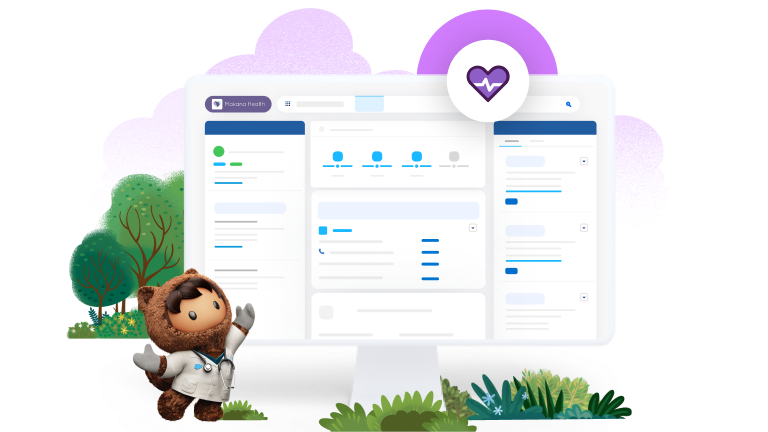
Health Cloud is a comprehensive healthcare CRM, built specifically for providers, payers, and life sciences organizations. It unifies patient data — including health records, social determinants, and preferences — into a single 360-degree view. It also integrates with EHRs, and includes healthcare-specific workflows and HIPAA-ready compliance. 95% of Salesforce healthcare customers achieved positive ROI using its Agentforce solutions.
For growing practices, Salesforce offers flexible CRM options for small business starting at $25 per user per month, with built-in automation for sales, marketing, and service from day one. It’s a CRM that grows with your practice, regardless of how many people you have on staff.
2. LeadSquared
LeadSquared is a HIPAA-compliant CRM with built-in automation, appointment handling, and a mobile-friendly interface. It’s designed to help small healthcare practices and individual caregivers with scheduling, patient interactions, and outreach. The platform facilitates real-time patient and provider updates.
LeadSquared ensures easy access to patient and provider data on the go. And, it provides analytics for tracking intake efficiency, conversion by campaign, and identifying care gaps.
3. Definitive Healthcare
Definitive Healthcare enables small healthcare teams to connect sales, marketing, and recruiting. Instead of a traditional CRM for patient management, it provides comprehensive data on healthcare providers, organizations, and decision makers, helping target the right customers. This platform is ideal for scaling businesses that sell into healthcare (MedTech, SaaS, or services) rather than practices focused purely on patient care.
Key features include detailed profiles of healthcare organizations, contact information for key personnel, and market insights.
4. CourierHealth
CourierHealth is a patient-focused CRM purpose-built to help biopharma teams upgrade the patient experience from diagnosis to therapy. While primarily serving the life sciences sector, its features are applicable to small practices seeking compliance and engagement tools.
Key features include tools for consent capture, communication preferences, patient scheduling, and workflow automation to simplify tasks like patient intakes and prior authorization renewals. It also provides analytics and reporting to identify operational gaps and ensure strict compliance.
5. iTransition
iTransition is a technology consulting and services provider specializing in the development, implementation, and customization of healthcare CRM solutions. It helps organizations choose and deploy purpose-built or custom-developed systems to securely manage patient data, automate sales and marketing processes, and team collaboration.
They offer expertise in key features like patient data management, document generation, task tracking, and reporting analytics. Their service focuses on providing specialized CRM consulting, system implementation, and custom modules to integrate with existing EHRs, patient portals, and telehealth applications.
Let’s compare these Healthcare CRMs
| CRM Platform | Primary Focus | Key Features | Best For |
|---|---|---|---|
| Health Cloud | Comprehensive 360-degree patient view and ROI through Agentforce. | EHR integration, healthcare workflows, HIPAA-ready, social determinants tracking. | Providers, payers, and life sciences. |
| LeadSquared | Intake efficiency and mobile-friendly provider updates. | Appointment handling, mobile interface, intake analytics, HIPAA-compliant. | Small practices and individual caregivers. |
| Definitive Healthcare | Market insights and targeting healthcare decision-makers. | Detailed organization profiles, contact info for key personnel, market data. | Businesses selling into healthcare (MedTech, SaaS). |
| CourierHealth | Upgrading patient experience from diagnosis to therapy. | Consent capture, scheduling, prior auth renewals, compliance analytics. | Biopharma teams and compliance-focused practices. |
| iTransition | Custom CRM development and systems implementation. | Specialized consulting, document generation, custom module integration. | Organizations needing custom-built or tailored systems. |
How AI is changing healthcare CRM tools
The latest State of the AI Connected Customer report shared that 74% of SMB customers agree that AI has contributed to increased customer satisfaction. AI is quickly becoming the most important feature to look for in a healthcare CRM. Healthcare administrative teams project up to ten hours of weekly time savings with AI agents — time that can go straight back into patient care. For small teams, that kind of productivity gain is what’s helping them act like enterprises.
Health Cloud brings intelligent AI agents and teams together on a trusted platform. It helps small healthcare organizations automate outreach, coordinate care, handle benefits verification, and answer patient inquiries around the clock. It integrates with healthcare systems, connects structured and unstructured health data, and is built with HIPAA-compliant governance so you can deploy AI without compromising patient trust.
For small teams already stretched thin, having an AI agent handle the routine work — so your people can focus on patients — is a core part of your practice.
Try the AI-powered Healthcare CRM
Get the healthcare CRM bringing teams and agents together on one connected platform.

Care for your patients with the right healthcare CRM today
The right healthcare CRM for your growing practice helps you scale personal care, automate routine tasks, and maintain a single source of truth for patient data while ensuring security. By choosing a platform that integrates with your EHR and scales with your growth, you can focus less on administration and more on what matters most — your patients.
Start your healthcare CRM journey with Salesforce, or activate Foundations, to try Agentforce and see what an agentic healthcare CRM can do for your small team.
AI supported the writers and editors who created this article.
What does a healthcare CRM do differently than a regular CRM?
A healthcare CRM is purpose-built with features like HIPAA-compliant data handling, care coordination tools, EHR integrations, and patient-specific workflows that a general CRM doesn’t include. It’s designed around the patient journey, not just a sales pipeline.
Is a healthcare CRM affordable for a small medical practice?
Yes — many healthcare CRM options, including Salesforce Starter Suite, start at $25 per user per month and include built-in AI tools that help small teams do more without adding headcount. Salesforce even offers a free CRM tier for up to two users as a starting point.
What should a small healthcare business look for in a CRM?
Look for HIPAA compliance, EHR integration, patient engagement tools, ease of setup, and scalable pricing. Built-in AI that automates appointment reminders, outreach, and follow-ups is increasingly essential for small teams managing high patient volumes.
How long does it take to set up a healthcare CRM for a small team?
With a modern, turnkey platform like Salesforce Starter Suite, you can start running sales and service in minutes using guided onboarding — no implementation specialists required. More complex setups with custom workflows and EHR integrations may take a few weeks.
Can a small business healthcare CRM help with patient retention?
Absolutely. A CRM helps you track patient interactions, send timely follow-ups, personalize communication, and identify patients who may be overdue for care — all of which contribute to stronger relationships and better retention over time.