Storytelling in the AI Era: Bring Authenticity Back to Your Marketing

In a world flooded with AI-generated content, your most powerful marketing tool is the one thing no algorithm can replicate — your story.

Your business started with a spark. Maybe it was a problem no one else was solving, a skill you’d spent years sharpening, or a vision you couldn’t shake. That origin — messy, real, and completely yours — is the foundation of a storytelling marketing strategy that can set you apart from your competitors. And yet, as artificial intelligence (AI) tools multiply and content production speeds up, many growing businesses are publishing more, but saying less.
The good news? Authenticity is having a moment — in fact, it’s the moment that’ll prevail over most others. Prospects and customers are increasingly tuning out generic, polished content and leaning into brands that are more human.
Let’s break down how to weave a storytelling strategy into every corner of your marketing — from your emails to your social posts to your sales conversations — and how smart tools can help you tell that story at scale without losing what makes it yours.
What’s brand storytelling?
Brand storytelling is a marketing approach that uses narrative techniques (like protagonist, plot, and conflict) to communicate a brand’s mission and values, ultimately building customer loyalty and awareness through compelling, authentic stories.
Here’s a great example: Salesforce’s story. It’s 1999, Marc Benioff, Parker Harris, Frank Dominguez, and Dave Moellenhoff are just beginning the inner workings of the first version of Salesforce’s CRM. They rented a one-bedroom apartment in San Francisco and write their mission on the back of an envelope.
As the four develop a prototype, they also build a distinctive startup culture. They only work on what they believe is important and necessary, to do it “fast, simple, and right the first time.” “No fluff” is their mantra. They wear Hawaiian print shirts, appoint Marc’s dog Koa as Chief Love Officer, and Salesforce is born.
This is how it all began — the Salesforce story. What’s yours?
Why storytelling still wins in the age of AI
We’re wired for stories. Research from Trailhead, Salesforce’s free online learning platform, shares that storytelling for content marketing is the best way to share your brand. Stories cause our brains to light up in ways that plain information simply doesn’t, which means your audience is far more likely to remember and act on a story than a bullet-point list of features.
In fact, according to the latest research from the Small and Medium Business Trends Report stated that 61% of customers feel companies treat them like a number, not an individual — a gap that authentic storytelling is uniquely positioned to close.
When your marketing leads with narrative, it builds the kind of trust that converts browsers into buyers and one-time customers into loyal advocates.
Build your storytelling marketing strategy from the ground up
Before you write a word of copy, get clear on the story only you can tell. What problem were you born to solve? What did it cost you to get here? What do your customers feel when they work with you?
These aren’t just “About Us” page questions — they’re the raw material for every piece of content you’ll create. When it comes to branding, put it plainly: Every small business has a story, and sharing yours helps you connect emotionally with your audience.
Map your story to your audience’s journey
A great storytelling marketing strategy doesn’t tell your story at people — it invites them into it. Think of your customer as the main character. They have a challenge; you’re the guide who helps them solve it. Structure your content around that arc: Name the problem, show the path forward, and let your product or service be the tool that makes the difference. This approach, sometimes called a “hero’s journey” marketing funnel, keeps your messaging customer-first without losing your voice.
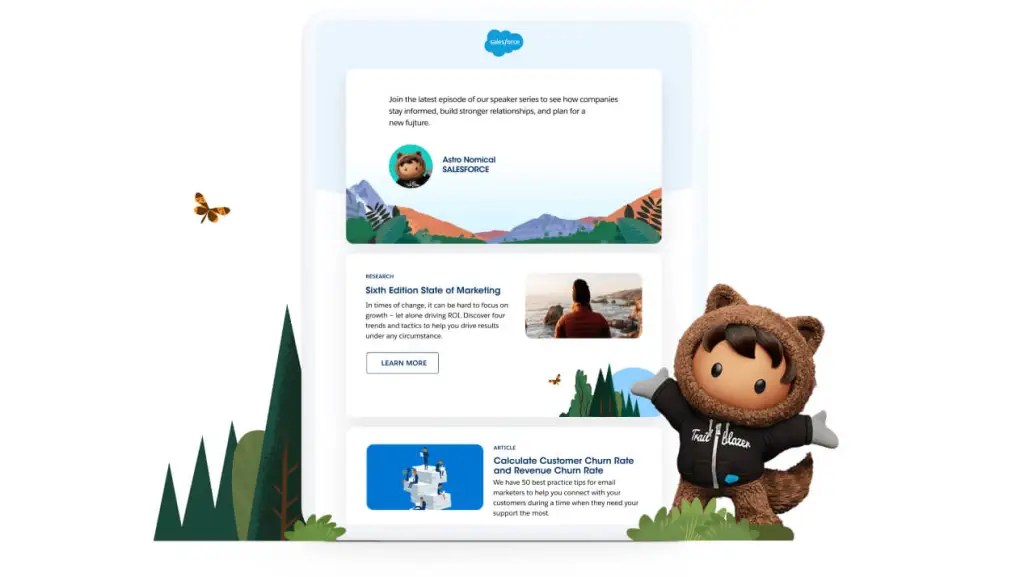
Here’s the only content marketing guide you’ll ever need.
Learn practical content marketing strategies to boost your small business’s online presence and engage your audience.
Weaving your story into every marketing channel
Email marketing
Email is one of your most direct lines to your audience, which makes it one of the best places to tell your story. Instead of leading with promotions, try opening with a moment — a behind-the-scenes detail, a customer win, or a challenge you recently navigated. Some of the best email marketing platforms for small businesses make it easy to personalize these narratives at scale, so the right story reaches the right person, at the right time.
Social media
Of course, you’re going to share your story on social media, right? Social feeds reward content that feels real, and your story is the realest thing you’ve got. Short-form video, in particular, has become one of the most effective formats for authentic brand storytelling — showing the people, the process, and the purpose behind your business. Instagram marketing for small businesses is a successful strategy; and most don’t just sell products — they create immersive brand experiences that keep followers coming back.
Content and SEO
A storytelling marketing strategy and a strong content approach go hand in hand. When your blogs, guides, and resources are built around real questions your customers are asking — and answered with the perspective only you have — they attract the right readers and build credibility over time. This content marketing guide walks you through how to use data and analytics to understand which stories are resonating, and then do more of what’s working.
While your content attracts the right readers, the ultimate proof point of your storytelling marketing strategy comes through customer stories. These narratives move your brand’s promise into a proven outcome, showcasing how real clients — the heroes of their own journeys — use your product or service as the essential guide to solve their problems. This validation builds trust, turning browsers into advocates.
We love our customers here and have dedicated a full collection to share here for some great examples: Salesforce customer stories.
Sales conversations
Storytelling isn’t just for marketing — it’s one of the most effective tools your sales team has. Sharing a quick, relevant story about how a similar business tackled a challenge creates connection and builds confidence in a way that a product demo alone can’t. When your customer relationship management (CRM) system captures customer context and history, your team can pull the right story at the right moment — making every conversation feel less like a pitch and more like a partnership.
Get Salesforce free for 30 days.
No credit card required, no software to install.

Smart tools that help you tell a better story
Here’s where AI earns its place in your marketing strategy: Not by replacing your voice, but by helping you amplify it.
AI can analyze which messages resonate with your audience, help you generate first drafts that you then shape with your own perspective, and surface insights from your customer data that would take hours to find manually. According to the Small Business Marketing Strategy guide, SMBs are increasingly using integrated tech to make their marketing sharper and their operations smoother — without sacrificing the personal touch that makes them stand out.
The key is staying in the driver’s seat. Use AI to handle the heavy lifting — scheduling, personalizing, analyzing — while you focus on the part that requires a human: the perspective, the honesty, and the heart behind the story.
The next (agentic) chapter of marketing
As you build out your storytelling marketing strategy, tools like Agentforce can take your marketing further by putting AI agents to work on routine tasks — so you’re spending less time on repetitive execution and more time on the creative, strategic work that only you can do.
Bionic, which serves more than 200,000 SMBs, is already using Agentforce to blend cutting-edge AI with human expertise to transform the customer experience — a real-world example of how the right technology can make your story travel further, faster.
Get the Guide to AI for Small Business
Save time, automate tasks, and set your team up for success with this free guide to all things AI and business.


Start telling your story with the right tools behind you
Your story is your competitive edge — and you don’t have to choose between telling it authentically and telling it efficiently. Your ambition is what got you here, we’re just here to provide the tools to get you seen.
Get started with Salesforce for free or activate Foundations to try out Agentforce today.
AI supported the writers and editors who created this article.
What is a storytelling marketing strategy?
A storytelling marketing strategy is an approach where your brand’s narrative — your origin, values, and customer impact — runs through every piece of content and communication you create. Instead of leading with features or promotions, you lead with context, emotion, and meaning that your audience can connect with.
How do small businesses use storytelling in marketing?
SMBs use storytelling across email, social media, blog content, and sales conversations to build trust and stand out from competitors. The most effective approach starts with a clear core story — why you started, who you serve, and what you believe — and then adapts that story to fit each channel and audience.
Can AI help with storytelling marketing without making it feel generic?
Yes, when used thoughtfully. AI tools can handle research, personalization, scheduling, and first drafts — but your job is to bring the perspective, voice, and honesty that makes the story worth reading. Think of AI as a capable collaborator, not a ghostwriter. These content marketing resources for small businesses offer practical guidance on blending AI efficiency with authentic voice.
How do I know which stories are resonating with my audience?
Your CRM and marketing analytics are your best guides here. Track open rates, engagement, and conversion data to see which narratives are generating response — then use those signals to refine your storytelling marketing strategy over time. The more you listen to your data, the more relevant your stories become.
What’s the difference between brand storytelling and content marketing?
They’re closely related but not the same. Content marketing is the broader strategy of creating and sharing valuable content to attract and retain customers. Brand storytelling is the narrative thread that runs through that content — the “why” behind what you share. When the two work together, your content feels cohesive, purposeful, and distinctly yours.