



Customer service has entered an era where AI agents don’t just assist the business — they actively deliver the experience.
AI agents stay always on, respond naturally, and take action across the business. Reps get the context to make every interaction personal. Supervisors get a clearer view of their workforce. And increasingly, the contact center connects directly into sales, marketing, and the broader customer relationship.
For years, contact centers were built to manage interactions. The next generation is built to orchestrate experiences.
Salesforce was recognized as a Leader in the 2026 IDC MarketScape for Worldwide Agentic CCaaS Platforms* — signaling what we see as a shift in what organizations should expect: AI that resolves customer needs, AI that makes reps more capable, and intelligence that connects every interaction to the broader relationship.
Customer expectations have changed. The technology is finally catching up.
Customers expect instant answers, conversational digital experiences, and businesses available whenever they need them. Traditional contact centers weren’t built for that: operating hours create gaps, staffing limits capacity, fragmented systems bury context, and rigid menus slow customers down.
Agentic AI breaks those constraints.
AI agents stay available around the clock, understand context, and take action — resolving needs across voice and digital channels without forcing customers through menus or repeating themselves. When an interaction needs a person, AI passes the context along, so the handoff doesn’t reset the conversation.
The result: a service experience that’s always available, increasingly conversational, and built around resolution — not just response.
The contact center is becoming a distributed intelligence layer
Organizations used to optimize customer service team by team — marketing on engagement, sales on pipeline, service on resolution.
But customers don’t see those silos. They expect every interaction, human or AI, to build on the last.
Connect the contact center to CRM data and business processes, and a service interaction becomes more than a service interaction — it surfaces sales opportunities, informs marketing, and sharpens customer intelligence. That’s a different definition of CCaaS.
CCaaS is evolving far beyond managing interactions
Traditional CCaaS was built for operational excellence: telephony, routing, workforce management, and quality tools. Those still matter, but they’re no longer enough.
The next generation combines autonomous AI, assistive AI, workforce intelligence, and customer data on one foundation — which changes the questions organizations should ask:
- Can AI agents resolve needs across voice and digital channels, using context to take action?
- Can AI make every rep as capable as a seasoned one?
- Can supervisors manage a blended human-and-AI workforce with real forecasting?
- Can the contact center connect intelligence across sales, marketing, and service?
Ground AI in CRM data, customer history, and enterprise workflows, and it goes beyond generating responses to take meaningful action. That’s the foundation of Agentic CCaaS.
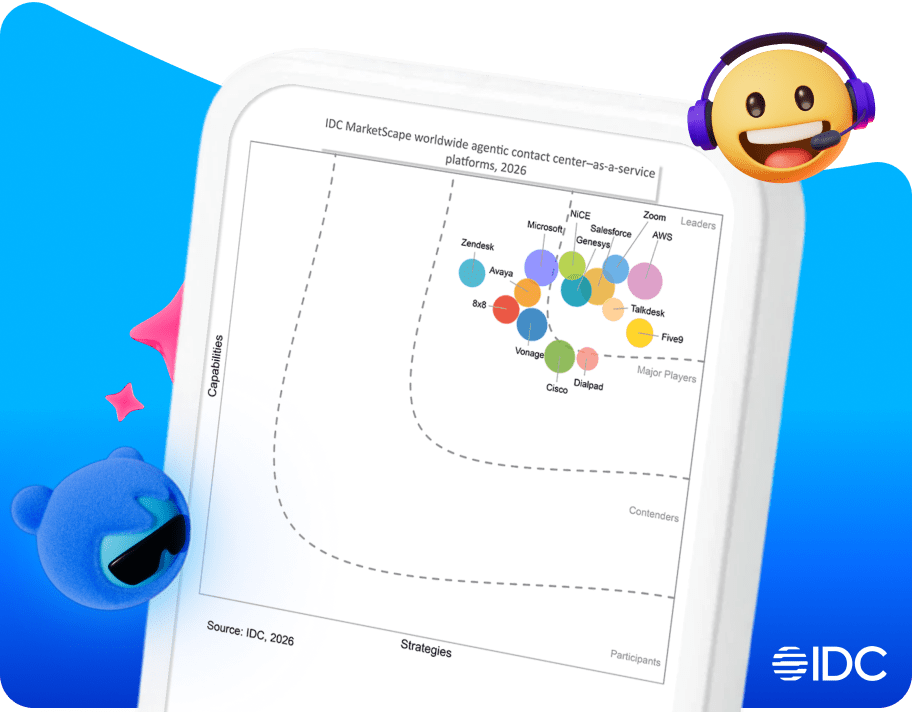
IDC MarketScape vendor analysis model is designed to provide an overview of the competitive fitness of technology and service suppliers in a given market. The research methodology utilizes a rigorous scoring methodology based on both qualitative and quantitative criteria that results in a single graphical illustration of each vendor’s position within a given market. The Capabilities score measures vendor product, go-to-market and business execution in the short-term. The Strategy score measures alignment of vendor strategies with customer requirements in a 3-5-year timeframe. Vendor market share is represented by the size of the circles. Vendor year-over-year growth rate relative to the given market is indicated by a plus, neutral or minus next to the vendor name.
The new playbook: agentic, connected, and built for what’s next
The future of customer service is built around a new kind of workforce — where AI takes on more of the work, customers can connect wherever they are, and people and AI work together to resolve needs faster. Behind it all, a unified view of every customer interaction turns service into a source of intelligence for the entire business.
Agentic first: Put AI at the center of every interaction
AI agents are becoming the first line of service, handling up to 80% of customer conversations while people focus on the moments that require judgment, empathy, or expertise. Agents understand intent, access context, and take action across workflows around the clock — absorbing spikes in demand and resolving routine needs without adding headcount.
And when a human is needed, AI brings the conversation to the right rep with the context already in hand.
The result: more resolutions, more capacity, and faster service at scale.
In every channel: Connect with customers wherever they are
Customers just want their issue resolved — whether they reach out by phone, chat, messaging, or another channel.
AI agents meet customers wherever they are and carry context across the journey, creating a more consistent experience from one interaction to the next. Service teams get a complete picture instead of piecing together disconnected conversations, while customers get answers without having to repeat themselves.
Hybrid workforce: AI and humans working together
The question is no longer, “How many reps do we need?” It’s “What’s the right mix of human and AI labor?”
AI handles predictable, high-volume work. Humans take on complex, relationship-driven moments. When an interaction reaches a rep, AI gives them everything they need to resolve it faster — summarizing conversations, surfacing relevant knowledge, recommending responses, extracting case details, automating service steps, and taking actions on their behalf. It can even bring in the right specialist when needed, meaning faster resolutions and a smoother experience for the customer.
Workforce intelligence helps leaders forecast demand and orchestrate this hybrid workforce before demand hits — turning service from reactive to ready.
Deeply unified: Understand every customer interaction across sales, service, and marketing
None of this works without shared context.
When customer data, CRM records, workflows, and AI come together, every interaction becomes a source of intelligence for the entire business. A service issue can surface a sales opportunity. A pattern in customer questions can inform marketing. A supervisor can see where AI is driving resolution and where people need to step in.
The contact center stops being a place where problems get handled and becomes a place where the business learns what customers need next.
That’s the thinking behind Agentforce Contact Center — built on the CRM from the start, bringing voice, channels, customer context, workflows, and agentic AI together to create a more intelligent, connected customer experience.
The contact center is just the beginning
The contact center used to be where customer questions got answered. Now it’s the intelligent operating layer for the entire customer experience.
AI resolves more. Reps perform better. Supervisors see everything. Workforce planning runs on human and agentic labor as one.
The leaders who win this era connect AI, people, and data — turning every interaction into something sharper, more connected, more decisive. The contact center isn’t a service operation anymore. It’s the engine behind the whole customer relationship.
We were named a Leader – find out why
Explore the latest IDC MarketScape to learn more about how the market is evaluating the next generation of contact center platforms and the capabilities shaping the future of customer service.



* SOURCE: “Worldwide Agentic Contact Center–as-a-Service Platforms 2026 Vendor Assessment”, August 2026, Doc #US54117326.