




Key Takeaways
The world of mobile apps can feel overwhelming for a small business or startup. You’ve poured time and resources into creating a great app, but how do you get noticed in a crowded marketplace? Despite the obstacles, small and medium business (SMB) owners have a unique advantage: agility and a closer connection to their customers. You don’t need a huge marketing team to succeed; you need smart strategies and tools that let you do more with less.
This article is specifically for smaller teams looking for mobile app marketing tips that deliver results without breaking the bank. We’ll show you how to use your existing customer data, master app store optimization, and how to use artificial intelligence (AI) to connect with the right users. Get ready to turn your mobile app into a growth engine for your business.
Market your SMB with Salesforce AI


How we curated these 10 mobile app marketing tips
Smaller teams operate with lean resources, so these mobile app marketing tips were specifically curated with a “bootstrapped” mindset. This focuses on high-impact strategies that use existing resources — like your customer relationship (CRM) system — and require minimal upfront investment.
We prioritize organic growth methods, personalization to maximize existing customer lifetime value, and the use of business management tools to reduce manual labor costs. Let’s get into the list.
1. Nail your app store optimization
App store optimization (ASO) is often the first touchpoint for potential users and the most cost-effective of all mobile app marketing tips. In essence, your app’s listing should be treated like a miniature storefront. The title, description, and keywords are all important to be found.
Optimizing your ASO is the fastest way to get in front of users actively searching for a solution like yours, a critical step toward early growth. Here are a few ways to do that:
- Use clear key terms by including an app title that is clear, concise, and relevant, that describes its function.
- Add high-quality screenshots and videos that clearly demonstrate the app’s core value and best features.
- Localize your listing by translating the title, description, and keywords for different regions and languages.
- Choose the correct category to ensure your app is discoverable by the right audience.
2. Reach out to your customers for support
Your most valuable resources are the customers you already have. They’re more likely to download your app, offer honest feedback, and spread the word.
A personalized email or text message announcing your mobile app is a great second step. According to recent Salesforce research, 80% of customers agree the experience a company provides is just as important as its products or services, highlighting the power of personalization in your mobile app marketing efforts. Maximize your existing customer base with the help of a CRM for small business: use your existing data to identify those interested or those who have tried it, then iterate from there.
Try the AI CRM for SMBs. See what’s possible.
Get started with Salesforce Suites — the AI-powered CRM made to grow your ambition.

3. Personalize your promotions with CRM data
For a successful mobile app marketing campaign, you can segment your audience based on their behavior, purchase history, and demographics, all available in your CRM. Then you can customize your heart out, and see what kind of connections you can make.
For example: You know a customer recently bought a product, so maybe you should send an app notification showing them how to track their order via the app, not just a general download invitation. Your marketing CRM for small business gives you a unified view of the customer to execute these tailored campaigns and see real results.
4. Encourage reviews and ratings
Positive ratings and reviews are social proof that drastically impact your app store ranking and download rates. They’re fundamental to effective mobile app marketing.
Implement an in-app prompt that asks happy users for a review at the moment they’ve successfully completed a key action — not right when they open the app. Salesforce’s Agentforce Service can help small businesses manage and respond to these reviews promptly, turning a complaint into an opportunity. You can also use Salesforce’s service CRM for small business to stay on top of feedback.
The AI Service CRM for
small business is here.


5. Power up your social network like a pro
Social media is a powerful awareness channel. Use your business’s social platforms to showcase the app’s key features and how it solves real-world problems for your users. Create short, engaging videos or carousels that demonstrate the app’s value. Your mobile app marketing strategy should include linking directly to the app store in your profiles and posts as well.
6. Run low-cost ad campaigns
While you may not have the budget for broad campaigns, hyper-targeted ads on platforms like social media or search engines can be highly effective. Focus on niche keywords and specific user demographics.
For example, a startup selling pet supplies should target users who follow pet-related pages or have recently searched for specific pet products. By integrating your advertising with your commerce data, you can measure the true return on investment (ROI) of these mobile app marketing efforts.
7. Focus on user onboarding and in-app experience
Acquiring a user is only half the battle — keeping them engaged is the ultimate goal of mobile app marketing. According to AppsFlyer research, the first 30 days of an app’s install are a critical period, with more than one in two apps being uninstalled in that time.
Ensure your onboarding process is seamless and highlights the core value of the app immediately. Use your CRM to collect in-app usage data to quickly identify and fix drop-off points. Here’s what to consider when creating your app onboarding process:
- Remove unnecessary sign-up steps or tutorials. Focus the initial screens on immediately showing the app’s core value (the “Aha!” moment).
- Use subtle, automated tool tips or short messages (via your CRM or a simple in-app messaging tool) that trigger only when a user first encounters a key feature, guiding them without manual support.
- Implement quick, yes/no in-app polls (“Was this helpful?) to pinpoint frustration points and drop-offs before they turn into uninstalls.
8. Implement in-app messaging and (limited) push notifications
Keep your app top-of-mind by using notifications judiciously. Notifications should always provide value — alerting a user to a relevant discount, a completed task, or a personalized recommendation. Over-messaging can lead to uninstalls. A small team should test different notification schedules and content, always prioritizing personalization, a key mobile app marketing tip.
9. Lean on artificial intelligence (AI) for efficiency
For smaller teams, artificial intelligence (AI) is not a luxury — it’s a necessity for scaling mobile app marketing without adding headcount. AI can automate routine tasks, analyze user data faster, and personalize outreach at scale.
For instance, an AI tool can analyze which users are most likely to uninstall and trigger an in-app offer to prevent churn. Agentforce 360 is Salesforce’s AI agent development platform, and offers digital labor capabilities that allow your teams to build agents to handle low-level activities and tasks. While your agent writes in-app copy or analyzes user data, your team can focus on strategic marketing initiatives.
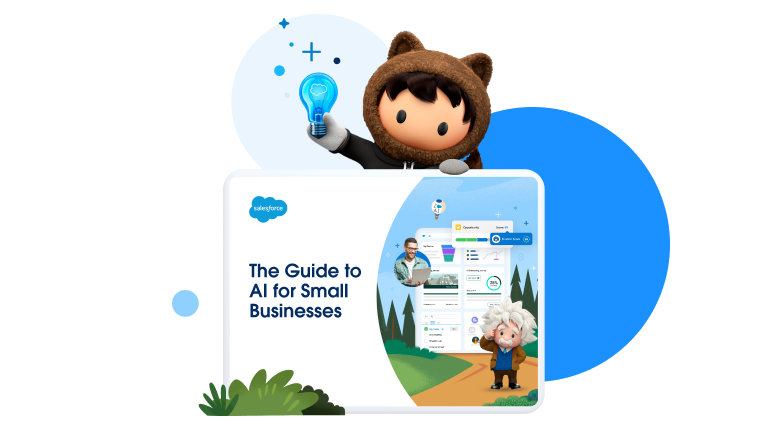
The Guide to AI for Small Business
Check out this free guide on incorporating AI into your business with these tips, strategies and tools.
Thank you for downloading the free AI guide!
Here's your free guide!10. Analyze and iterate your mobile app marketing strategy
Speaking of analysis, the most important of all marketing tips, regardless of product or industry, is to never stop learning and iterating. Track key metrics like downloads, daily active users, and customer lifetime value (CLV). What works today may not work tomorrow, and you should be ready to pivot when something is off or not working.
Use the powerful Data 360 to get a total view of your app’s performance and customer behavior. Regularly review your data and be ready to tweak your app store keywords, ad copy, or in-app messaging. Continuous iteration is the hallmark of a successful mobile app marketing strategy.
The marketing CRM for small business is here.
Automate your marketing campaigns with a connected tool built for growing businesses.

Market your mobile app like the pros
Your small, agile team can succeed by using cost-effective strategies to market your mobile app: optimize your app store listing, use your CRM data for better customer personalization, and automate tasks with AI tools like Agentforce 360. Turn your mobile app into a strong, scalable tool for growth, and your business can thrive in the mobile space.
Start your journey with the Free or Starter Suite today. Looking for more customization? Explore Pro Suite. Already a Salesforce customer? Activate Foundations to try out Agentforce 360 today.
AI supported the writers and editors who created this article.
What is the most cost-effective mobile app marketing tactic for a startup?
The most cost-effective strategy is app store optimization (ASO), which involves optimizing your app’s title, description, and keywords to rank higher in app store search results. It helps you reach users who are already actively searching for a solution like yours, lowering your customer acquisition cost (CAC).
How can a small business use its existing CRM for mobile app marketing?
Your CRM data allows you to segment your existing customer base for highly targeted and personalized campaigns. You can identify loyal customers for early access, send personalized announcements, or re-engage dormant users with special in-app offers based on their purchase history.
Why is user retention more important than user acquisition for small teams?
Acquiring new users is significantly more expensive than retaining existing ones. For small teams with limited budgets, focusing on a strong onboarding experience and valuable in-app messaging maximizes the lifetime value of each user, leading to more sustainable growth.
How does Agentforce 360 help with mobile app marketing for small businesses?
Agentforce 360 uses artificial intelligence (AI) to automate repetitive tasks like responding to common service inquiries or analyzing large datasets. This frees up your small marketing and service teams to focus on strategic mobile app marketing initiatives, like ASO or creating high-value content.
Should a small business focus on iOS or Android first?
The decision depends on your target audience and location. Use market research to determine which platform is dominant among your ideal customers. It’s often best to focus all your limited mobile app marketing resources on excelling on one platform before expanding to the other.