Key Takeaways
One of only three leading U.S. manufacturers of stone fabrication equipment, BACA Systems drives safety and innovation in the stone fabrication industry through robotic solutions that enhance quality, efficiency, and worker safety.
Until recently, BACA was running Sales Cloud and Service Cloud effectively for its customer-facing work. However, the rest of the business — inventory, procurement, accounts payable, accounts receivable, work orders, and field service — was managed across a mix of separate tools that weren’t connected to each other or to Salesforce.
- Customer payments flowed through a process that made ACH alternatives difficult to offer.
- Field technicians completed service calls and submitted expenses through Concur, requiring manual re-entry into Salesforce.
- Field teams coordinated largely through text messages, with no easy way to tie those conversations back to a project record.
With not every employee sitting at a desk, forcing these teams into a traditional, rigid desktop CRM UI didn’t make sense. Because of this frontline interface barrier, the opportunity was clear: bring everything together into one system so every team could work from the same data.
For BACA and Andrew Russo, VP of Business Systems and the company’s sole admin, the challenge was twofold: pull their full operational footprint into one backend, while delivering that data to frontline workers in the exact apps they already used. They needed an architecture that could decouple the database from the user interface.
How Salesforce Helps BACA Systems
Starting in 2022, BACA made a deliberate decision to consolidate as much of its operations onto Salesforce as possible, using a combination of Salesforce Flows, targeted Apex, and AppExchange apps. The guiding principle was simple: if a process was adjacent to the core business, it belonged on the platform.
One platform, one admin, one source of truth
Today, BACA’s Salesforce org contains nearly 1,300 custom objects, more than 700 custom-managed flows, and over 25% of the maximum Apex code lines a single org can hold. The company runs Rootstock ERP, built natively on Salesforce, handling all accounting, inventory management, purchasing, procurement, and manufacturing work orders without an external ERP like NetSuite or Microsoft Dynamics.
Managing an ecosystem of this scale traditionally requires a massive team of developers and administrators. Instead, Andrew uses AI-augmented workflows to maximize his impact as a solo resource. For advanced developer tasks, he leverages AI coding tools like Agentforce Vibes and Claude to rapidly write code and design custom components. To streamline administration, Andrew uses Setup with Agentforce as a conversational partner to instantly troubleshoot user permissions, build out declarative metadata, and manage the platform’s backend without endless manual clicking. Pairing these administrative capabilities with advanced coding tools allows a single admin to efficiently scale an enterprise-level footprint alongside BACA’s rapid growth.
AIforce powers field teams, AI agents, and everything in between
Not every employee at BACA spends their day at a desk. Field technicians who travel to customer sites to install and service machines need to log time, track project expenses, and communicate with project managers as part of their day-to-day work. Salesforce’s headless architecture gives those employees exactly what they need in the tools they’re already using, without requiring them to change how they work.
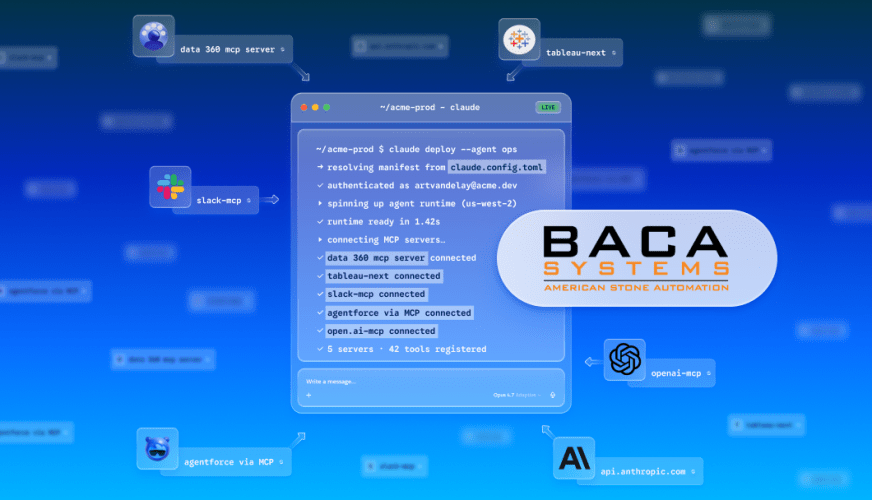
By decoupling the “head” (the front-end experience) from the “body” (backend data and logic), AIforce solves both sides of the operational equation. First, it delivers modern UI flexibility for humans, allowing BACA to surface Salesforce data, workflows, and business logic on any workspace or device. Second, it provides raw programmatic access for autonomous agents to interact directly with backend logic—safely operating within strict platform governance, native sharing rules, and predefined agentic guardrails.
Here are just a few examples of how BACA is using Salesforce in a “headless” way:
- Omnichannel AI Agents: BACA deployed a custom Inventory Agent built on Agentforce, running directly in Slack and other internal tools. When employees need to check material availability or open purchase orders, they simply ask the agent in plain language. The agent accurately handles 70–80% of these queries, freeing up leadership to focus on higher-value work and showcasing how AIforce enables autonomous agents to interact directly with backend logic.
- Conversational Search via Agentforce Coworker: By deploying Agentforce Coworker, BACA uses Salesforce’s AI teammate to evolve beyond traditional, record-focused search. This headless, conversational interface empowers users to perform intricate data queries—such as pinpointing customers who ordered last year but not this year—in a matter of seconds rather than hours. Immediately following a partial rollout to staff, the tool generated a targeted outreach list that secured two live customer demos within a week. This implementation demonstrates how AIforce translates complex backend database logic into simple, conversational interactions, evolving staff from static ‘data exporters’ into proactive, autonomous data explorers.
- Seamless Project Management: Each field project gets a dedicated Slack channel. Field teams can communicate, log time, and run Salesforce quick actions directly from Slack without ever opening the full Salesforce UI. This highlights how AIforce delivers complete workspace flexibility, embedding critical Salesforce workflows directly into the communication tools teams use every day.
- A Custom Payments App Saves $200,000 Annually: One of the most measurable wins from BACA’s headless approach comes from rethinking how customers pay. By building a custom, decoupled payments module entirely on Salesforce, the company now enables customers to pay by ACH directly, eliminating a 3.5% credit card processing fee. Since going live, this headless implementation projects a savings of approximately $200,000 per year—a massive return that vastly outpaces the cost of building the feature.
- Custom Front-Desk Check-In: Andrew is extending this decoupled model to the office by prototyping a visitor app with Salesforce Multi-Framework. By using React to build a bespoke frontend packaged as a native Salesforce UI Bundle, he achieves high performance while automatically inheriting platform security.
Building a headless, autonomous ecosystem requires ironclad governance. Because autonomous agents operate probabilistically rather than deterministically, traditional code testing isn’t enough; you need a high-fidelity staging pipeline to safely stress-test how these workflows and agents behave before they interact with real employees or customers.
To solve this, Andrew leverages Salesforce Full Copy Sandboxes to build a perfect, 1:1 mirror of BACA’s complex manufacturing metadata and 700+ active flows. This high-fidelity staging environment allows him to aggressively prototype, refine agentic guardrails, and train AI models in complete isolation—ensuring innovation never threatens the stability of BACA’s daily production environment.
Enterprise-grade security built in, not bolted on
Because this is built on Salesforce, every headless deployment automatically inherits native sharing rules and field-level permissions.
To maintain complete visibility outside the browser, BACA leverages features in Salesforce Shield. Because data runs headlessly through Slack and external custom components, Shield: Event Monitoring provides continuous activity tracking—recording who, what, when, and where data is accessed across APIs, MCP, Apex and Flows.
Furthermore, with Event Monitoring, BACA can deploy Transaction Security Policies to automatically block and alert on unauthorized behavior—safeguarding operations to remain secure, reliable, and transparent for both users and autonomous agents. This enables robust enterprise compliance and security standard alignment without requiring extra configurations.
“When you’re building as fast as we do, you can’t afford to worry about security vulnerabilities”, said Russo. “With Salesforce Shield, we inherit a massive, enterprise-grade security infrastructure from day one. I don’t have to build the guardrails; they’re already there.”
Whether it’s field technicians using Slack, finance teams in the core org, or warehouse staff managing inventory in Rootstock, BACA’s ERP built inside of Salesforce, every user operates under a consistent security framework, enhanced by Shield.
The Salesforce Difference
For a 50-employee manufacturer with a single technical resource, BACA Systems chose Salesforce not just for its features, but for its fundamental architecture. By consolidating their entire business on a single platform, they avoided the hidden costs and integration complexity of alternative systems.
With Salesforce, the same core data model supports every business process, eliminating departmental silos.
This unified foundation enables BACA to operate as a true Agentic Enterprise, where operational logic, financial records, and workflows run seamlessly on the backend, delivering the perfect user experience exactly where it’s needed, all backed by enterprise-grade security.
End-to-end AI development on one platform
Get to know the platform that enables rapid innovation with airtight security. Unlock the AIforce in a free 30-day trial.