
Summer is officially over and the holiday season is closing in fast for retailers. Ecommerce teams have their hands full: Merchandisers are optimizing catalogs, marketers are racing to capture compliant customer consent without slowing down checkout, and developers and admins need to ship updates fast while keeping sites running smoothly. That’s a lot to keep up with, especially considering that ecommerce teams burn up to 40% of their day on administrative friction instead of actively building and improving the customer experience.
The B2C Commerce September 2026 Release changes that. It gives merchandisers simpler tools, deepens marketing’s consent-management integrations, strengthens trust and security, and adds a batch of game-changing features to the developer toolkit.
Whether you’re launching new merchandise, capturing consent at checkout, monitoring cross-service latency, or writing custom endpoints, this release gives your team the agility to move faster. Here’s everything you need to know.
Key release highlights by role
Merchandisers: Streamline catalog and storefront management
- Customize Product Readiness Checks: Ensure products meet catalog standards before going live by adding up to 20 custom attributes to your standard storefront readiness check.
- Agentic Categorization in Product List: Eliminate product categorization gaps by reviewing agentically generated category recommendations and accepting or declining them for any products that are missing categories.
- Site-Wide Regions with Content Blocks: Build promotional banners, headers, and mega-menus once in Page Designer and apply them across your site without recreating content page-by-page.
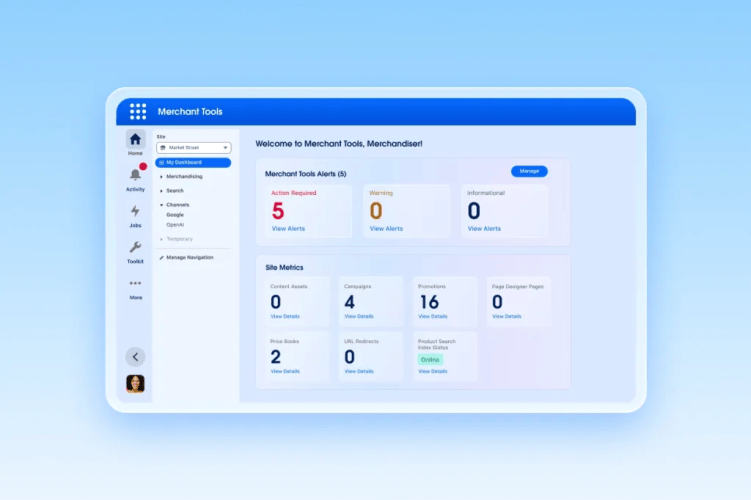
- Dedicated Business Manager Workspace & Utility Bar: Discover, install, and manage native or partner apps in a single App Catalog workspace, and access alerts, settings, and storefront previews from a global Utility Bar.
- Multiple Tax Items on Basket Line Items: When you use B2C Commerce with Salesforce Order Management, tax items are copied over automatically, taking one thing off your list. Track up to 10 individual tax values (such as state, federal, or district) per line item without building custom workarounds.
- Product Comparisons for shopper agent: Shoppers can compare products side by side right inside the conversation, creating a faster path to the right decision.
- Commerce Help Agent (beta): Get agent-driven guidance right within Business Manager, so you can work more efficiently with access to step by step instructions and relevant links right within Merchant agent.
Marketers: Seamless marketing and commerce journeys
- Automatic Shopper Consent Sync: Keep shopper notification preferences up-to-date automatically between Data Cloud and B2C Commerce whenever email or SMS opt-ins change.
- SFRA Checkout Consent Capture: Capture shopper marketing consents directly during SFRA checkout without adding friction to order completion.
Store managers: Unified inventory across B2C and POS
- Unified Inventory with OCI: Unified Omnichannel Inventory makes OCI the single source of truth for both POS and B2C — so every sale, return, adjustment, and transfer updates one shared inventory record instantly, across stores, warehouses, distribution centers, and fulfillment partners. A new POS-OCI Connector sends real-time delta updates to OCI on every in-store transaction… Store associates see accurate, variant-level inventory on the product detail page
Admins: Enhanced security, observability and data governance
- Data Residency Advisories: View proactive alerts when connecting B2C Commerce to Salesforce orgs across different geographic regions to maintain compliance.
- Bot & Leaked Credential Protection: New eCDN custom WAF fields — verified bot/verified bot category and leaked username/password — let you throttle AI crawlers, search bots, and scrapers (beyond robots.txt) and challenge/rate limit leaked-credential logins to stop credential stuffing and ATO.
- End-to-End Request Tracing (Beta): Follow single customer requests across B2C Commerce services in Log Center to pinpoint latency issues or errors fast.
- SCAPI Default for New Realms: New B2C Commerce realms now build directly on SCAPI, providing a modern REST API standard for long-term extensibility.
Developers: Agentic development and autonomous workflows
- MCP and Agent Plugins for Commerce Operations (Beta): Developers and admins can use their preferred coding agent, whether that’s Claude, Codex, Copilot, or any other, to triage order failures, set up storefronts, investigate bot attacks, inspect site performance, and generate business reports.
- B2C CLI 2.0: The B2C CLI, part of the Agentic B2C Developer Toolkit, now is SCAPI (Salesforce Commerce API) native. OCAPI functionality is deprecated with all operations using SCAPI by default.
- Agentforce Commerce Vibes: Delegate multi-step development tasks to an autonomous VS Code agent designed specifically for Storefront Next, SFRA, and Composable Storefronts—complete with line-by-line diff reviews.
- Customize OOTB components for shopper agents: Brands get full control over Carter’s look. Re-skin the chat window, buttons, and UI components beyond default branding to match your storefront.
Recap: Explore more agentic innovations launched at Dreamforce
The agentic era is rewriting the rules of commerce and Salesforce is building the infrastructure to match. Shoppers already expect ChatGPT-style natural-language search regardless of where they shop, so the Commerce Cloud team unveiled Carter, our new Shopper Agent, along with Agentic Commerce Search. These out-of-the-box tools help you exceed customer expectations for natural language shopping experiences. Additionally, Commerce Connect allows you to push your catalog directly into ChatGPT, Google, and TikTok.
Other innovations focus on pain points that have historically slowed retailers down. Storefront Next compresses site launches from months to weeks, while our new Merchandising Agent cuts average time-to-task by 88%.
Explore our Innovations Hub to see how these new capabilities can help your team launch faster, secure your storefront, and build smarter commerce experiences.