2025 in Review: Design is How AI Finds Meaning

From experience architecture to ontology to context engineering, the decisions that affect usability and adoption are rooted in design.

Key Takeaways
In 2025, while the headlines shouted AI breakthroughs, designers were solving a deeper question: How do you architect AI’s ability to understand the world and the ways that humans work – especially in the context of Salesforce?
I drive AI content strategy for the Experience org at Salesforce, deciding what we publish on the design blog and informing our social media tactics. We began this year with a few high-level content themes and an editorial compass pointed toward end users.
While the company focused on Agentforce, we zoomed in on the underpinnings of how AI can support humans. The decisions that determine ease of use, and thus adoptability, are rooted in design – though it’s not always apparent.
Bookmark this post and get ready for link-a-palooza: We’re going to connect some dots across the content we published in 2025 about building AI that centers on the human experience.
What we’ll cover:
What is design in the age of AI?
Boost critical design skills
Value design systems and systems thinking
Learn how humans communicate and collaborate
Map meaning and context
Practice being design-led
What is design in the age of AI?
The responsibilities of design have expanded in the age AI. We learned from Kat Holmes, our Chief Experience Officer at Salesforce, that we’re “building expertise in agent experience design, where AI agents are treated as a new kind of user.”
In her blog, “Welcome to a new Era of Experience with AI Agents,” she discussed the design of agents and for agents to ensure AI prioritizes the goals of human users who are becoming agent orchestrators. Because AI systems are dynamic, there’s no need to have a single user journey or click path. Flexibility is key as people “discover what makes AI agents feel like an embedded and invaluable part of how” work gets done.
To borrow the words of a colleague who’s a principal AI architect, design used to be about creating screens. Now, it’s about deciding what happens before the screen appears.
Shift to agentic experience design and experience architecture
Diving a bit deeper, Principal Product Designer Hervé Mischler drove the point that traditional UX design doesn’t have frameworks for coding assistants and multi-agent orchestration. Thus, there’s a UX paradigm shift that requires designers to embrace agentic experience design, system building, and creating “experiences that harness coordinated AI agents across platforms while maintaining human agency and understanding.”
Design Director JoEllen Kames, on the Agentforce platform team, explained the importance of experience architecture and runtime experiences. To make dynamic systems possible, product designers have to architect the “invisible” scaffolding that enables AI systems to respond in real time and “create experiences that surface the right things at the right time and in the right places.”
Boost critical design skills
The proliferation of generative AI caused many practitioners to take stock and upskill. Learning designer and writer Nic Dimond shared a series of blogs reassuring designers that their UX expertise translates well, and that they can create a learning path to understand key agentic concepts.
Of course, with “vibe coding” sweeping across the industry this summer, many designers and developers began experimenting with coding assistants like Cursor and Windsurf to quickly generate prototypes. (That early experimentation was a helpful prelude to the fall launch of Agentforce Vibes for enterprises.) Vibe coding blurred the line between designers and developers, expanding their mutual capabilties.
Necessarily, Kat Holmes implored CEOs to invest in their teams and focus on four critical design skills to thrive with AI: experience architecture, designing agent collaboration, conversation design, and building context maps and ontologies.
Value design systems and systems thinking
The SLDS 2 launch in 2025 delivered the foundation for agentic design systems for Salesforce products built on the Lightning Platform. The decoupled architecture, modular components, agentic design patterns, and global styling hooks make it easier for users to build and customize dynamic experiences at scale. The most recent releases include dark mode (beta) and Salesforce DX MCP.
Use Salesforce DX MCP to ground your AI with SLDS 2.
It’s systems thinking, explained former Salesforce designer Min Chang, that helps him understand the concepts that shape how a product works. “Instead of designing for isolated screens, I’m now designing how a system moves between states, like logged in or logged out, light mode or dark mode.”
Speaking of systems thinking, it’s a core design skill. Lead Researcher Holly Prouty unpacked the growth opportunities for designers in describing how the Jobs to be Done for UX designers have changed. “There’s an increasing desire and capacity to spend energy ensuring the right things are being built. …So, designers are spending more time connecting the dots across products, teams, and workstreams.”
Learn how humans communicate and collaborate
Understanding human communication patterns and expectations is essential to building AI that responds to the way humans work and collaborate. Conversation design is rich with insights that can shape AI behavior. We explored “what is conversation design” and conversational UI, how to repair broken conversations between humans and AI, and the impact conversation design makes to the quality of call with an AI agent.
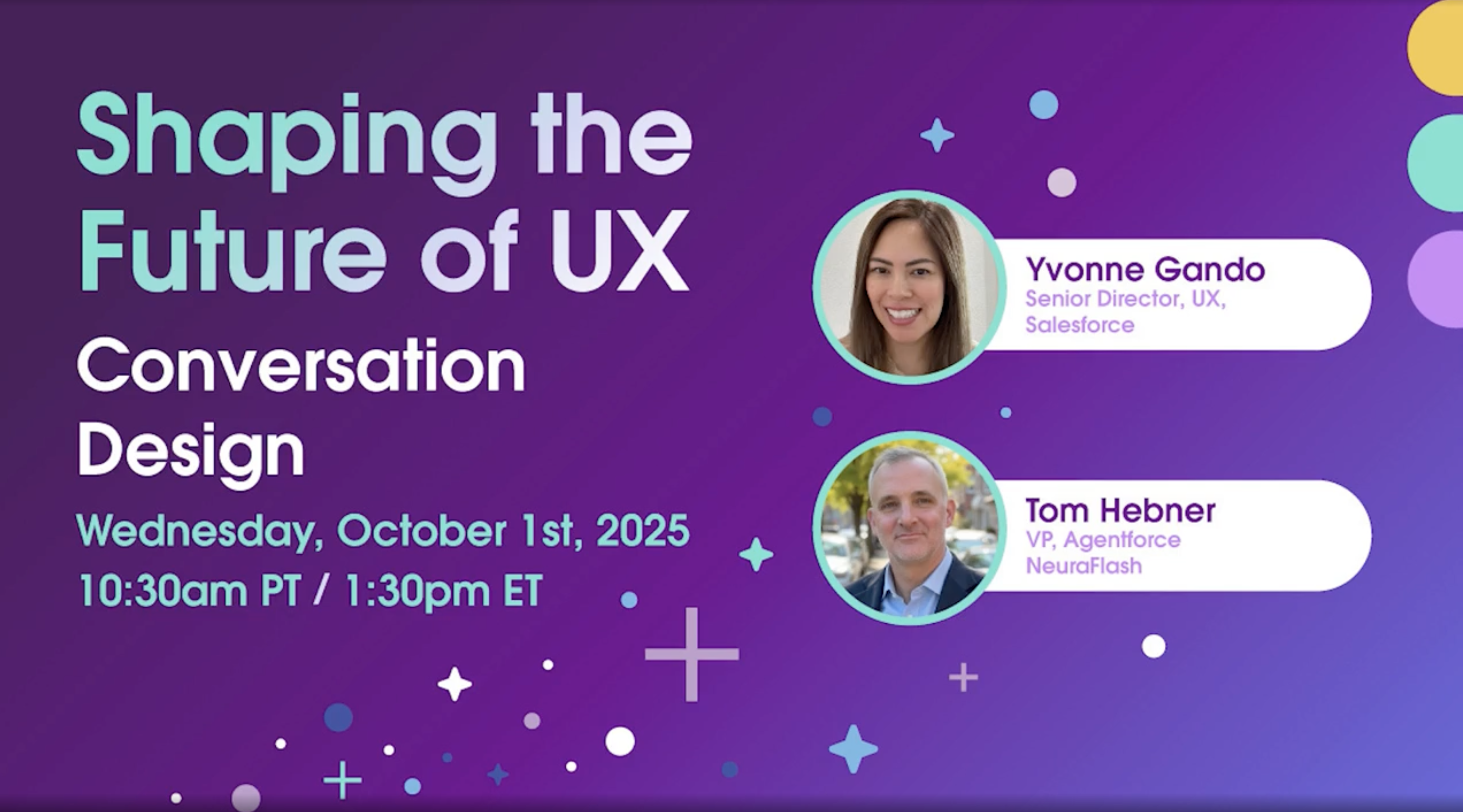
Shaping the Future of UX: Conversation Design
Watch this conversation to get examples of a good vs bad call with an AI agent.
Understanding human expectations of AI affects its design. Our researchers Michelle Tabart and Mar Drouhard have led studies on how people perceive the value of agents and whether Agentforce improves productivity for your sales team. It turns out, just because your AI agent works doesn’t mean your teams will find it useful.
In a related topic, Principal Design Strategists Andrea Small and Kate Piper, with Experience Strategy Architect Bethany Pickard, dug into the ways that humans collaborate at work, which informs their expectations of AI. Currently, most tools tend to support independent work. The race is on to design “multiplayer” experiences that enable teams to collaborate more easily with one another and AI agents.
Map meaning and context
AI’s powerful capabilities can easily go sideways if the machine doesn’t understand the language and context of your business. This is where ontology – a system for organizing the data about the data – is crucial to experience design. As Principal Ontologist Madonnalisa Chan shared, without ontologies, your experience using any number of digital platforms, such as Netflix or Spotify, would be chaotic.
“There are numerous decisions an AI agent has to make based on the information it can access. All of that information needs to be labeled and connected accurately and consistently in a machine-readable format.”
Senior Ontologist Krista Davis added more depth by explaining how designers can become semantic thinkers: “Instead of just asking whether a button looks good, you’ll need to ask whether the system knows what the button is for, where it belongs, and how it should behave across contexts.” Similarly, AI agents need structural and descriptive ontologies to teach them what data means and where the data lives.
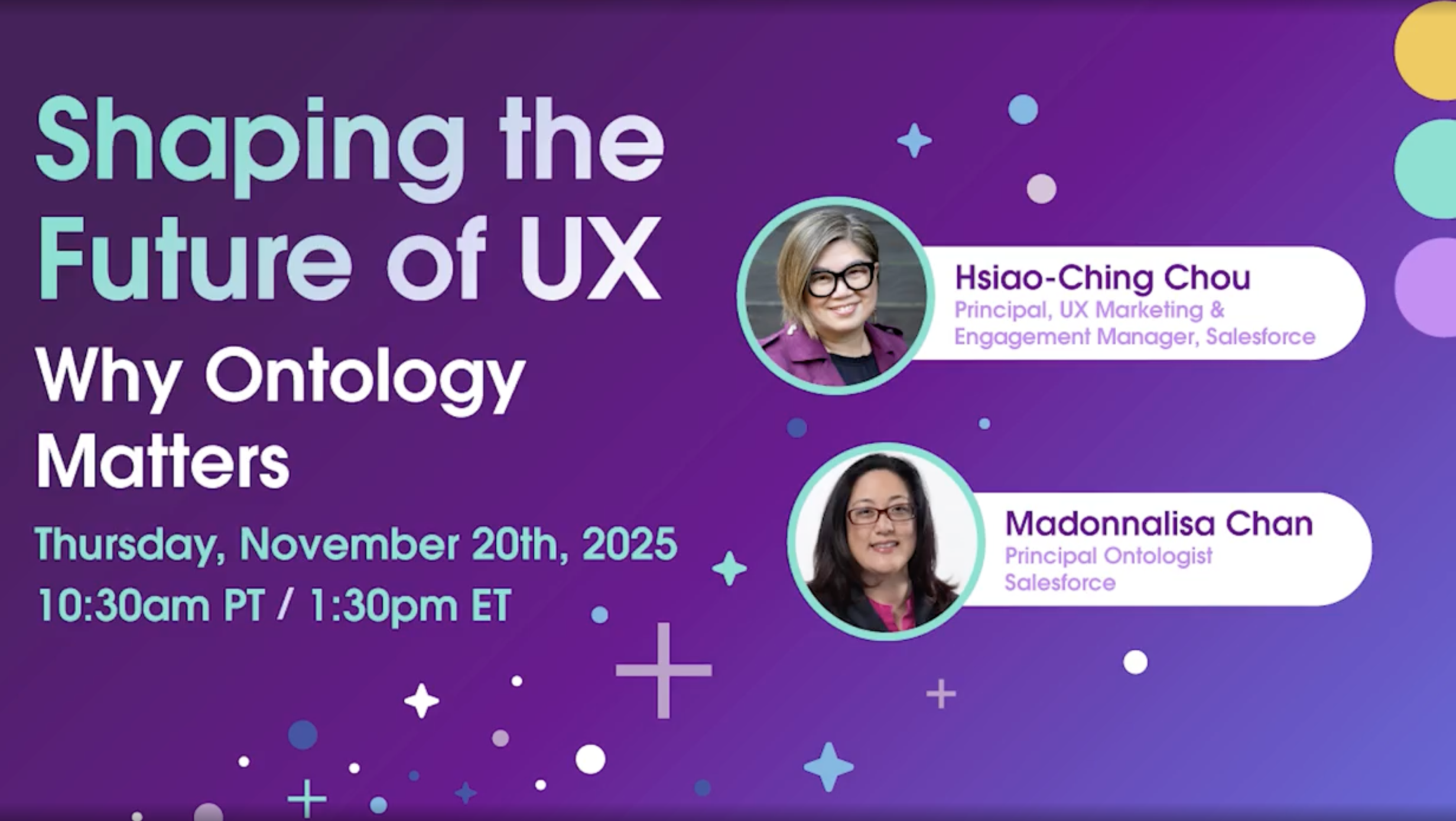
Shaping the Future of UX: Why Ontology Matters
Watch this episode on ontology to learn more about why it matters.
And that semantic backbone is a part of context engineering. Principal Architect Shelby Hubick offers a perspective on what having context as the new design material means. “Without this structure, we’re effectively shipping broken interfaces in a clever new wrapper.”
Practice being design-led
As far as CRMs go, being “design-led” isn’t the immediate association you might make. What we covered in 2025 makes clear that AI’s potential requires the multiplying effect of design to shape and guide its behavior.
The decisions that ensure AI understands your intent and goals, and responds in expected ways that are easy to navigate rely on a strong partnership with design.
Ultimately, design is what makes AI make sense.