

Key Takeaways
Business owners, have you heard all the buzz around employee agents? If you haven’t heard by now, they’re the hottest new tech assistant that’s ready to help with, well, just about everything.
Small and medium business (SMB) leaders are quickly finding out that employee agents (of all kinds) are essential for keeping pace in a competitive market. By automating routine workflows and providing instant, intelligent assistance, an employee agent for your growing business can fundamentally change how your team operates, offering the kind of efficiency and support that used to be exclusive to large enterprises.
We’ll dive into exactly how to use this smart technology to move your business forward. Let’s go.
What’s an employee agent and how can it help your small business?
An employee agent is a type of artificial intelligence (AI) that operates within your existing business software to help employees complete tasks, automate workflows, and find information faster.
Think of it as a personal assistant for every team member — from sales representatives who need to draft emails to service agents handling urgent customer requests. These agents work behind the scenes, using your data to generate relevant suggestions and actions, reducing the time spent on manual input or searching for information. They learn from past interactions, ensuring that the quality and speed of their assistance continuously improves.
Employee agents vs. customer-facing agents
It’s helpful to distinguish between an employee agent and its counterpart — the customer-facing agent, often called a chatbot or virtual agent.
AI Tools for Small Business
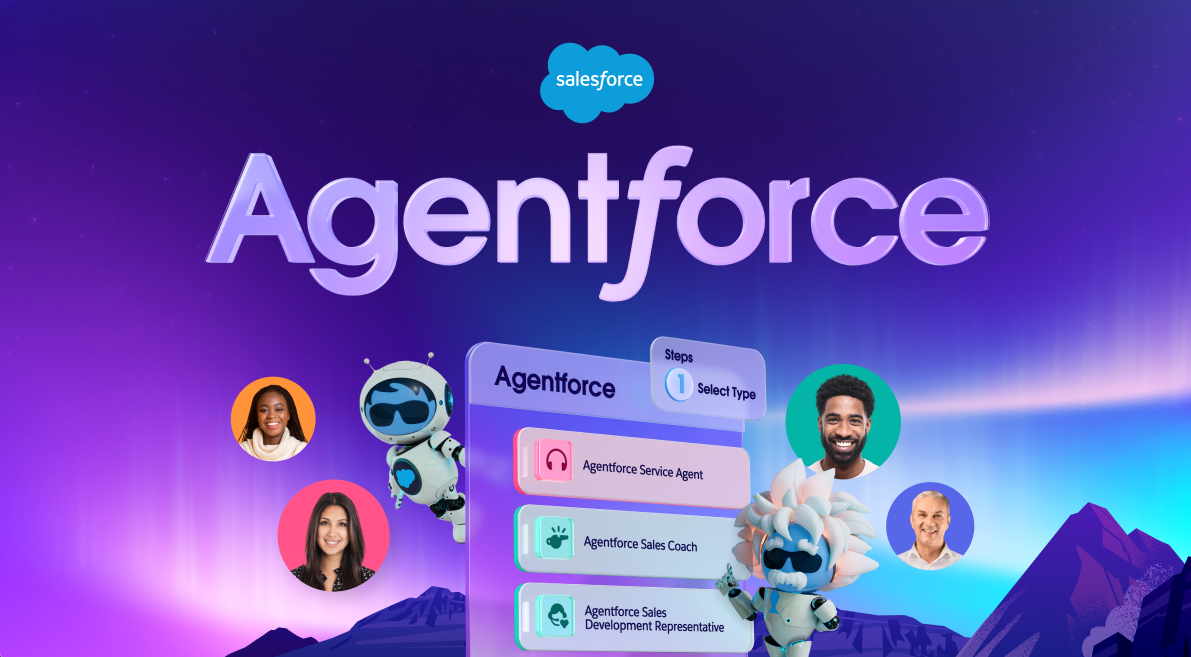

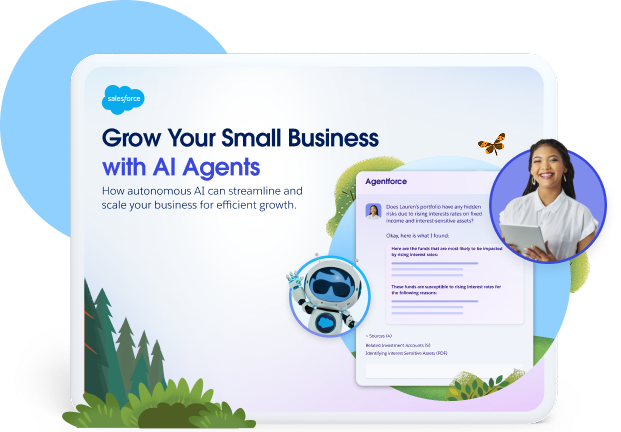

Employee agent: This tool is internal. It supports your team — sales, service, marketing, and operations — by making their jobs easier and more productive. For example, it might summarize a lengthy customer record or draft a follow-up task. Employee agents support your team, and operate within the tools you use daily, such as sales, marketing or service dashboards.
Customer-facing agent: This tool is external. It interacts directly with your customers — answering service issues, frequently asked questions (FAQs) on your website, or guiding them through the purchase process. While both are powered by AI, the customer-facing agent is dedicated to supporting your prospects and customers, rather than your team.
Both tools live in your customer relationship management (CRM) and are beneficial to business. Let’s get into the benefits of an employee agent.
Key benefits of an employee agent for small business
For an SMB, the ability to scale efficiently without overspending on labor is pretty important. The right AI agent allows your small team to handle a large volume of work with confidence.
Scaling operations without overhiring
An employee agent effectively expands your team’s capacity. By taking over tasks like logging data, summarizing meetings, or drafting initial responses, the agent allows your existing staff to handle more customers or larger projects without the strain of increased manual labor. For a growing startup, this means you can free up capital for other growth initiatives.
Reducing errors and improving consistency
When people are rushed or overwhelmed, mistakes happen. An employee agent provides a consistent, data-driven approach to every interaction.
For instance, when a service agent is responding to a complex issue, the AI can instantly pull the most accurate, up-to-date information from your knowledge base, ensuring the customer receives the correct solution every time. This consistency builds trust and improves the overall quality of your service and sales processes.
Boosting employee satisfaction and retention
No one likes tedious data entry or spending hours searching through files. By automating the most mundane parts of the job, an employee agent allows your employees to focus on the meaningful, customer-centric work they were hired to do. This shift leads to higher job satisfaction, reduces burnout, and improves employee retention — a huge win for an SMB where every team member is essential.
Start your AI journey with Salesforce Suites
Activate AI right inside the Suites — powered by Agentforce and ready to boost business.


Top 8 ways employee agents help SMBs in every department
The true value of an employee agent lies in its versatility across your entire business. Whether you’re in sales, service, or marketing, these tools integrate into your workflow, simplifying all processes.
1. Prepare for sales calls with AI-generated summaries
Before a sales call, the employee agent can surface a concise summary of the customer’s purchase history, recent support tickets, and contact details — right where the sales rep is working. This helps each rep feel prepared and ready for the deal.
2. Draft sales emails faster
Reach customers and prospects faster by drafting or refining emails with AI — without starting from scratch. Have your agent draft sales emails using the context of past conversations and customer details, ensuring they’re personalized and on-brand. Learn more about effective sales strategies on Trailhead.




3. Automate data entry
Train your agent to log calls, update Opportunities, and add notes so you don’t have to dig through customer details. By automating these administrative tasks, sales reps can reclaim valuable hours previously spent on manual entry to focus on closing deals. This automation also ensures that every record is captured accurately and consistently, removing the risk of error or forgotten details.
4. Get a complete customer view
Get a complete view of customer history, notes, and open issues in seconds, eliminating long hold times while reps search for information. For example, an employee agent can pull data directly from your CRM about your most successful customer segments to draft email copy tailored to their specific pain points.
5. Draft service responses
Help service reps stay ahead of their queue by using AI to draft service responses faster. Ask your employee agent to craft quick personalized follow-ups using customer context, so you can resolve cases faster and focus on higher impact issues.
6. Automate case updates
Update cases, add comments, and capture key details with a simple prompt, so reps can stay focused on customers, not administration. This is crucial for managing case volume efficiently.
7. Generate content for lead nurture
A marketing agent can analyze past campaign performance to suggest new email or social media copy variations, boosting promotions and pipeline.
8. Assist with social media post drafting
An employee agent can help draft details about a campaign in seconds for AI-assisted social outreach. It can even help you create catchy captions and automate posts across multiple integrated platforms, ensuring your brand stays active without the constant manual effort.
Getting started with employee agents
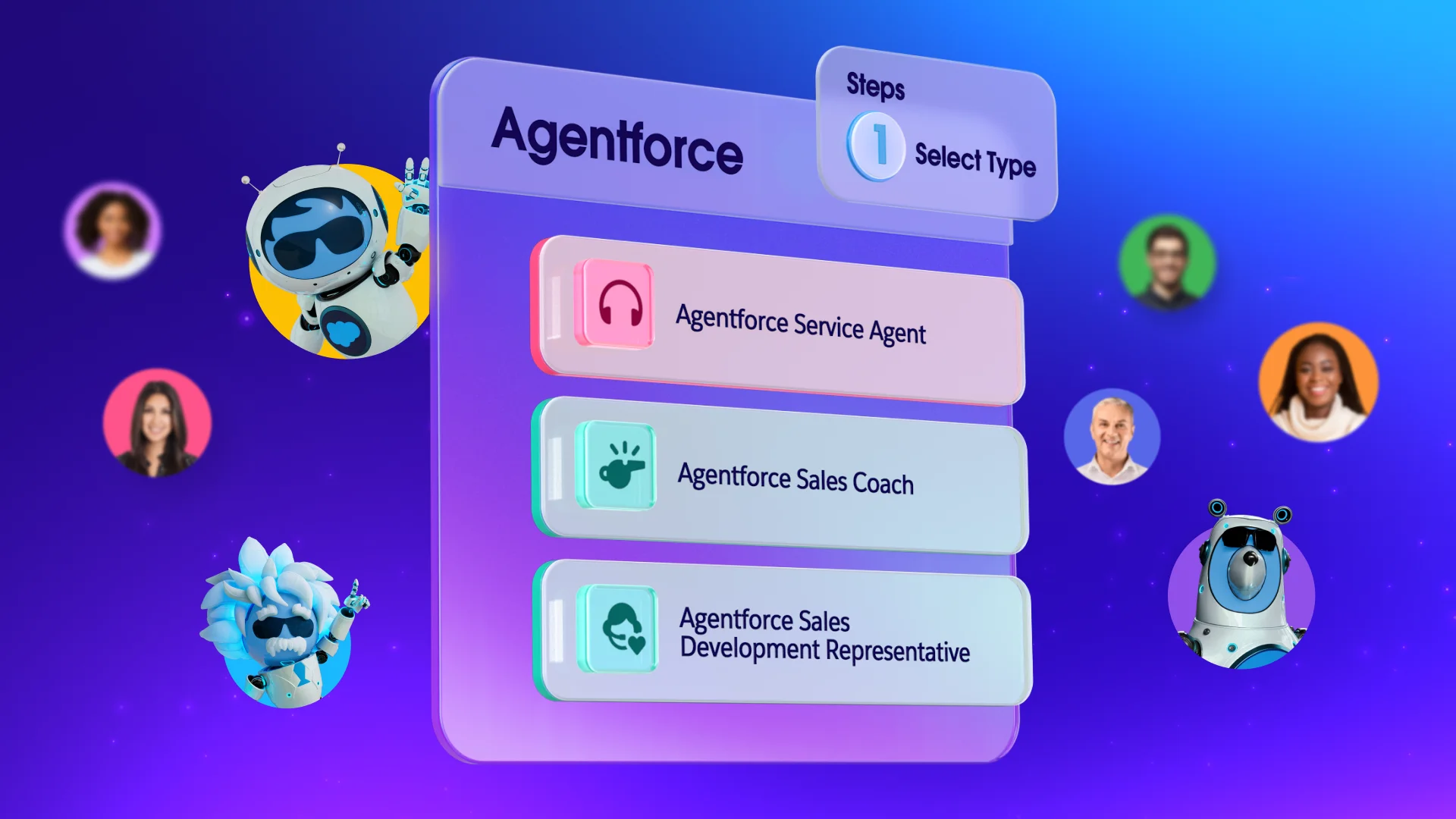
Adopting an employee agent doesn’t require a massive overhaul. The key is to start small, integrating the technology into the workflows where your team spends the most time on manual tasks. You can begin seeing the benefits immediately, allowing your SMB to grow smarter, not just harder.
Here are some additional resources to get you started:
- The Guide to AI For Small Businesses
- What is Agentforce 360 for Small Business?
- Agentforce for Small Business: Sell Smarter, Support Faster
Start your CRM journey with embedded AI features in Free Suite today, and see how your AI assistant helps you get more done in a Starter Suite trial.
AI supported the writers and editors who created this article.
What’s the difference between an employee agent and a chatbot?
An employee agent is an internal tool designed to help your team members with tasks within your existing business systems. A customer-facing agent interacts directly with your customers on your website or app to answer questions or guide them through simple processes. Both are powered by Salesforce AI, but their audiences and goals are different.
How does an employee agent use my small business data?
The agent uses the secure, structured data within your CRM (like customer history, sales notes, and service cases) to provide highly relevant and contextual assistance. It doesn’t access external, non-business related data.
Is this technology only for large companies?
No, tools like Agentforce 360 are specifically designed to be accessible and impactful for small businesses and startups. Because they automate high-volume, low-value tasks, they offer a lot to small teams, providing an affordable way to scale operations efficiently.
What are some of the tasks an employee agent can automate for my sales team?
For your sales team, an employee agent can automatically log call notes, update opportunity stages after a meeting, summarize long email threads with a prospect, and draft initial follow-up emails based on meeting context.
How quickly can my team start seeing the benefits of using an employee agent?
Because the agent integrates with your existing Salesforce setup, your team can begin using it immediately. The benefits are often instant — employees gain immediate time savings on tasks like data summary and drafting.