How Kogan.com Automated 67% of Customer Inquiries and Tripled Resolution



By deploying Agentforce across multiple use cases, Kogan.com automated more than half its customer interactions and grew resolution rate from 6% to 67%.

Kogan.com is one of Australia’s largest pure-play online retailers, selling everything from televisions and appliances to mobile plans and insurance. The company’s model is built around competitive pricing and high volume, which means that when customers have questions, they arrive in the thousands. Most inquiries are predictable, such as “where’s my order?” (WISMO) or “how do I make a return?” But predictable doesn’t mean easy to scale, especially when Black Friday and Boxing Day send volume through the roof.
Before Agentforce, Kogan.com’s entire customer service operation ran through web forms and email, with no live chat or inbound phone line. This resulted in significant delays in customer response. For a business built on competitive pricing and lean operations, that model was already under strain before peak retail periods pushed it further.
To handle that volume without adding headcount every time sales spiked, Kogan turned to Agentforce, starting with a single use case and building from there.
One agent, many use cases
Since WISMO inquiries accounted for roughly 60% of Kogan.com’s inbound customer requests, the first use case they built was order management. The use case was built to cover the full order lifecycle, including status lookups, cancellations and delivery address updates. For customers who aren’t logged in, the system detects the authentication requirement and routes them to a dedicated authentication subagent. That subagent has exactly one job: get the customer logged in. Once complete, the system returns the customer to where they came from.
Product returns came next, bringing the deployment’s most architecturally demanding flow. The TV return flow runs through seven enforced steps: order lookup, marketplace eligibility check, duplicate case detection, a troubleshooting interlude if the product issue is unconfirmed, photo upload, return eligibility determination, and case creation. If a customer wants to abandon the return mid-flow and ask about something else, an exit protocol fires, clears the sub-topic’s state, and routes them back to the main support topic without losing the session.
Product recommendations and TV troubleshooting brought two more use cases online. For product discovery, Agentforce uses Kogan.com’s own search and product detail APIs. Salesforce Knowledge grounds the TV troubleshooting subagent via a prompt-template retrieval action using the same knowledge articles the customer care team already maintains.
Across these use cases, if Agentforce is unable to resolve an inquiry, it will route the customer to a human live representative. The system checks live queue availability and if the wait exceeds 15 minutes, it offers customers the option to create a case and receive a callback. On every handoff, the representative receives a conversation summary before picking up.
Determinism where it matters
Agent Script, Salesforce’s schema-driven scripting language for deterministic agent control, is what makes those complex flows reliable at scale. The seven-step process for TV returns isn’t a suggestion: Agent Script enforces each one in sequence, holds state across the full session, and if a customer abandons mid-flow and comes back, they pick up where they left off.
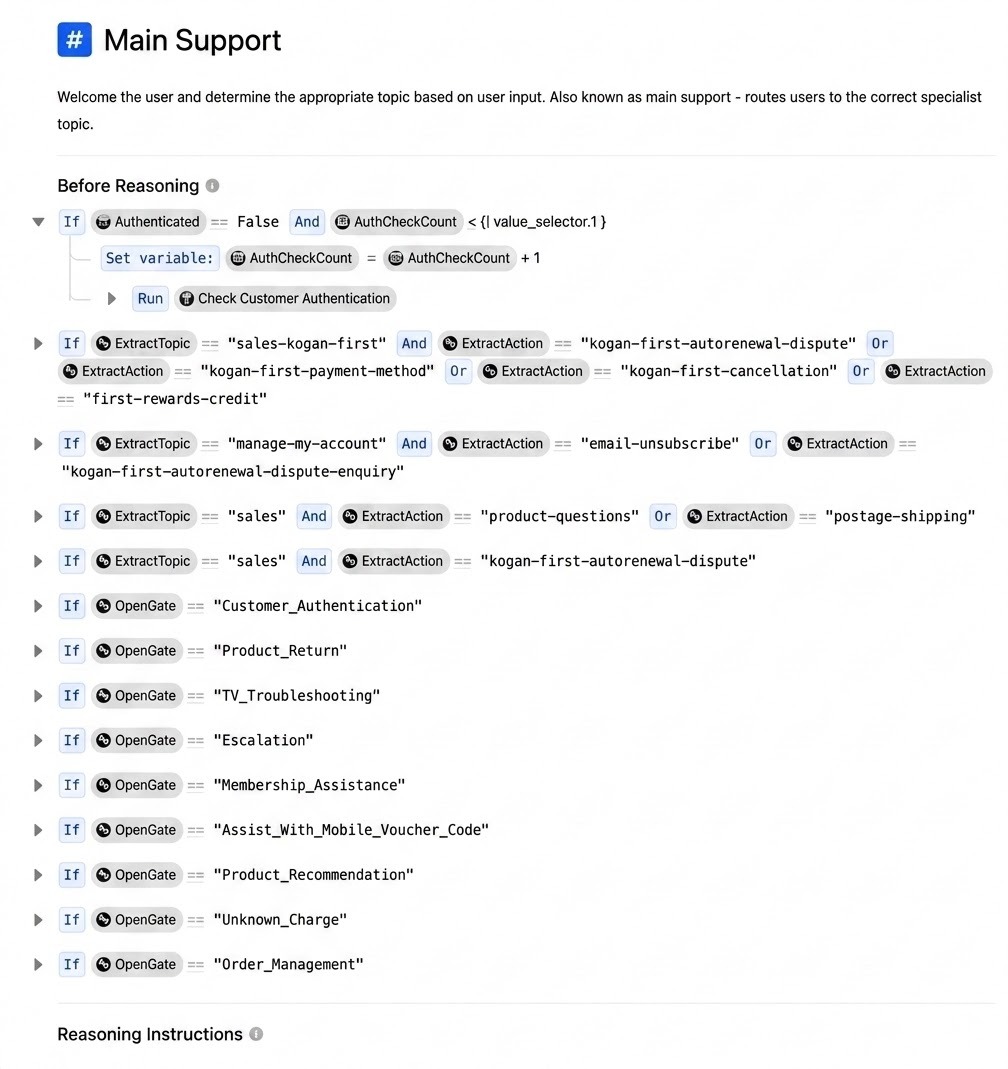
Not every part of the deployment relies on Agent Script. Conversational flows — order management, FAQ, product recommendations — lean on the LLM’s reasoning. The design principle is to enforce determinism where process discipline is non-negotiable, and default to generative reasoning everywhere else. Over-applying determinism creates brittleness; an if/else tree that covers every order management scenario is harder to maintain than one that lets the model handle the ambiguity it’s good at.
From deflection to resolution
Agentforce now handles approximately 50% of Kogan.com’s total customer inquiry volume, but that’s just the beginning. Kogan.com measures success through “true resolution,” a custom metric measuring whether a customer’s question was fully answered without a follow-up contact. The metric is validated monthly: Kogan.com runs its own extraction and cross-checks the figure against Salesforce’s number. At launch in March 2026, the true resolution rate was 6.2%. Today, it stands at approximately 20%. That improvement came from the A/B testing discipline the team applied at every release, the shift to deterministic flows for complex use cases, and continuous tuning anchored to real transcript data.
The deployment processes roughly 5,000 cases per month automatically and has grown to 36,850 actions per week, making Kogan.com the highest-consuming Agentforce customer in the ANZ region.
“What matters most to me is that the customer care team can own this channel. We’ve been able to upskill our customer care team and they’ve been able to deploy this use case by use case, grow its capability and steer it inline with our customer’s needs.” said Goran Stefkovski, CTO of Kogan.com. “We have achieved the ultimate combo: The customer care team who know our customers best are the ones who build and own the agent, and the Agentforce platform provides the guardrails to keep the service secure.”
The business impact runs much deeper than deflection. Customer preference for the agent has climbed from 50% to 78% since deployment began. CSAT scores for agent-handled interactions are within four percentage points of human-handled ones. And over the past year, Kogan.com absorbed a 20% increase in sales volume with a 10% drop in customer servicing costs.
Kogan.com is already building toward the next chapter. Agentforce Voice is in testing, representing Kogan.com’s first-ever inbound voice channel. The same agent logic that runs in chat will carry over to voice, adding a new channel without rebuilding the system. Product returns are expanding beyond TVs to robo vacuums and portable AC units, adding roughly 7% more total case volume. And Kogan.com has already extended the deployment to Mighty Ape, another brand in the Kogan Group, taking a proven architecture to a new surface.
Three things Kogan.com learned
Lesson 1: Know where to draw the line between deterministic and generative
Kogan.com’s earliest builds with Agent Script applied deterministic control broadly, enforcing if/else branching for flows that didn’t actually need it. The team found that over-specifying creates its own problems: rigid trees are harder to maintain and break in unexpected ways when customers go off-script. The rule they landed on is simple: use Agent Script where the sequence is non-negotiable and a missed step has real consequences. Leave everything else to the LLM. Product returns need determinism. Order status lookups don’t.
Lesson 2: Let the data tell you where to invest
Kogan.com didn’t guess which use cases to build next — they looked at what customers were actually asking. Order management came first because WISMO queries alone accounted for 60% of contact volume. Returns and membership followed the same logic. The roadmap is essentially a ranked list of contact frequency, and that discipline hasn’t stopped: automated returns are expanding to Robo Vacuums and Portable AC because the data shows those categories account for roughly 7% of remaining case volume. The next use case is always the one customers are already asking for.
Lesson 3: Let the team closest to customers own the agent
The people who know what customers actually ask — and where answers fall short — are in the contact center, not in engineering. Kogan.com’s customer care team drives the agent’s development, which means improvements are grounded in real domain knowledge rather than abstracted requirements. The technology gives them the surface to build on; the expertise is already there.
See how Agentforce can help your company automate customer service. Learn more here.